Aligning European Early Learning Standards with Developmental Toy Selection
The European Union's Eurydice network has released a comparative report on early childhood education and care curricula across European systems, cataloguing how member states structure developmental…
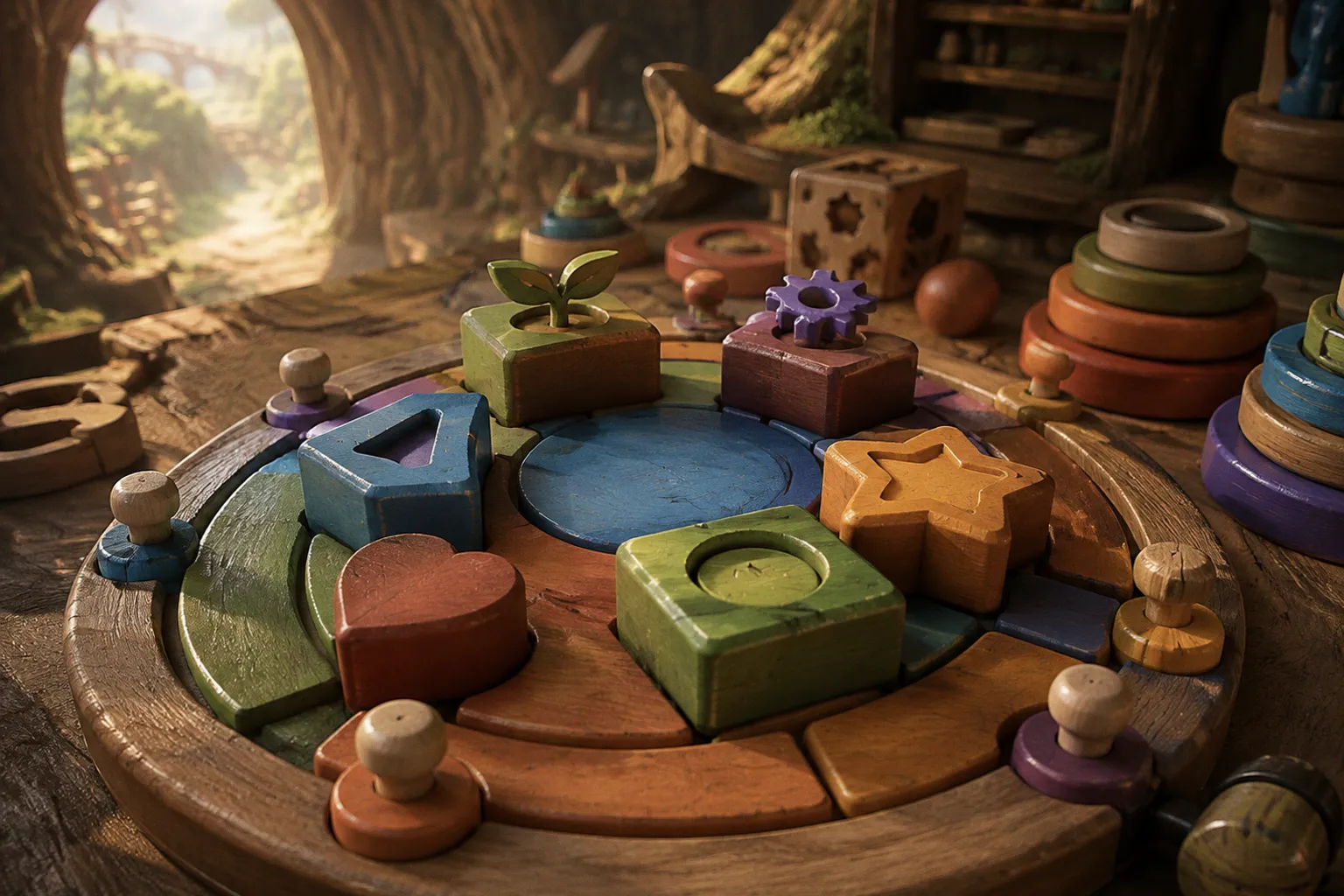
Curriculum benchmarks shift as the EU maps early learning standards
By Trenton Lewis
The European Union's Eurydice network has released a comparative report on early childhood education and care curricula across European systems, cataloguing how member states structure developmental milestones from infancy through pre-school age. The publication arrives in the same week as Circana's September retail analytics, where developmental infant products registered a 3% lift — a convergence that places policy frameworks and purchasing behaviour within the same observational window.
What the Eurydice review defines
The report provides comparative data on age-appropriate learning activities and the sequencing of developmental milestones across European systems. For readers selecting wooden manipulatives, spatial reasoning puzzles, or fine motor kits, the operative value lies in cross-referencing a product's stated "developmental age" against the milestone clusters these curricula use to order cognitive load, sensorimotor coordination, and early numeracy tasks.
Specific numerical breakdowns for individual national frameworks were not present in the summary material available; treat the publication as a reference baseline rather than a prescriptive guide.
Market signal: infant up, pre-school flat
Circana's September retail snapshot describes a stabilizing but bifurcated infant and pre-school category. Infant/Toddler toys grew +3% year-to-date in 2026, while Pre-school toys contracted -3% — reproducing the pattern recorded in 2025 (+5% versus -2%). For wooden and open-ended product developers, the figures indicate where purchasing momentum currently sits:
- Infant segment consolidation. VTech Baby and Fisher-Price hold roughly a quarter of segment value. Wooden toy makers targeting the 0–3 cohort are competing for shelf attention against well-resourced IP-led lines.
- Pre-school sound-led growth. The Talking & Sound subclass rose +27% year-to-date, driven largely by audio-based systems such as the Toniebox. Audio playback complements literacy exposure but does not substitute for tactile fine motor or spatial reasoning development, leaving room for wooden alternatives to define their developmental positioning more precisely.
Reading the two datasets together
When a curriculum-level review and a market-level sales snapshot appear in the same period, the practical task is identifying overlap. Eurydice defines the developmental sequence in formal settings; Circana measures where household spending is actually flowing. The 3% infant gain is the most directly relevant figure for makers of wooden grasping toys, stacking sets, and early cause-and-effect boards — the categories operating in the earliest developmental windows.
What to monitor in the next reporting cycle:
- Whether the Pre-school contraction persists, or whether milestone-framed merchandising — labelling products against specific age-band competencies — can re-anchor value perception for tactile, open-ended play.
- Whether Eurydice's comparative structure prompts European retailers to revise age-band labelling on developmental wooden products carried across member-state markets.
Treat the Eurydice report and the Circana figures as complementary inputs rather than aligned projections: one sequences the developmental trajectory, the other registers current purchasing direction. Any product assessment against either source should hold the two functions separate.