Wooden Puzzle Sizing Mistakes That Frustrate Young Kids
Thirty-piece wooden jigsaw. Ages 2+. Made of “eco-friendly wood.” The boxes stack this way in nearly every toy retailer, and the claims printed across them are confidently wrong.
Piece counts on toddler puzzles routinely exceed what a young child’s hand can manage, while age labels often drift away from the developmental reality they are meant to describe. The category is built on a sizing fiction, and the marketing language around it has been allowed to harden into convention.
This is not a small mismatch. It is one reason puzzles end up abandoned on shelves. A child who cannot seat a piece may experience the activity as failure, even when the real problem is the design of the puzzle. A well-matched wooden puzzle can remain useful through several stages of development, especially when its construction tolerates ordinary handling and its visual cues remain clear. An incorrectly sized one teaches a different lesson: this object is harder than I am.
A puzzle that is wrong-sized teaches one thing very effectively: that puzzles are not for you.
Material is the other variable the category gets wrong, often inside the same box. A thin jigsaw with a paper overlay and a weak core does not offer the same tactile experience as a substantial wooden piece with a clean edge and a finish that can withstand repeated handling. Thickness, surface texture, grip, finish, and image clarity all affect whether a child can pick up a piece, turn it, place it, remove it, and try again.
Solid wood, water-based finishes, and directly printed graphics can be useful design choices, but they are not magic guarantees. They matter because they may support better handling and clearer visual information. They do not make an unsuitable puzzle developmentally appropriate, and they cannot prevent normal wear forever. The first question is always whether the child can use the puzzle successfully. The material decision comes next.
The Developmental Gap: Why Piece Count Isn’t Everything
Piece count is the number parents reach for first because it is printed in large type on the box and easy to compare between products. It is also one of the weakest metrics for matching a puzzle to a child. Two puzzles can carry the same piece count and offer very different levels of difficulty. In some cases, a higher-count puzzle is easier because the image is clearer and the pieces have more obvious homes.
Visual complexity is the variable most parents miss. A 12-piece puzzle featuring a high-contrast farm scene, where each animal sits against a distinct color block, may be easier to solve than an 8-piece puzzle made from near-identical blue gradients with no internal landmarks. The 8-piece version is functionally harder because the eye cannot find an anchor point. Treating piece count as the sole difficulty variable collapses a multi-part problem into a single number on the side of a box.
Piece style adds another layer. A three-piece peg puzzle for a young toddler exercises a different set of movements from a three-piece interlocking jigsaw. The first asks the child to grasp a handle, orient a shape, and lower it into a matching space. The second asks for more precise alignment, pressure, and control of the tabs. The number is the same; the motor demand is not.
Age, count, style, visual structure, and material thickness work together. The mistake is adjusting only one of them and assuming the rest will follow.
| Specification | What it controls | Common mismatch |
|---|---|---|
| Piece count | How much material the child must track and complete | A large jigsaw count paired with an early age label |
| Piece style | The precision and coordination needed to place a piece | Thin interlocking tabs offered before the child is ready for them |
| Visual complexity | How easily the child can identify a piece’s destination | Similar colors, repeated patterns, or images without landmarks |
| Material thickness | Grip, stability, and ease of turning | Thin pieces that flex or slide when handled |
| Board layout | Whether the child can understand where pieces belong | An image with few clear boundaries or overlapping visual cues |
The useful question is not whether a puzzle has “enough” pieces. It is whether the child can understand what the pieces are asking them to do. A puzzle can be small in count and still be demanding. It can also be relatively large and inviting if the pieces are thick, the image is segmented, and every shape has a clear visual home.
Pincer Grasp and Peg Puzzles for the 12–18 Month Milestone
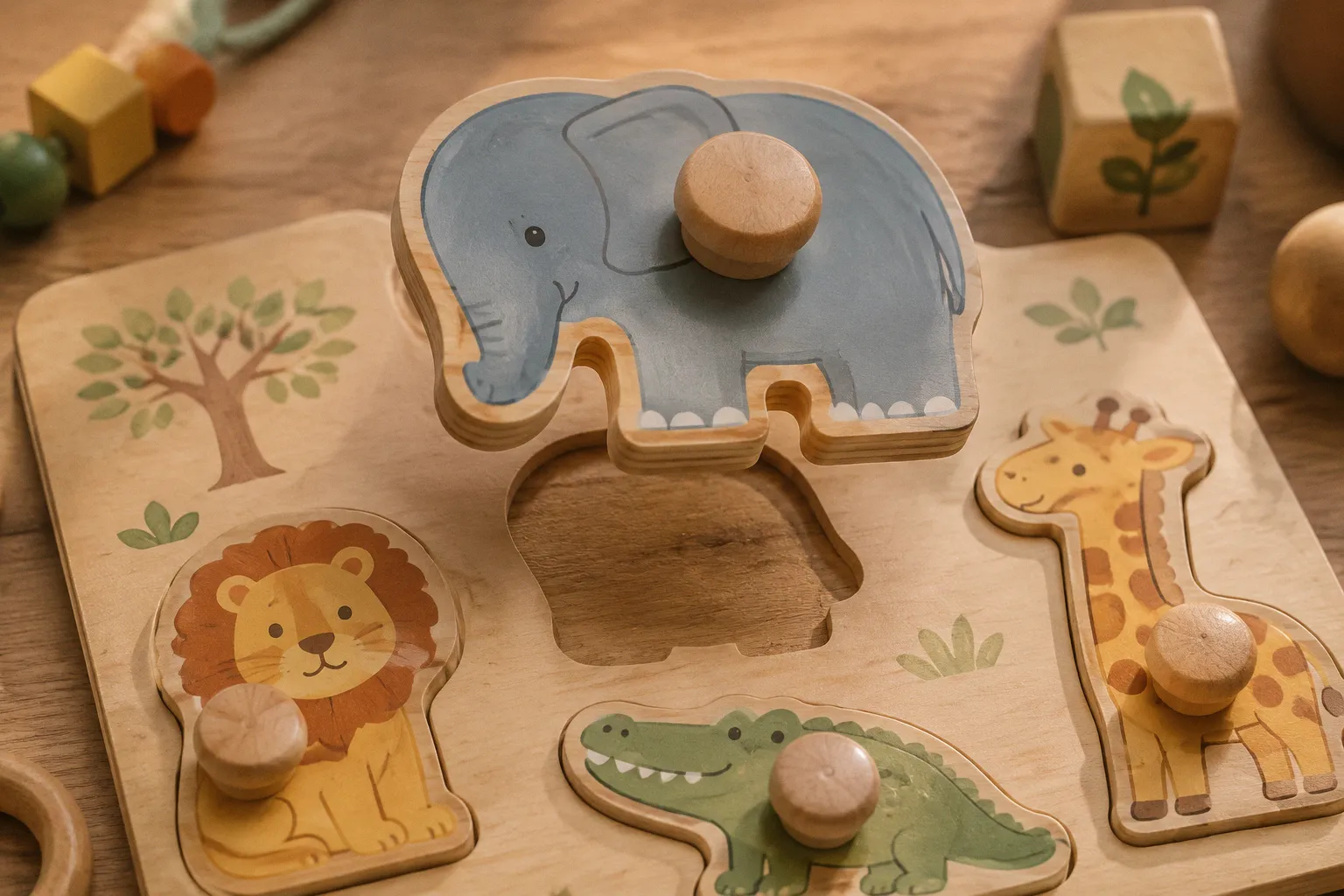
Between roughly 12 and 18 months, a child’s hand is becoming more capable of picking up small objects between the thumb and forefinger. The puzzle that fits this stage is usually a wooden peg or knob puzzle with a small number of large, clearly distinct pieces. The exact count matters less than the size of the pieces, the accessibility of the handles, and the clarity of the matching spaces.
A fixed knob is not decoration. It gives a small hand a stable place to grip. The child can close the fingers around the handle, rotate the wrist, and lower the piece toward the board without having to pinch a thin edge. That is a meaningful difference when the child is still learning how to coordinate grasp, orientation, and release.
For this age, look for:
- Large knobs or pegs that can be grasped without precise fingertip control.
- Pieces that are thick enough to turn without bending.
- Strong contrast between the piece and the space beneath it.
- Simple silhouettes rather than nearly identical shapes.
- A board with enough room around each opening for an imperfect attempt.
- A finish that is smooth and intact, with no lifting paper, loose film, or rough edge.
The material should be treated as part of the handling experience, not as a promise of indefinite durability. Solid wood may provide a more stable feel than a thin composite board, but construction quality varies. A solid piece with a poorly finished edge is not automatically a better choice than a carefully made engineered-wood piece. What matters at the point of purchase is whether the surfaces are smooth, the pegs are secure, the pieces are easy to grasp, and the finish shows no signs of flaking or separation.
Paper graphics and pasted-on stickers deserve particular caution on products intended for children who still mouth objects. A lifting label can become a source of loose material, while a damaged paper surface can make the image harder to read. Direct printing or a firmly bonded finish may hold up better under ordinary play, but parents should still inspect the puzzle regularly. Even a well-made toy needs to be removed from rotation when edges split, coatings peel, or handles loosen.
For the earliest stage, choose a puzzle the child can grasp before choosing one with more pieces.
A small peg puzzle also introduces a useful distinction between matching and solving. The child may initially place a piece by trial and error, by copying the picture beneath it, or with an adult’s help. That still counts as meaningful use. The goal is not to demand an independent, perfectly completed board. It is to offer a physical problem that can be understood through repetition.
If the pieces are too small, the handles too flat, or the images too similar, the child may spend the whole session dropping pieces and moving them around without discovering the intended action. That is not evidence that the child needs a harder puzzle. It is often evidence that the entry point is wrong.
Transitioning to Chunky Wooden Shapes at 18–24 Months
From about 18 to 24 months, many children are ready to move from simple peg boards toward larger knobs, chunky silhouettes, and shape-matching puzzles. This is not a mandatory handover. Some children will remain interested in peg puzzles for longer, while others will be ready to experiment with a more complex board earlier. The useful sign is not the birthday on the box but the quality of the child’s interaction with the current puzzle.
A chunky wooden puzzle generally offers pieces that are thick, easy to lift, and stable when placed on a flat surface. The pieces may depict animals, vehicles, household objects, or basic shapes. They can often be used in more than one way: matching the piece to the recessed space, naming the object, tracing its outline with a finger, or comparing two shapes that look similar.
At this point, a manageable puzzle may contain several pieces, provided they are visually distinct and the board does not create unnecessary confusion. A six-piece puzzle with clear silhouettes may be more appropriate than a ten-piece puzzle with repeated colors and crowded artwork. The best puzzle piece sizes for toddlers are the ones that can be picked up confidently and rotated without the child having to pinch a narrow corner.
Thickness matters because it changes what happens after the piece leaves the board. A substantial piece is easier to hold, turn, and set down. A thin piece can flex, catch against the edge of the opening, or slide under another piece. Those small mechanical frustrations accumulate quickly for a toddler who is still learning the sequence.
The manufacturing details begin to matter more as the puzzle receives heavier use. Look at the edges rather than stopping at the front of the package. A good chunky puzzle should have:
- Smoothly finished edges without splinters or sharp transitions.
- Pieces that sit flat instead of rocking on uneven surfaces.
- Openings cut cleanly enough that the correct piece can be seated without force.
- Graphics that remain legible when the piece is turned or partially covered.
- Handles and knobs that do not wobble under ordinary pressure.
A paper-faced product is not automatically unusable, but its surface deserves inspection. Once the paper lifts at a corner, the child may catch it with a fingernail or bring the damaged area to the mouth. A directly printed or well-sealed surface can make the image easier to maintain, yet no finish should be treated as immune to drops, spills, chewing, or rough play. Normal wear is part of the life of a toy; the editorial issue is whether the design fails gracefully or creates a new hazard as it wears.
One developmental reference commonly used in early-childhood guidance notes that toddlers in the later part of this period often work with very simple puzzles, including boards with only a few pieces. The point is not to turn that observation into a pass-or-fail benchmark. Completion depends on whether the child has seen the puzzle before, how familiar the image is, whether an adult is helping, and whether the board offers strong visual cues.
It is more useful to watch what happens during play:
1. Does the child understand that each piece has a particular location?
2. Can they pick up and rotate the piece without immediately losing control of it?
3. Do they look at the shape or image before trying to force it into an opening?
4. Can they make progress with a small amount of help?
5. Do they return to the puzzle willingly after a failed attempt?
If the answer to most of these questions is no, moving to a larger count will not solve the problem. A simpler board, larger pieces, or a clearer image is the more logical adjustment.
The Interlocking Trap: Why Early Jigsaws Overwhelm Toddlers
The interlocking wooden jigsaw is where many parents get sizing wrong and where packaging language gets loudest. Boxes can present a high piece count beside a surprisingly young age label, as if the number itself were proof of developmental value. It is not.
Thin interlocking pieces ask for a different kind of control from chunky shapes. The child must distinguish among tabs and blanks, align two edges, apply pressure in the right direction, and keep already placed pieces from shifting. A piece may look as if it fits while remaining slightly raised. The child then needs to recognize that the problem is alignment rather than force. That is a lot of information to coordinate at once.
For many children, chunky silhouettes remain the better bridge before thin jigsaws. When a child is ready to try interlocking pieces, a small set with thick, easy-to-handle pieces and a strongly segmented image is a more sensible starting point than a crowded scene with many nearly identical fragments. A low piece count does not make a jigsaw automatically easy, but it reduces the amount of searching the child must do.
The familiar “30-piece puzzle, ages 2+” format is therefore a warning sign rather than a recommendation. Some two-year-olds may enjoy handling the pieces, assembling parts with help, or using the picture as a matching board. That is different from being able to complete the jigsaw independently. The age label may describe exposure to the toy, not a realistic expectation of successful play.
For children approaching the preschool years, an interlocking puzzle in the low-teens can be a reasonable introduction when the pieces are thick and the picture is organized into clear sections. Larger counts can follow when the child completes the current set without prolonged guessing or repeated requests for rescue. The progression should be based on observed ease, not on a race toward the biggest number available.
The key distinction is between challenge and friction. Challenge asks the child to notice, compare, and persist. Friction comes from pieces that bend, edges that do not meet cleanly, indistinguishable colors, or tabs that require more precision than the child can currently supply. The two may look identical to an adult watching from across the room, but the child experiences them very differently.
A practical progression looks like this:
- Start with peg or knob puzzles when grasping and matching are still the main task.
- Move to chunky shapes when the child can place familiar pieces with less assistance.
- Introduce a small interlocking set with thick pieces and a visually divided image.
- Increase the count only after the current puzzle feels repeatable rather than exhausting.
- Keep an easier puzzle available, especially when the child is tired or playing without an adult nearby.
Do not skip a step because the next box looks more impressive on the shelf. A child who has mastered a simple board has not necessarily mastered the joining motion of a jigsaw. The developmental progression is not a ladder made of numbers. It is a change in the type of problem the hands and eyes are being asked to solve.
Beyond the Numbers: Visual Complexity and Pattern Recognition
A puzzle’s difficulty depends on how distinguishable the pieces are from one another, how much visual structure the image provides, and how repeatable the patterns are. This is the variable most sizing guides leave out, and it is where a parent can rescue a frustrating puzzle—or accidentally make an easy one harder.
A 20-piece jigsaw with strong color segmentation, clear iconography, and isolated subjects—a tree here, a fox there—may be functionally easier than a 12-piece puzzle made from a field of nearly identical forest greens. In the first puzzle, the eye can search for a recognizable landmark. In the second, every piece resembles several others, so the child must rely on shape alone. The count is lower, but the visual search is more demanding.
Pattern repetition creates the same problem. A puzzle in which several pieces contain similar clouds, stripes, windows, or patches of grass forces the child to track image and shape at the same time. That double demand can make a supposedly simple puzzle feel punishing. Repeated patterns are not inherently bad; they become a poor early choice when there are too few additional clues to separate one piece from another.
The picture under the pieces also changes the experience. A matching image can support recognition, but an overly busy board can produce visual noise. Large, distinct areas are usually easier to use than tiny details spread across every opening. For a first jigsaw, the strongest images are often not the most artistically elaborate ones. They are the ones that give the child somewhere to begin.
When choosing between two puzzles with similar counts, compare the visual logic:
| Easier visual design | More demanding visual design |
|---|---|
| Distinct colors assigned to separate objects | Several objects sharing the same color |
| Large recognizable subjects | Small details repeated across the board |
| Clear borders between sections | Blended gradients and continuous backgrounds |
| A matching guide image | An image partly hidden or printed only on the box |
| Pieces with obvious shape and picture clues | Pieces that must be identified mainly by tab geometry |
Material choices matter here because surface wear can reduce the very cues that make a puzzle usable. A graphic that becomes scratched, faded, or lifted is no longer giving the child the same information it gave on the first day. Direct printing or a firmly bonded image may help colors and edges remain readable under ordinary play, but it is still sensible to check the surface over time. Water, chewing, rough storage, and repeated drops can affect any wooden toy.
This is also where claims about longevity need restraint. A solid-wood puzzle may remain useful for years, while another may show wear sooner because of its finish, construction, or treatment in the playroom. It is reasonable to prefer robust materials and repairable, inspectable surfaces. It is not reasonable to promise that one construction will certainly pass through a fixed number of children or developmental stages. Durability is a probability shaped by design and use, not a guaranteed lifespan printed into the grain.
Buy the puzzle your child can finish. Then buy the next one up.
The downstream effect of correct sizing is worth naming. A child who finishes a puzzle gets a clear connection between effort, adjustment, and result. That experience can make it easier to return to a similar task. A child who repeatedly faces a puzzle that is too difficult may instead avoid the category altogether. Neither reaction is a permanent verdict on the child’s ability, but the pattern of experiences matters.
That is why wooden puzzle piece count mistakes are more consequential than they look. Choosing a 30-piece board for a toddler because the label says “age 2+” is not simply buying a more advanced toy. It may mean choosing the wrong motor action, the wrong visual density, the wrong piece size, and the wrong level of support all at once.
A correctly sized wooden puzzle does not need to last forever or become a family heirloom to be worthwhile. It needs to give the child a fair chance to understand the task, use the piece without fighting the material, and experience success often enough to stay interested. Look for clear images, substantial pieces, secure handles, smooth edges, and an age fit grounded in the child’s actual play rather than the largest number on the package.
The best progression is usually quieter than the marketing suggests: peg to chunky shape, chunky shape to thick interlocking piece, then gradually toward more pieces and more complex images. When the puzzle meets the child where their hands and eyes are, difficulty becomes productive. When it does not, no claim about “educational” value can repair the mismatch.