HABA Kullerbü Windmill Starter Set: A Modular Marble Run for Toddlers
According to AD HOC NEWS, HABA’s Kullerbü Kullerbu Windmill 25 Piece Starter Track Set is positioned as a compact entry point into the company’s marble-run system for young children.
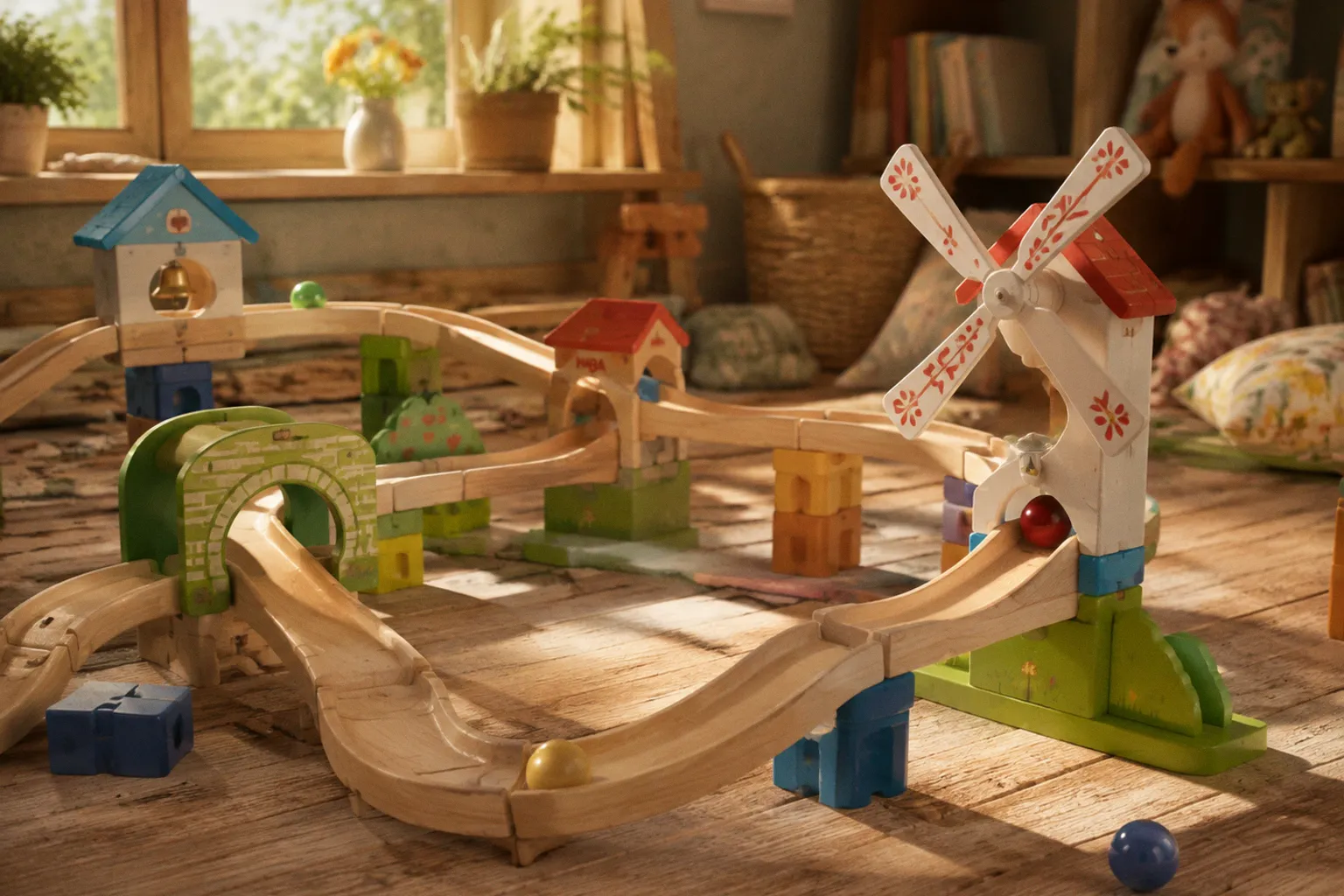
The 25-piece course combines wooden balls, plastic track elements, columns, and themed features including a spinning windmill and bell. For families choosing wooden toys, the important detail is not the colorful scenery but the construction: this is a mixed-material play system, not an all-wood product.
A starter track built for repeated rebuilding
The set is designed as a closed course. Balls travel through a building structure, around curves, through the rotating windmill, and toward a bell that marks the end of the run. HABA’s Kullerbü system uses a click connection between columns and track sections, allowing the layout to be assembled, taken apart, and rearranged.
That matters more than a fixed decorative theme. A marble run earns its place in the playroom when the child can alter the route, test what happens on a slope or curve, and repeat the sequence without the structure collapsing immediately. The Windmill Starter Track Set appears to focus on that first layer of experimentation: build, release, observe, rebuild.
The product is listed under SKU 300438 on HABA’s US site. The boxed set measures approximately 5.04 inches wide, 18.50 inches high, and 17.32 inches deep, with a shipping weight of 4.23 pounds. Those measurements suggest a relatively substantial package for a starter course, even though the finished play system is described as compact.
Material check: wood is only part of the story
HABA describes the broader Kullerbü system as using solid beech wood, plywood, and molded plastic. The Windmill set therefore should not be assessed as a conventional wooden toy in the strict sense. Its tactile experience comes from the contrast between wooden balls and engineered plastic track sections: the balls provide weight and a hard, smooth rolling surface, while the plastic pieces create the grooves, curves, and click-fit connections.
That mixed construction has practical advantages. HABA says the large balls are approximately 4.6 cm in diameter and designed for the track grooves rather than being small traditional marbles. The company also describes the system as suitable for repeated assembly and disassembly, with sturdy columns and track elements intended to withstand use by young children.
Still, material transparency should remain part of the buying decision. The available information does not establish that the finishes are non-toxic, that the wood is FSC-certified, or that the plastic components are biodegradable. Those claims should not be inferred from the presence of wood or from the product’s German manufacture. AD HOC NEWS reports that the set is made in Germany, but country of manufacture is not, by itself, a complete sustainability assessment.
For a material-conscious buyer, the useful questions are straightforward: how durable are the click connections after repeated rebuilding, how easily can individual components be replaced, and what happens when one themed element fails? A product with a modular system has a better chance of remaining usable than a sealed, single-purpose toy—but only if its parts remain available and compatible.
What to check before choosing it
HABA positions Kullerbü products for children from roughly 2 to 8 years old, depending on the specific set, and describes the Windmill starter course as intended for children starting at about age 2. The company also states that the balls and vehicles are large enough not to be swallowed by young children. These are manufacturer-described characteristics, not a substitute for checking the exact age and safety information on the local product listing.
The most relevant feature for early play is the immediate feedback: the ball moves, the windmill spins, and the bell rings. That sequence makes the result visible and audible without requiring batteries or an electronic screen. The developmental value should remain grounded in what the child actually does—placing pieces, pushing or releasing the ball, watching its path, and changing the arrangement—not in the theme alone.
The set is also described as compatible with other Kullerbü tracks and accessories. That can extend its useful life, but it can also turn a starter purchase into the beginning of a larger collection. Before expanding, check whether the original course still supports varied play. If the child is rebuilding and testing routes, the system is doing meaningful work. If the windmill and bell become the only attraction, the additional pieces may add clutter rather than durable play value.