Wooden STEM Toys: Essential Safety and Readiness Checklist
A toddler can turn a simple wooden construction set into a bridge, a tower, a sorting game, or a handful of very tempting pieces to carry straight to the mouth.
That open-ended quality is part of the value of STEM play—but it also means safety depends on more than whether the box says Montessori, natural wood, or early learning.
A useful wooden STEM toys toddler safety checklist looks at three things together: the toy’s physical construction, the child’s current play habits, and the space in which the activity will happen. A beautifully finished set can still contain a detachable peg that is unsuitable for a child under three. A well-made block set can become frustrating or unsafe when used on a crowded table with loose parts, older siblings, and no adult nearby.
The aim is not to remove every manageable challenge from play. It is to create the right amount of challenge: enough for problem-solving, tactile feedback, and co-play, without asking a young child to handle components they are not yet developmentally ready to use.
Start with the child, not the label
Age guidance is useful, but it should not be treated as a rigid developmental verdict. Two children of the same age may have very different patterns of play. One may build carefully and return pieces to a tray. Another may still mouth unfamiliar objects, throw pieces when frustrated, or pull firmly at anything that looks detachable.
Before introducing toddler STEM toys, watch how the child handles similar materials. Readiness is more visible in behavior than in a number printed on packaging.
Look for these signs:
- The child usually keeps non-food objects out of their mouth during play.
- They can follow a simple instruction such as “build here” or “place the piece in the basket.”
- They show some control when picking up, transferring, stacking, or fitting objects together.
- They can tolerate a small amount of frustration without immediately throwing or biting the toy.
- They are beginning to use materials with purpose rather than exploring every item primarily through mouthing.
- They can play on the floor or at a low table without standing on the toy, chewing it, or carrying loose pieces around the room.
This does not mean a child must complete a construction task independently. In early learning, readiness often means the child can participate in a safe interaction with an adult providing scaffolding. You might hold the base steady, offer two pieces rather than the entire set, or narrate the next step while the child experiments.
A toddler who is not ready for loose connectors may still be ready for large interlocking blocks, chunky gears, wide wooden planks, or simple ramps. Readiness is not a door that is either open or closed. It develops gradually as hand strength, attention, impulse control, and emotional regulation grow together.
The safest STEM toy is not the one with the fewest possibilities. It is the one whose possibilities match the child’s current way of using materials.
A practical readiness check
Use the toy first as an adult would, then imagine the most energetic and least careful version of the child’s play. Twist the wheels. Pull the pegs. Turn the pieces upside down. Drop a block from a low height. If the set includes connectors, ask whether a determined toddler could detach one without tools.
Now consider the play pattern the toy invites:
| Play feature | More suitable for an emerging toddler player | Requires closer supervision |
|---|---|---|
| Large, single-piece blocks | Stacking, balancing, arranging, and knocking down | Usually easier to manage, though still inspect for cracks |
| Wide ramps and planks | Cause-and-effect play with cars or balls | Watch for climbing, throwing, or unstable structures |
| Chunky gears fixed to a board | Turning, sequencing, and tactile exploration | Check that gear axles remain secure |
| Loose wheels, pegs, nuts, or bolts | Matching, fitting, and early engineering tasks | Small detachable components may create choking risks |
| Wooden beads or narrow connectors | Patterning and fine motor practice | Especially unsuitable when the child still mouths objects |
| Multi-step construction kits | Planning, testing, and collaborative building | Adult support may be needed to prevent frustration and unsafe improvisation |
The table is not a replacement for the manufacturer’s instructions or a formal safety assessment. It is a way to slow down the decision before the toy reaches the playroom.
Inspect mechanical integrity beyond the surface
Wooden toys often feel reassuring because they are solid, weighty, and quiet in the hand. That first impression can be misleading. Safety problems are frequently found at the points where pieces join: wheels attached to axles, pegs fixed into boards, handles fitted to tools, magnets enclosed in parts, or decorative elements glued onto a larger block.
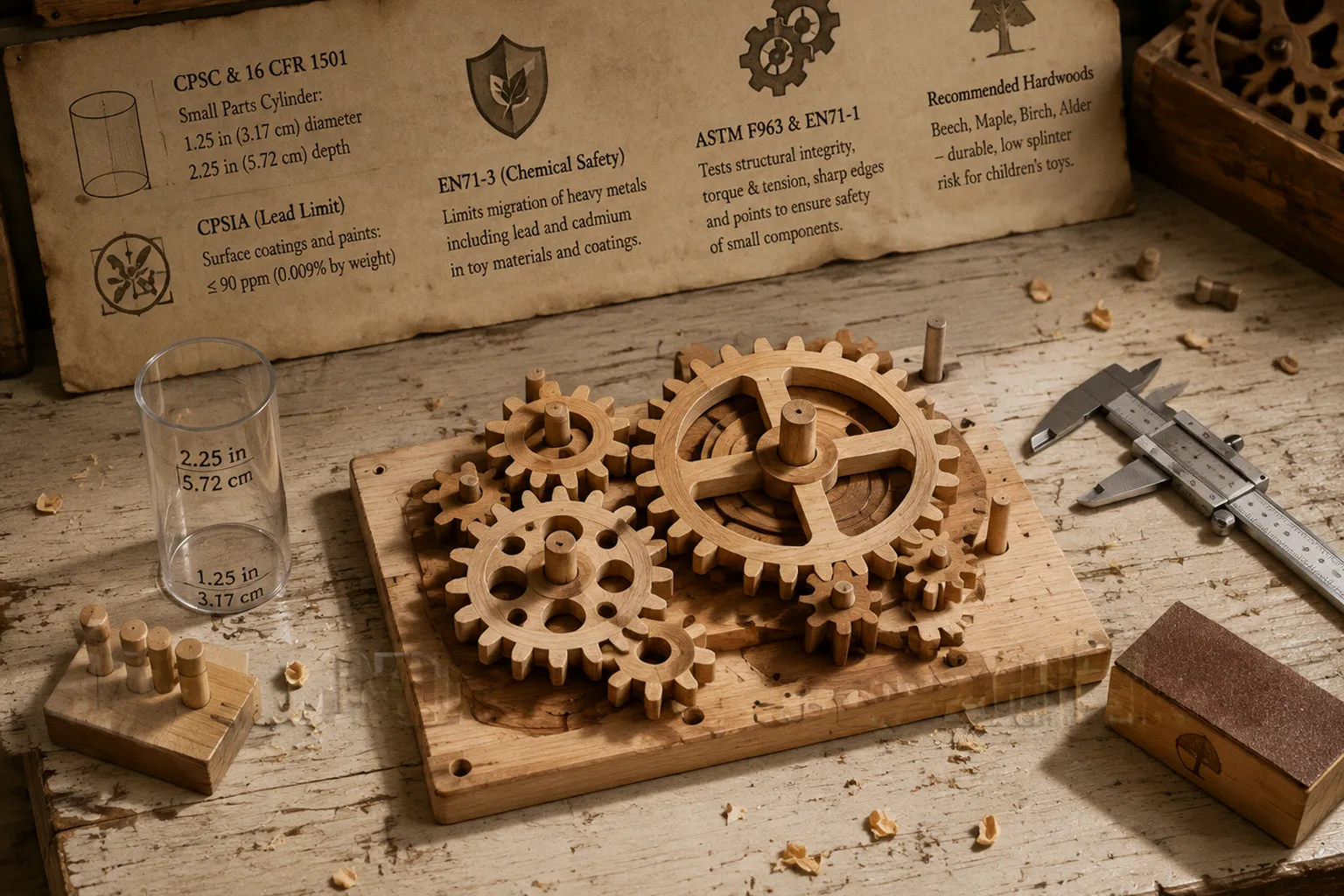
Mechanical safety standards such as ASTM F963 and EN71-1 address structural integrity, sharp edges, sharp points, and resistance to forces such as tension and torque. Parents do not need to reproduce laboratory testing at home, but they can identify warning signs that a toy should not remain in circulation.
Examine the toy in this order
1. Look along every edge and corner.
Run a clean finger slowly over the surface. You are looking for splinters, rough patches, lifted veneer, sharp corners, or a point that catches the skin. A small rough area may become larger after repeated handling.
2. Check attached parts for movement.
Gently test wheels, pegs, knobs, handles, axles, and decorative pieces. A part that rotates as intended is different from a part that wobbles at its joint. If the whole attachment shifts, creaks, or begins to separate, remove the toy.
3. Inspect drilled holes and openings.
Wooden STEM sets often include holes for threading, fitting, or connecting. Check the inside edge as well as the outside. A smooth outer surface does not guarantee that a drilled opening is free from rough wood.
4. Look for cracks that may widen under pressure.
Hairline cracks around a hole, joint, or narrow section deserve attention. Toddlers apply force in unpredictable ways: pulling sideways, twisting while holding another piece, or sitting on a structure.
5. Check whether the toy remains stable during ordinary play.
A balance board, ramp, or building base should not tip unexpectedly when a child places a typical piece on it. Stability is part of safety, particularly when the child may lean over the activity or reach across it.
6. Listen for changes.
New rattling, clicking, or a loose sound inside a wooden part can indicate a detached component. Do not keep shaking the toy in front of a child as an experiment; simply set it aside for closer inspection.
Mechanical failure does not always happen on the first day. Seasonal changes, washing, moisture, repeated dropping, and normal wear can affect joints and finishes. Build a short inspection into the routine: before a new set is introduced, after active play, and whenever a piece has been thrown, chewed, or stepped on.
Common construction problems
A toy may need to be removed when:
- a wheel or peg can be pulled away from its attachment;
- a glued decorative piece lifts at one edge;
- a block has a split running through the grain;
- an axle has a sharp exposed end;
- a connector has become thin, brittle, or cracked;
- a surface has developed a splinter after washing or heavy use;
- a piece rattles internally;
- a fastener is exposed where a child can scratch or pinch a finger.
Do not repair a critical part with household glue and assume the toy has returned to its original safety level. Adhesive may not withstand the same pulling and twisting forces as the original construction, and a repair can create a new small detachable part. When a structural component fails, replacement is usually the more responsible choice.
Apply the small-parts rule carefully
The small-parts question is often the most important part of a wooden STEM toys toddler safety checklist. Under CPSC guidelines and 16 CFR 1501, a toy part or component that fits completely inside a small-parts test cylinder measuring 1.25 inches in diameter and 2.25 inches deep is classified as a choking hazard for children under three.
In metric terms, that is approximately 3.17 cm in diameter and 5.72 cm in depth.
This measurement gives families a clear screening reference, but home screening has limits. A toy’s safety assessment is not based only on whether one loose piece fits into a cylinder. Parts can become detached during foreseeable use, and the shape, flexibility, compression, and condition of an object may affect how it behaves. A home check cannot replace a manufacturer’s testing or a formal compliance assessment.
For practical purposes, treat any loose part that could fit entirely within those dimensions as unsuitable for a child under three, especially when the child still mouths objects. Pay particular attention to:
- small wooden nuts and bolts;
- narrow pegs;
- loose wheels;
- beads and threading pieces;
- short connector rods;
- tiny gears;
- removable caps;
- small balls;
- decorative buttons or tokens;
- pieces from a mixed-age construction set.
Separate the set rather than abandoning the learning goal
If a construction kit contains both large and small components, you may be able to create a safer version of the activity. Offer the large base pieces and keep the small connectors stored out of reach. Use the larger parts for stacking, balancing, ramp-building, and comparing size or weight.
This preserves the cognitive work—planning, testing, revising, and noticing cause and effect—without presenting every component at once. As the child grows, you can reassess the smaller elements rather than relying on a package label to make the decision for you.
Keep loose parts in a closed container with a secure lid. A shallow open basket may be convenient for adult-led play, but it also makes it easy for a child to carry pieces to another room. After the activity, scan the floor, under furniture, and inside nearby containers. A missing connector is not just an inconvenience; it changes the safety status of the entire set.
Watch siblings and mixed-age groups closely. A four-year-old may use a small peg appropriately while a younger child nearby reaches for it. Shared play needs a shared storage plan, not simply an instruction to the older child to be careful.
Check coatings, finishes, and material information
The phrase “natural wood” describes the appearance or material of a product. It does not, by itself, confirm that the toy has been tested for chemical safety. A wooden toy may have paint, stain, varnish, oil, adhesive, printing ink, or a surface coating applied over the wood.
Under the U.S. Consumer Product Safety Improvement Act, lead in paints and surface coatings on children’s toys is restricted to a maximum of 90 parts per million, or 0.009% by weight. In Europe, EN71-3 addresses the migration of certain elements, including heavy metals such as lead and cadmium, from toy materials and coatings.
These standards are useful only when connected to a real product and credible documentation. A seller’s use of words such as “eco,” “non-toxic,” or “Montessori” is not the same as evidence of compliance. Nor does an attractive unfinished appearance prove that every adhesive or treatment used in production is suitable for children’s products.
What to look for in product information
A responsible manufacturer or retailer should provide clear information about:
- the intended age range and supervision guidance;
- the manufacturer or responsible business identity;
- the materials used in the toy and its finish;
- the relevant safety standard or regulatory framework;
- testing or compliance documentation where appropriate;
- care instructions that do not compromise the finish;
- recall information or a way to contact the company.
For a U.S.-market product, look for information connected to ASTM F963-23 and applicable CPSC requirements. For a product sold in Europe, EN71-1, EN71-2, and EN71-3 relate respectively to physical and mechanical properties, flammability, and migration of certain chemical elements.
Do not interpret the presence of a standard number as automatic proof that the specific item in your hand has been properly assessed. Certification language can be vague, especially on marketplace listings. If documentation is missing, the sensible response is not panic; it is to choose a product from a supplier that can explain what was tested and under which framework.
Observe the finish during everyday use
Even a compliant finish can deteriorate. Remove a toy from play if:
- paint is flaking or lifting;
- varnish has begun to peel;
- a child has chewed through the surface;
- the wood underneath has become rough;
- an unusual odor persists after opening and airing;
- water damage has caused swelling, cracking, or discoloration;
- cleaning has left the surface sticky or tacky.
Avoid soaking wooden toys unless the manufacturer specifically permits it. Excess moisture can swell the grain and weaken glued joints. Strong household cleaners may also damage the finish and leave residues that were never intended for mouthing contact.
“Non-toxic” is a useful description only when it is supported by accountable manufacturing information and a finish that remains intact in real play.
Choose wood for the way children use it
Hardwoods such as beech, maple, birch, and alder are commonly used for children’s wooden toys because they are durable and generally less prone to splintering than softer woods. That does not make every hardwood toy safe, and it does not make every softwood toy unacceptable. Construction quality, grain direction, finishing, joints, and maintenance all matter.
The best material choice is the one that supports the intended play without creating fragile edges or weak connection points. A large solid block can tolerate repeated stacking and knocking down. A thin decorative piece may not tolerate being twisted, regardless of the species of wood.
Match material and design to the activity
For toddlers, look for:
- broad surfaces that are easy to grasp with the whole hand;
- rounded or softened edges;
- pieces with enough thickness to resist splitting;
- stable bases for ramps, gears, and balancing activities;
- smooth drilled holes with no sharp internal edges;
- finishes that do not become slippery or sticky;
- simple forms that allow the child to see how the parts relate.
Be cautious with pieces that are very thin, sharply pointed, unusually long, or dependent on a narrow neck to remain attached. These forms may be appropriate in an older child’s supervised engineering set but are less forgiving when a toddler throws, bends, or mouths them.
Wood also carries sensory information that plastic often presents differently. The grain, weight, temperature, and resistance of a wooden block provide tactile feedback as a child grips and positions it. This can support fine motor development and spatial reasoning, but only when the surface remains smooth and the shape is easy to control.
Verify compliance without confusing standards with marketing
Safety standards can feel intimidating because product pages often list several codes at once. The simplest way to read them is to ask what kind of risk each standard addresses.
| Standard or framework | Main area it addresses | What families should understand |
|---|---|---|
| ASTM F963-23 | U.S. toy safety requirements, including physical, mechanical, flammability, and chemical considerations | A relevant standard reference should relate to the specific toy, not just the company in general |
| EN71-1 | Mechanical and physical properties | Covers issues such as sharp points, sharp edges, and structural integrity |
| EN71-2 | Flammability | Addresses how toy materials behave in relation to fire |
| EN71-3 | Migration of certain elements | Concerns chemical migration from materials and surface coatings, including specified heavy metals |
| CPSC small-parts rules and 16 CFR 1501 | Choking hazards for young children | A small detachable part can make a toy unsuitable for children under three |
When a listing says “tested to EN71” or “ASTM approved,” look for more detail. Which part of the standard? For which model? Was the testing performed on the finished product, including the coating and assembled joints? Is there a manufacturer name and product identifier?
The absence of a long laboratory report on a retail page does not automatically mean the toy is unsafe. However, a vague badge, a copied standards list, or a claim that the toy is safe because it is wooden should not be treated as proof.
A sensible purchasing sequence
1. Identify the manufacturer and exact product.
Avoid listings that cannot clearly name who made the toy or where the product information comes from.
2. Read the age and supervision guidance.
Treat it as one piece of evidence, then compare it with the child’s mouthing, throwing, and frustration patterns.
3. Count the detachable parts.
Do not focus only on the large blocks. Examine every peg, axle, wheel, cap, bead, and decorative element.
4. Review material and finish information.
Look for specific descriptions rather than broad environmental or educational claims.
5. Look for applicable compliance information.
A credible supplier should be able to identify the relevant safety framework and answer questions about testing.
6. Inspect the actual toy when it arrives.
Packaging and photographs cannot reveal a rough drilled hole, a loose axle, or a cracked corner.
7. Keep records for higher-value or frequently shared sets.
Retain the packaging, instructions, and product details so you can check for updates or recalls.
This sequence is especially useful for Montessori wooden blocks safety standards and early STEM kits purchased online, where photographs may show only the finished appearance.
Prepare the play space as part of the safety plan
A well-designed toy still needs a suitable environment. Early STEM play often involves building upward, sending objects down ramps, balancing pieces, and testing what happens when a structure collapses. The floor space should allow the child to make those discoveries without needing to build beside stairs, hard furniture corners, or a walkway.
For early STEM play space preparation, create:
- a clear, stable surface at floor or low-table height;
- enough room for a structure to fall without landing on a child’s feet;
- a defined tray or mat for loose components;
- good lighting so cracks, splinters, and missing pieces are visible;
- a storage container that younger children cannot open independently;
- a calm place where an adult can sit close enough to scaffold the activity;
- separation between small-part sets and toys intended for babies or mouthing children.
Co-play is not the same as taking over. Sit nearby, model one action, and leave space for the child to test an idea. If a tower collapses, resist the urge to rebuild it immediately. Help with emotional regulation first—name the disappointment, pause, and then invite the child to decide whether to try a wider base or a shorter structure.
That approach improves safety as well as learning. A child who feels supported is less likely to snatch, throw, or force a piece into a connection that does not fit.
Extend the play without adding unnecessary risk
You can increase the learning value of a large-piece wooden set through simple prompts:
- Build a bridge that is wide enough for one car, then wide enough for two.
- Test which ramp angle makes the car travel farther.
- Sort blocks by shape before building.
- Compare a tall narrow tower with a short wide tower.
- Make a path and invite the child to predict where the ball will stop.
- Use descriptive language: heavy, light, smooth, balanced, wobbly, under, over, beside.
- Take a photograph of a successful structure so the child can revisit the idea later.
These extensions support early engineering thinking without introducing smaller components. They also give adults an opportunity to observe how the child handles materials over time.
A weekly review keeps the set safe
Wooden STEM toys do not need a complicated maintenance routine. A brief review once a week—and immediately after rough play—usually catches the changes that matter.
Remove and reassess any item that shows:
- a new splinter, crack, or rough edge;
- loose wheels, pegs, axles, or decorative parts;
- peeling paint or damaged coating;
- swelling from moisture;
- a missing component from a multi-piece set;
- persistent odor or residue;
- signs that the toy has been used as a step, hammer, or object to chew.
Store the toy away from damp areas and strong heat. Keep sets complete where possible, because a missing large base or divider can change how safely the remaining parts are used. If the toy is shared between classrooms or families, pass along the original age guidance and any supervision notes rather than assuming the next adult will infer them.
When in doubt, retire the specific piece. A wooden toy is replaceable; a preventable injury is not.
The final decision
Safe wooden STEM play is built from several modest decisions: choosing a design with sound joints, removing small detachable parts from a younger child’s reach, checking that coatings and materials are properly described, and matching the activity to the child’s actual play behavior.
Hardwood, a natural finish, or a Montessori label can all be positive features, but none is a substitute for inspection and credible compliance information. Standards such as ASTM F963 and EN71 provide a framework for physical and chemical safety; they do not remove the need for sensible supervision and ongoing care.
The most useful checklist is therefore one you can repeat:
- Is the child ready for the way this toy is likely to be used?
- Could any component become a choking hazard?
- Are the joints, edges, holes, and surfaces intact?
- Is the finish documented and still in good condition?
- Can the play space support building, testing, and collapse safely?
- Will an adult be close enough to offer scaffolding when the task becomes frustrating?
When those answers line up, wooden STEM toys become more than attractive objects on a shelf. They become tactile tools for planning, persistence, fine motor control, spatial reasoning, and shared discovery—introduced at a pace that respects both the child’s curiosity and their safety.