Why Collectors Are Auctioning Off Hundreds of Rare Farm Toy Tractors
According to BBC reporting, a 77-year-old collector from Essex is putting roughly 500 toy John Deere tractors up for auction to make room for more collectibles — a story that, on the surface, reads…
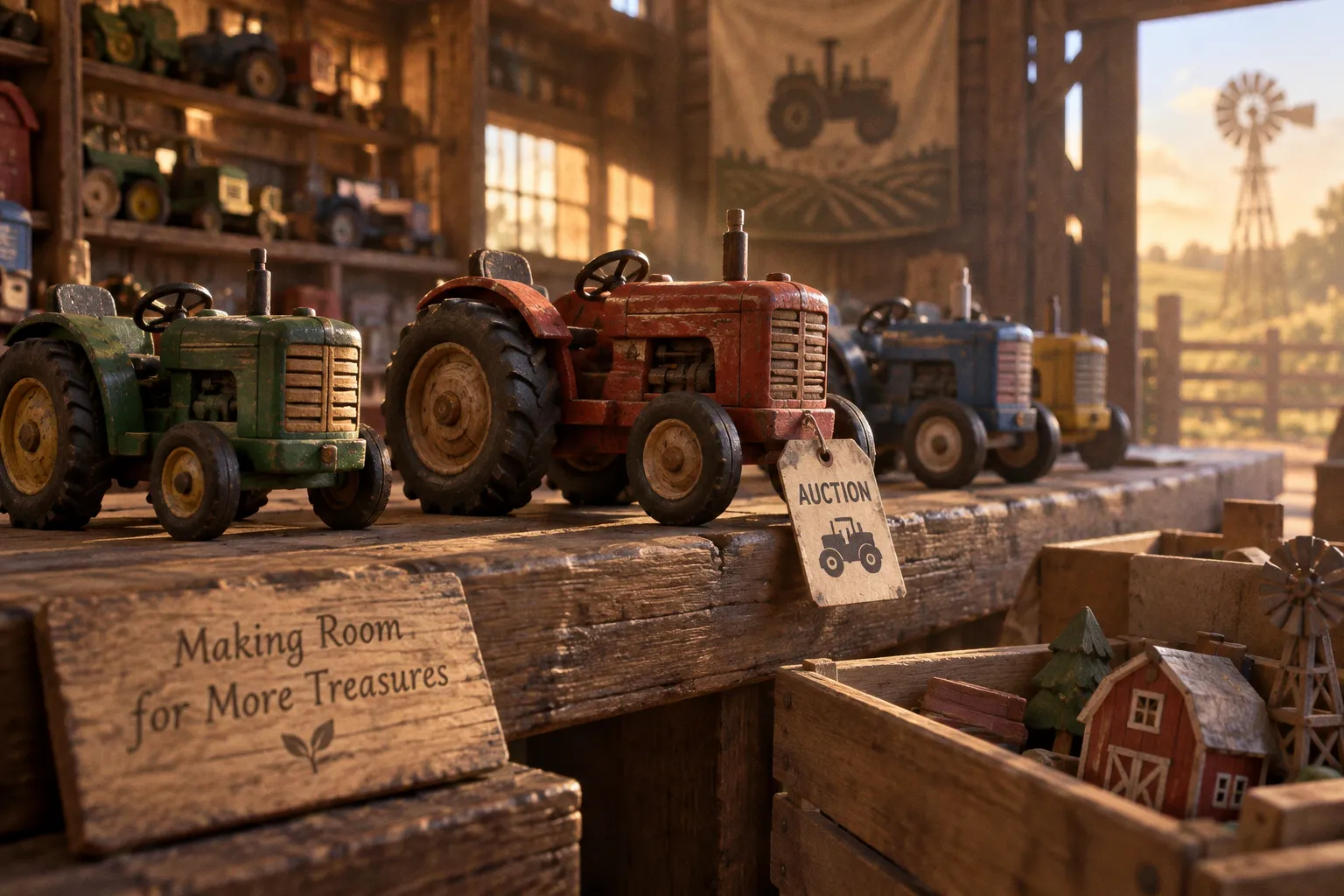
According to BBC reporting, a 77-year-old collector from Essex is putting roughly 500 toy John Deere tractors up for auction to make room for more collectibles — a story that, on the surface, reads as pure hobbyist news but quietly says a great deal about what actually survives in the toy world, and why.
Peter Green, a retired building surveyor from Saffron Walden, has spent twelve years assembling one of the most extensive John Deere collections in the UK. The majority are 1:16 scale models made by farm toy manufacturer ERTL, with rarer bespoke commissions — including a Kinze 8650 conversion, a 4520 V8 with twin rear wheels, and a modern 9RX830 — expected to fetch between £300 and £500 each at the Cheffins vintage sale on 16 October in Cambridge. Green told the BBC the house had become "just about full up."
Materials, Cabinets, and Play
ERTL's classic farm replicas are die-cast metal with painted finishes — sturdy, weighty, and built to be held, but in practice more often displayed. Green fitted glass-fronted cabinets into his home to house them, and that detail matters: these are toys engineered to look like machinery, then treated as miniature machinery rather than as playthings.
This is where a wooden-toy perspective draws a sharp line. A FSC-certified timber tractor, sealed with a non-toxic water-based finish, is built for the playroom floor. It will dent, weather, and pick up character in a child's hands. A die-cast collectible, by contrast, is built for the shelf — its market value tied to originality, packaging, and the absence of wear. Both can outlive their first owner, but only one is designed to be used along the way, and that distinction shapes everything from tactile integrity to long-term resale.
Longevity, Lifecycle, and What Collectors Already Know
Ted Shepherd, an associate at Cheffins, described the collection's "level of research and attention to detail," adding that offerings of this quality "rarely come to the market." He is right — a 12-year, 500-piece curated archive is, by any measure, an unusually high survival rate for toys.
It is worth pausing on why. Most mass-produced plastic playthings do not make it to a second childhood. They crack, yellow, lose small components, and end up in landfill or, at best, a recycling stream that struggles with mixed polymers. Green's collection held because it was kept behind glass, yes — but also because ERTL's metal-bodied replicas are physically robust enough to survive that storage without degrading. The lesson, for anyone choosing toys with longevity in mind, is not that glass cabinets are required. It is that the material you select upfront decides whether the object has any future beyond its first child. Biodegradability and non-toxic finishes matter most when a toy is actually played with; sealed metal and climate-controlled storage matter most when it is not.
Green plans to reinvest the proceeds into his 1:32 scale John Deere line and a new run of Caterpillar earthmoving models. The hunt, clearly, is far from over.