FSC Certified Wooden Toys: What the Label Means
A wooden toy can feel wonderfully simple: smooth timber, a few careful shapes, perhaps a warm coat of colour and the satisfying weight of something made to last.
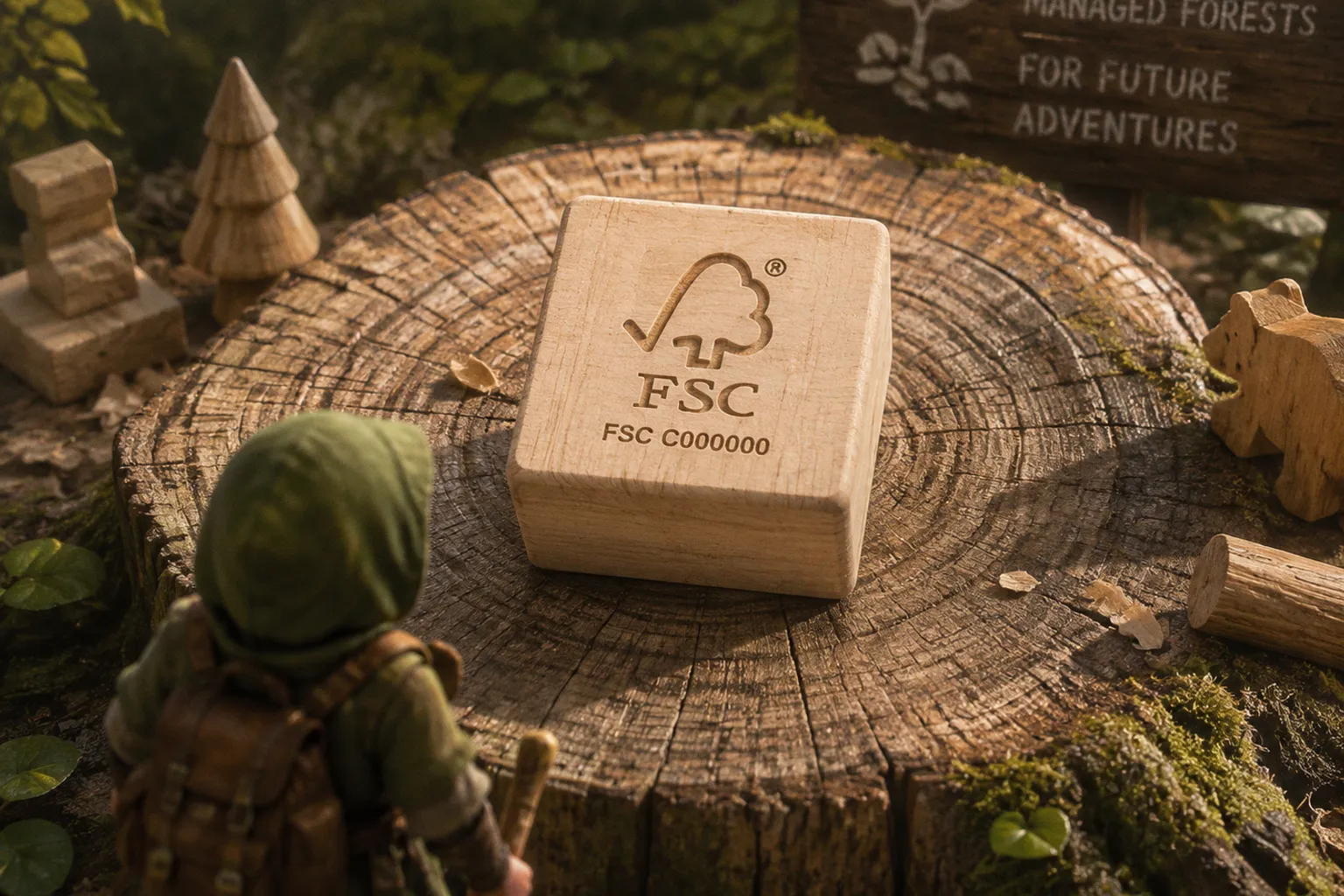
But when a box also carries an FSC label, parents often wonder what that symbol actually promises. Does it mean the toy is non-toxic? Is every piece made from certified wood? Does it tell us anything about the paint, glue, or safety of the finished product?
The meaning of FSC certified wooden toys is narrower, and more useful, than many product descriptions suggest. FSC certification is primarily about where the wood comes from and how that timber is tracked through the supply chain. It is a sustainability and sourcing certification—not a complete safety certificate for the toy.
That distinction matters. A responsibly sourced wooden train can still need separate checks for paint, small parts, construction, and age suitability. Once we understand what the label covers, it becomes much easier to choose wooden toys with both environmental care and children’s real play needs in mind.
Decoding the FSC label: beyond the logo
FSC stands for the Forest Stewardship Council. Its certification system follows timber from responsibly managed forests or approved recycled sources through the chain of custody that turns raw wood into a finished product.
For a wooden toy, this may include timber used for:
- Building blocks and balancing stones
- Wooden train tracks and carriages
- Peg dolls and sorting toys
- Craft blanks and carving kits
- Puzzles, stacking toys, and pretend-play accessories
- Parts of larger toys that combine wood with metal, fabric, plastic, or cardboard
The central idea is traceability. The FSC system is designed to verify that the wood can be connected to acceptable sources rather than entering the product anonymously through an untracked supply chain.
This is the practical answer to the question what does FSC certified wood mean for toys? It means that the timber has been sourced and controlled according to FSC requirements. The certification addresses forest management, timber origin, and the chain of custody between the forest and the product.
It does not mean that every material in the toy has been certified. Nor does it mean that the toy has passed every possible safety or chemical test.
A wooden toy may contain several different materials:
- Timber for the main body
- Water-based or other decorative paint
- Varnish, wax, or oil
- Adhesives
- Metal axles, hinges, bells, or fasteners
- Plastic wheels or connectors
- Fabric details or paper packaging
FSC certification is concerned with the timber component and its sourcing. The other materials require their own evaluation. This is why a thoughtful product description should tell you more than simply that a toy is eco-friendly or responsibly made.
FSC tells you a story about the wood’s journey. It does not tell the whole story of the finished toy.
That is not a weakness in the certification. It is simply the boundary of what the label is designed to do. In the classroom, we use many different kinds of information to understand whether a play material is suitable: how it is made, how it feels in children’s hands, what risks it presents, and how it supports play. FSC is one part of that picture.
The hierarchy of labels: FSC 100%, Mix, and Recycled
Not all FSC labels mean the same thing. The wording beside the FSC logo is important, particularly when a product contains several sources of timber or recycled material.
FSC 100%
An FSC 100% label means that all timber in the product comes from FSC-certified, responsibly managed forests.
For a simple solid-wood toy, this is the clearest form of FSC timber claim. If a set of wooden blocks carries an FSC 100% label, the timber used for those blocks is represented as coming entirely from FSC-certified forests.
The label still does not certify:
- The toy’s paint or finish
- The toxicity of coatings or adhesives
- The mechanical strength of the toy
- The absence of lead or heavy metals
- The suitability of the toy for a particular child
- Non-wood elements included in the product
So FSC 100% describes the wood source, not the complete manufacturing process.
FSC Mix
An FSC Mix label applies when a product combines material from different approved sources. The FSC Mix standard requires at least 70% of the material to come from FSC-certified forests or recycled sources. The remaining balance may be FSC Controlled Wood.
That makes FSC Mix meaningful, but different from FSC 100%. It should not be read as a claim that all of the timber came from certified forests.
This distinction is easy to lose in a warm, appealing product description. A toy may be marketed as an FSC-certified wooden product, while the precise label shows that it is FSC Mix. The accurate interpretation is that the product contains a qualifying mix of FSC-certified and/or recycled material, with the balance controlled under FSC requirements.
FSC Recycled
An FSC Recycled label means the product is made from 100% reclaimed or recycled timber materials.
This can be especially relevant for products made from recycled wood fibres or reclaimed timber rather than newly harvested forest material. As with the other FSC categories, the label relates to the timber source. It does not automatically confirm the safety of paint, glue, surface treatments, or other components.
A quick comparison
| FSC label | What it tells you about the timber | What it does not tell you |
|---|---|---|
| FSC 100% | All timber comes from FSC-certified, responsibly managed forests | Whether paint, finishes, adhesives, or non-wood parts are safe |
| FSC Mix | At least 70% of the material comes from FSC-certified forests or recycled sources; the balance may be FSC Controlled Wood | That 100% of the timber came from certified forests |
| FSC Recycled | The timber material is 100% reclaimed or recycled | Whether the finished toy meets every applicable toy-safety requirement |
For families choosing between different wooden toys, the label category can help clarify the environmental claim. It should not, however, become a shortcut for judging quality. A beautifully made FSC 100% toy still needs sound construction. An FSC Mix toy may be thoughtfully designed, durable, and developmentally rich. The label gives information about sourcing; the toy itself still deserves a closer look.
Why the wood source matters in children’s play
Young children often explore materials with their whole bodies. They grasp, mouth, rub, stack, knock, carry, and drop objects. The tactile feedback of timber is part of the appeal: wood has weight, warmth, grain, and resistance that plastic often does not provide.
In open-ended play, children may use a wooden block as a bridge, a bed for a small figure, a piece of pretend food, or part of a tower that must be rebuilt after it falls. The material becomes part of the play language.
For parents and educators, responsibly sourced wood can support a broader approach to choosing children’s products:
- Fewer unnecessary materials and more attention to longevity
- A preference for toys that can remain useful across several stages of play
- Greater interest in repairable or durable construction
- Awareness of how timber is sourced rather than treating wood as automatically sustainable
- More careful separation of environmental claims from safety claims
A wooden toy is not automatically sustainable simply because it is made of wood. Timber can be sourced in very different ways, and the product may be designed for a short life, heavily packaged, or difficult to repair. FSC certification offers useful information about forest sourcing, but it does not answer every environmental question.
The most valuable heirloom toys tend to earn their place through repeated use. A set of blocks that supports early stacking, later construction, small-world play, and collaborative problem-solving has a longer developmental life than a toy with only one prescribed action. Durability and play value work together here: a well-made object is more likely to stay in a child’s environment long enough to become familiar, versatile, and genuinely loved.
The safety gap: what FSC does not cover
This is the part I would want every parent and educator to understand before reading the word eco-certified on a toy box.
FSC certification does not test or certify:
- Paint and pigment safety
- Chemical toxicity of surface finishes
- Varnishes, waxes, or oils
- Glue and adhesive formulations
- Structural safety
- Choking hazards
- Sharp edges or splinters
- Small detachable parts
- Product testing against toy-safety standards
A product can carry a legitimate FSC label and still require separate evidence that it has been manufactured and tested as a children’s toy.
In different markets, toy-safety frameworks may include standards such as EN 71 in Europe or ASTM F963 in the United States. These are separate from FSC. The relevant requirements depend on where the product is sold and how it is classified, but the important principle remains the same: forestry certification and toy-safety certification perform different jobs.
When I help families think through wooden play materials, I encourage them to hold two questions side by side:
1. Was the timber sourced responsibly?
2. Is the finished toy suitable and safe for the child who will use it?
The first question is where FSC helps. The second needs information about the complete product.
A practical safety reading of the product page
A reliable product listing should make it possible to identify more than the source of the wood. Look for clear information about:
- The recommended use and supervision
- Small parts or choking risks
- The type of finish, where the maker chooses to disclose it
- Whether the product is intended for mouthing or early oral exploration
- The manufacturer or responsible seller
- Applicable toy-safety standards
- Care instructions, particularly for painted or sealed surfaces
- Any non-wood components that may affect use
Age labels can be helpful, but they should not be treated as rigid developmental gates. A three-year-old who still mouths objects needs a different level of supervision from a confident four-year-old who uses the same puzzle carefully. Children’s motor planning, impulse control, and play habits vary widely.
This is where the adult’s observation matters. A toy’s label cannot see whether a child is likely to throw it, chew it, hide pieces under furniture, or use it in a busy group setting. We can.
Verifying authenticity: how to spot a valid FSC label
A product description may use words such as sustainable, natural, responsibly sourced, or eco-friendly. Those phrases can be helpful, but they do not all represent a formal certification.
An official FSC product label includes several identifying elements:
- The FSC logo with its trademark symbol
- The label title, such as 100%, Mix, or Recycled
- An FSC licence code, usually shown in a format such as FSC C000000
The licence code is particularly useful. A logo printed without the relevant code should not be treated as proof of a verified FSC claim. The presence of a logo alone is not enough to establish that a product is legitimately certified.
This does not mean a small wooden toy maker without an FSC label is irresponsible. Some independent makers source local timber, reclaimed wood, or wood from a known supplier but do not hold or use FSC certification. Those claims should be described accurately rather than folded into a certification they do not possess.
Equally, a polished brand with beautiful sustainability language still needs to be clear about what the certification applies to. Does it cover the entire product, only the wooden body, or the packaging? A complex toy containing timber, plastic, metal, and fabric may involve several material streams.
When reading a label or product page, use this simple sequence:
1. Find the actual FSC label.
Do not rely only on a sentence saying that the product is made with sustainable wood.
2. Identify the category.
Check whether it says FSC 100%, FSC Mix, or FSC Recycled.
3. Look for the licence code.
A formal FSC label should include one.
4. Ask what part of the product is covered.
The timber claim may not extend to paint, fabric, plastic, or packaging.
5. Look for separate safety information.
FSC does not replace toy-safety testing or responsible product guidance.
This small amount of label literacy can prevent two common mistakes: dismissing a meaningful certification because it is not a complete safety guarantee, or assuming it is a complete safety guarantee because it appears on a wooden toy.
The role of Controlled Wood in sustainable sourcing
Controlled Wood is often the least understood part of the FSC Mix label. It is not the same as timber from an FSC-certified forest. Instead, FSC Controlled Wood must be assessed for specific risks and excluded from unacceptable sources.
The system is designed to avoid wood connected with:
- Illegal logging
- Violations of civil rights
- Forests with high conservation value
- Conversion of forests to non-forest use
- Genetically modified trees
This explains why FSC Mix is not simply a diluted version of FSC 100%. It reflects a controlled combination of materials, with requirements around the source of the non-certified balance.
For families, the practical takeaway is straightforward: FSC Mix still communicates meaningful sourcing controls, but the label should be read precisely. If you are comparing two products and your priority is that all timber comes from FSC-certified forests, FSC 100% is the more direct claim. If the product uses a combination of certified and recycled inputs, FSC Mix may accurately describe that supply chain.
There is also a gentle lesson here about sustainability language. Responsible production is rarely one dramatic feature. It is usually a collection of decisions: the origin of the wood, the amount of material used, the lifespan of the toy, the possibility of repair, the packaging, and the quality of the design.
A wooden toy that encourages years of open-ended play has a different environmental value from a novelty item that is quickly abandoned, even if both carry attractive green labels. That is not something FSC is intended to measure—but it is something adults can observe.
Choosing FSC certified wooden toys for real play
Once the label has been understood, bring the decision back to the child. The best sustainable toy is still one that invites rich, repeated play.
For babies and toddlers, consider how the object supports:
- Grasping and releasing
- Transferring objects between hands
- Posting, stacking, and filling
- Early cause-and-effect exploration
- Safe tactile feedback through shape, weight, and texture
For preschool children, look for wooden toys that create room for:
- Co-play with an adult or sibling
- Sorting, matching, and early mathematical thinking
- Narrative play with figures, vehicles, or loose parts
- Fine-motor practice through threading, fitting, and construction
- Emotional regulation through repetition and predictable actions
For older children, traditional wooden toys can support more complex planning:
- Designing stable structures
- Negotiating shared building ideas
- Revising a plan after a collapse
- Creating rules for a game
- Combining craft materials with construction and pretend play
Notice that none of these benefits comes from the FSC label itself. They come from the design of the toy and the way children are supported while using it. FSC helps adults make a more informed sourcing choice; co-play and thoughtful presentation help children access the toy’s developmental value.
A basket of wooden blocks, for example, does not need a scripted activity every time it comes out. One day, a child may build a tower. Another day, the blocks become homes for animals. An adult can extend the play with a small prompt: Which block could make the bridge stronger? Where might the people go when the tower falls? How could we make space for someone else to build?
These moments provide scaffolding without taking over. The adult follows the child’s idea, adds language, and gently stretches the thinking.
Common mistakes when reading FSC claims
Even experienced adults can misread sustainability labels when packaging is busy or product descriptions are enthusiastic. The most common misunderstandings are easy to correct.
Mistake 1: Treating FSC as a non-toxic claim
FSC does not certify paint, finishes, adhesives, or chemical toxicity. A separate safety assessment is needed for those features.
Mistake 2: Assuming FSC Mix means all the timber is certified
FSC Mix requires at least 70% FSC-certified or recycled material, while the remaining balance may be Controlled Wood. It is not the same claim as FSC 100%.
Mistake 3: Trusting an unverified logo
A legitimate FSC product label includes the logo, label category, and licence code. A logo printed without identifying information should be treated cautiously.
Mistake 4: Applying the wood claim to every component
A toy may include plastic wheels, metal pieces, fabric, or cardboard. FSC certification concerns the timber material covered by the claim, not automatically the entire product.
Mistake 5: Choosing the label and forgetting the play
Environmental sourcing matters, but a toy also needs to fit the child’s interests, abilities, sensory preferences, and everyday environment. A durable toy that is never used has limited practical value.
The strongest choice is not simply the toy with the greenest wording. It is the one whose sourcing, safety information, construction, and play value all make sense together.
Extending the value of a responsibly sourced wooden toy
Once a wooden toy enters your home or classroom, its useful life depends partly on how it is offered. Children often need time to discover what an open-ended object can do.
Try these gentle extensions:
- Place a small number of pieces in a clear basket rather than presenting an overwhelming collection.
- Pair blocks with figures, fabric, cardboard tubes, or natural loose parts to invite new forms of pretend play.
- Rotate toys so familiar materials regain their freshness without requiring constant buying.
- Use descriptive language instead of directing every move: balanced, heavy, wobbly, smooth, taller, underneath.
- Repair loose parts or damaged surfaces promptly where appropriate, following the maker’s care guidance.
- Invite children to help return pieces to a simple, predictable storage place.
- Watch for the moment when frustration rises, then offer scaffolding rather than solving the problem immediately.
- Let children repeat an activity. Repetition is often where motor confidence and emotional regulation grow.
Wooden toys are especially good companions for this kind of play because they do not usually dictate one correct outcome. A set of natural timber blocks can remain relevant as a child’s language, planning, and social play develop.
For educators, it can also be useful to observe how materials move through a group. Do children negotiate access to the most popular pieces? Does the design encourage parallel play or shared construction? Are there enough similar shapes for children to participate without competing? These questions connect sustainability with inclusion and classroom practice.
A responsibly sourced toy should not become a precious object that children are afraid to touch. Its purpose is still play: active, sensory, sometimes noisy, occasionally untidy, and full of experimentation.
A balanced way to read the label
The phrase sustainable wood certification for toys can sound broad, but FSC has a specific role. It verifies the sourcing and traceability of timber under defined categories. FSC 100% means all timber comes from FSC-certified forests. FSC Mix means at least 70% comes from FSC-certified or recycled sources, with the remaining balance potentially coming from Controlled Wood. FSC Recycled means the timber material is 100% reclaimed or recycled.
That information is valuable. It helps families and educators move beyond the assumption that every wooden toy is automatically sustainable. It also rewards makers and manufacturers that provide clearer sourcing information.
But the label should sit alongside, not replace, questions about the finished product. Look at the construction, surface, components, safety information, durability, and the kind of play the toy makes possible. Observe the child, too. A toy that supports concentration, co-play, problem-solving, and repeated creative use is doing more than filling a shelf.
FSC certification gives us a clearer starting point: we know more about the timber’s journey. From there, thoughtful adults can make the wider decision—choosing playthings that are responsibly sourced, carefully made, appropriate for the child, and likely to remain part of everyday play for a long time.