Cooperative Board Games: How Shared Play Works
A child who melts down when someone else wins is not necessarily being “a bad sport.” Often, the difficulty is more basic: competition asks young children to manage disappointment, compare themselves…
A child who melts down when someone else wins is not necessarily being “a bad sport.” Often, the difficulty is more basic: competition asks young children to manage disappointment, compare themselves with others, wait for another player’s turn, and keep following rules while their emotions are already running high.
Cooperative board games offer a different route into tabletop play. Instead of one child winning against the others, everyone works toward a shared goal. Players pool actions, make decisions together, and respond to the same game mechanism. The group may rescue the animals, reach the treasure, plant the garden, or finish the mission before the cards or tokens run out.
So, what are cooperative board games for kids? They are games in which the players collaborate against a shared challenge rather than competing directly with one another. That small change in structure can make a big difference to how children communicate, handle setbacks, and stay engaged.
The mechanics of shared victory: how cooperative play differs from competition
In a traditional competitive board game, the main question is usually: Who will win? Each player has an individual score, position, or collection of pieces. Your success may depend partly on another player’s failure.
In a cooperative game, the question changes to: How can we solve this together?
Children may still take turns, roll dice, draw cards, match pictures, count spaces, or plan several moves ahead. The difference is that their choices contribute to the same outcome. A player might decide which animal to move, another might notice a useful pattern, and a third might remind the group how many turns remain.
This is what makes cooperative games for children especially valuable in the early years. The game does not remove challenge. It changes where the pressure sits.
| Feature | Competitive board game | Cooperative board game |
|---|---|---|
| Main goal | Finish ahead of the other players | Reach a shared goal before the game mechanism does |
| Decision-making | Players usually protect their own advantage | Players discuss which action helps the whole group |
| Emotional outcome | One player or team wins; others lose | The group experiences a collective win or loss |
| Social practice | Managing comparison, waiting, and disappointment | Sharing ideas, listening, negotiating, and encouraging |
| Adult support | May be needed around losing and conflict | Often focuses on guiding discussion without taking over |
| Typical challenge | Opponents, scores, or limited resources | A timer, card pile, spreading problem, route, or puzzle |
The rules still matter. Cooperative play is not simply free play with a board nearby. Children need to understand that actions have consequences and that the group cannot choose everything at once. If the game has limited turns, the players must decide how to use them. If a problem spreads across the board, they must notice it and respond.
That combination creates a useful kind of cognitive friction: enough challenge to encourage thinking, but less interpersonal threat than direct competition can bring.
How cooperative board games work in practice
Most cooperative games for young children include several familiar elements:
1. A shared objective. The players are trying to complete one task together, such as collecting objects, reaching a destination, or preventing a problem from taking over the board.
2. A common game mechanism. Cards, dice, spinners, or tokens introduce movement and uncertainty. The mechanism creates the challenge rather than one child deliberately defeating another.
3. Shared resources or actions. Players may use the same pile of cards, move pieces for one another, or decide together where a token should go.
4. A visible sense of progress. Children can see the group getting closer to the goal. This supports motivation and helps them connect actions with outcomes.
5. A clear ending. The group either completes the task or the game mechanism reaches its own goal first. A definite ending helps children understand that losing is part of the game structure, not a personal judgement.
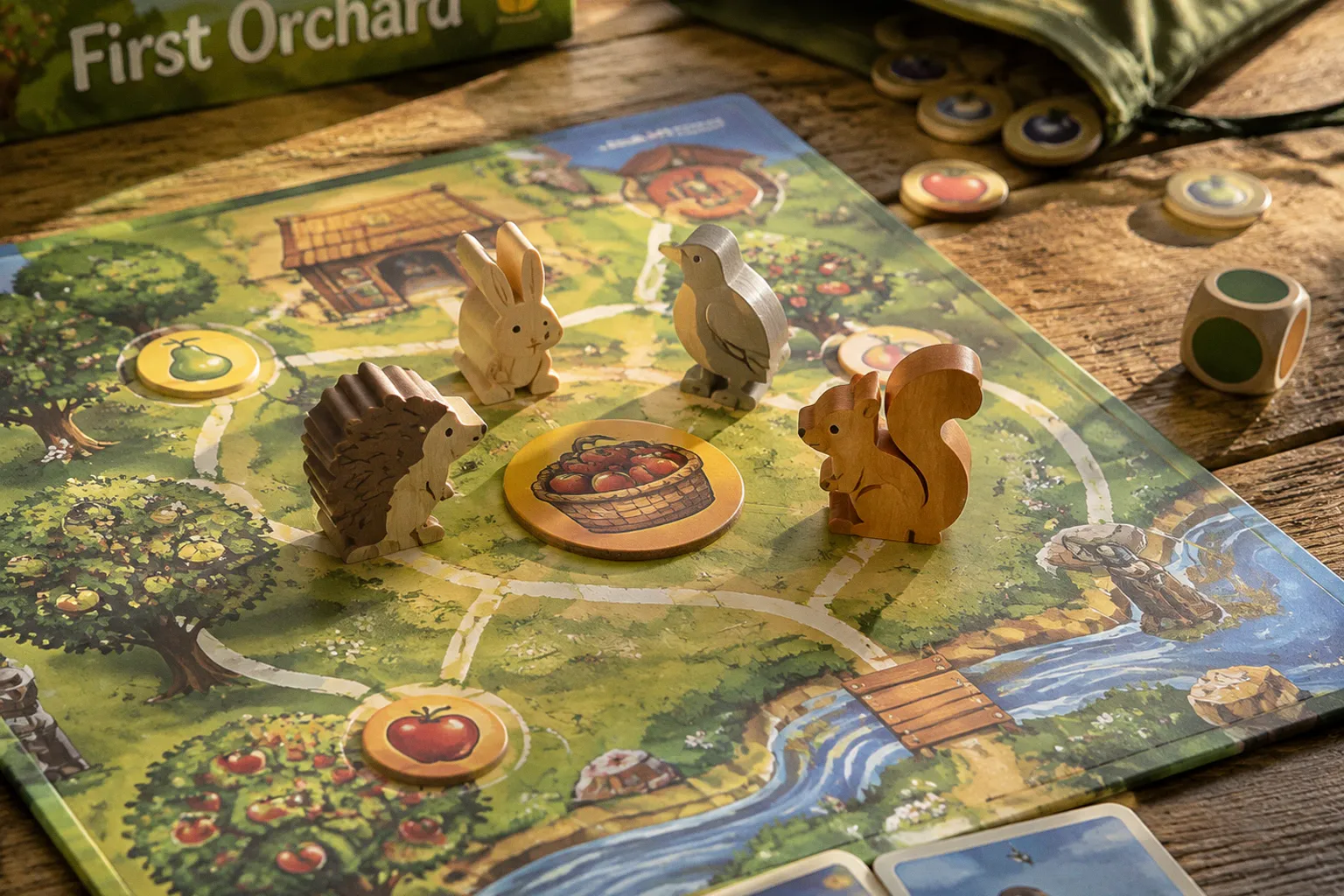
Games such as First Orchard, Hoot Owl Hoot! and Race to the Treasure! are examples created specifically for toddlers and young children. Their themes are concrete, their rules are comparatively accessible, and their cooperative structure gives adults plenty of opportunities to model language around planning and emotional regulation.
Cooperative play does not remove frustration; it gives children a safer place to practise what to do with it.
What children are learning around the board
A cooperative game can look simple on the surface: move a piece, pick up a card, find a match, or count spaces. Underneath, children are coordinating several developing skills at once.
Communication and shared decision-making
When children play as a team, they need to express an idea and make room for someone else’s idea. This may sound like:
- “I think we should move this piece first.”
- “You can choose the card.”
- “Let’s see what happens if we put it here.”
- “We need to help the owl before the next turn.”
- “What do you think?”
For younger children, this is not always smooth. One child may reach for every piece. Another may become quiet and let the loudest player decide. The adult’s role is not to solve every disagreement immediately, but to scaffold participation.
A gentle prompt can redistribute the conversation: “We have heard one idea. Let’s ask what the other players notice.” Another useful phrase is: “You do not have to agree straight away. Can you explain why you chose that?”
This keeps the focus on the shared problem rather than on who is in charge.
Working memory and flexible thinking
Children have to hold rules in mind while responding to changing information. They may remember that a particular card moves a piece backward, that a certain colour matches a particular space, or that the group has only a few turns left.
Because the board state changes with each move, children also practise flexible thinking. A plan that seemed sensible two turns ago may no longer be the best choice. Cooperative play gives children repeated, manageable opportunities to revise their thinking without the mistake belonging to one player alone.
This is one reason tabletop games can complement puzzles and other spatial brainteasers. A jigsaw puzzle asks a child to analyse shape, orientation, and visual detail. A cooperative board game adds timing, social information, and shared planning to that problem-solving process.
Counting, pattern recognition, and early academic skills
Many educational board games for children naturally include counting, one-to-one correspondence, colour recognition, classification, sequencing, and simple probability. A child may count the spaces on the board, compare how many objects remain, or recognise that a repeated pattern is helping the group move forward.
Research supported by Asmodee’s Game in Lab initiative linked regular board game sessions in schools with a 17% boost in arithmetic skills and a 10% improvement in reading skills among children aged 6 to 12. These findings do not mean that any single game will produce the same result, or that board games replace teaching. They do show why purposeful tabletop play deserves a place beside books, manipulatives, and practical classroom activities.
The learning is often strongest when adults keep the conversation connected to the game:
- “How many spaces do we need to reach the tree?”
- “Which group has more pieces?”
- “What sound does this word begin with?”
- “We had five cards, and we used one. How many are left?”
- “What changed after we moved that token?”
The game provides a reason to use the skill. That purpose matters. Children are often more willing to count, compare, or describe when the answer affects a shared mission.
Emotional regulation in a lower-stress gaming environment
Young children are still developing the ability to pause, recover, and continue after something goes wrong. A game can bring these challenges into a small, repeatable space. A card may undo progress. A turn may not go as hoped. The group may lose just as it reaches the final step.
In a cooperative game, the emotional outcome is shared. A child is not the only person who failed to collect the final item, and another child is not celebrating alone while everyone else watches. This can create a lower-stress environment for practising emotional regulation.
That does not mean cooperative games completely eliminate arguments, sibling rivalry, or distress. Children can still disagree about rules, grab pieces, become upset by randomness, or blame one another when the group loses. The difference is that the game gives adults a structure for supporting the repair.
The adult’s role: co-play, not command
Co-play works best when the adult is involved without becoming the director of every move. Children need enough room to make decisions, including imperfect ones.
A helpful adult might:
- Name the emotional response: “That was disappointing. You wanted the group to reach the treasure.”
- Slow the moment down: “Let’s pause before we choose the next card.”
- Return the problem to the group: “What options do we have now?”
- Model perspective-taking: “Your idea might help us collect the key. I wonder what your sister has noticed.”
- Keep the rules stable: “We can feel cross, and the rule still stays the same.”
- Celebrate process: “You listened to each other before deciding.”
This language supports emotional literacy without turning the game into a lesson about behaviour. The child remains inside the play, where the practice feels meaningful and manageable.
A group loss can also become useful. Rather than rushing to reset the game or quietly changing the rules, acknowledge what happened and help the children look back: “We did not reach the goal this time. Which part became difficult?” The answer may reveal a planning issue, a misunderstood rule, or simply the effect of chance.
For children who become anxious about losing, it can help to begin with games where the shared goal is highly visible and the number of possible actions is limited. Success should feel possible, but not guaranteed.
Choosing team board games for preschoolers and beyond
Age labels can be useful for safety and broad suitability, but they are not a complete picture of readiness. A four-year-old who enjoys complex puzzles may manage a game that frustrates an older child who finds turn-taking difficult. Look at the child’s current play patterns, language, attention span, and tolerance for uncertainty.
When selecting cooperative games for children, consider the following qualities.
1. The rules should fit the child’s working memory
A young child may manage a game with one or two central rules but lose the thread when several exceptions are added. Choose a game where the core action can be explained clearly and demonstrated with the pieces.
If you need a long explanation before the first turn, the game may be too demanding for the moment. You can often introduce a simplified version first, then add the full rules after the child understands the rhythm of play.
2. The game should offer meaningful choices
A cooperative game becomes less valuable when children simply follow adult instructions. Look for moments where players decide which piece to move, which object to collect, or how to respond to a changing board.
The choice does not need to be complicated. For a preschooler, deciding whether to help one character or another can be a genuine exercise in prioritising.
3. The tactile feedback should support understanding
Wooden pieces, chunky tokens, textured boards, and clearly differentiated cards can make the game easier to follow. Tactile feedback is particularly helpful for children who understand a concept more readily when they can move and handle objects rather than only listen to verbal instructions.
A child may not yet explain the idea of quantity, distance, or sequence, but may show it by grouping pieces, lining them up, or choosing a shorter route across the board.
4. The play time should match the child’s stamina
A game that lasts too long can turn a promising activity into a test of endurance. Preschoolers may need a short round, a movement break, or permission to watch one turn before joining.
The aim is not to complete every game exactly as written. The aim is to create repeated experiences of shared planning and repair. A ten-minute game played with attention can offer more developmental value than a longer session filled with adult correction.
5. The theme should invite connection
Children engage deeply when the game’s story or purpose gives their actions meaning. Helping animals, building a route, protecting a garden, or finding hidden objects can encourage language and collaboration.
A theme does not need to be elaborate. What matters is that it gives children something to talk about together.
6. The game should allow different levels of participation
The best team board games for preschoolers can include a child who is still learning the rules, a more confident sibling, and an adult without making one player feel like a passenger.
One child might roll the die, another might count the spaces, and a third might decide where the token goes. These roles can change from turn to turn, allowing children to contribute through different strengths.
Competitive and cooperative games are not enemies
It is tempting to frame cooperative games as the emotionally healthy alternative to competitive games. That is too simple. Children need opportunities to practise winning, losing, waiting, comparing, and coping with disappointment. Competitive play can support those experiences when the rules and adult support are appropriate.
Research involving 65 children aged four to six, followed across six weeks, found that preschoolers reported enjoying cooperative board games more than competitive board games. The same research did not show that cooperative games automatically produced higher prosocial behaviour than competitive games. That distinction matters: enjoyment may make children more willing to return to a game, but the social outcome depends on the design, the relationships around the table, and the way adults support play.
A balanced play environment might include both:
- Cooperative games for shared planning, group problem-solving, and lower-pressure emotional practice.
- Competitive games for learning to manage comparison, uncertainty, and individual outcomes.
- Puzzles and spatial games for visual reasoning, persistence, and independent concentration.
- Memory matching games for attention, recall, and turn-taking.
- Open-ended construction or creative tabletop play for flexible thinking and self-directed collaboration.
The key question is not whether one format is universally best. Ask what the children need to practise today.
If siblings have spent the afternoon arguing over winners and losers, a cooperative game may reset the social atmosphere. If children always avoid challenge unless an adult guarantees success, a gentle competitive game may offer useful practice in managing uncertainty.
Common mistakes that make cooperative play harder
The structure of a cooperative game helps, but adults can accidentally turn it back into a contest or remove the thinking from the children.
Taking over the decisions
Adults often see the best move quickly. It is natural to want to help the group succeed, especially when a child is hesitating. But if the adult selects every action, children practise compliance rather than collaboration.
Try offering two observations instead of one instruction: “We can move the blue piece toward the key, or we can help the character who is nearly surrounded. What do you notice?”
Letting the most confident child become the leader
A child with strong language or previous experience may begin making every decision. This is not necessarily deliberate bossiness; the child may simply be processing the game faster.
Give each player a clear turn to contribute. You might use a simple routine: everyone shares one idea, then the group chooses. For younger children, pointing, selecting between two options, or placing a token can count as meaningful participation.
Changing the rules whenever the group might lose
A little flexibility is appropriate when introducing a new game. Quietly removing every consequence, however, can make the game confusing and teach children that difficulty should always be avoided.
If you simplify, say what you are doing and why: “For our first round, we will use fewer problem cards so we can learn the rules. Next time, we can try the full version.”
Praising only the win
If the group completes the mission, celebrate it. But also notice the actions that made the play possible: listening, waiting, explaining, changing a plan, or encouraging a younger player.
This helps children understand that cooperation is not merely a route to victory. It is part of what makes the game work.
Treating frustration as a problem to eliminate
A child who pushes the board away may need a pause, but not necessarily an immediate escape from every difficult feeling. Support the child first, then decide whether to continue, simplify, or stop.
A calm phrase such as “Your body is telling us this feels too hard right now” gives the child information without shame. Emotional regulation develops through supported experiences, not through being told to calm down on command.
Extending the play beyond the game
A cooperative board game can become a small laboratory for everyday learning. Once children know the basic play pattern, carry its language into other routines.
During tidy-up time, use shared-goal language: “Can we get all the blocks into the basket before the song ends?” When preparing a snack, invite planning: “Which jobs should we do first?” During a puzzle, ask: “Would it help if we worked on the edge together?”
These are not attempts to turn every activity into a formal game. They simply help children recognise the same habits across contexts: making a plan, sharing roles, noticing a problem, and adjusting when the first idea does not work.
You can also extend the game in practical ways:
1. Change the team roles. Let one child handle cards, another move pieces, and another track the shared goal. Rotate these responsibilities so participation remains balanced.
2. Invite children to retell the game. Ask what happened first, what became difficult, and how the group responded. This supports sequencing, narrative language, and reflection.
3. Add counting naturally. Count the remaining tokens, compare distances, or record how many turns the group needed. Keep the mathematics connected to the play rather than turning it into a worksheet.
4. Create a small variation together. Children might invent a new goal, draw an extra challenge card, or redesign the route. This develops ownership and flexible thinking.
5. Use the game as a bridge to emotional language. Ask which moment felt exciting, worrying, surprising, or frustrating. There is no need to force a discussion; a brief comment is enough.
6. Pair tabletop play with movement. After a seated game, invite children to act out the journey, sort objects by colour, or build the board’s setting with blocks. This gives developing bodies a chance to reset while keeping the shared idea alive.
For educators, cooperative tabletop play can also reveal useful information. You may notice who watches before joining, who needs visual prompts, who finds uncertainty difficult, or who naturally supports peers. These observations are more valuable when treated as clues about scaffolding needs rather than fixed labels.
The real value of a shared game
Cooperative board games do not make children patient, generous, or emotionally regulated by magic. They create repeated situations in which those skills have a reason to be used.
A child learns to listen because the group needs to decide. They practise counting because the team needs to know how far it can move. They manage disappointment because the board has changed and the play can continue. They discover that another player’s idea may improve their own plan.
For parents and educators, the most useful approach is simple: choose a game with a clear shared goal, keep the rules manageable, protect each child’s opportunity to contribute, and let the group experience both success and setback without rushing to fix either one.
Then put the game away while there is still a little appetite left for another round. Cooperative play grows through return visits. Each session gives children another chance to build the bridge between thinking together and playing together—and that bridge reaches well beyond the board.