Secondhand Wooden Puzzles: Complete Inspection Checklist
A child finds a beautiful wooden puzzle at a charity shop, turns it over in eager hands, and immediately starts testing every piece with their mouth.
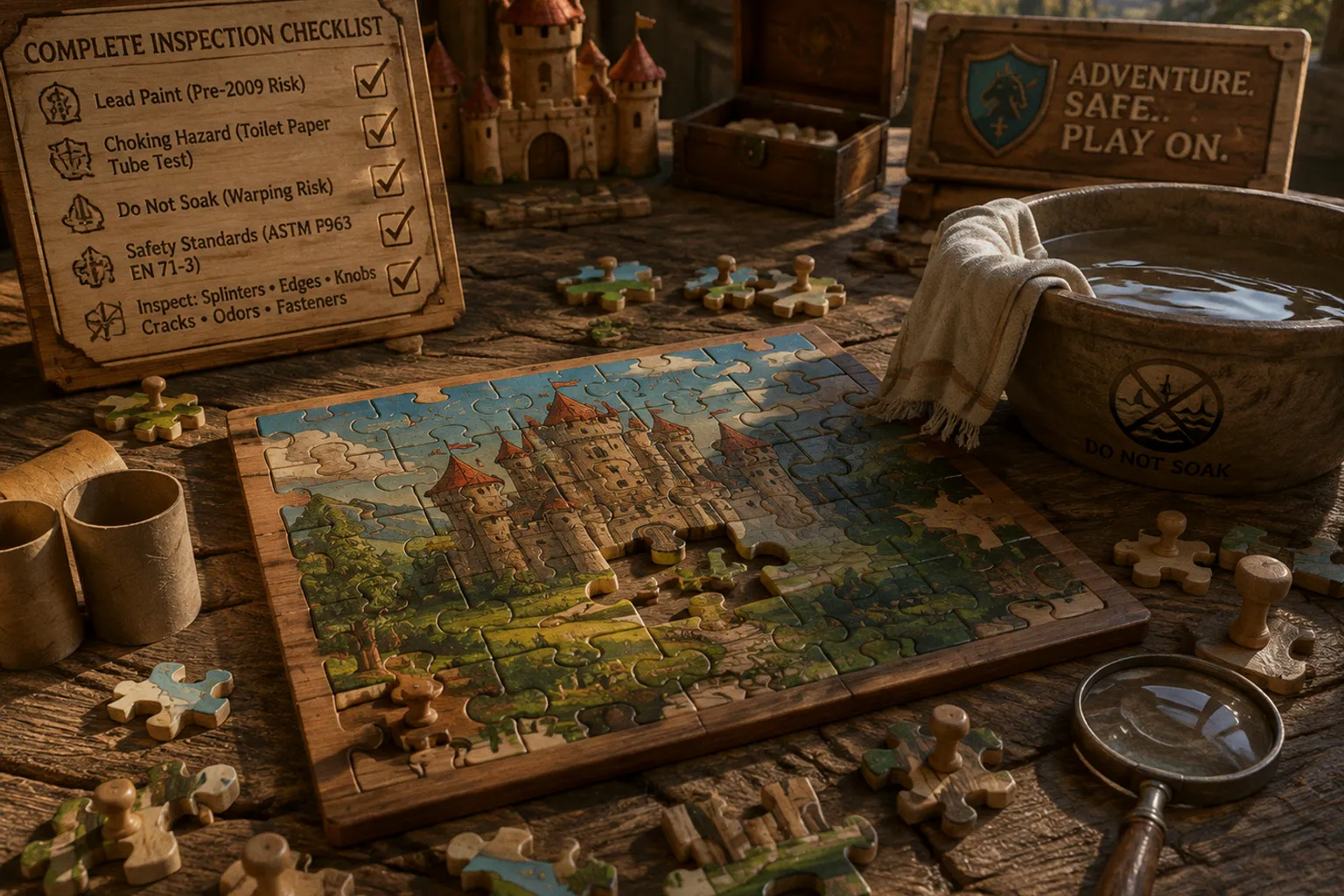
That familiar play pattern is useful information: secondhand wooden puzzles need more than a quick glance before they enter a playroom.
A careful secondhand wooden puzzles inspection checklist should cover five things in order: the puzzle’s structure, its surface finish, the completeness and size of its pieces, its cleanliness, and the age of the toy. A puzzle can look charming and sturdy while still having a loose peg, a hidden splinter, flaking paint, or a small detachable part that is not suitable for a young child.
The aim is not to reject every older toy. Many solid wooden puzzles have been enjoyed safely for years. The aim is to slow down the handover between finding the puzzle and placing it in a child’s hands.
Start with the child, not the puzzle
Before inspecting the toy itself, think about the child who will use it.
A puzzle with large, chunky pieces may be a comfortable choice for a toddler who is still developing grasp strength and visual-motor coordination. A more delicate vintage wooden jigsaw puzzle may be better kept for an older child who can handle thin pieces without bending, chewing, or throwing them. The same puzzle can be appropriate for one child and unsuitable for another, depending on mouthing habits, impulse control, and the way they usually play.
This is especially relevant when inspecting secondhand puzzles for toddlers. Children under three commonly explore unfamiliar objects through their mouths. That makes the size and attachment of every piece part of the safety assessment, not a minor detail.
Look at the play demands as well as the physical condition:
- Does the puzzle have large knobs or pegs that a child can grasp without forcing their fingers into narrow gaps?
- Are the pieces thick enough to resist easy bending?
- Could a child pull off an attached shape, wheel, peg, or decorative element?
- Does the puzzle invite calm placement and matching, or is it likely to be carried, shaken, or chewed?
- Will an adult be nearby during early play?
There is no need to rely on a rigid age label alone. A label may be missing, outdated, or inconsistent with the child in front of you. What matters is the combination of design, condition, and the child’s current way of exploring.
A secondhand puzzle is ready for play only when its condition matches the child’s real behaviour—not the age printed on a faded box.
1. Check the wooden structure from every side
A used wooden jigsaw puzzle safety check begins with the frame and pieces outside the picture surface. Hold each component in good light and run a fingertip slowly along the edges. The inspection should be tactile as well as visual: small splinters and lifted fibres are often easier to feel than to see.
Examine the frame
A frame should sit flat and feel stable when you gently press at its corners. Look for:
- Cracks running through the frame or across a corner joint
- Gaps where glued sections have begun to separate
- Warping that prevents the frame from lying flat
- Raised or sharp edges around the inner puzzle opening
- Recessed fasteners that have become exposed
- Areas that feel soft, swollen, or unusually brittle
A small surface mark is not automatically a problem. The question is whether the damage changes the way the puzzle behaves. A frame that rocks, flexes, or has a sharp split can catch skin and may continue to deteriorate with handling.
For layered wooden puzzles, inspect the points where one layer is bonded to another. Children often test these edges with fingernails, and loose layers can become tempting places to pick. If a section is lifting, do not treat household glue as an instant repair. A repair may alter the fit of the pieces, leave an accessible residue, or create a new rough edge.
Inspect every piece separately
Spread the pieces out rather than inspecting them in a stack. Check the front, back, sides, and any cut-outs.
Pay attention to:
- Hairline cracks around narrow puzzle connections
- Splits that run through a peg or knob
- Sharp corners created by chipped wood
- Raised fibres along the cut edge
- Pieces that have been chewed or heavily worn
- Deformation that makes a piece buckle or sit above the frame
- Glue marks or detached decorative components
Thin pointed sections deserve extra attention. They can break during ordinary play and leave a small fragment behind. A piece does not need to be visibly broken to be unsafe; a weakened section may snap when a child twists it.
If the puzzle includes peg knobs, lift and gently rotate each one. A peg should remain firmly attached without rocking, clicking, or turning independently of the piece. Do not hand a puzzle to a child if a knob feels loose, even if it has not come off yet.
Use touch as a practical screening tool
A useful tactile pass is slow and deliberate:
1. Place the puzzle pieces on a clean, well-lit surface.
2. Press gently along each edge with a fingertip.
3. Feel for sharp points, rough fibres, lifting layers, and unusual softness.
4. Turn the piece over and repeat the check.
5. Flex only very gently; do not force a piece to test it.
6. Set aside anything that produces a splinter-like sensation or shows movement at a joint.
This is not a laboratory test, but it reflects the way young children encounter wooden toys. Hands, lips, and teeth notice the surface long before a parent spots a tiny raised fibre across the room.
2. Look closely at paint, varnish, and smell
Older painted toys require a more careful surface inspection than unpainted wooden puzzles. Paint can chip, crack, powder, or lift at the edges. Varnish may become sticky, cloudy, or worn through in places that receive repeated handling.
Why pre-2009 painted toys need extra caution
Under the Consumer Product Safety Improvement Act of 2008, the modern federal lead-paint limit for children’s products is 90 parts per million. The standard was implemented in 2009. Painted toys made before that period may not meet the modern limit, particularly if the finish is old, damaged, or unknown.
This does not mean every pre-2009 wooden puzzle is dangerous. It does mean that an older painted puzzle should not be treated as automatically safe because the paint looks attractive or because the toy has survived for decades.
Inspect for:
- Flaking or peeling paint
- Powdery residue on fingers
- Cracks where the finish lifts from the wood
- Bare patches on frequently handled edges
- Bubbling or blistering
- A strong chemical odour
- Paint transferred onto a cloth during a gentle surface wipe
If the finish is visibly deteriorating, keep the puzzle away from children. Repainting at home does not reliably resolve the underlying question of what is beneath the new layer, and sanding an old finish can spread contaminated dust.
Home lead test kits should not be treated as a perfect answer for vintage varnishes and painted wooden surfaces. Their accuracy can vary by product, coating, colour, and surface condition. When the finish is old, damaged, or uncertain, the safest practical decision may be not to use the puzzle for children—particularly children who mouth objects.
Consider the standard, not just the age
If a manufacturer, box, or product record identifies a safety standard, note it as part of the puzzle’s history. Common standards associated with wooden toys include:
- ASTM F963 in the United States
- EN 71, including DIN EN 71-3 for limits relating to heavy-metal migration, in the European Union
- AS/NZS ISO 8124 in Australia and New Zealand
A visible standards mark is useful context, but it does not replace a physical inspection. A puzzle may have been safe when sold and later become damaged, contaminated, or incomplete. Surface condition still matters.
3. Confirm that the puzzle is complete
Missing pieces are frustrating, but incompleteness also changes how a puzzle is used. A child may try to force an unrelated piece into an open space, become upset when the image cannot be finished, or search through packaging and loose parts that should not be accessible.
For a secondhand puzzle, compare the pieces with the original image if one is available. If there is no picture, arrange the pieces in the frame and look for gaps, mismatched cuts, or areas that appear to have been replaced.
Check for:
- Missing wooden pieces
- Repaired pieces with visible breaks
- Substituted pieces from another puzzle
- Loose knobs or handles that no longer match their pieces
- Small accessory parts that belong to the original game
- A lid, tray, or storage insert that has broken into fragments
A puzzle does not have to be complete to have value. In classroom practice, an incomplete set can sometimes become a sorting or matching resource for supervised older children. But it should not be presented as a complete puzzle, and loose fragments should be removed from play.
Watch for hidden detachable parts
Some wooden puzzles include movable features, such as knobs, pegs, small wheels, layered shapes, or attached objects. Test each component gently. The goal is not to pull parts apart but to see whether normal handling produces movement.
A detached peg or small knob may become a choking hazard. The same applies to a thin wooden shape that breaks away from a larger piece. Place every questionable component beside the puzzle during the inspection instead of assuming it is harmless because it was originally designed as part of the toy.
4. Apply the small-parts test for young children
The toilet paper tube test is a simple household screening method for small puzzle pieces and detachable knobs. If a loose part fits completely inside the tube, it should not be given to a child under three.
This test is a proxy for the formal CPSC small-parts cylinder described in 16 CFR 1501. It is not a substitute for every aspect of professional testing, but it is a useful first screen when evaluating thrifted wooden puzzle safety.
To use it:
1. Remove every loose piece, knob, peg, and detachable decoration.
2. Use a standard empty toilet paper tube.
3. Place each part into the tube without compressing or forcing it.
4. If the part fits entirely inside, keep it away from children under three.
5. Repeat the test after washing or handling the puzzle, since damaged parts can break into smaller pieces.
Do not test only the largest or most obvious pieces. Young children may be drawn to a small corner section, a loose knob, or a broken fragment rather than the main puzzle shape.
The tube test also needs to be considered alongside behaviour. A large piece may not fit inside the tube but could still present a risk if it has a detachable component, a sharp broken edge, or a coating that is flaking into the mouth.
5. Clean the puzzle without damaging it
A vintage wooden puzzle cleaning checklist should begin with the material’s limits. Wood is porous, and many puzzles rely on glued layers, printed surfaces, or fitted joints. Soaking can cause the grain to rise, weaken adhesive and glue joints, and permanently warp both pieces and frames.
Use a gentle surface-cleaning method
For most solid wooden puzzles, begin with:
- A soft, dry brush or cloth to remove loose dust
- A barely damp cloth for marks on sealed surfaces
- A separate dry cloth to remove remaining moisture
- A well-ventilated place where the pieces can dry fully
- Clean hands while handling the puzzle afterward
Avoid submerging or soaking the puzzle. Do not place it in a sink of diluted bleach or water. Immersion can damage the wood and adhesive even when the intention is sanitisation.
If the puzzle has unsealed wood, faded paint, lifting paper, or a cracked finish, use as little moisture as possible. Test a small, inconspicuous area first. Stop if colour transfers to the cloth, the surface becomes tacky, or the wood begins to swell.
Treat mould and strong odours as warning signs
A musty smell, visible mould, soft patches, or dark growth in cracks should not be brushed aside as ordinary secondhand dust. Porous materials can hold contamination below the visible surface, and aggressive cleaning may spread it or damage the toy without resolving the problem.
If a puzzle has persistent mould or a strong chemical odour after airing, it is not a good candidate for children’s play. This is one of the cases where the sentimental appeal of an old toy should not outweigh the condition of the material.
Keep cleaning separate from safety repair
Cleaning removes surface dirt; it does not repair a loose peg, stabilise a cracked frame, or make an unknown paint finish safe. Complete the structural and surface inspection before cleaning, then repeat a quick check afterward. Moisture, rubbing, and handling can reveal lifted fibres or loosened labels that were not obvious at first.
A practical inspection table
The following sequence keeps the assessment focused and prevents a bright picture or appealing brand from distracting from a physical problem.
| Area to inspect | What to look for | Practical decision |
|---|---|---|
| Frame | Cracks, warping, gaps, sharp inner edges, exposed fasteners | Set aside if the frame flexes, rocks, or can catch skin |
| Puzzle pieces | Splinters, broken corners, lifted layers, unusual softness | Remove damaged pieces from children’s play |
| Pegs and knobs | Rocking, twisting, cracking, loose glue joints | Do not use for young children if any attachment moves |
| Paint and finish | Flaking, powder, bubbling, peeling, strong chemical odour | Avoid use when the coating is deteriorating or unknown |
| Completeness | Missing, substituted, or broken pieces | Use only with an honest understanding of what is missing |
| Small parts | Pieces or fragments that fit inside a toilet paper tube | Keep away from children under three |
| Cleanliness | Dust, mould, musty smell, sticky residue | Clean gently; discard if contamination persists |
| Documentation | Manufacturer information or safety-standard marking | Useful context, but never a replacement for inspection |
Common mistakes when buying used wooden puzzles
Even careful adults can make the same few errors when a puzzle looks well made.
Mistake 1: Judging condition from the picture side
A colourful image often receives most of the attention. The back, edges, and underside are where structural problems tend to hide. Always turn the puzzle over and inspect the parts individually.
Mistake 2: Assuming solid wood means risk-free
Solid wood can still splinter, crack, retain an old coating, or carry a loose component. The material is not the entire safety story. Construction and condition matter just as much.
Mistake 3: Testing only for missing pieces
Completeness is satisfying, but it is not the same as safety. A complete puzzle with a loose peg or flaking paint needs more caution than an incomplete but structurally sound unpainted puzzle.
Mistake 4: Washing the puzzle as if it were plastic
Water can enter seams, raise the grain, weaken glue, and distort fitted pieces. Wooden puzzles need controlled surface cleaning rather than immersion.
Mistake 5: Relying on an age label without observing the child
A label may not account for mouthing, chewing, throwing, or a child’s current ability to manage small parts. Watch how the child plays and choose the level of supervision accordingly.
Mistake 6: Repairing before understanding the damage
A quick application of glue or paint may conceal a problem without making it safe. If a piece is cracked, a knob is loose, or the finish is peeling, first decide whether the puzzle belongs in children’s play at all.
Turn inspection into a play-based decision
Once the puzzle has passed the physical checks, introduce it gradually. Sit nearby and observe how the child handles it. Some children begin by matching colours; others rotate pieces repeatedly, tap them against the table, or ask an adult to complete the difficult section. These actions show where scaffolding will help.
You can extend the play value without rushing to solve the puzzle:
- Name the textures and shapes as the child handles them.
- Pause before offering a piece so the child has time to rotate and compare it.
- Use co-play to model turning a piece, rather than taking over the whole task.
- Invite the child to sort pieces by colour, size, or image detail before fitting them.
- Use simple emotional-regulation language when frustration rises: the puzzle can be paused, pieces can be gathered, and the child can return later.
- For older children, ask what visual clue helped a piece fit instead of praising speed alone.
- Keep loose parts in a labelled container so a missing piece is noticed promptly.
The best puzzles support a child’s sense of agency. A wooden jigsaw puzzle offers tactile feedback through resistance, weight, and the small satisfying change when a piece settles into place. Those experiences help children build spatial reasoning while also practising persistence and flexible problem-solving.
For group play, introduce one puzzle at a time and watch the social pattern. A cooperative arrangement can emerge naturally when one child notices colours, another finds edge pieces, and a third tests the fit. If the puzzle creates repeated grabbing or conflict, offer clear roles: one child sorts, one searches, and one places. The toy becomes a setting for communication rather than a contest over possession.
The final decision: keep, adapt, or pass it on
After inspection and cleaning, place the puzzle into one of three practical categories.
Keep for regular play when the frame and pieces are stable, the finish is intact, no small-part concern is present for the intended child, and the puzzle can be cleaned without damaging it.
Adapt for supervised or older-child use when the puzzle is structurally sound but incomplete, more delicate than a toddler’s typical play style, or better suited to a table activity with an adult nearby. Remove questionable loose parts and be clear about what the puzzle can and cannot safely do.
Pass it on or discard it when there are splinters, structural cracks, loose knobs, persistent mould, strong chemical odours, deteriorating paint, or uncertain small fragments that cannot be confidently assessed. A decorative old puzzle may still be attractive on a shelf, but it does not need to become a child’s toy.
Secondhand wooden puzzles can be thoughtful, durable additions to a playroom. They can also carry the wear of many years in ways that are easy to miss at first glance. A calm inspection gives adults the information they need: what is safe to offer, what requires supervision, and what has reached the end of its useful life.
The most reliable checklist is simple in principle: feel the wood, test the attachments, inspect the finish, measure the small parts, clean gently, and watch the child play. That small pause protects the hands, mouths, attention, and confidence of the children the puzzle was meant to serve.