Toddler Board Game Setup: What to Check Before Play
A toddler may be ready to sit beside you for a simple game long before they are ready to follow a full set of competitive rules.
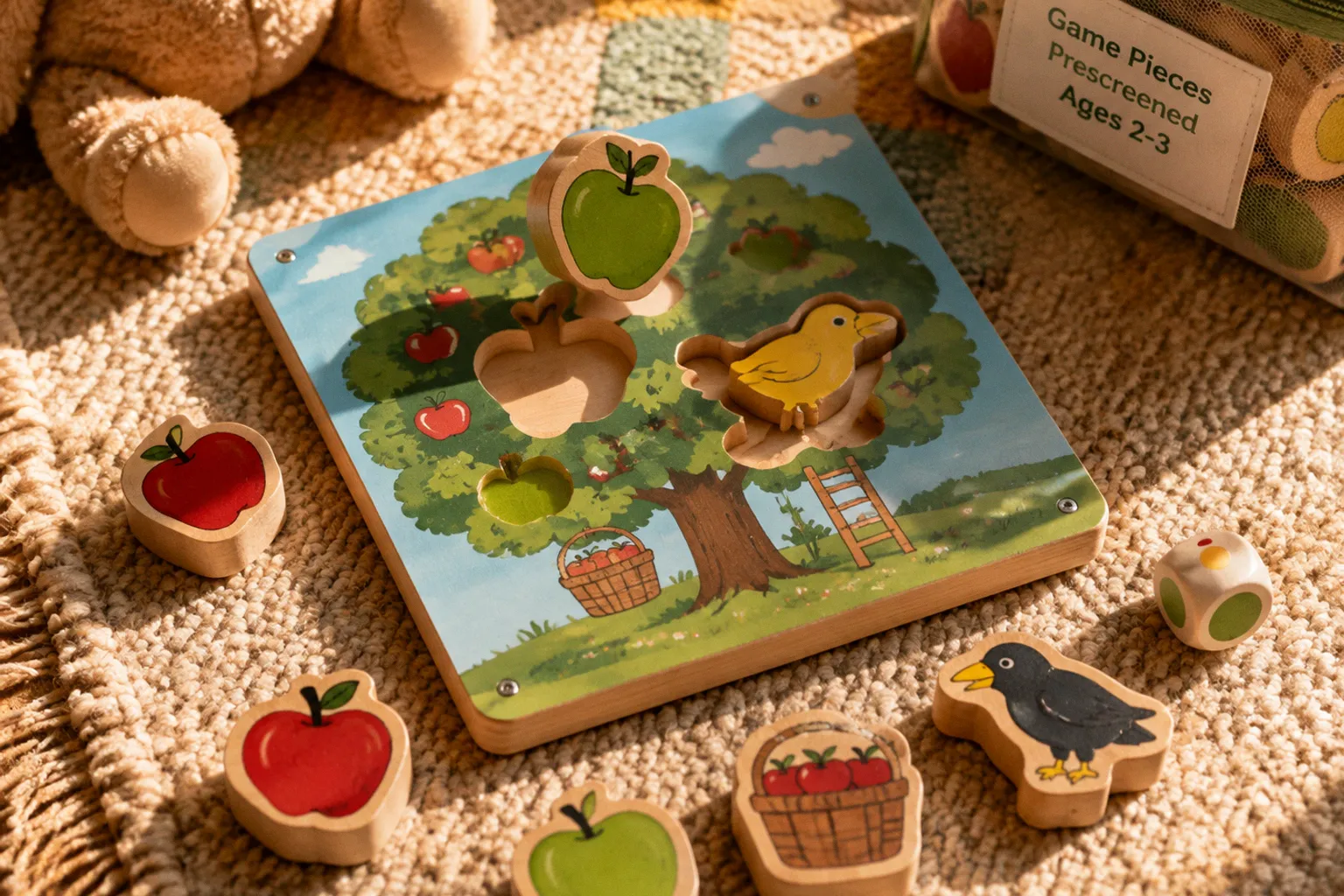
They may match two colours beautifully, wait for a turn with support, and still sweep every piece from the table when the game does not move quickly enough. That is not a failure of readiness. It is useful information about how the game needs to be introduced.
A good toddler board game readiness checklist begins with safety, but it does not end there. The pieces must be physically suitable, the play surface should reduce distractions, and the rules need to match the child’s current capacity for attention, visual matching, movement, turn-taking, and emotional regulation. For children around 2 to 3 years old, the first successful game session is usually short, highly supported, and built around one clear action rather than a complete rulebook.
The aim is not to make a toddler play like an older child. The aim is to create a tabletop experience where they can explore, communicate, wait briefly, make a choice, and enjoy the feeling of doing something together.
Start with the safety check
Before introducing any board game to toddlers, look at the physical components as carefully as you would inspect a new sensory tool or classroom resource. A game marketed for young children should still be checked by the adult using it. Packaging is helpful, but it cannot tell you how a particular child will handle the pieces during excited, unsupervised, or exploratory play.
Board games designed for children under 14 should meet recognised toy safety requirements, including ASTM F963 in the United States and EN71 in Europe. These standards address areas such as small parts, sharp edges, mechanical endurance, and potentially harmful chemical properties. In Australia and internationally, testing for toys intended for children under 36 months can include drop, torque, tension, and small-parts testing. One referenced physical-property test includes a 140 cm drop test.
Those standards provide an important baseline. They do not replace active supervision, especially when a toddler still mouths objects, throws pieces, or enjoys taking things apart.
Use this first-pass safety screen
Before the game reaches the table, check:
- Small components: Look closely at tokens, counters, pegs, miniature figures, card sleeves, spinners, and removable fasteners. A box marked 3+ is not automatically suitable for an unsupervised child under 3.
- Loose or detachable parts: Pull gently on pieces that are attached to boards, wheels, handles, or spinners. If something feels loose, set it aside until you can assess whether it is safe.
- Sharp edges and splinters: Run your fingers along wooden pieces and board corners. Tactile feedback is valuable in early play, but rough edges or cracked surfaces are not.
- Paint and surface condition: Check for flaking, peeling, strong chemical odours, or damaged coatings. Choose durable, non-toxic materials from a reputable manufacturer.
- Breakable mechanisms: Spinners, pop-up elements, clips, and moving parts should withstand ordinary toddler handling. If a mechanism jams or releases a small component, remove it from play.
- Mouth contact: If the child still mouths toys, avoid pieces that are difficult to clean or contain parts that could break away.
- Storage: Keep small components in a secure, clearly organised container when the game is not in use. A transparent zipper pouch can make the pieces easy for an adult to locate while reducing loose parts around the play area.
Safety is also about the way the game is presented. Put out only the pieces needed for the current activity. A full box tipped onto the floor can turn a calm matching game into a fast-moving sorting and grabbing session, with components travelling into mouths, under furniture, or into the hands of a younger sibling.
A safe game setup is not the one with the most pieces available. It is the one where the adult can see, reach, and understand every piece in use.
Separate physical readiness from game readiness
Toddlers often show partial readiness. A child may be able to match colours but not wait through another player’s turn. They may understand that a piece belongs on the board but become upset when the adult moves first. They may enjoy rolling a large die but have no interest in counting the dots.
This is why rigid age-gating can be unhelpful. The better question is: Which parts of this game can the child participate in successfully today?
For an early tabletop experience, look for signs such as:
- The child can remain with one activity for a short period, even with an adult nearby.
- They show interest in matching colours, pictures, shapes, or familiar objects.
- They can follow one simple instruction at a time.
- They can tolerate a brief pause while another person acts.
- They can hand an object to an adult or place it in a particular location with support.
- They are beginning to use words, gestures, or facial expressions to show choice, frustration, excitement, or uncertainty.
- They can recover from a small disappointment when an adult offers calm co-regulation.
None of these signs needs to be perfect. A toddler may take turns for two rounds and then lose interest. That still counts as useful practice. Readiness develops through repeated, supported experiences rather than appearing all at once.
What to look for in the game itself
For a first game, the most accessible features are usually:
| Game feature | Why it helps | What the adult may need to do |
|---|---|---|
| Large, easy-to-grip pieces | Supports hand strength, grasping, and tactile exploration | Offer one piece at a time and watch for mouthing |
| Colour or picture matching | Gives the child a visible way to connect an action with a result | Name the colour or image without turning it into a test |
| Very short turns | Makes waiting more manageable | Use a predictable phrase such as “My turn, then your turn” |
| Cooperative goal | Reduces the pressure of winning and losing | Celebrate shared progress rather than speed |
| Simple movement prompt | Adds whole-body engagement to tabletop play | Demonstrate the action and accept an adapted version |
| Few components | Lowers visual and organisational load | Keep extra cards, tokens, and rules out of sight |
| No reading requirement | Keeps the focus on interaction and problem-solving | Use your own short verbal prompts |
Simple games for toddlers often replace standard dice, written instructions, or complex scoring with oversized pieces, colour matching, picture recognition, or gross-motor prompts. These design choices are not merely decorative. They reduce the number of steps the child must hold in mind.
Prepare the play space before bringing out the board
The physical environment can either scaffold attention or quietly work against it. A busy table, television in the background, nearby toys, and a younger child reaching for the components all increase the amount of emotional and cognitive work required from a toddler.
For a first family game night preparation, keep the setup deliberately plain:
1. Choose a stable surface. A low table or clear section of the floor can work well, as long as the board will not slide easily.
2. Remove competing materials. Put away construction toys, noisy electronic items, and unrelated puzzles before the game begins.
3. Use a small number of components. Set aside complex cards or decorative pieces that are not needed for the first version of play.
4. Seat the child close to the adult. Physical proximity makes it easier to offer gentle hand-over-hand support, notice rising frustration, and keep pieces within view.
5. Place the board where everyone can reach it. If the child cannot access the relevant area, they may spend more energy leaning, grabbing, or pulling the board closer.
6. Keep the session short. Stop while the child is still managing reasonably well rather than waiting for complete dysregulation.
7. Have a calm ending ready. A simple tidy-up routine, a drink of water, or a quiet sensory activity can help the transition away from the game.
Low distraction does not mean silent or formal. Toddlers often benefit from a warm, steady stream of language. Describe what is happening: “You found the red piece,” “The bear is moving to the tree,” or “I am waiting while you choose.” This kind of narration supports vocabulary and joint attention without turning play into an interrogation.
Avoid asking a string of questions such as “What colour is this? How many dots? Whose turn is it?” A child who understands the game may still stop responding when too many demands arrive together. Offer language as an invitation, not a performance requirement.
Modify the first version of the game
The first play session does not need to use the complete rule set. Thoughtful modification is often the difference between a child experiencing a game as inviting or overwhelming.
Start by identifying the game’s central action. Is it matching, placing, moving, remembering, choosing, or cooperating toward a shared goal? Build the first session around that action and temporarily remove anything that competes with it.
Useful modifications for toddlers
- Remove small tokens, extra cards, and decorative elements that do not affect the main play.
- Use only two or three colours or picture types instead of the entire set.
- Replace a standard die with a colour die, a large soft die, or an adult-selected movement.
- Let the child choose between two pieces rather than asking them to choose from the full supply.
- Begin with open matching before adding turn-taking.
- Allow the child to move the adult’s piece as well as their own.
- Keep cards face-up when memory rules would otherwise create unnecessary difficulty.
- Use a cooperative aim, such as filling a shared board or collecting objects before they disappear.
- Stop after a few successful turns and return to the same game another day.
- If the child becomes distressed, pause the rules and return to sensory exploration: holding a large piece, sorting colours, or placing objects on the board.
Modification is not cheating. It is scaffolding. In an early years setting, we routinely adjust the number of steps, the size of the materials, and the amount of adult support so that a child can participate meaningfully. Board games deserve the same thoughtful approach.
A simple progression for introducing board games to toddlers
You can build the experience in stages rather than expecting a complete game immediately.
Stage one: Explore the components.
Let the child touch, turn, stack, sort, and name the pieces. Show how the board opens and where the pieces can go. At this point, there may be no winner, no turns, and no need to complete the game.
Stage two: Practise one action.
Invite the child to match a piece to a colour or picture, place an object in a marked space, or move one large token along a short path. Repeat the same action several times so the child can predict what happens next.
Stage three: Add a supported turn.
Use a clear rhythm: adult turn, child turn. Keep the language consistent. If waiting is difficult, make the adult turn very brief and give the child a visible object to hold while they wait.
Stage four: Introduce a shared goal.
Work together to complete a simple task. Cooperative board game setup for kids is particularly useful when winning and losing are still emotionally intense. The adult can model flexible thinking by calmly responding when an outcome is unexpected.
Stage five: Add one new rule.
Only after the child is comfortable with the basic action should you introduce an additional step, such as counting spaces, remembering a card, or choosing between two pathways.
This gradual progression gives the child repeated opportunities to experience competence. That feeling matters. A toddler who learns that tabletop play is manageable and social is more likely to return to it with curiosity.
Support turn-taking and emotional regulation
Turn-taking is one of the most valuable reasons to introduce simple board games, but it is also one of the hardest skills for many toddlers. Waiting requires impulse control, attention, memory, and trust that their opportunity will come. Those abilities are still developing.
Make the turn structure visible and predictable. Point to the person who is acting. Use a consistent phrase. Pass a large object back and forth if that helps mark the rhythm. Some children benefit from holding a small “waiting piece” or placing their hands on their knees while the adult takes a turn. Others need the adult’s turn reduced to one quick action.
When a child reaches for the pieces during your turn, avoid framing the behaviour as naughty or unfair. Their body may be communicating that the waiting period is too long. Shorten your action, narrate what will happen next, and offer a concrete cue: “I am moving one piece. Then you choose.”
Winning and losing can be introduced gently, but there is no developmental prize for making a two-year-old endure a competitive outcome before they are ready. If the child becomes upset when the adult succeeds, shift to a cooperative version. The game can still teach matching, sequencing, planning, and communication without making the child practise a loss they cannot yet regulate.
Useful adult language includes:
- “We are working on this together.”
- “That turn did not go the way you hoped. I am here.”
- “You can choose again when it is your turn.”
- “The piece fell off. We can put it back.”
- “Would you like help, or would you like to try?”
- “Let’s make the next turn smaller.”
The adult’s response is part of the game environment. Calm co-regulation helps a child notice that frustration is temporary and that mistakes do not end the activity.
Watch for the difference between challenge and overload
A little difficulty can invite concentration. Too much difficulty often looks like silliness, grabbing, wandering away, throwing pieces, or suddenly refusing an activity the child enjoyed a moment earlier.
Before assuming the child is being uncooperative, look at the demands of the game:
- Are there too many pieces on the table?
- Does the child need to remember several rules at once?
- Is the waiting time longer than their current attention span?
- Are the components hard to grasp?
- Is the board visually crowded?
- Does the game require counting when the child is more comfortable with matching?
- Has the session continued after the child showed early signs of fatigue?
- Is the adult correcting every move instead of allowing experimentation?
Overload can be reduced by changing the task, not by repeating the instruction more firmly. Remove a rule. Clear half the board. Offer a choice between two pieces. Move closer. Add a movement break. Or finish the game without insisting that every component returns to its original position.
A successful session may last only a few minutes. It may include one matching turn, a short period of sorting, and a cheerful tidy-up. That is still tabletop play readiness in progress.
The best early game is not the one a child completes independently. It is the one that gives them a manageable reason to return.
Common setup mistakes to avoid
Even well-designed educational board games can become difficult when the adult presentation adds too much complexity. These are the problems I most often see in early play environments.
Bringing out the whole box
A large pile of pieces creates visual noise and invites grabbing. Prepare a small tray or pouch with only the components required for the simplified version.
Explaining all the rules first
Toddlers learn through action and repetition. Demonstrate one turn, then let the child try. A long verbal explanation is unlikely to be retained, particularly when the pieces are already within reach.
Correcting every move
If the child places a piece in the wrong space, pause before correcting. Ask whether the move is part of exploration or whether the child genuinely needs help. Too much correction can shift the emotional tone from shared play to testing.
Treating the age label as a guarantee
A recommended age range is a starting point, not a readiness assessment. Consider the child’s fine-motor control, mouthing habits, attention, communication, and ability to manage brief waiting.
Using competition too early
Competitive rules can be motivating for older preschoolers, but many toddlers engage more deeply when the adult shares the goal. Cooperative play also gives the adult more opportunities to model language, flexible thinking, and emotional recovery.
Continuing after regulation has gone
Once a child is throwing pieces, crying intensely, or leaving repeatedly, the useful learning may already be over. End warmly, keep the language simple, and try a shorter version another time.
Storing pieces without a system
Loose game parts quickly become a practical problem. A labelled transparent pouch, divided container, or dedicated shelf helps adults reset the activity without frustration. It also makes it easier to remove questionable or overly complex components before the next session.
Extending the play beyond the board
A board game should not be the only place where the underlying skills appear. Once you know what the child is practising, you can carry the same ideas into everyday play.
For colour matching, sort socks, lids, or large craft materials. For turn-taking, roll a large soft ball back and forth or take turns adding blocks to a tower. For memory, place two pairs of familiar objects face-up before gradually hiding them. For spatial reasoning, use chunky wooden puzzles, simple shape sorters, or a small collection of blocks to recreate a short model.
These extensions help the child meet the same developmental ideas in different sensory contexts. A child who struggles to wait during a board game may find the rhythm easier when taking turns pushing a car down a ramp. A child who finds a printed board confusing may understand matching more clearly with real objects first.
Keep the adult role responsive. Offer a little support, observe what the child can do, and then step back enough for them to make a discovery. This is the balance between scaffolding and taking over.
A practical toddler board game readiness checklist can therefore be reduced to five questions:
1. Are the components physically safe, durable, and appropriate for the child’s current handling habits?
2. Can the game’s main action be understood without reading or holding several rules in mind?
3. Does the setup allow the child to see, reach, and participate?
4. Can the adult adapt the game without making the child feel tested?
5. Is there a shared, calm way to finish before frustration takes over?
If the answer to one question is no, the game may still be useful. It may simply belong on the shelf for now, or it may need a smaller, simpler first version.
The strongest first game experiences are built from ordinary moments: matching a wooden piece, waiting for a hand to pass the turn, finding a place on the board, and smiling when the shared goal is reached. With safe components, thoughtful modification, and an adult who notices the child’s signals, tabletop play becomes more than an activity to complete. It becomes a gentle rehearsal for communication, flexible thinking, motor planning, and emotional regulation—one manageable turn at a time.