Wooden Tangram Puzzles: Step-by-Step Guide for Kids
A good wooden tangram does not announce its quality with a complicated box or a long list of developmental promises. You notice it when you pick up the pieces.
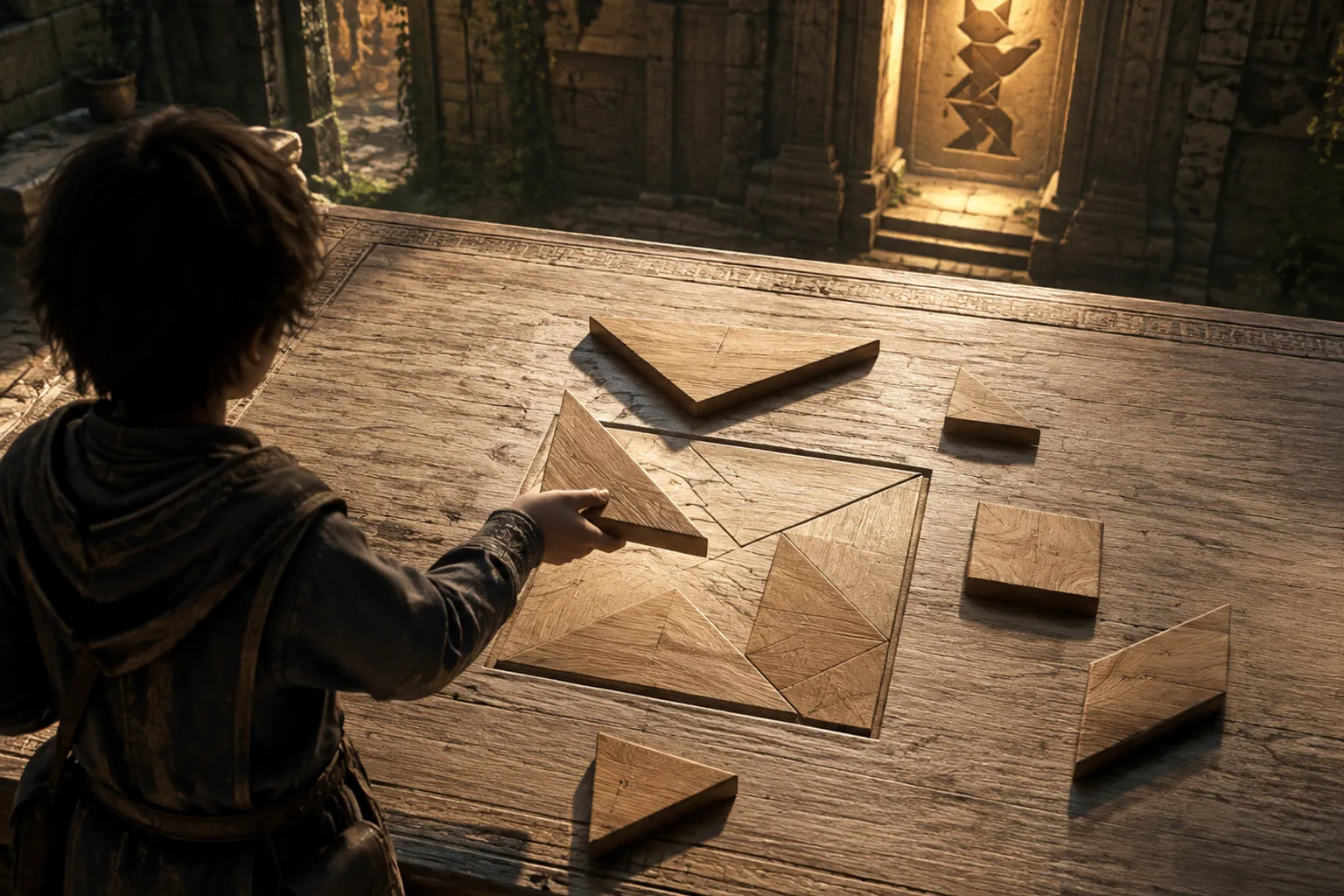
They have enough weight to stay put on the table, edges that do not catch on the skin, and a surface that feels like wood rather than a thin coating hiding rough plywood.
That physical confidence matters because a tangram is handled constantly. Children turn pieces over, slide them across the table, press them against one another, and sometimes test them in ways no adult would have planned. The material is not separate from the puzzle experience. It determines whether the child can concentrate on shape, position, and rotation—or gets distracted by pieces that wobble, splinter, or refuse to lie flat.
The familiar seven-piece set is especially effective because it gives children a complete geometric system in a compact form. The same pieces can become a square, a boat, an animal, a person, or an abstract silhouette. Learning the wooden tangram puzzle steps for kids is not about memorizing one answer. It is about discovering how a fixed group of shapes can be rearranged into very different wholes.
The Material Reality Inside a Wooden Tangram Box
Before discussing technique, look at the object itself. A wooden tangram is a manipulative toy, not a decorative plaque, and the construction should support repeated handling.
A well-made set usually has pieces cut from hardwood, plywood, or another stable wood product. The exact material matters less than the execution. The pieces should be flat enough to sit securely on a smooth surface, with edges that are sanded rather than sharp and corners that are cleanly defined. If the cuts are inconsistent, the geometry becomes harder to read: two pieces may appear to be the same size when they are not, or a supposedly straight edge may leave an unwanted gap.
The grain can vary, especially in natural wood, and small differences in color are not a problem. Splits, raised fibers, visible glue failure, or a finish that feels sticky are different matters. Run a fingertip along the edges before offering the set to a young child. That simple inspection will not replace the manufacturer's safety information, but it can reveal obvious problems.
Finish deserves the same practical attention. If a manufacturer describes a coating as non-toxic or water-based, that is useful information, but it is not a reason to assume every product is identical. Look for clear safety information appropriate to children's toys, and consider whether the finish is fully cured and free from a strong lingering odor. A water-based finish may be preferable in some products, but the label alone does not tell you everything about durability or chemical composition. If the manufacturer provides information about relevant testing or compliance, that is more meaningful than a vague promise printed on the front of the box.
Young children may put wooden pieces near their mouths, especially during the first encounters with a new toy. That is one reason age guidance, piece size, smooth edges, and active supervision matter. A tangram is not automatically suitable for every preschooler simply because it is made of wood. The individual pieces need to be large enough for the intended age group, and a child who still routinely mouths objects should use the set only under close adult supervision.
Wood also changes how the puzzle feels in use. Plastic pieces are often lighter and easier to produce with uniform color, while wood gives the child more friction and a clearer tactile response. A piece tends to stay where it is placed instead of skating across the table. That small difference can make rotation and alignment easier for a beginner.
Anatomy of the Seven-Piece Set: Understanding the Tans
A classic tangram contains seven tans: two large triangles, one medium triangle, two small triangles, one square, and one parallelogram. Together, they can be arranged into the original square. That reconstruction is not just a satisfying opening exercise; it is the clearest demonstration that the set is a system of related parts rather than a random collection of wooden shapes.
Some beginner products may use fewer pieces, larger shapes, or simplified activity cards. Those can be useful introductions for very young children. They are not the classic seven-piece tangram, however, and should not be judged by the same expectations. If you want to practise traditional tangram silhouettes, check that the complete set is present.
| Piece | Quantity | Geometric role |
|---|---|---|
| Large triangle | 2 | Creates broad areas and long outer boundaries |
| Medium triangle | 1 | Bridges larger sections and fills medium-sized spaces |
| Small triangle | 2 | Fits narrow corners and smaller triangular gaps |
| Square | 1 | Provides a compact four-sided block with four right angles |
| Parallelogram | 1 | Introduces slanted sides and requires attention to orientation |
The five triangular pieces are isosceles right triangles. Their angles are 45 degrees, 45 degrees, and 90 degrees, although their size and area differ. The square has four right angles. The parallelogram has two acute angles and two obtuse angles—commonly 45 degrees and 135 degrees in a standard tangram—so it is the set's most obvious lesson in orientation.
That distinction is worth making early. The pieces do not all have the same angle properties, and not every corner is a right angle. Children are learning to notice whether a side is horizontal, diagonal, short, or long, but they are also learning that a shape can look different after rotation or reflection without changing its identity.
The two large triangles are congruent: same shape and same size. The two small triangles are also congruent to each other. The medium triangle, square, and parallelogram each have their own role. When a child compares them, the useful question is not merely what each piece is called. Ask what can change when it moves:
- Which pieces have the same size and shape?
- Which pieces can combine to make a square?
- Which pieces have a right angle?
- Which piece has slanted sides that cannot be matched by turning alone?
- What happens when a piece is rotated? What happens when it is flipped?
The classic set can be rebuilt into its original square, but the pieces do not need to be stored that way. In fact, rebuilding the square is best treated as one activity among several. It gives the child a stable reference point before the set is used to construct less familiar forms.
A tangram is a small, tactile argument that a whole can be taken apart and still remain understandable.
Foundational Rules for Successful Dissection Play
Traditional tangram silhouette puzzles are governed by a small group of constraints. They make the task difficult enough to be meaningful without turning it into a guessing game.
For a standard seven-piece silhouette challenge:
1. Use all seven pieces. The familiar target silhouettes are designed around the complete set. Other tangram activities may invite children to work with only a few pieces, but that is a different exercise.
2. Keep every piece flat. Pieces should rest on the same playing surface rather than being stacked or propped on one another. This keeps the construction two-dimensional and makes the boundary easier to inspect.
3. Make the pieces meet. The pieces should form one connected figure. A small gap between two pieces may be acceptable during exploration, but it is not a finished solution if the target requires a continuous shape.
4. Do not overlap pieces. Every part of the set needs its own space inside the silhouette. Overlap can make an arrangement look complete while hiding an incorrect fit.
5. Stay inside the outline. The outer edges should follow the target boundary. A solution can have the correct general idea and still fail because one corner extends beyond the silhouette.
These rules do not need to be delivered as a lecture. A child can learn them by checking the construction. Is there a piece left over? Are two pieces sitting on top of each other? Is there a hole? Does one edge protrude beyond the card? Each question turns a vague sense that something is wrong into a specific geometric observation.
It is also useful to separate two kinds of play. In free construction, the child can stack, combine, invent, and use fewer pieces if that is the point. In a silhouette puzzle, the constraints are part of the challenge. Neither mode is more legitimate. Trouble begins when an adult treats an open-ended design as incorrect or treats a traditional silhouette as solved before the rules have been met.
Scaffolding Techniques for Early Spatial Development
Introducing tangrams to preschoolers works best when the first task is not the hardest one. A printed black silhouette can be visually demanding even for an older child: the outline gives no information about where one piece ends and another begins. For a beginner, that is a large jump from touching and naming shapes to planning an entire seven-piece arrangement.
The progression should move from visible structure to invisible structure.
Begin with matching, not guessing
A pattern card that shows the internal pieces in different colors gives the child more information than a plain silhouette. The child can match the large red triangle to the red area, then turn the piece until its edges align. This is not a shortcut around the real skill. It isolates one skill—orientation—before asking the child to solve orientation, size, position, and overall planning at the same time.
Once the child can complete several colored patterns, use cards that show the piece divisions in one color. After that, introduce a simple outline. The transition may take days or weeks; there is no value in rushing it.
Let the hands learn the scale
Large, chunky pieces are often easier for small hands to manipulate than a compact adult-sized set. The right size depends on the child and on the product, but a piece should be easy to pick up, rotate, and place without being swallowed by the hand. A larger set also makes the geometry easier to see on the table.
Do not assume that a bigger set is automatically safer or better. Check the manufacturer's age guidance and the construction of the individual pieces. Large pieces with poorly finished edges are still poorly finished pieces.
Use the original square as a home base
When the child is overwhelmed, return to the square. Ask them to rebuild it without a card, or provide a partially completed square with one or two pieces already placed. The square gives the child a known boundary and demonstrates how large and small pieces relate.
From there, try simple transformations:
- Make a square from the two large triangles.
- Replace that pair with combinations of smaller pieces.
- Build a rectangle or triangle with guidance.
- Change one arrangement by moving only one piece.
- Create a design and ask another person to copy it.
These activities develop shape composition without the pressure of finding a single correct animal or figure.
Cover part of a complex silhouette
A detailed silhouette can be divided into manageable regions. Cover the tail of an animal and work on the body, or hide the lower half of a figure while the child explores the head and upper boundary. This is not how the final puzzle is solved, but it helps the child understand that a complex outline can be decomposed into smaller spatial problems.
The adult's role is to offer a useful question rather than place the piece. Try:
- Which edge of the outline is longest?
- Do you need a straight side or a slanted side here?
- Could two small triangles make the same space as a larger piece?
- What have you already ruled out?
- What changes if you turn the piece over?
Avoid correcting every attempt immediately. Children need to see that an incorrect placement can be examined and reversed. If the adult reaches for the pieces too quickly, the child may learn to wait for instructions instead of developing a plan.
Move from concrete clues to memory
At first, it is reasonable to let the child trace the outline, compare a piece to the card, or use a colored model. Later, remove one support at a time. Hide the colored pattern. Show the silhouette briefly, then let the child work from memory. Ask the child to describe the arrangement before touching the pieces.
This is the point at which the wooden tangram shape building guide becomes more than a matching activity. The child is beginning to hold a spatial plan in mind.
The right help does not solve the puzzle for a child. It makes the next useful move visible.
Strategic Approaches to Solving Complex Silhouettes
Once a child is comfortable with simple cards, the silhouette itself becomes the puzzle. There is no single method that solves every design, but a repeatable sequence prevents random shuffling.
1. Read the boundary first
Before moving pieces, inspect the target. Is the outer edge mostly horizontal and vertical, or does it contain several diagonal lines? Are there narrow points, a broad base, or a large central area? The boundary often gives more information than the interior.
A long edge may suggest one of the large triangles. A small pointed corner may require a small triangle. A slanted section may involve the parallelogram, although a triangle can also create a diagonal boundary. The point is not to identify the answer instantly; it is to form a reasoned first hypothesis.
2. Establish the largest areas
Large triangles cover substantial space and often define the outside contour. Placing them early can reduce the number of possible arrangements. This does not mean the largest pieces always belong in the first positions. Some silhouettes hide them in the body or base, and forcing them onto the boundary can create a dead end.
Use the large pieces as structural anchors, then check whether the remaining spaces have plausible dimensions. If the last gap is an awkward shape that no remaining piece can fill, the problem may have started with the wrong anchor.
3. Compare lengths, not just angles
A piece may have the right-looking angle and still be the wrong size. Compare the length of the available boundary with the piece's edge. The two large triangles and the small triangles share angle relationships, but they do not occupy the same amount of space.
This is where children often learn that visual similarity is not enough. Two pointed pieces can have the same general appearance while producing very different gaps. Encourage them to compare the whole outline rather than focus on one attractive corner.
4. Treat the parallelogram as an orientation problem
The parallelogram has two useful faces and can be rotated into several positions. In a standard tangram, a simple rotation may not be enough to produce the required mirror orientation; the piece may need to be flipped over. Some wooden sets are thick enough that turning the piece over changes the visible color or finish, which makes the operation easier to notice.
Do not present flipping as a mysterious trick. Explain that the shape has been reflected, like an image in a mirror. If a slanted edge is correct but the neighboring edge points the wrong way, reflection may be the missing move.
5. Work from corners and interruptions
A clean corner is often more informative than a broad, empty area. Find the target's sharpest point and test which piece can create it without extending beyond the boundary. Then look for interruptions in a long edge: a notch, a change of direction, or a narrow channel.
This approach is especially useful with animal silhouettes, where the head, legs, tail, and ears create distinctive boundary features. Do not assume the visual identity of the animal tells you how to build it. A cat-shaped outline may be solved from the tail inward; a person-shaped outline may be easier from the feet upward.
6. Reverse the last move
When a construction stops making sense, remove the most recently placed piece rather than disturbing everything. Ask what new space has been created. Often the child has not made a completely wrong start; one piece has simply occupied a location that should have remained open.
This habit turns frustration into analysis. A failed attempt contains information about the size, angle, or orientation that does not work.
7. Use hints in a controlled order
If the child is stuck, give one kind of information at a time:
1. Point to a boundary feature.
2. Suggest a piece family—large triangle, small triangle, square, or parallelogram.
3. Suggest rotation or reflection.
4. Show where one piece could begin.
5. Demonstrate only the next move, then return control.
Showing the complete answer too early may produce a short-term success without much learning. A partial hint preserves the important work: comparing possibilities, making a prediction, and revising it.
A beginner tangram puzzle progression should feel demanding but recoverable. If every card requires adult intervention, the cards are too difficult for independent play. If the child solves everything without changing orientation or reconsidering a placement, the set is no longer offering much challenge.
Building Mathematical Intuition Through Geometric Play
Tangrams are valuable because mathematical ideas appear as physical relationships. A child does not have to begin with formal vocabulary to notice that two small triangles can occupy the same area as a square, or that a piece can change direction without changing its shape.
Area and equivalence
The seven pieces come from one square, so their areas are related. Two small triangles can combine to form a square, a larger triangle, or a parallelogram depending on the arrangement. These transformations give children an early experience of equivalence: different-looking shapes can cover the same amount of space.
Later, the adult can introduce language such as half, quarter, larger, smaller, same area, and whole. Keep the explanation tied to the pieces. A fraction becomes more understandable when the child can move the parts and see what has been divided and recombined.
Decomposition and recomposition
A silhouette is a whole that must be decomposed into parts. The reverse activity—starting with pieces and composing a new whole—builds the same idea from the opposite direction. This is one reason tangrams fit naturally into early geometry. The child is not only naming shapes; they are deciding which relationships make a larger form possible.
Ask the child to build a design and then explain it without naming the picture. They might describe a large triangle beside a square, two small triangles at the edge, and a parallelogram turned over. That explanation shifts attention from recognition to structure.
Mental rotation
At first, children rotate pieces physically after every failed attempt. With practice, they begin to predict the result. They may say that a piece needs to turn so its long side faces the edge, or that the parallelogram must be flipped because the slope is reversed.
That movement from hand-based trial to mental prediction is central to tangram puzzles for spatial reasoning. It should not be forced. Give children time to handle the pieces, because physical manipulation is the route through which the mental image becomes reliable.
Symmetry and reflection
Some designs are symmetrical; others are not. A child can build one half of a shape and look for a matching arrangement on the other side. The parallelogram is particularly useful here because it makes reflection visible. Turning a shape is not always the same as mirroring it.
These observations can remain informal for a long time. The aim is not to turn play into a terminology test. The aim is to help the child see that position, direction, and shape are related but not identical properties.
Precision and fine motor control
Sliding a piece into a narrow space requires more than a general understanding of the picture. The child has to control pressure, align an edge, rotate around a point, and stop at the boundary. That work supports hand-eye coordination and careful movement.
It is tempting to list every possible developmental benefit of a wooden puzzle, but the strongest case is more specific. Tangrams give children repeated practice in observing, predicting, testing, and adjusting. Those habits matter beyond geometry, even when the child never describes them in mathematical language.
Choosing and Caring for a Wooden Tangram
The best set is not necessarily the heaviest or most expensive one. Look for a combination of usable geometry and reliable construction.
Useful details include:
- Clearly differentiated pieces, especially when a beginner is learning the set.
- Smooth faces and edges without splinters, sharp corners, or loose surface fibers.
- Pieces that lie flat instead of rocking on the table.
- A storage box or tray that keeps the seven pieces together without forcing them into place.
- Activity cards that move from colored piece-matching to plain silhouettes.
- Age guidance that fits the actual size of the pieces and the child's stage of play.
- Manufacturer information about the wood, finish, and relevant toy-safety testing.
Care is simple but still matters. Keep the pieces dry, wipe them with a slightly damp cloth when needed, and follow the manufacturer's cleaning instructions. Avoid soaking unfinished or lightly finished wood. If the surface becomes rough, cracked, or damaged, stop using the affected piece until it can be assessed. A beautiful wooden toy is not a safer toy once its edges begin to fail.
Storage also affects the life of the set. A child who has to force pieces into a crowded box may damage the corners over time. A tray that shows the square arrangement can help with cleanup, but it should not turn every play session into a demand to restore one correct pattern. The pieces are tools for construction, not ornaments that must remain untouched.
Long-Term Lifecycle: What Happens to the Tangram After the Child Grows Up
Wooden toys can have a longer useful life than disposable plastic toys, but durability is not guaranteed by the word wooden. It depends on the wood product, the quality of the cut, the finish, storage, and how the toy is used. A well-made set may pass from one child to another, but it should be inspected each time it changes hands.
The most sustainable stage of a toy's life is usually continued use. A tangram can move from preschool matching to independent silhouette solving, then into classroom activities, sibling play, or open-ended construction. It can be used by children who are interested in pictures and by children who prefer abstract patterns. That range is more valuable than a claim that the material will disappear harmlessly at the end.
Disposal requires more caution than a simple environmental slogan suggests. Whether a wooden tangram can go into a composting system depends on the wood, adhesives, paint, and finish, as well as local rules. A coated or painted piece should not automatically be composted or turned into garden mulch. Burning painted, glued, or treated wood can release unwanted substances, and household kindling is subject to local safety rules. If the set is still intact, passing it on, donating it, or repurposing it is generally a better first option than disposal.
An unfinished or minimally finished product may have different end-of-life options from a painted plywood set, but the manufacturer and local waste guidance should decide that question. The responsible claim is not that every wooden tangram returns neatly to the soil. It is that a durable, repairable, reusable toy has more chances to stay in service before disposal becomes necessary.
That is the real argument for choosing carefully. The weight, grain, and smooth edges are not proof of sustainability by themselves. They are signs to inspect alongside the finish, construction, safety information, and expected use. A tangram earns its place in a child's room when it can withstand ordinary handling, invite increasingly complex thinking, and remain useful after the first novelty has gone.
The first step is simple: take the seven pieces out and learn what each one can do. Start with the square, move to colored patterns, then introduce silhouettes one boundary at a time. Let the child rotate, flip, fail, and try again. The puzzle becomes more rewarding when the solution is not supplied too quickly—and when the wooden object in their hands is solid enough to support the work.