Montessori Spindle Box Steps for Early Math
A Montessori spindle box is a small wooden material with a very specific job: to connect written numerals with quantities the child can hold, separate, count, and check. It is not simply a tray of dowels divided into numbered sections.
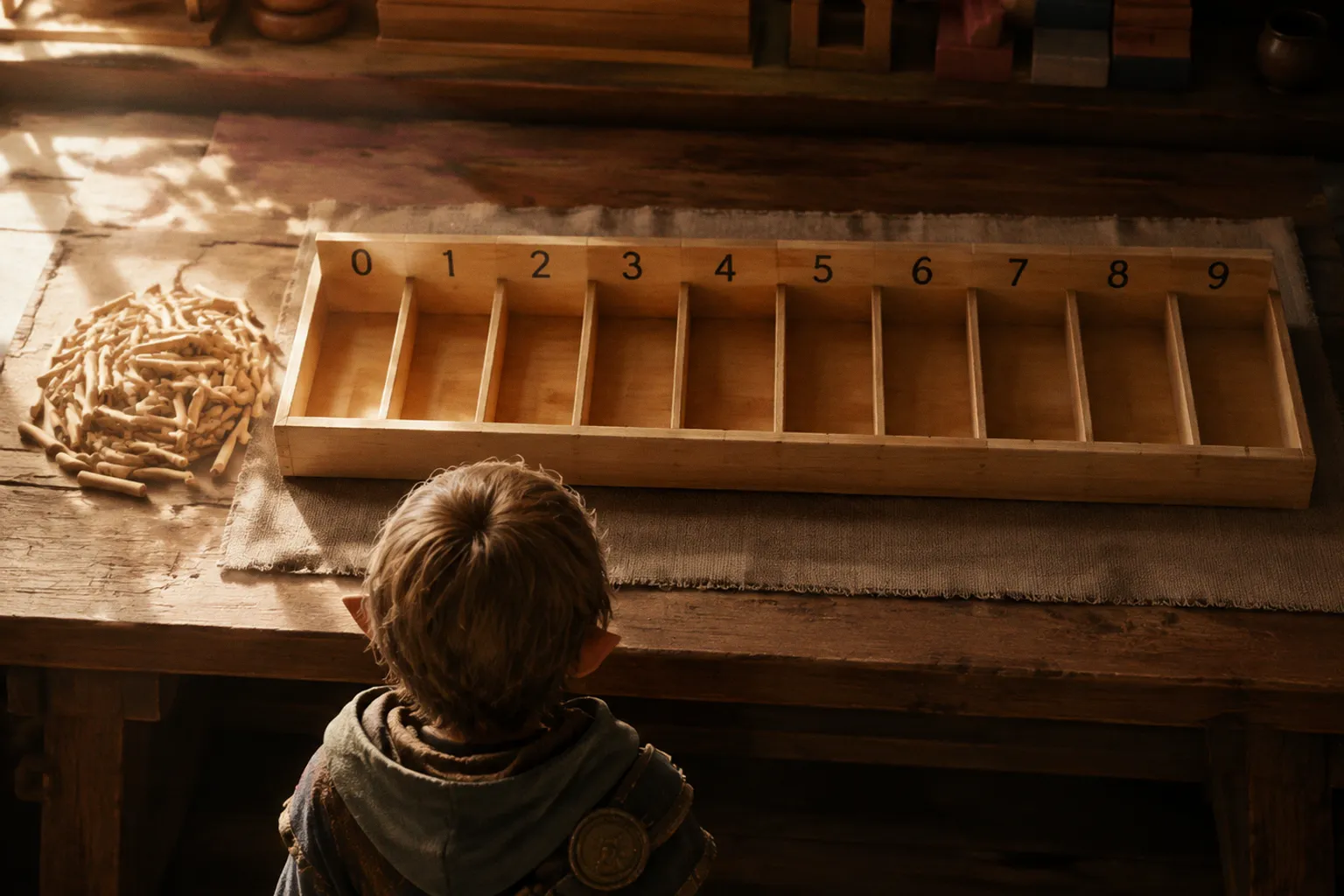
Its value comes from the relationship between the compartments, the labels, the loose spindles, and the empty space reserved for zero.
The material is intentionally plain. The spindles are usually uniform in length and appearance, so the child cannot rely on color, shape, or a picture cue to distinguish one quantity from another. The quantity has to be built by the hand. One spindle goes into the compartment marked 1, two into the compartment marked 2, and so on through 9. By the end, the child has not only named the numbers but has physically made each group.
That simplicity makes the presentation easy to underestimate. If the adult rushes the sequence, lets the child scoop up handfuls, or treats the work as a general sorting game, the central mathematical idea becomes less clear. The spindle box works best when the material, the pace, and the adult’s intervention remain deliberately restrained.
Prerequisites for the Spindle Box: Building on Number Rods and Sandpaper Numerals
The spindle box usually appears after the child has had experience with two related Montessori materials: the Number Rods and the Sandpaper Numerals. The exact timing depends on the child, but the sequence matters more than a particular birthday.
The Number Rods give quantity a physical dimension. The child works with rods that increase in length and are divided into regular sections. Through that work, number is not introduced as an isolated word or mark. It is experienced as a measurable amount: one section, two sections, three sections, and so forth.
The Sandpaper Numerals provide the written symbols. The child traces the numerals with the fingers while hearing their names. This movement prepares the hand for writing, but it also gives the child a muscular impression of the symbol itself. The numeral is no longer only something seen on a page; it is a form the hand has followed.
The spindle box brings those two strands together. The child already has some understanding that quantities can be compared and represented physically, and has begun to recognize the written numerals. The new work is to match the symbol with the corresponding number of individual objects.
A child does not need to be able to write the numerals before using the spindle box. Nor does the child need to perform written addition or subtraction. The useful readiness signs are more basic:
- The child can recognize at least some of the numerals from 1 through 9.
- The child can count a small group of objects in a stable one-to-one sequence.
- The child can carry and place the material with reasonable control.
- The child can stay with a short, ordered presentation without turning the spindles into loose construction pieces.
- The child is beginning to understand that the last number counted tells how many objects are in the group.
That last point is particularly important. A child may recite the number sequence accurately while still losing track of which object has been counted. The spindle box exposes that difference. Every spindle must be counted once, and each one must be assigned to the compartment represented by the numeral.
If the child is not yet connecting symbol and quantity, the adult can return to the Number Rods or use simpler counting activities without presenting the spindle box as a test. The material should clarify a relationship that is beginning to form, not force the child to memorize a relationship that has no foundation.
The Mechanics of the Material: Understanding the 45-Spindle System
The standard spindle box contains forty-five loose spindles and ten compartments labeled 0 through 9. The quantity of spindles is deliberate. The child is expected to distribute them as follows:
| Compartment | Number of spindles |
|---|---|
| 0 | 0 |
| 1 | 1 |
| 2 | 2 |
| 3 | 3 |
| 4 | 4 |
| 5 | 5 |
| 6 | 6 |
| 7 | 7 |
| 8 | 8 |
| 9 | 9 |
The compartments from 1 through 9 require a total of forty-five spindles. When the quantities are correct, no spindle remains outside the box. This is the material’s control of error. The adult does not need to recount every compartment and announce whether the child has succeeded. The arrangement itself provides information.
An extra spindle means that at least one group is too small. An empty spindle pile at the end, together with correctly filled compartments, confirms that the full set has been distributed. A child who notices a mismatch has the opportunity to revisit the work and locate the problem independently.
Compartment 0 has a different function. It is labeled, visible, and part of the sequence, but it receives no spindle. The empty compartment is not an omission in the material. It is the concrete representation of zero.
Most spindle boxes are arranged as two connected or separate wooden sections, although construction varies. Some have one long tray divided into ten spaces; others divide the numerals across two boxes. The exact layout is less important than the essential features:
- The compartments are clearly separated.
- The numerals are legible and permanently attached.
- The spindles are loose and uniform enough that quantity remains the only meaningful difference.
- The box can be carried safely by a child.
- The compartments are deep enough to hold the spindles without making removal difficult.
- The material offers a visible place for every numeral from 0 through 9.
The number forty-five is not decorative arithmetic printed in a product description. It is what allows the material to close its own loop. If a set is missing spindles, the child may be unable to complete the distribution even when the counting is accurate. If the set includes extras, the control of error becomes less immediate. Before a lesson, the adult should quietly confirm that all the spindles are present.
The forty-five spindles are not a spare-parts detail. They are what allows the child’s counting to meet a built-in mathematical check.
The physical design also affects how the lesson feels. A box that slides across the mat makes the child use effort for the wrong reason. Compartments with rough interiors distract from counting. Numerals that are too small or faint weaken the connection between the written symbol and the quantity being built.
What to examine before presenting the material
For home use, the spindle box does not need to look luxurious. It does need to be dependable. Look closely at the parts the child will touch repeatedly:
- The wood and construction. Solid wood is generally more durable than a thin decorative surface applied over a weaker core. What matters most is that the compartments do not flex, separate, or shed material at the edges.
- The finish. The surface should be smooth without becoming excessively slippery. A child needs to grip the spindles and move them precisely, not chase them across a glossy tray.
- The numerals. They should remain readable after repeated handling. Engraved or deeply applied numerals are less vulnerable to ordinary rubbing than a thin surface print.
- The spindle ends. The ends should be smooth and free of splinters. Small dowels are handled in groups, and rough ends quickly become a practical problem.
- The compartment fit. The spindles should sit comfortably in the spaces. If they jam, the child may focus on forcing them into place. If they roll out easily, the quantity becomes difficult to preserve.
- The overall weight. The child should be able to carry the material with two hands and place it on a work mat without an adult taking over.
The best material is not the one with the most elaborate finish. It is the one that remains quiet during the work. The child should notice the number of spindles, not a peeling label, a sharp divider, or a tray that shifts whenever a hand reaches for the next object.
Montessori Math Spindle Box Presentation: Guiding the Child Through Quantities 1 to 9
The presentation should be slow enough for the child to see the correspondence between numeral and quantity, but not so slow that every movement becomes theatrical. The adult demonstrates economy: carry the box carefully, place it deliberately, count once, and avoid unnecessary conversation.
1. Invite the child to carry the material
Show the child how to carry the box with both hands. If the material has two sections, carry one section at a time. Place the boxes on the work mat before returning for the second part.
This movement is not separate from the lesson. Montessori materials are designed to be chosen, transported, arranged, and returned by the child. Carrying the box gives the child responsibility for the whole activity rather than presenting the work as something an adult has set up for passive viewing.
2. Arrange the boxes and spindles
Place the compartments in a clear order, with the numerals facing the child. Put the loose spindles in a single pile within easy reach. A pile is preferable to a scattered field of dowels: it gives the child a defined source from which each quantity will be taken.
The adult should sit or kneel beside the child rather than blocking the material. The child needs an unobstructed view of the numerals and enough room to move each spindle from the central pile to its compartment.
3. Begin with the numeral 1
Indicate the compartment marked 1. Pick up one spindle and place it inside. Name the numeral and the quantity in a calm, ordinary voice. The point is not volume or repetition. It is the precise pairing of one written symbol, one spoken number, and one object.
Pause briefly so the child can register the completed group before moving on.
4. Build the quantities in order
Continue with 2, 3, and 4. For each compartment, take the spindles individually from the pile. Count each transfer as it happens. The child should be able to see that the group in the compartment grows by one as the numeral increases by one.
At this stage, the adult’s hands should do only what is necessary. Avoid touching the child’s hand unless the child needs help with the movement. Avoid pointing repeatedly once the child has found the next numeral. A clear presentation leaves room for the child to take over.
When the child is ready, invite them to continue. Some children can begin contributing after the first quantity; others need to watch several compartments before taking a turn. The adult can offer the next compartment without turning the work into a rapid quiz.
5. Continue through the second section
Move to 5, then 6, 7, 8, and 9. The groups become larger, but the procedure does not change. Each spindle is picked up separately and counted into the appropriate compartment.
The larger quantities are where the material’s physical logic becomes especially useful. A child may know that 8 comes after 7 in the spoken sequence, but the spindle box requires eight actual objects to be gathered and kept together. The child sees the increasing length of the groups and feels the difference in the hand.
Do not encourage the child to scoop up a handful and estimate the number. Estimation has its place elsewhere, but this lesson is about one-to-one correspondence. A handful of spindles is an undifferentiated bundle. Individual transfers make the count visible.
6. Leave compartment 0 for its own exploration
The first presentation generally focuses on the quantities from 1 through 9. Compartment 0 remains empty during this work. It is not filled temporarily and then corrected. The child should encounter it as the labeled space that receives no spindle.
The adult can draw attention to the compartment without adding an object to it. This makes the difference between 0 and 1 visible: the compartment labeled 1 contains one spindle, while the compartment labeled 0 contains none.
7. Let the material complete the check
When the child reaches 9, do not immediately recount every compartment on the child’s behalf. Invite attention to the central area where the loose spindles were placed. If the quantities have been made correctly, the pile is empty.
If spindles remain, help the child look back through the compartments rather than supplying the answer. The control of error should remain available to the child. An adult who instantly announces the incorrect compartment replaces an opportunity for mathematical self-correction with a simple performance judgment.
Why one-by-one handling matters
The one-by-one movement is not a ceremonial rule. It gives the child several kinds of information at once:
- Each object is counted once.
- The spoken number is connected to a single physical item.
- The completed group remains visible in its compartment.
- Larger quantities take longer to build and occupy more space.
- The difference between adjacent quantities can be seen and felt.
- The child’s hand repeats the same reliable process for every numeral.
This is why a spindle box presentation should not be turned into a speed exercise. Faster is not more advanced. The child is constructing an internal relationship between the symbol and the group. That relationship needs accurate movement more than entertainment.
Defining Zero: Teaching the Concept of an Empty Set
Zero deserves a separate moment because it does not behave like the other compartments. For 1 through 9, the child places a positive quantity into a marked space. For 0, the correct action is to place nothing there.
The adult may invite the child to look at the numeral, touch the inside of the compartment, and notice that it is empty. The child can compare it with the neighboring compartment containing one spindle. The contrast is direct and concrete: one means a single object is present; zero means no object is present.
The empty space should not be filled as part of the lesson. Compartment 0 is explored without placing any spindle in it. There is no need to insert a spindle temporarily, remove it, and then explain the absence. That variation conflicts with the material’s central rule and makes the meaning of the empty set less clear. The child can understand zero through the deliberate absence of a spindle.
The adult’s language should remain simple and accurate. Rather than offering a long abstract explanation, name what is observable: the compartment is marked 0, and there are no spindles in it. Once the child understands the idea, the written symbol can be reinforced through matching and later through other number activities.
The spindle box does not teach every property of zero. It does, however, give the child a strong first experience of zero as a quantity that can be represented by an empty set. This is different from saying that zero is merely the first label in a row or a number that comes before one. The empty compartment gives the concept a physical form.
Zero is represented by the space where no spindle is placed. The emptiness is not missing work; it is the work.
Some children respond immediately to this contrast. Others continue to treat every compartment as if it should contain something. In that case, the adult can return to the comparison between 0 and 1 without correcting through a long verbal explanation. The material is strongest when the child can see the answer.
Self-Correction and Mastery: Using the Built-In Control of Error
The spindle box supports independent work because the arithmetic leaves evidence behind. Once the child has distributed the spindles, the result can be checked without an adult hovering over each compartment.
This does not mean the child will always notice an error immediately. The control of error is an invitation to check, not a guarantee that every mistake will be diagnosed at once. The adult can protect the process by asking where the remaining spindle belongs or by drawing attention to the empty pile. The adult should avoid turning the check into a correction delivered from outside.
After the basic presentation is secure, the child may return to the material in several ways.
Repeating the original sequence
Repetition is valuable when it remains purposeful. The child may rebuild the quantities from 1 through 9, this time taking more responsibility for choosing the next compartment and controlling the count. The adult’s role becomes smaller as the child’s familiarity grows.
A child who repeats the work is not necessarily stuck. Repetition allows the hand to become more economical and gives the mind time to consolidate the relationship between numeral and quantity.
Presenting the quantities in a different order
Once the child understands the standard sequence, the compartments can be filled in a less predictable order. The child might begin with 4, move to 1, then continue with 7 and 3. The numerical relationship has not changed, but the child can no longer rely entirely on the rhythm of reciting the number sequence.
This variation is useful only after the original work is comfortable. Introduced too soon, it adds memory demands without strengthening the central concept.
Checking a prepared error
An adult may place an incorrect number of spindles in one compartment and invite the child to investigate. The error should be small enough to be found through counting, not so elaborate that the activity becomes a guessing game.
The purpose is not to catch the child out. It is to make the control of error more visible: the written numeral and the physical group must agree. If the compartment labeled 6 contains five spindles, the child can count the group and decide what needs to change.
Comparing neighboring quantities
The child can compare the groups in two adjacent compartments. The group under 8 contains one more spindle than the group under 7. This comparison can be made without introducing formal addition language. The child already has the concrete evidence in front of them.
The same idea becomes useful when moving later toward the cards and counters, where the child will explore the distinction between quantities that are even and odd. The spindle box itself is not the full odd-and-even lesson, but it prepares the child to see numbers as organized quantities rather than isolated labels.
Handling and storing the spindles carefully
Independent mastery also includes practical care. The child can gather the spindles into one pile, make sure none is left under the mat, and return them to their container. If the box has a lid or designated storage position, the child can close it without forcing the parts.
This matters because a missing spindle changes the mathematical integrity of the set. The adult should periodically count the complete collection outside the child’s work cycle, especially in a classroom or shared play environment. Replacing a lost spindle with one of a different size or shape may keep the box visually complete but weakens the consistency of the material.
Common Presentation Errors
The spindle box is forgiving when the material is sound, but several adult habits can blur the lesson.
- Presenting it before the child has a basic symbol–quantity connection. The child may sort by compartment without understanding why the numeral governs the group.
- Turning the activity into a test. Frequent questions about the next number can make the child perform for the adult instead of attending to the material.
- Allowing handfuls instead of individual transfers. The child may place approximately the right amount, but the one-to-one correspondence becomes difficult to observe.
- Filling compartment 0. The zero compartment remains empty. It is explored as an absence, without placing a spindle in it.
- Correcting every error immediately. The remaining spindle or an incorrectly sized group should be allowed to provide information before the adult steps in.
- Overexplaining zero. A long abstract explanation can obscure the simple contrast between one object and no object.
- Using a damaged or poorly finished box. Rough edges, unstable dividers, and illegible numerals compete with the mathematical purpose of the material.
- Adding extensions before the basic work is established. Bundles, reverse counting, and mixed-order presentations are secondary activities. They should not replace the first clear experience of matching each numeral with its quantity.
A spindle box is not a toy that becomes educational because numbers have been printed on it. Its design is educational because each part narrows the child’s attention toward a precise relationship. The uniform spindles remove visual distractions. The numbered compartments give the quantities a fixed location. The forty-five-piece set makes the result checkable. The empty 0 compartment makes absence visible.
The strongest presentation is therefore also the least showy. The adult prepares the material, demonstrates the movement, uses accurate language, and then makes room for the child’s hands. The child counts, places, notices, and corrects. Over time, the written numeral stops being an isolated mark. It becomes a quantity that the child can reconstruct.
That is the real purpose of the Montessori spindle box lesson steps: not merely to fill ten compartments, but to make number concrete enough that the child can recognize it, build it, and trust their own count.