Natural Rubber Baby Teethers: What to Check Before Buying
Natural rubber baby teether safety criteria are not limited to the material label. A product can be made from renewable Hevea latex and still have design or care requirements that create avoidable risks.
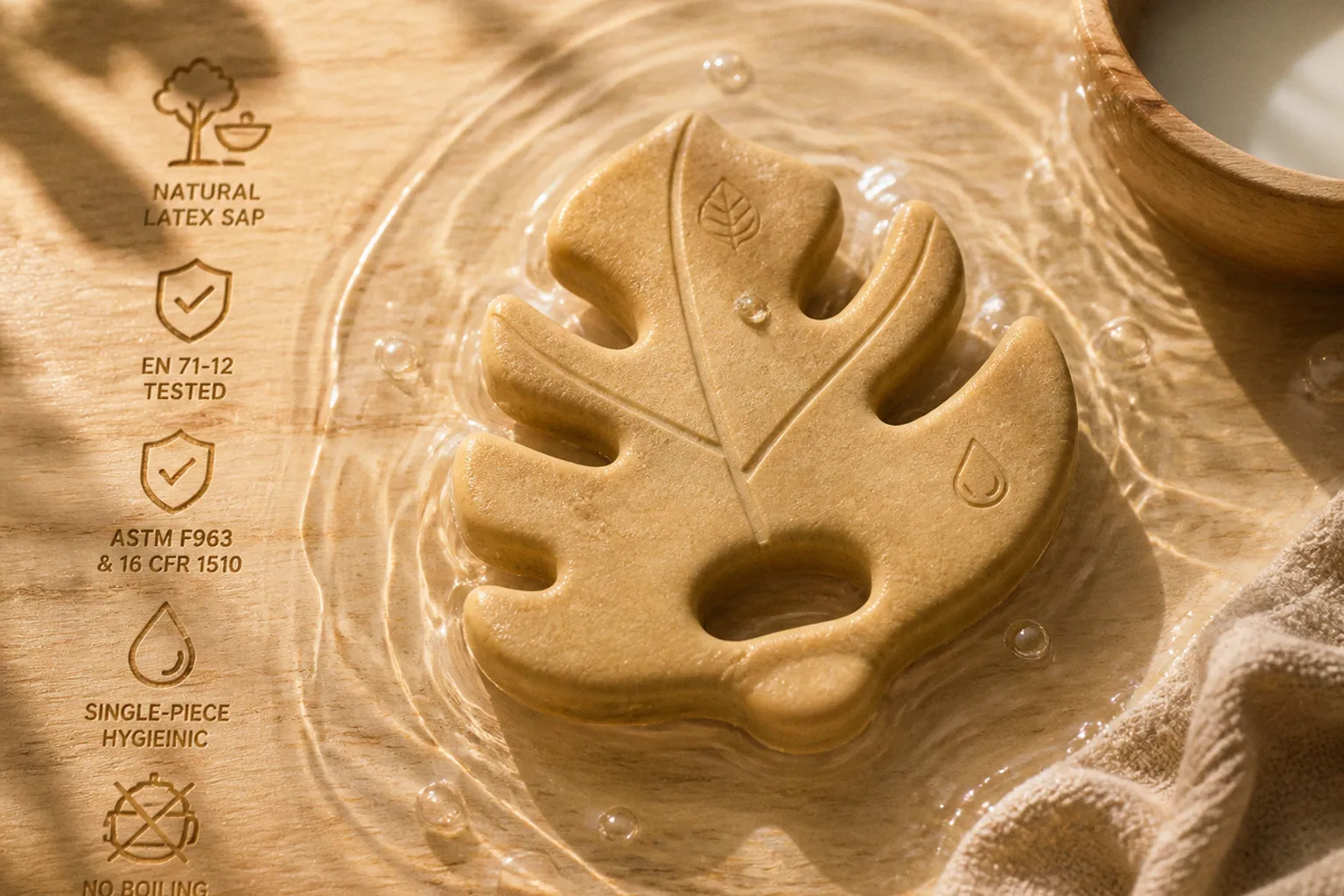
The decisive variables are construction, chemical testing, resistance to mechanical stress, cleaning instructions, and the child’s sensitivity to natural latex proteins.
Natural rubber has a specific advantage: it is flexible, renewable, and biodegradable. It is also a material that degrades when exposed to excessive heat and can retain moisture if the teether contains an opening or internal cavity. For this reason, choosing a safe natural rubber teether requires more than confirming that the package says “natural,” “organic,” or “non-toxic.”
The material is only one part of teether safety. Geometry, certification, and maintenance determine how that material behaves in actual use.
The science of Hevea brasiliensis: why natural latex matters
Natural rubber used in baby teethers is produced from latex sap harvested from the Hevea brasiliensis tree. The latex is naturally elastic and can be formed into soft, compressible shapes that provide resistance against the gums. This mechanical resistance is the primary functional property of a teether. It gives the child a controlled surface to bite, press, and manipulate during the period when oral exploration and fine motor control are developing.
The developmental value should be described precisely. A teether is not a general cognitive-development device. Its direct contribution is mainly sensory and motor:
- Biting provides oral pressure and tactile feedback.
- Holding and rotating the object engage grasping, wrist adjustment, and bilateral coordination.
- Changing the angle of the teether requires simple sensorimotor problem-solving.
- Different contours provide varied resistance and proprioceptive input around the mouth and hands.
These functions are modest but relevant. The product’s role is to support a specific developmental activity, not to accelerate cognition in a broad or measurable way.
Natural rubber is also renewable. A Hevea rubber tree can remain productive for an average of approximately 35 years of latex tapping. That does not automatically make every rubber teether environmentally responsible. Manufacturing, transport, packaging, coatings, and product lifespan still affect the overall footprint. However, the raw material itself has a different environmental profile from petroleum-derived plastics.
The phrase “100% natural rubber” should therefore be interpreted narrowly. It describes the principal elastomeric material, not necessarily every component of the product. A finished teether may include pigments, surface treatments, labels, packaging elements, or other materials. A transparent specification should identify:
- The source of the rubber, ideally natural latex from Hevea brasiliensis.
- Whether the teether is made as one continuous piece.
- Whether pigments and finishes are suitable for products intended for mouthing.
- Whether the manufacturer declares the absence of BPA, PVC, phthalates, lead, and cadmium.
- Which safety standards were used for testing.
- How the product should be cleaned and stored.
A claim such as “chemical-free” is not technically useful. All physical materials consist of chemicals, and the phrase does not identify what was tested or excluded. A more meaningful declaration names restricted substances and connects the product to a recognized testing framework.
Natural rubber compared with food-grade silicone
Natural rubber and food-grade silicone are not interchangeable materials. They differ in elasticity, heat resistance, surface behavior, odor, environmental characteristics, and maintenance requirements.
| Parameter | Natural rubber teether | Food-grade silicone teether |
|---|---|---|
| Raw material | Latex sap from the Hevea brasiliensis tree | Synthetic silicone elastomer |
| Flexibility | High elasticity with a softer, more resilient bite response | Flexible, but generally more stable and uniform under repeated heat exposure |
| Biodegradability | Naturally biodegradable under suitable conditions | Not generally biodegradable |
| Heat tolerance | Sensitive to high heat, steam sterilization, dishwashers, and prolonged boiling | Typically more tolerant of high-temperature cleaning, subject to manufacturer instructions |
| Allergy consideration | Contains natural latex proteins that may trigger sensitivity | Does not contain natural latex proteins |
| Internal moisture risk | Depends heavily on whether the design is sealed and hole-free | Also depends on construction, but material type alone does not eliminate the risk |
| Typical maintenance | Wipe or wash gently according to instructions; dry thoroughly | May allow broader cleaning methods, but instructions still control |
| Main selection issue | Latex sensitivity and heat degradation | Material authenticity, additives, and design quality |
The comparison does not establish that one material is universally superior. Natural rubber is appropriate when the buyer understands its limitations and the product has a well-controlled design. Silicone may be more practical for families who rely on steam sterilization or dishwasher cleaning. The correct choice depends on the child’s medical context, the household’s cleaning routine, and the manufacturer’s specifications.
Decoding safety certifications: EN 71-12 and ASTM F963
Certification language is often presented as a decorative mark on packaging. It should instead be read as evidence that specific hazards were evaluated. The relevant question is not whether a product says “tested,” but what standard was applied, what product category was covered, and whether the documentation corresponds to the exact model.
European toy safety standard EN 71 includes requirements relevant to mechanical, physical, and chemical hazards. EN 71-12 is specifically concerned with N-nitrosamines and N-nitrosatable substances in elastomeric and rubber toys. These compounds are particularly relevant to products made from rubber or other elastomeric materials that may be mouthed by children.
The importance of EN 71-12 is material-specific. A general statement that a product complies with EN 71 does not tell the buyer whether the chemical requirements for rubber components were addressed. The product documentation should identify the applicable part of the standard when the teether is made from natural rubber.
In the United States, ASTM F963 is the consumer safety specification for toy safety. Teethers are also covered by 16 CFR Part 1510, which addresses specific requirements for teethers, including mechanical hazards. These frameworks are concerned with hazards such as:
- Detachment of components under tension.
- Breakage under compression.
- Choking hazards from small parts.
- Structural failure during foreseeable use.
- Other mechanical risks associated with products designed for infants.
A certification claim does not replace physical inspection. Testing is performed on defined samples and under specified conditions. It does not mean that a product is indestructible, immune to misuse, or safe after the material has visibly deteriorated.
How to evaluate a certification claim
Use a simple sequence rather than relying on a logo:
1. Identify the exact product. The test report or declaration should correspond to the same model, size, material, and design shown on the package.
2. Look for the standard number. “Complies with safety standards” is less informative than a named reference to EN 71, EN 71-12, ASTM F963, or 16 CFR Part 1510.
3. Separate chemical and mechanical testing. A rubber teether needs both. Chemical testing does not establish resistance to tearing, and mechanical testing does not establish compliance for N-nitrosamines.
4. Check the intended age range. A product designed for an older child may not meet the same practical requirements for an infant who cannot reliably release an object.
5. Treat unexplained seals cautiously. A certification symbol without a standard, manufacturer, or traceable product reference is not a substitute for documentation.
The absence of a visible certificate does not prove that a product is unsafe. Some manufacturers provide compliance information through product documentation rather than printing every standard on the package. The problem is the absence of verifiable information, not the absence of a particular logo.
A safety mark has value only when it identifies the tested hazard, the applicable standard, and the product covered by the claim.
The mold trap: why single-piece construction matters
The most consequential design distinction in natural rubber teethers is whether the product is a sealed, single-piece form or contains a hole, seam, hollow chamber, or attached element.
A single-piece, hole-free construction prevents water from entering the interior. A hermetically sealed design offers the same functional advantage. If moisture cannot enter, the product does not create an enclosed wet environment where mold and bacterial accumulation can develop unseen.
This is different from saying that every natural rubber teether is mold-proof. It is not. A teether with an opening can admit saliva, bathwater, or cleaning water. The outside may appear dry while moisture remains inside. The problem is difficult to detect because the internal surface cannot be visually inspected or dried effectively.
The risk is especially relevant when the object is cleaned by immersion. Parents may reasonably assume that washing removes contamination. For a hollow design, washing can also introduce water into the cavity. Repeated cycles increase the probability that moisture remains trapped.
Design features to inspect before purchase
Check the physical construction, not only the product description:
- No drainage or ventilation holes. A hole may look like a minor design detail, but it can connect the external surface to an internal cavity.
- No concealed chamber. Some teethers are molded as hollow figures or animals. If the product does not clearly state that the interior is sealed, do not assume it is.
- No glued or mechanically attached parts. Ears, rings, beads, tags, or decorative pieces can become weak points.
- No accessible seam that opens under flexing. A seam is not automatically unsafe, but it requires closer inspection for splitting and material separation.
- Consistent surface finish. Cracks, tackiness, peeling pigment, or irregular soft spots indicate material degradation or manufacturing defects.
- Adequate size for the intended age. A component that can detach and fit into a small-parts testing cylinder creates a choking hazard.
The single-piece requirement is not merely a hygiene preference. It is also a mechanical advantage. Fewer interfaces mean fewer potential failure points. A continuous molded form reduces the number of seams, joints, adhesive bonds, and detachable elements exposed to repetitive biting and pulling.
When to remove a teether from use
Discard the product when you observe:
1. A tear, puncture, split seam, or deep bite mark.
2. A change in texture, including unusual stickiness or hardening.
3. Peeling paint, pigment transfer, or surface flaking.
4. A new opening that allows water to enter.
5. A persistent odor that was not present when the product was new.
6. Any detached component, even if it appears too small to be swallowed.
7. Visible internal contamination or liquid trapped inside the object.
Do not attempt to repair a damaged teether with glue, tape, stitching, or sealant. These repairs introduce new materials and can create a detachable fragment. They also do not restore the original mechanical properties tested by the manufacturer.
Material integrity: why natural rubber requires gentle care
Natural rubber cannot be maintained with the same routine used for heat-resistant silicone. High-temperature steam sterilizers, dishwashers, and prolonged boiling can degrade the latex. Heat may alter the material’s elasticity and surface integrity, shortening the safe service life of the teether.
This limitation is often overlooked because sterilization is commonly associated with infant products. The assumption that hotter cleaning is always safer is incorrect when the product is not designed for high heat. A degraded teether may become sticky, brittle, cracked, or structurally weaker. Thermal damage can occur before the change is obvious.
The manufacturer’s cleaning instructions have priority. If the instructions are unavailable, a conservative approach is preferable:
- Clean the surface with mild soap and water.
- Avoid prolonged soaking unless the product is explicitly designed for immersion.
- Do not place the teether in a dishwasher.
- Do not use a steam sterilizer.
- Do not boil it for an extended period.
- Rinse away cleaning residue.
- Dry the entire exterior thoroughly before storage.
- Store it in a clean, dry location rather than a sealed damp container.
The exact cleaning process depends on the construction. A hole-free, sealed teether may tolerate careful washing better than a hollow product, but neither the material nor the design should be used to infer permission for heat sterilization.
A practical cleaning sequence
For routine cleaning, follow this order:
1. Inspect first. Look for cracks, punctures, tackiness, and changes in shape. Cleaning a damaged product does not make it suitable for use.
2. Wash gently. Use lukewarm water and a mild cleanser compatible with infant products.
3. Rinse completely. Residual cleanser can remain on textured surfaces and may be ingested during mouthing.
4. Dry without heat. Air-dry on a clean surface. Avoid radiators, direct high heat, and aggressive drying devices.
5. Inspect again. Confirm that no water remains around seams, handles, or surface recesses.
6. Store separately. Contact with dirty floor surfaces, diapering equipment, or damp fabric increases contamination.
Do not apply oils, disinfectants, essential oils, or unapproved coatings to restore softness or alter the surface. Such substances can change friction, leave residues, or interfere with the rubber’s intended properties.
Natural rubber also changes with age and environmental exposure. Ultraviolet light, heat, oils, and repeated mechanical stress can contribute to deterioration. A product that is used daily should be inspected more frequently than one used occasionally. The relevant endpoint is not a fixed calendar interval but the condition of the material.
Navigating latex sensitivity in early infancy
Natural rubber contains latex proteins. This is the principal biological limitation that distinguishes it from silicone. A natural rubber teether cannot accurately be described as completely hypoallergenic.
Most children will not develop a reaction simply because an object contains natural latex. However, infants with known latex sensitivity or a relevant medical history require individualized guidance from a qualified healthcare professional. The label “natural” does not reduce the allergenic potential of latex proteins.
A buyer should distinguish among three separate claims:
- Non-toxic: usually refers to the absence or restriction of specified harmful substances under a defined standard.
- Latex-free: means the product does not contain natural latex, although the claim still requires manufacturer reliability.
- Hypoallergenic: indicates a lower likelihood of causing an allergic reaction, but it does not mean zero risk.
These terms are not interchangeable. A product can be free from BPA, PVC, phthalates, lead, and cadmium while still containing natural latex proteins. Chemical safety and allergy suitability are separate evaluation categories.
Stop use and seek medical advice if a child develops symptoms after contact with the product, particularly swelling, hives, persistent redness, breathing difficulty, or other signs of an acute reaction. Severe symptoms require urgent medical attention. Do not test a suspected sensitivity by repeatedly exposing the child to the teether.
A structured buying checklist
Before selecting a natural rubber teether, establish whether the product satisfies the following conditions:
- The material is identified as natural rubber or latex from Hevea brasiliensis, rather than described only with broad terms such as “eco” or “natural.”
- The product is a single-piece, hole-free, or hermetically sealed design.
- There are no attached decorations, loose rings, cords, beads, or glued elements.
- The manufacturer identifies relevant safety standards, including EN 71-12 where applicable for rubber chemical testing.
- Mechanical safety is addressed through an appropriate framework such as ASTM F963 and 16 CFR Part 1510.
- The product documentation describes restrictions on BPA, PVC, phthalates, lead, and cadmium.
- Cleaning instructions explicitly explain whether the teether can be immersed and which methods must be avoided.
- The product is not intended for steam sterilizers, dishwashers, or prolonged boiling unless the manufacturer specifically states otherwise.
- The age recommendation matches the child’s developmental stage and ability to hold and release objects.
- The child has no known latex sensitivity that would make natural rubber unsuitable.
- The surface is smooth, intact, and free from cracks, tackiness, peeling, or unexplained odor.
- The product can be dried fully after cleaning and stored without trapped moisture.
If several of these points cannot be verified, the problem is not necessarily that the teether is dangerous. The problem is that the buyer lacks sufficient information to evaluate it responsibly. For an object used in the mouth of an infant, uncertainty about construction and care is itself a reason to choose a better-documented alternative.
Final assessment
A safe natural rubber baby teether is defined by a combination of properties: certified material safety, mechanically stable construction, sealed or hole-free geometry, suitable sizing, and low-heat maintenance. The renewable origin of Hevea latex is a meaningful environmental feature, but it does not compensate for a hollow design, unclear testing, or improper cleaning.
The most defensible choice is a single-piece natural rubber teether with traceable compliance information, explicit restrictions on harmful substances, clear cleaning instructions, and no indication that moisture can enter the interior. Families should also account for latex sensitivity and accept that natural rubber is not compatible with every sterilization routine.
The verdict is direct: prioritize construction and documentation before branding or sustainability claims. If the product is hole-free, mechanically intact, appropriately tested, and maintained without heat degradation, natural rubber can be a practical non-toxic option for early oral and fine motor exploration.