Natural Toy Sealants: How Non-Toxic Finishes Actually Work
A wooden toy can be made from a beautiful, responsibly sourced piece of timber and still deserve a closer look at its finish. For babies and toddlers, the surface is not merely something they see or touch.
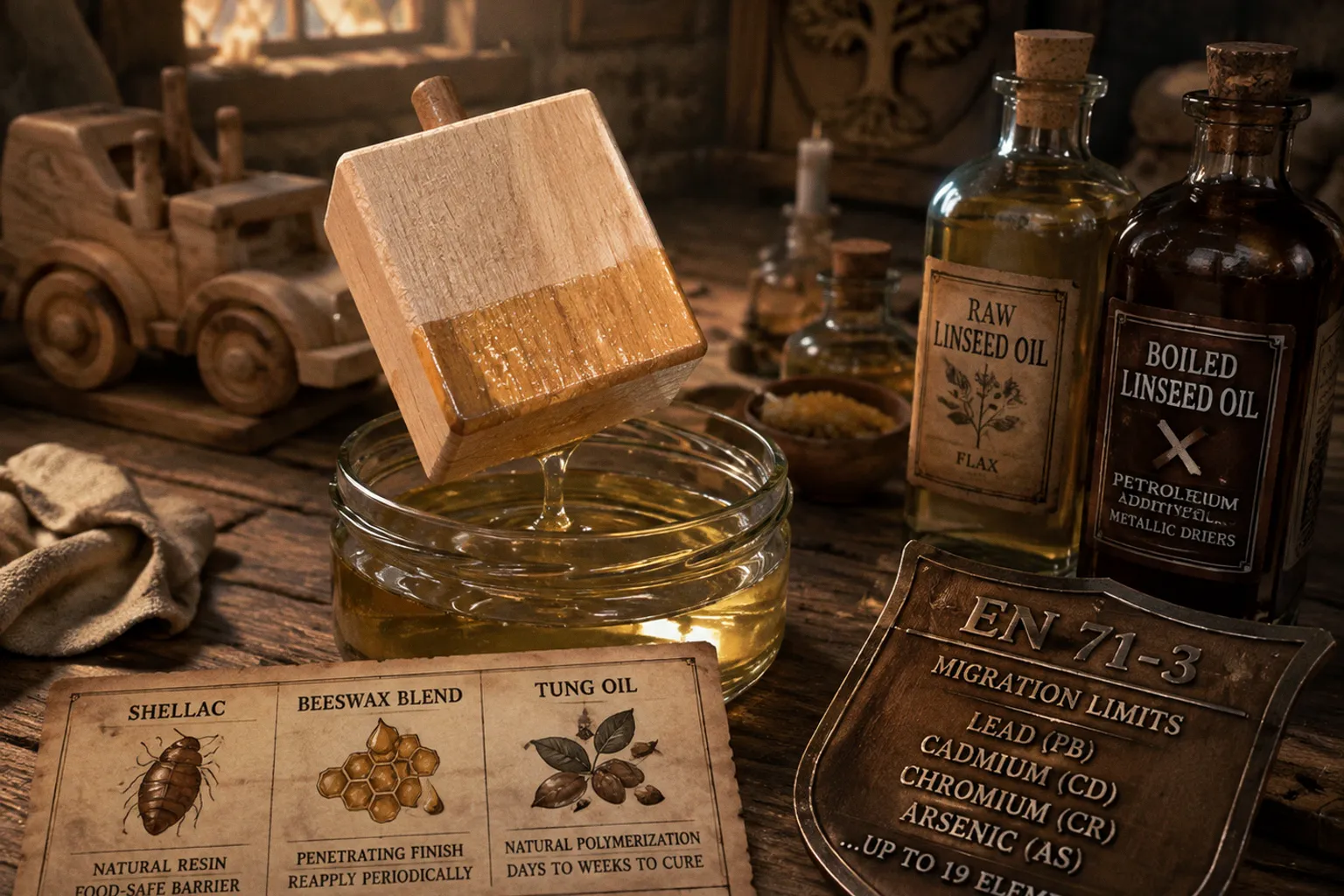
It is rubbed between small fingers, pressed against the cheek, dragged across the floor, and very often explored with the mouth.
That is why choosing natural non toxic wooden toy sealants is not simply a matter of finding a label that says “natural,” “plant-based,” or “eco-friendly.” The real question is what the finish does as it cures, whether it can migrate from the surface, how it behaves under saliva and friction, and whether the product is genuinely different from a conventional coating with a reassuring marketing name.
A safe finish is not defined only by its ingredients. It is also defined by its formulation, application, curing process, intended use, and evidence of compliance.
Why curing matters more than “dry to the touch”
Parents often hear that a wooden finish needs to dry before the toy is used. In practice, drying and curing are not the same event.
A surface may feel dry because the liquid carrier has evaporated or because the outer layer has begun to harden. That does not necessarily mean the finish has completed the chemical changes that make it stable and inert. Some oils polymerize over time. Shellac must lose its alcohol solvent and harden into a continuous barrier. Water-based products may dry relatively quickly but still require additional time before they reach their intended performance.
For a toy that may be mouthed, this distinction matters.
During curing, the finish is changing from a liquid or soft coating into a stable surface. Depending on the formulation, that can involve:
- evaporation of a solvent or carrier;
- oxidation and polymerization of plant-based oils;
- hardening of a resin film;
- bonding between the coating and the wood fibres;
- reduction of residual odour and chemical transfer.
The curing period varies considerably. Some water-based finishes may be ready for use after roughly 24–48 hours, while pure tung oil can take several days or even weeks to cure fully. The product instructions remain the starting point, but the intended use of the object should also guide caution. A decorative wooden object handled occasionally has a very different exposure pattern from a teething ring that spends long periods in a child’s mouth.
“Dry” describes how a surface feels. “Cured” describes whether the finish has become stable enough for its intended use.
This is one of the most common points missed in homemade toy projects. A parent may apply an oil, leave the piece overnight, notice that it no longer feels wet, and assume the job is complete. With a mouthing toy, that shortcut is not worth taking. If the finish still has a strong odour, feels tacky, transfers colour or oil to a clean cloth, or has not reached the manufacturer’s stated cure time, it should not be offered for play.
What polymerization does to a plant-based oil
Some drying oils become more solid as they react with oxygen. This process, broadly described as polymerization, creates a more durable network within and across the wood surface. Pure tung oil is one example: it naturally polymerizes and can produce a water-resistant finish, but it is not a quick solution.
Raw linseed oil also behaves differently from commercial boiled linseed oil. Pure raw linseed oil comes from flax seeds and is considered non-toxic in its unmodified form. It dries slowly, however, which is one reason manufacturers have historically altered linseed oil products to speed up the process.
That alteration is where the safety question becomes more complicated.
Commercial “boiled linseed oil” is not simply raw linseed oil that has been warmed in a pot. It commonly contains petroleum-based additives and metallic driers, including heavy metal compounds, designed to accelerate drying. This product should not be treated as a safe finish for wooden toys, especially toys intended for mouthing.
The name can sound traditional and harmless. The formulation is what matters.
Safety standards look at migration, not just presence
A coating does not become safe merely because its ingredients sound familiar. Safety testing asks how substances behave in the finished article and whether they can move from the surface into the body under specified conditions.
European toy safety standard EN 71-3 is particularly useful to understand because it addresses the migration of up to 19 chemical elements from toy materials. These include elements such as lead, cadmium, chromium, and arsenic. The focus is not simply on whether an element exists somewhere in the coating. The question is how much can migrate from the material and become available for ingestion or contact.
That is a more meaningful approach for children’s products. Many substances may be present in trace amounts within a material without presenting the same risk as a substance that readily transfers to saliva, skin, or digestive fluids.
North American requirements use related but not identical approaches. Depending on the product and claim, assessment may involve heavy-metal composition requirements, toy safety rules, and food-contact compliance. FDA 21 CFR 175.300 is often used as a food-contact safety benchmark for certain resinous and polymeric coatings, but it should not be treated as a universal approval for every finish, every toy, or every application.
A finish marketed as suitable for food contact is not automatically certified as a toy coating. Conversely, an artisan finish described as food-safe may not have been tested as a complete toy under the relevant safety standard.
For parents and educators, the practical lesson is straightforward: look for evidence relating to the finished product and its intended use, rather than relying on a single attractive ingredient claim.
The language on the tin needs careful reading
Natural toy sealants are often described with phrases such as:
- non-toxic;
- food-safe;
- child-safe;
- plant-based;
- zero VOC;
- chemical-free;
- suitable for nursery products;
- safe for wooden utensils.
These phrases do not all mean the same thing.
“Plant-based” describes the origin of an ingredient, not necessarily the safety of the whole formulation. A plant-derived substance may still irritate skin, cause an allergic response, or require a long curing period. “Food-safe” may refer to a cured film under specific conditions rather than a wet product straight from the container. “Zero VOC” can describe a particular regulatory category or measured formulation, but it does not mean the product has no chemicals, no odour, or no need for ventilation.
“Chemical-free” is especially unhelpful. Everything in a finish is made of chemicals, including natural oils and waxes. A more useful description identifies the actual ingredients, the intended use, the required cure time, and the standard or testing pathway used by the manufacturer.
If the product is intended for a toy used by a baby, opaque language is a reason to pause. A clear technical data sheet and specific curing instructions are far more reassuring than a leaf symbol on the front label.
Three natural finish families, three different behaviours
There is no single best natural finish for every wooden toy. A smooth stacking rainbow, a bead maze, and a teething ring place different demands on the surface. The finish must work with the shape of the toy, the type of wood, the intensity of handling, and the likelihood of prolonged mouthing.
Shellac: a natural resin film
Shellac is a natural resin produced by the lac bug and dissolved in alcohol. Once the solvent has evaporated and the shellac has fully cured, it forms a protective surface film. Properly prepared shellac has long been used on wooden objects, including items where a food-safe barrier is desirable.
Its main strength is that it forms a more defined film than a simple oil-and-wax treatment. This can help protect the timber from handling, light moisture, and the gradual marking that comes with everyday play.
There are still details to manage:
- the alcohol solvent must fully evaporate;
- the finish should be applied in thin, even coats;
- the product should be intended for the relevant use;
- the completed toy needs adequate curing time;
- damaged or flaking film should not be ignored.
Shellac can be a sensible option for decorative or heavily handled wooden toys when properly formulated and cured. It is less suitable to think of it as a magic coating that removes the need for inspection. Any surface film can wear, chip, or become rough with repeated use.
Pure tung oil: durable, but slow
Pure tung oil is extracted from tung tree seeds. It polymerizes naturally and can create a water-resistant finish that penetrates the wood and gradually hardens.
For nursery furniture or a wooden toy that needs a tactile, natural-looking surface, tung oil can be appealing. It allows the grain to remain visible and does not create the same kind of thick film as a conventional varnish. The trade-off is patience. Pure tung oil may take several days to weeks to cure fully, depending on application, airflow, temperature, humidity, and the number of coats.
It also needs to be distinguished from tung-oil products that contain additional solvents, resins, or drying agents. The word “tung” on the label does not tell you that the product is pure.
For a child’s toy, the surface should be completely cured rather than merely non-sticky. A lingering oil smell is a practical sign that more time may be needed, although smell alone is not a complete safety test.
Beeswax and oil: soft, tactile, and maintenance-heavy
A beeswax finish combined with mineral oil or a food-grade plant oil creates a soft, low-build treatment. Rather than forming a hard, continuous film, it tends to sit within the surface and leave the wood with a smooth, pleasant feel.
This is the type of finish many people have in mind when searching for a beeswax finish for baby toys. It can work well for wooden objects where tactile feedback is central: grasping toys, smooth blocks, simple sensory boards, and nursery pieces that receive gentle handling.
Its limitation is durability. Beeswax-and-oil coatings have relatively low resistance to long-term wear and water immersion. They require periodic reapplication, and the surface may become dull, dry, or uneven over time.
That maintenance is not a fault; it is simply part of the finish’s character. The mistake is applying a soft wax finish to a toy that will be repeatedly soaked, scrubbed, or exposed to constant saliva and expecting it to behave like a cured film.
| Finish type | How it protects the wood | Main strength | Main limitation |
|---|---|---|---|
| Shellac | Forms a natural resin film after the alcohol carrier evaporates | A clearer protective barrier and smooth finish | Must cure fully; film can wear or chip |
| Pure tung oil | Penetrates and polymerizes into a water-resistant surface | Durable natural-looking finish with visible grain | Slow curing, sometimes taking days or weeks |
| Beeswax with oil | Creates a soft penetrating treatment rather than a hard film | Pleasant tactile feel and simple ingredients | Lower resistance to water and wear; needs reapplication |
| Pure raw linseed oil | Slowly oxidizes and hardens within the timber | Plant-derived and non-toxic in its unmodified form | Very slow drying and not the same as boiled linseed oil |
| Commercial boiled linseed oil | Usually modified with chemical driers and additives | Fast drying for general woodworking | Not appropriate to treat as a safe toy finish |
The hidden problem with boiled linseed oil
Boiled linseed oil is a useful example of why traditional-sounding product names can mislead.
Pure raw linseed oil is derived from flax seeds and does not carry the same formulation concerns as commercial boiled linseed oil. The commercial version is typically designed for woodworking efficiency. Petroleum-based additives and metallic driers help it dry faster, but those additions change the safety profile.
This distinction is especially important when a finish is intended for a toy that a child may chew. A product that is acceptable for a garden bench, workshop project, or decorative wooden sign is not automatically appropriate for a teething toy.
A similar caution applies to generic “Danish oil,” “teak oil,” and other blends. These names can cover a range of formulations. Some contain drying agents, solvents, resins, stains, or preservatives. The name of the oil is not enough; the full ingredient information and stated intended use matter.
If the label does not make the formulation clear, choose a product specifically manufactured and documented for children’s toys or food-contact wooden items. Even then, follow the cure instructions rather than assuming that a familiar brand or natural-sounding name answers every safety question.
The safest finish is not necessarily the one with the most natural-sounding name. It is the one whose complete formulation and cured behaviour are understood.
Preparing the wood before applying a sealant
A safe coating can still produce a poor result if the wood is not prepared properly. Rough fibres, deep scratches, and dust trapped under the finish create places where moisture and grime collect. They also change the way a child experiences the toy through their hands and mouth.
Preparation should be calm and methodical.
1. Start with sound, unfinished wood
Remove old coatings unless you can identify them and confirm that they are suitable for the intended use. Sanding over an unknown finish does not make it safe. It may simply create dust from a material you have not identified.
Check the toy for:
- splinters or lifted grain;
- cracks around holes and joints;
- sharp corners;
- loose beads or small parts;
- glue squeeze-out;
- deep dents that could remain rough after finishing.
A sealant is not a structural repair. If the wood is splitting or a component is loose, address that before thinking about the surface treatment.
2. Sand to a smooth but usable surface
For many small wooden projects, sanding to at least 220 grit before applying the sealant gives a smooth foundation. The goal is not to make every piece feel artificially slick. Children benefit from tactile variety, but that variety should come from the grain, shape, and weight of the toy—not from sharp fibres or abrasive patches.
Pay particular attention to:
- end grain, which can feel rougher and absorb more finish;
- drilled holes, where fibres may lift;
- inside curves and handles;
- edges that contact the lips;
- joints where finish can pool.
After sanding, remove dust thoroughly. Dust left on the surface can become embedded in oils, waxes, or films and create a gritty texture.
3. Apply thin coats
More finish is not more protection. Thick applications can remain soft beneath a dry outer skin, extend the curing period, and create uneven patches. This is especially problematic with oils and waxes.
Thin coats allow the product to behave as intended. Excess should be wiped away according to the manufacturer’s directions. The surface should not remain visibly wet or sticky after the recommended working period.
For a child’s toy, avoid improvising combinations of oils, waxes, essential oils, pigments, and household ingredients. Homemade mixtures may feel simple, but their migration behaviour and cure time are difficult to establish. Exact chemical migration rates for custom, uncertified mixtures are not generally known without testing.
4. Respect the full cure time
Place the item in a clean, well-ventilated area away from children, pets, food, and open flames where relevant to the product. Do not shorten the process because the toy is needed for a birthday or because the surface appears finished.
Keep the toy out of use until:
- the stated curing period has passed;
- the surface is no longer tacky;
- no finish transfers to a clean cloth;
- the odour has reduced appropriately;
- the product’s instructions for children’s items have been met.
Ventilation supports curing, but it does not turn an unsuitable product into a suitable one. Nor does an extra day automatically make a coating appropriate if the formulation contains additives not intended for mouthing.
Matching the finish to the type of play
The best choice depends on how the toy is used, not only on how it looks in a product photograph.
A wooden puzzle handled by an older child may need resistance to repeated gripping and sliding across a table. A baby’s grasping ring has a different exposure pattern: frequent skin contact, saliva, and possibly prolonged chewing. A nursery shelf may need protection from spills without being treated as a mouthing object.
This is where early years practice helps. Observe the play pattern before deciding on the finish.
For mouthing and teething toys
Choose a formulation explicitly intended for children’s toys or food-contact use, and confirm that the completed coating must be fully cured before use. Avoid commercial boiled linseed oil and unidentified woodworking blends.
The surface should be smooth, stable, and easy to inspect. A soft oil-and-wax finish may need more frequent maintenance than a cured film. If the toy is washed often or remains wet for long periods, a low-durability coating may not be the best match.
Natural rubber teethers and wooden teethers also require different care routines. Do not assume that advice for one material transfers neatly to the other.
For open-ended blocks and construction toys
Blocks usually receive vigorous tactile handling but less sustained mouthing as children become older. A penetrating oil, beeswax blend, or appropriate shellac can each be considered, depending on the desired feel and maintenance routine.
A slightly visible grain can support sensory exploration. Children notice temperature, weight, friction, and texture through their hands. A coating that leaves the wood feeling warm and natural may support this tactile feedback better than a thick, plastic-like surface.
The finish should still be stable and free from roughness. Open-ended play generates plenty of knocks; inspect the edges and corners regularly.
For puzzles, vehicles, and painted wooden toys
These toys often involve more friction between parts. Wheels, knobs, puzzle pieces, and sliding shapes can wear at contact points faster than a simple block.
A surface film may provide more initial protection, but any flaking or chipping becomes a maintenance concern. A penetrating finish will not peel in the same way, but it may show wear sooner and need refreshing.
If colour has been added, the safety of the pigment and binder matters as much as the clear topcoat. A safe sealant cannot compensate for an unsuitable paint beneath it.
Common mistakes that undermine an otherwise careful project
Many problems arise not from choosing a natural finish, but from using the right-sounding product in the wrong way.
Mistake 1: Treating “food-safe” as a complete answer
Food-contact suitability can be relevant, but it does not replace toy-specific assessment. Ask what the claim covers, whether it applies after full curing, and whether it relates to the complete product rather than one ingredient.
Mistake 2: Confusing raw and boiled linseed oil
These are not interchangeable. Pure raw linseed oil and commercial boiled linseed oil have different formulations and drying behaviour. The latter should not be used as a safe toy finish simply because the label contains the word “linseed.”
Mistake 3: Returning the toy when it feels dry
Dryness is a surface sensation. Curing is a chemical process. Follow the longer, stated cure requirement when in doubt, especially for toys intended for babies.
Mistake 4: Adding essential oils for fragrance
A pleasant scent does not improve toy safety. Essential oils can irritate sensitive skin and create additional exposure concerns. There is no developmental benefit that requires a teething toy to smell like a kitchen cupboard.
Mistake 5: Applying wax over an unknown coating
Wax can make a surface feel smoother without resolving what lies underneath. It may also disguise early signs of wear. Identify the base material before adding another layer.
Mistake 6: Skipping ongoing inspection
A finish that was appropriate when applied may become unsuitable after months of chewing, washing, and dropping. Look for rough areas, cracks, exposed raw fibres, clouding, peeling, and changes in smell or texture.
When a toy becomes damaged, remove it from the play area until it can be repaired safely or replaced. Children do not need a perfect toy collection, but they do need materials that remain physically sound.
How parents and educators can extend the play value safely
A well-finished wooden toy offers more than durability. Its weight, grain, resistance, and surface temperature give children useful tactile feedback. The adult’s role is not to direct every action, but to provide enough scaffolding for the child to explore safely and socially.
Try these simple extensions:
1. Pair the toy with descriptive language. Use words such as smooth, rough, heavy, light, warm, cool, round, and flat. This links sensory experience with early vocabulary without turning play into a test.
2. Use co-play rather than correction. If a child stacks blocks in an unexpected way, join their pattern before suggesting another possibility. Shared attention supports social interaction and gives the child room to lead.
3. Offer contrasting textures nearby. A wooden ring beside organic cotton fabric, natural rubber, or a soft brush creates a small sensory landscape. Keep the materials clean, age-appropriate, and free from loose parts.
4. Build emotional regulation into the setup. Repetitive actions such as stacking, posting, threading, or rolling can offer a steady rhythm when a child is tired or overwhelmed. A calm adult presence is part of the scaffold.
5. Rotate rather than overfill. A few well-chosen toys make it easier to notice how a child uses them and whether a surface is wearing. Too many objects can bury the tactile and social possibilities beneath visual clutter.
6. Invite children into care as they grow. Older children can help wipe wooden toys with a suitable cloth and learn that materials need maintenance. This turns sustainability from an abstract value into an everyday practice.
The finish is part of the toy’s life cycle. A natural coating may need refreshing, while a film finish may need inspection for chips. Caring for the object teaches children that durable materials are not disposable, and that responsible play includes looking after what we use.
A practical decision before you buy or refinish
Before choosing among natural wood oils, waxes, or resin-based coatings, ask five direct questions:
- Is the complete product intended for children’s toys, food-contact items, or only general woodworking?
- Does the manufacturer identify the ingredients, including solvents and drying agents?
- What is the full cure time—not merely the time until the surface feels dry?
- Is there information about relevant toy safety or migration testing?
- How will the finish behave under the actual play conditions: mouthing, washing, friction, or outdoor moisture?
If the answers are vague, the finish is not necessarily dangerous, but the uncertainty is meaningful. For baby products, it is reasonable to choose a documented product over an attractive but unverified homemade blend.
For readers comparing wider nursery materials, a zero-VOC toy sealant guide can also help clarify why low-emission language should be read alongside cure times and intended-use information.
The finish should disappear into safe play
A good wooden toy finish does not need to announce itself. It should preserve the feel of the wood, protect the surface appropriately, and remain stable through the kind of play the toy is designed to support.
Shellac, pure tung oil, beeswax-and-oil treatments, and raw linseed oil each behave differently. None becomes automatically suitable because it is natural, and none should be judged only by the first hour after application. The meaningful questions are about formulation, migration, curing, durability, and care.
For families and early years settings, the most dependable approach is a quiet one: choose a transparent product, prepare the wood carefully, allow the finish to cure completely, and keep inspecting the toy as children use it. That small amount of attention protects not only the surface, but the sensory richness and open-ended play that make wooden toys so valuable in the first place.