Natural rubber teethers: a step-by-step cleaning guide
Natural rubber is not silicone, and cleaning it as if it were can shorten a teether’s life. Boiling water, steam sterilizers, dishwashers, and freezing temperatures may crack or degrade natural rubber latex.
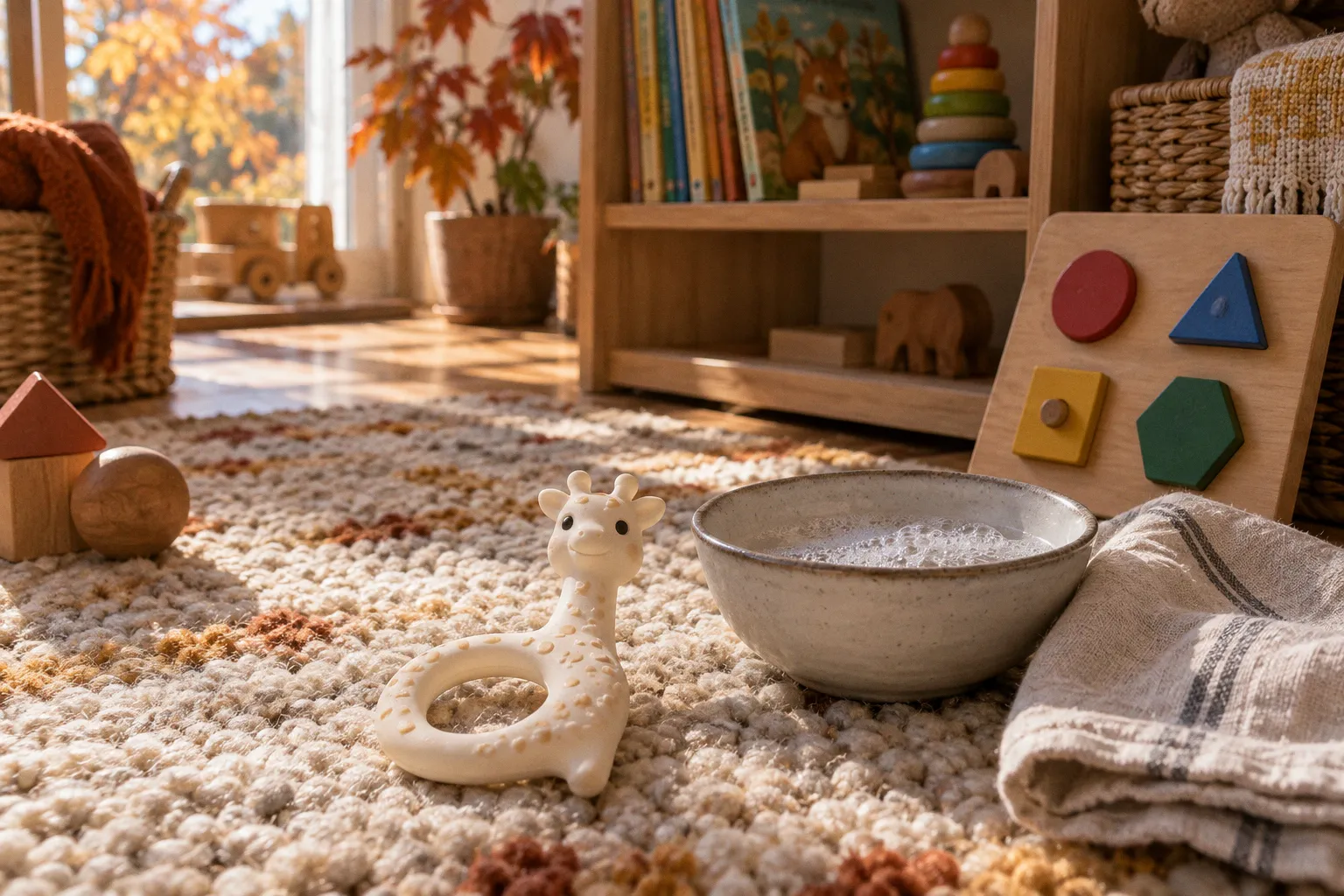
For routine hygiene, use a gentle hand-wash with warm water and mild dish soap, then let the teether dry thoroughly.
That routine needs one adjustment if the teether has a squeaker or air holes: do not submerge it. Water trapped inside can create conditions for mold. The safest natural rubber teether cleaning and sterilization steps depend on the toy’s construction and the manufacturer’s instructions—not on whether a method works for other baby products.
Why high-heat sterilization can damage natural rubber
Natural rubber has different material properties from food-grade silicone. Heat and harsh detergents can make latex deteriorate prematurely, so methods that seem reassuringly thorough—boiling, steam sterilizing, or running a teether through the dishwasher—are not automatically safe.
For natural rubber, “more intense” does not mean “more hygienic.” If the manufacturer does not specifically approve a high-heat method for that model, avoid it. The same caution applies to UV sterilizers: use one only if the manufacturer says it is suitable for that particular natural rubber teether. A product’s natural-material credentials are not a substitute for care instructions.
A useful distinction is between cleaning and sterilizing. Everyday cleaning removes ordinary dirt and residue. Sterilizing is a more intensive process, and not every material can tolerate the heat or equipment commonly used for it. Do not assume that a natural rubber teether can be sterilized like a silicone one.
With natural rubber, protect the material first: warm water and mild soap are the routine, not boiling water or steam.
Before washing, check the toy for openings and read the manufacturer’s care guidance. If instructions permit only wiping, follow that limit. If the toy has a cavity, squeaker, or air holes, treat moisture management as part of cleaning—not as an afterthought.
The gentle hand-wash method
For a solid teether with no openings, a careful hand-wash is the straightforward daily option. Use warm water and a small amount of mild dish soap. Wash the surface gently, rinse away the soap, and allow the teether to air-dry completely before returning it to the baby.
If the toy only needs a quick clean and the manufacturer’s instructions allow it, wipe it with a clean, damp cloth instead of washing it under running water. This uses less water and limits how much moisture reaches seams or openings. Do not use abrasive pads or harsh cleaners unless the care instructions specifically call for them; aggressive cleaning can undermine the material you are trying to preserve.
A practical routine looks like this:
1. Check the construction. Look for air holes, a squeaker, a seam, or another opening that could let water enter. Confirm the care instructions before choosing a method.
2. Use warm water and mild soap. Wash a solid teether by hand, gently cleaning its surface. For a toy that should not be immersed, use a clean damp cloth.
3. Rinse away residue. Soap left on the surface is not part of a clean finish. Rinse gently if the toy’s design and instructions allow it.
4. Dry it fully. Leave it in a clean, well-ventilated place until the surface is dry before storing or offering it again.
5. Inspect before use. Look for cracks, sticky or degraded areas, or other changes in the rubber. If the toy’s condition has changed, follow the manufacturer’s guidance about whether to stop using it.
This is a cleaning routine, not a promise that every natural rubber toy can be treated identically. Shapes, construction, and manufacturer instructions differ. A toy with a hollow interior calls for more restraint than a solid piece, because water that enters the cavity may be difficult to remove.
Preventing mold in teethers with air holes
A squeaker or air hole changes the washing decision. If water gets inside, it can remain trapped in the cavity and create a mold hazard. For these teethers, do not submerge the toy. Wipe the exterior with a clean damp cloth, following the manufacturer’s instructions, and avoid squeezing or handling it in a way that draws water through an opening.
This is a point where an apparently thorough wash can backfire. A toy may look clean on the outside while retaining moisture inside. The risk is not solved by leaving the surface to dry; internal water may not be exposed to the airflow that dries the exterior.
Keep the following distinctions in mind:
| Teether construction | Cleaning approach | Main concern |
|---|---|---|
| Solid, with no openings | Gentle hand-wash with warm water and mild soap, if the manufacturer permits | Rinse off soap and air-dry completely |
| Squeaker or air holes | Do not submerge; wipe the surface with a clean damp cloth | Water trapped inside can create a mold hazard |
| Care instructions specify a method | Follow the instructions for that model | Do not substitute heat or equipment without approval |
If you cannot tell whether a toy has an opening or cavity, do not assume that it is solid. Check the product information or contact the manufacturer. When instructions are unclear, wiping the surface is the more cautious approach than immersing it.
Drying also deserves attention after a permitted hand-wash. Set the teether aside where air can reach it rather than putting it away damp. Avoid sealing it in a container while moisture remains on the surface. For toys with openings, however, surface drying cannot guarantee that the inside is dry; prevention starts by keeping water out.
Cooling a teether without freezing it
A chilled teether may offer extra soothing relief, but natural rubber should not go in the freezer. Freezing can cause the material to crack. If the manufacturer permits cooling, place the teether in the refrigerator for around 20 minutes, then check its condition and temperature before giving it to the baby.
The refrigerator is not a sterilizer, and chilling does not replace cleaning. Wash or wipe the toy according to its care instructions, let it dry, and then cool it if appropriate. Putting a wet teether in storage or leaving it in conditions the manufacturer has not approved adds avoidable uncertainty.
Do not treat the 20-minute guidance as permission to ignore product-specific instructions. Manufacturers may give different care directions for a particular design. If the packaging says not to refrigerate the teether, follow that advice rather than applying a general rule.
Scent, inspection, and material aging
A new natural rubber teether may have a subtle tree-sap scent when it comes out of the package. That smell can naturally fade after a few days of washing and air-drying. It is not, on its own, a reason to boil the toy or use a strong fragrance or cleaner to cover the scent. Those responses may be harder on the material than the smell itself.
The more useful habit is regular inspection. Natural rubber’s service life cannot be generalized across manufacturers, so no universal lifespan should be assumed. Care instructions, construction, and the toy’s condition matter. Look for cracks or signs that the rubber has deteriorated, particularly after cleaning or cooling. If the surface changes, stop and consult the manufacturer’s guidance.
Material claims also need a firm boundary. Natural rubber is a plant-derived material, but that does not make every cleaning method safe, and it does not establish suitability for a child with a known latex allergy. Do not use a natural rubber teether for an infant with a known latex allergy unless a qualified clinician has advised that it is appropriate.
A durable routine is gentler, not harsher
For most routine care, the answer is simple: hand-wash a solid natural rubber teether with warm water and mild dish soap, or wipe it with a clean damp cloth when that is the suitable method. Keep toys with air holes or squeakers out of standing water. Avoid boiling, steam, dishwashers, unsuitable UV sterilizers, and the freezer unless the manufacturer explicitly approves the method.
That approach respects both hygiene and tactile integrity. A teether is handled, chewed, washed, and handled again; harsh treatment can compromise the material without making the care routine more responsible. Follow the instructions for the specific toy, keep water out of cavities, let permitted washes dry fully, and retire the teether if it shows deterioration.