Non-Toxic Wooden Crib Checklist Before Nursery Setup
A crib can look beautifully simple—smooth timber, a quiet finish, clean lines—but the safety of a nursery depends on details that are easy to miss at first glance.
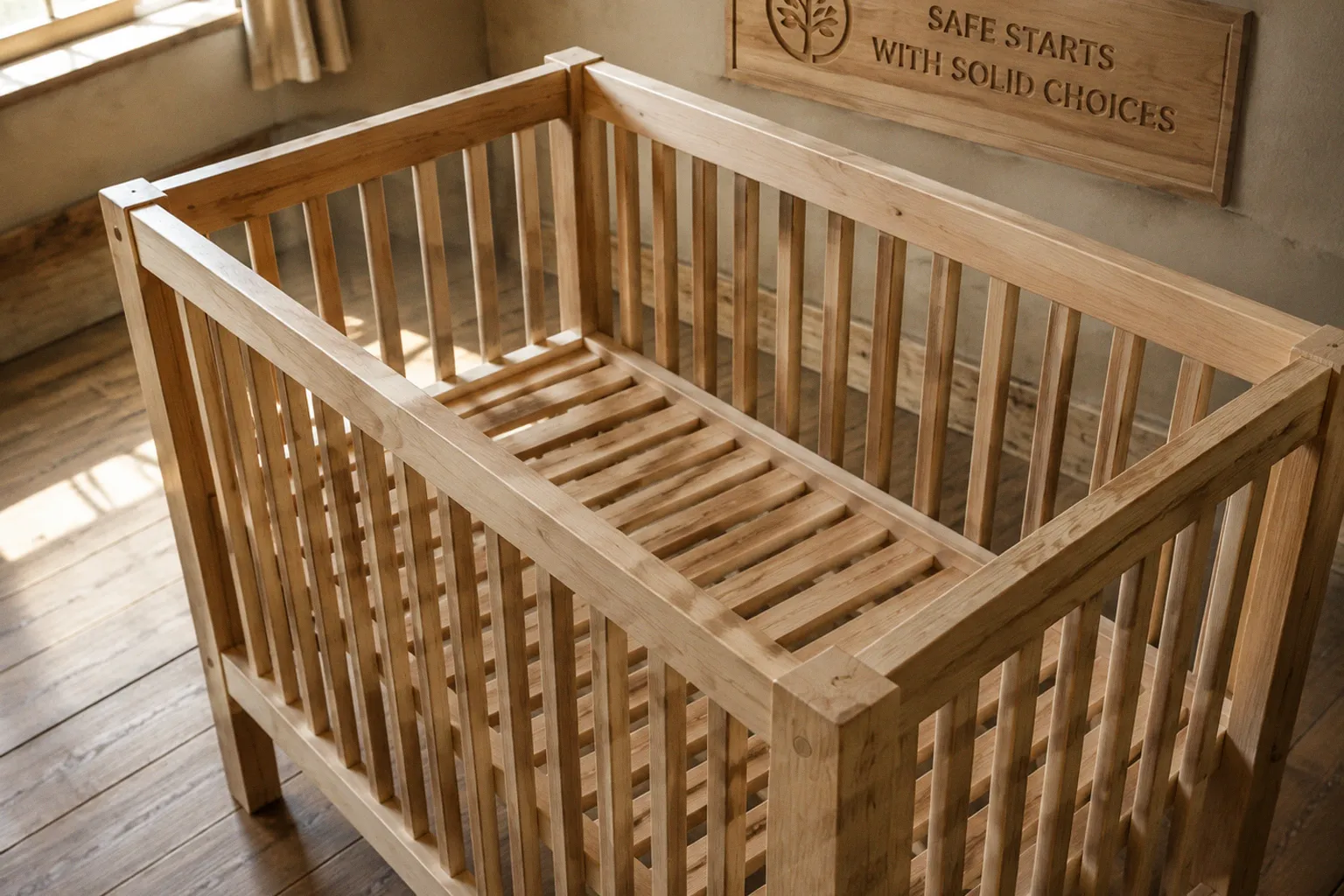
Parents often focus on the wood species or the colour of the finish, while the more important questions are slightly less visible: How was the crib constructed? What does it release into the room? Are the slats correctly spaced? Does the mattress fit closely enough to prevent entrapment?
A non-toxic wooden crib checklist brings those questions together before the crib becomes the centre of the nursery. The goal is not to find a product that makes dramatic claims on its packaging. It is to look for a sound combination of low emissions, durable construction, safe mechanical design, and clear evidence of independent testing.
Start with the crib’s core material
The phrase “wooden crib” does not always mean the same thing. A crib may be made from solid wood, engineered wood, MDF, particleboard, or a combination of materials. These materials can sit beneath the same attractive paint colour, so the construction details deserve more attention than the styling.
Solid wood cribs made from materials such as beech, pine, or maple generally avoid the synthetic glues, formaldehyde emissions, and composite adhesives commonly associated with MDF, particleboard, and other engineered wood products. That does not make every solid wood crib automatically non-toxic. A solid timber frame can still be coated with a finish that produces unwanted emissions, and hardware or glue used in assembly may still require scrutiny.
Think of the wood as the foundation rather than the complete answer.
When reading a product description, look for clear language about:
- Which parts are solid wood and which, if any, are composite board.
- Whether the mattress platform, drawer components, or support panels use MDF or particleboard.
- How the wood has been sealed and finished.
- Whether the manufacturer provides emissions or chemical-testing information.
- Whether replacement parts and assembly instructions are available.
A vague description such as “wood construction” gives you very little to work with. It may refer to a crib with solid-wood rails and composite panels hidden in less visible areas. That is not necessarily a reason to reject the crib, but it is a reason to ask more precise questions.
Why construction matters in a nursery
Infants spend long periods close to the crib’s surfaces. They breathe near the mattress platform and rails, touch the finish with their hands, and may eventually mouth the top rail as they pull themselves upright. A nursery also tends to be a relatively enclosed room, particularly during colder weather when windows remain closed.
This is where practical material choices support healthy indoor air quality. A crib with a solid wood structure and independently verified low emissions gives you a stronger starting point than one that simply looks natural.
“Natural-looking” is a visual description, not a chemical or safety standard.
A beautifully pale crib may have a heavily pigmented coating. A darker crib may use a carefully tested water-based finish. Colour, grain, and the word “eco” cannot tell you enough on their own.
Check chemical emissions, not just marketing language
A low VOC baby crib checklist should begin with a straightforward question: has the finished crib been tested for emissions?
VOC stands for volatile organic compounds. These are chemicals that can be released into indoor air from finishes, adhesives, coatings, and other manufactured materials. In a nursery, the relevant issue is not whether a crib is made from wood in the broadest sense. It is whether the completed product has been assessed for what it emits into the room.
What GREENGUARD Gold tells you
GREENGUARD Gold certification is designed for products used in sensitive environments, including nurseries. The certification screens products for emissions from more than 10,000 chemicals and 360 individual VOCs. It is therefore more meaningful than a general claim that a finish is “safe,” “natural,” or “non-toxic” without supporting documentation.
GREENGUARD Gold does not mean a crib contains no chemical compounds at all. It indicates that the product meets stringent limits for chemical emissions. That distinction matters because responsible product evaluation depends on precise language rather than absolute promises.
When reviewing a crib listing or manufacturer page, look for:
1. The exact certification name.
“GREENGUARD Gold” is more specific than “green certified” or “eco-tested.”
2. The certified product or model.
A company may make several cribs, but certification may apply only to particular models or configurations.
3. The finished product, not just the raw timber.
Testing the wood alone does not tell you how the stain, lacquer, adhesive, or assembled components behave together.
4. A traceable certification record or testing reference.
If a claim cannot be connected to a named product, treat it cautiously.
The safest approach is to regard emissions testing as one layer of evidence. It works alongside structural testing, material transparency, and careful inspection after delivery.
What “water-based” and “non-toxic finish” really mean
A water-based finish may be a sensible choice, but the phrase itself is not a complete testing standard. Manufacturers can use different formulations, and the exact composition of proprietary finishes is not always publicly available. Similarly, “non-toxic finish” is useful only when supported by clear product information or independent certification.
A solid wood crib with a non-toxic finish should ideally offer:
- A smooth surface without flaking, bubbling, or sticky areas.
- No strong chemical odour that persists after unpacking and airing.
- Clear information about the coating or emissions testing.
- A finish that remains intact when wiped according to the care instructions.
- No exposed rough patches around rails, corners, or mattress supports.
Do not confuse smell with a complete safety assessment. A strong odour is a practical warning sign, but the absence of smell does not prove that a product has been independently tested.
Work through the mechanical safety checks
Chemical safety is only half of the nursery conversation. A low-emission crib still needs to hold its shape, keep its rails secure, and prevent dangerous gaps. Babies move in ways that are wonderfully unpredictable: they rotate, push, pull, climb, and test every edge they can reach.
For cribs sold for use in the United States, federal regulations and ASTM F1169 address key mechanical requirements. The crib should have stationary sides; drop-side crib designs are prohibited in the U.S. because of their safety hazards.
The measurements that deserve your attention
Federal regulations specify that crib slat spacing must be no wider than 2 3/8 inches, approximately 6 centimetres. This limit helps prevent an infant’s head from becoming trapped between slats.
A full-size crib also has regulated interior dimensions of approximately:
- 28 ± 5/8 inches wide
- 52 3/8 ± 5/8 inches long
The mattress should fit the crib closely. The mattress edge gap should be no more than the width of two fingers. This is a simple check, but it is one of the most useful hands-on steps once the crib is assembled.
| Check | What you are looking for | Why it matters |
|---|---|---|
| Slat spacing | No more than 2 3/8 inches, or about 6 cm | Helps reduce the risk of head entrapment |
| Crib sides | Stationary sides rather than a drop-side mechanism | Avoids hazards associated with drop-side designs |
| Mattress fit | No gap wider than two fingers at the edge | Reduces the risk of a baby becoming wedged |
| Interior dimensions | Full-size dimensions close to 28 ± 5/8 by 52 3/8 ± 5/8 inches | Supports a properly fitted full-size mattress |
| Hardware | Tight, complete, and correctly installed fasteners | Prevents movement, loosened rails, and structural instability |
| Frame condition | No cracks, splinters, sharp projections, or peeling finish | Protects skin, fingers, and mouths during everyday use |
These checks are not a substitute for a current safety certification, but they help you notice problems that may appear during assembly or after use.
A useful assembly pause
After assembling the crib, do not move straight on to arranging the nursery décor. Stand beside it and run your hands along the rails, corners, and mattress support. Listen for movement when you apply gentle pressure to the frame. Look at every fastener rather than assuming the final step was completed correctly.
This is particularly helpful when the crib has been assembled by more than one person. A missing washer, partially tightened bolt, or incorrectly positioned mattress support may not be obvious from across the room.
If the instructions are unclear, stop and contact the manufacturer rather than improvising with substitute screws or hardware. A crib is not the place for a convenient fix from the household toolbox.
Inspect the finish where children actually touch
A finish can affect both indoor air quality and day-to-day durability. The top rail, corner posts, and lower edges receive the most tactile contact. Once a baby can sit or stand, those areas may also receive chewing, rubbing, and repeated pressure from small hands.
A good finish should feel even and secure. Pay close attention to:
- Rough grain that catches on a fingertip.
- Splinters along the top rail.
- Paint or lacquer that lifts at corners.
- Sticky or soft areas that collect dust.
- Cracks where two finished surfaces meet.
- Strong odour that remains after the crib has been aired as directed.
- Visible differences between the finish on the main frame and the mattress platform.
The finish does not need to be glossy to be protective. A matte surface may be perfectly suitable if it is properly sealed and durable. Likewise, a “natural” oil or wax finish should not be treated as automatically safer than a tested water-based coating. The key question is how the completed surface performs and what evidence supports the manufacturer’s claim.
Before the baby sleeps in it
If the manufacturer recommends airing the crib before use, follow that guidance in a well-ventilated room. Keep the crib away from the baby’s sleeping space until the product has been assembled, inspected, and any persistent odour has been addressed.
Do not add an extra liner, pad, decorative bumper, or loose fabric to make the interior feel softer. These additions can create new hazards and may interfere with the mattress fit. The safest nursery is often the one with fewer objects inside the sleep space, not more.
Understand the difference between certification seals
Parents sometimes see several logos on a nursery product and assume they all test the same thing. They do not. One certification may focus on chemical emissions, while another verifies structural and mechanical compliance.
JPMA certification is a voluntary seal indicating that a product has been assessed by an independent laboratory for compliance with applicable ASTM standards and federal regulations. It is relevant to the crib’s physical safety and construction. JPMA certification should not be presented as proof that a crib has passed VOC off-gassing tests.
GREENGUARD Gold, by contrast, focuses on chemical emissions and indoor air quality. It screens for emissions from more than 10,000 chemicals and 360 individual VOCs. These certifications answer different questions, so they are best understood together rather than placed in competition.
| Certification or claim | Main area of focus | What it does not prove |
|---|---|---|
| GREENGUARD Gold | Low chemical emissions and VOC limits | That the crib contains no chemicals at all or is mechanically safe without further evidence |
| JPMA certification | Independent laboratory verification of relevant ASTM and federal safety requirements | That the crib has passed VOC-specific emissions testing |
| “Solid wood” | The primary structural material | That the finish, adhesives, or hardware are non-toxic |
| “Water-based finish” | A description of the coating type | That the exact formulation has been independently tested |
| “Eco-friendly” | A broad sustainability or marketing statement | Specific emissions, dimensions, or mechanical compliance |
This distinction helps prevent a common mistake: treating one reassuring label as a complete safety profile.
Be cautious with older and second-hand cribs
A vintage or hand-me-down crib may have beautiful craftsmanship, but age changes the safety conversation. Older cribs may have drop-side mechanisms, wider slat spacing, worn hardware, unstable mattress supports, or finishes that have not been evaluated against current expectations.
Cribs made before 2011 should not be assumed to be safe or non-toxic simply because they are made from solid timber. Lead paint testing, structural inspection, and confirmation that the crib does not use a prohibited drop-side design would all be necessary before considering one for use.
Even then, a crib with an unknown history can be difficult to assess. Missing instructions, modified hardware, replacement parts of uncertain origin, and years of movement between homes all make reliable evaluation harder.
For a second-hand crib, walk through these questions carefully:
1. Is the manufacturer and model identifiable?
2. Are the original assembly instructions available?
3. Are all structural parts and fasteners present?
4. Are the sides stationary?
5. Does the slat spacing meet the current measurement?
6. Is the finish intact and free from peeling?
7. Has the crib been recalled or modified?
8. Does the mattress fit with no more than a two-finger gap?
If several answers are uncertain, the crib may not be a sensible foundation for a newborn’s sleep space, regardless of how appealing the timber looks.
In a nursery, durability is not only about how long the furniture lasts. It is also about how reliably it keeps its safety properties as a child grows.
A practical setup sequence for families
The easiest way to use this non toxic wooden crib checklist is to inspect the crib in stages rather than trying to answer every question at the shop or while surrounded by packaging.
Before purchase
Read beyond the product photographs. Confirm the construction materials, the finish information, the relevant certification, and the dimensions. If the manufacturer uses broad phrases such as “chemical-free” or “completely safe,” look for the evidence behind those statements.
For an eco friendly nursery furniture safety review, ask whether the product balances responsible material choices with current mechanical standards. Sustainability is valuable, but it should not be used to excuse unclear safety information.
During delivery and unpacking
Inspect the components before assembly. Look for damaged rails, crushed corners, cracked timber, peeling coating, and hardware that does not match the instructions. Keep the packaging and documentation until the crib has been assembled and checked.
If the crib arrives with a strong persistent odour, give it space and ventilation before placing it in the nursery. Do not cover the smell with fragrance sprays or essential oils; these add more substances to the air rather than solving the original concern.
During assembly
Follow the manufacturer’s sequence. Tighten each connection as directed, check that the mattress support is at the correct position, and make sure no parts are left over without an explanation in the instructions.
Once the crib is complete, inspect it from the level of the mattress as well as from standing height. A detail that is easy to miss above the rails may be obvious when viewed from where the baby will sleep.
Before first use
Place the mattress in the crib and check the edges with your fingers. Confirm that the gap is no wider than two fingers. Press gently against the rails and check for movement. Run a clean hand over the top rail and corners to identify roughness or lifted finish.
Keep the sleep space clear of loose items. Nursery design can remain warm and tactile through the surrounding room—wooden shelves, organic cotton textiles used outside the crib, a soft rug placed safely away from climbing routes—without placing extra materials inside the sleeping area.
As your child grows
Repeat the inspection occasionally. Toddlers use furniture with more force than babies do, and a crib that felt firm on the first day may need its fasteners checked later according to the manufacturer’s care instructions.
Watch the areas your child touches most. If the top rail begins to splinter, peel, or show exposed material, stop and seek guidance from the manufacturer. Do not casually repaint or reseal a surface with an unverified household product, particularly where a child may chew.
The details that make a crib feel genuinely reassuring
The best non-toxic wooden cribs do not require you to choose between a calm nursery aesthetic and careful safety standards. Solid wood can provide a durable, tactile structure. A properly tested finish can support better indoor air quality. Independent certifications can give you information that marketing language alone cannot provide.
Still, no single label does all the work. The strongest choice is usually the one with a clear material description, current mechanical compliance, appropriate emissions testing, a well-fitting mattress, and instructions that make safe assembly possible.
A crib is not merely another piece of nursery furniture. It is the surface your child will sleep beside, touch, pull against, and eventually test with growing confidence. Taking the time to check the wood, finish, emissions, dimensions, hardware, and certifications is a practical form of care—and it gives the rest of the nursery room to be beautiful without carrying the whole burden of safety.