Organic Cotton Baby Toys: Safe Washing Steps
Organic cotton baby toys are often chosen because they feel simpler: a soft textile, a short materials list, fewer unnecessary finishes, and a surface that will spend a great deal of time against a baby's face and hands.
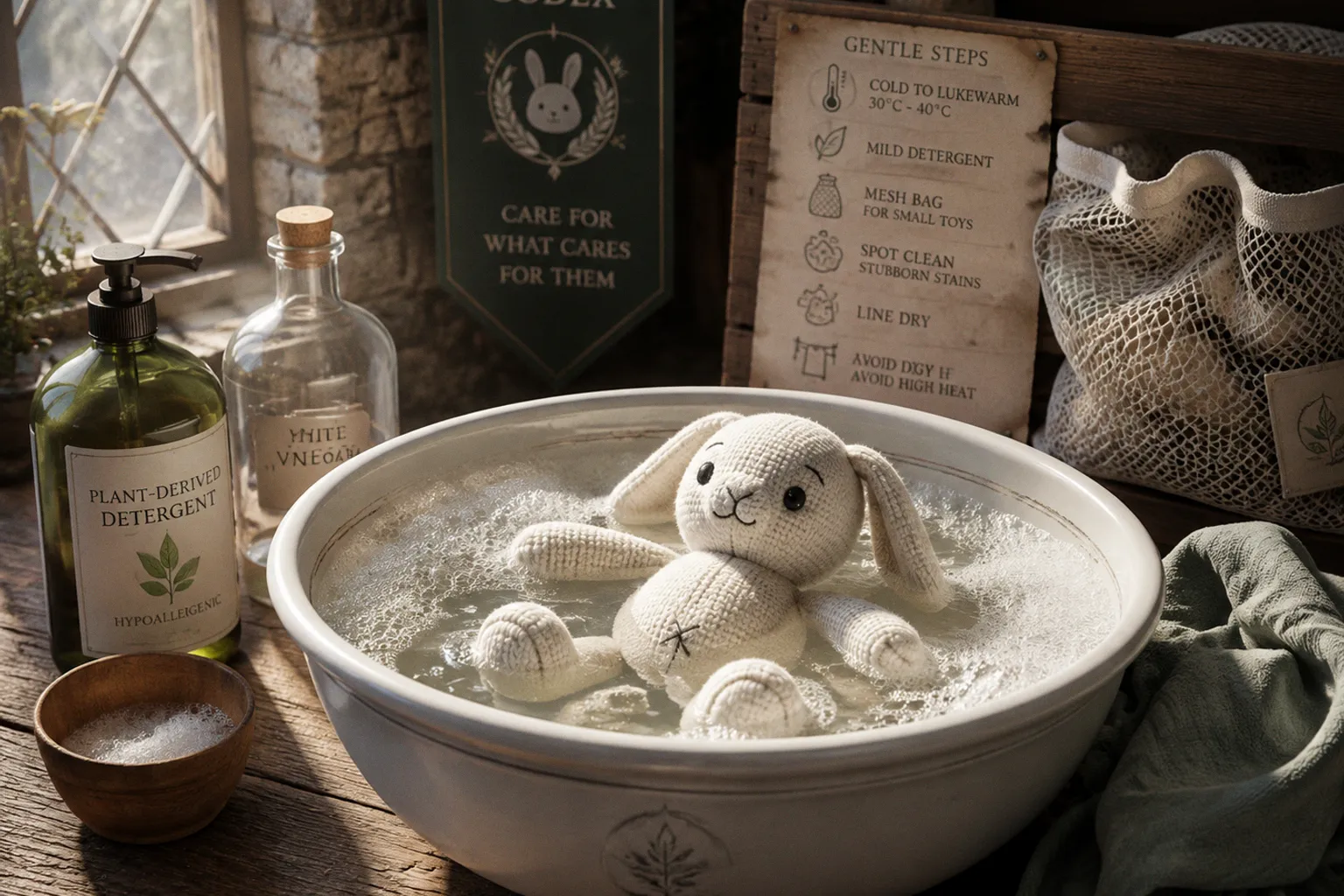
But the word “organic” does not make the entire toy automatically free from synthetics, coatings, adhesives, dyes, or chemical residues. A toy may have an organic cotton outer fabric while containing polyester filling, plastic eyes, silicone parts, wooden attachments, or internal sound components.
That is why organic cotton baby toy washing steps begin with the toy itself, not the washing machine. Check the care label, examine how the parts are attached, and decide whether the item can tolerate immersion. GOTS certification can provide useful information about certified textile production, but it is not a substitute for checking the construction and care instructions of the finished toy.
The aim is straightforward: remove milk, food, drool, and ordinary household dirt without adding unnecessary fragrance, heat, friction, or moisture to a product designed for frequent handling. The best routine is usually gentler and less complicated than the one used for adult laundry.
Organic cotton is not automatically the same as an all-natural toy. Treat the fabric, filling, stitching, and attachments as separate parts of the washing decision.
Preparing Your Washing Machine for Organic Textiles
Before placing a baby toy in the drum, look at the machine that will wash it. Detergent residue, fabric softener, fragrance, and loose dye from previous loads can remain in the dispenser, door seal, filter area, and drum. A toy with a napped or plush surface can hold onto residue more readily than a smooth cotton garment, so a clean machine is part of washing non toxic plush toys responsibly.
An empty maintenance cycle can help remove accumulated buildup. Follow the washing machine manufacturer’s instructions first; some machines have a dedicated cleaning programme, while others recommend a hot empty cycle with a specific cleaner. There is no need to improvise with a large amount of vinegar or other household ingredients. Vinegar may help with mineral deposits in some cleaning contexts, but it is not a universal machine cleaner, and repeated use can be unsuitable for certain seals or components. The reliable approach is to clean the detergent drawer and door seal, check the filter according to the manual, and run the machine’s recommended maintenance cycle.
The detergent matters more than an elaborate laundry ritual. Choose a product that is:
- fragrance-free rather than merely labelled with a soft or “fresh” scent;
- free from optical brighteners and added dyes where possible;
- suitable for sensitive skin or baby laundry, while still checking the ingredient information;
- used in the amount recommended for the load and water hardness.
The word “hypoallergenic” is not a complete materials disclosure. It describes a marketing or product-positioning claim, not a guarantee that every ingredient will suit every child. If the label provides little useful information, choose a simpler alternative rather than relying on the front-of-pack promise.
Fabric softener and dryer sheets are best left out of the routine. They are designed to leave a coating on textile fibres, changing the hand feel and absorbency of the fabric. Fragranced products can also leave a scent that is unpleasant or irritating for some children. Plant imagery or “natural” wording on the packaging does not, by itself, change how the product behaves on the textile.
A second preparation step is to inspect the toy before washing. Look for:
- loose threads, open seams, or areas where stuffing is visible;
- wooden rings, stitched ribbons, crocheted loops, or silicone pieces that may catch;
- batteries, speakers, crinkle material, squeakers, or other components that should not be submerged;
- surface treatments or embellishments that the care label says must be wiped rather than washed.
If a seam is already opening, washing may turn a small repair into a lost filling or detached part. Repair it first, or keep the toy out of the machine and clean only the surface.
Hand-Washing Techniques for Delicate Plush Toys
Hand washing is usually the better choice for lightly stuffed comforters, small sensory toys, toys with attached components, and products whose labels say to wash gently or by hand. It gives you control over pressure, soaking time, and the movement of water through the filling.
It is particularly useful when the toy includes wooden rings, cotton cords, embroidered details, knotted ribbons, or stitched-on features. These pieces may be durable in ordinary play but can snag against a machine drum or become twisted during a high-speed spin. A toy does not need to be extremely delicate to benefit from a slower wash.
Hand-Wash Procedure
1. Read the care instructions and test for colourfastness.
Dampen an inconspicuous seam with cool or lukewarm water and press it with a white cloth. If colour transfers noticeably, avoid soaking the whole toy and use a more limited surface-cleaning method.
2. Prepare a clean basin.
Use lukewarm water rather than very hot water. The correct temperature depends on the care label, but moderate water reduces the risk of shrinkage, dye bleeding, and distortion. Cold water can still be effective for light soil; there is no need to make the water uncomfortably warm.
3. Dissolve the detergent before adding the toy.
Use a small amount of fragrance-free detergent and distribute it through the water. Undiluted detergent placed directly on one patch of cotton can leave a concentrated mark and make rinsing more difficult.
4. Move the toy through the water without twisting it.
Press it gently beneath the surface and release it repeatedly. This allows water to pass through the outer fabric and, where appropriate, the filling. Avoid aggressive rubbing, wringing, or pulling at embroidered and stitched features.
5. Keep the soak short unless the label says otherwise.
A brief soak can loosen dried food or saliva, but prolonged soaking allows the filling to become saturated and may stress dyes, adhesives, or internal components. For a visibly dirty toy, drain the water and make a fresh solution rather than adding more detergent.
6. Rinse until the water is free of a slippery detergent feel.
Use clean water and repeat the gentle compression motion. A plush toy may require several changes of rinse water because the pile and filling retain moisture. Residual detergent is a reason to rinse again, not a reason to add fragrance products.
7. Remove water with towels.
Place the toy between clean towels and press down. Do not twist it into a rope or lift a heavy, saturated toy by one ear, limb, or attached loop.
Hand washing does not make an unsuitable toy washable. A product with electronics, paper inserts, glued parts, or a filling that the manufacturer specifically says must stay dry should be surface-cleaned instead. In those cases, wipe the accessible fabric with a barely damp cloth and allow it to dry completely, following the care instructions for the individual item.
Machine-Washing Protocols for GOTS-Certified Cotton
Machine washing can work well for a larger plush toy or a group of small cotton items when the care label permits it. GOTS-certified cotton describes the certified textile and its processing requirements; it does not mean every component of a finished toy can be treated as ordinary cotton laundry. The outer shell, filling, thread, trim, and attachments still need to be considered.
Use a protective mesh bag when the toy fits comfortably inside one. The bag should not compress the toy tightly, and it should not be used to force an item into a cycle that the manufacturer does not allow. For a larger plush toy, a clean pillowcase secured so that the toy cannot escape may provide a similar layer of protection, but the care label remains the deciding authority.
| Parameter | Hand Washing | Machine Washing |
|---|---|---|
| Best suited to | Small plush toys, toys with attachments, lightly stuffed comfort objects | Washable larger plush toys and groups of simple cotton items |
| Water temperature | Cool to lukewarm, according to the label | Cool or lukewarm, according to the label |
| Detergent | Small amount, dissolved in the basin first | Fragrance-free detergent measured for the load |
| Mechanical action | Gentle pressing; no wringing or twisting | Delicate or gentle cycle with a low or moderate spin |
| Protection | Clean basin and towel pressing | Mesh laundry bag or similar protective cover where suitable |
| Items to exclude | Electronics, batteries, paper, and components marked dry-clean or surface-clean only | Any toy with components that can be damaged by immersion or agitation |
| Drying | Flat or supported air-drying | Flat or supported air-drying unless the label specifically permits another method |
A gentle cycle does not mean every setting should be left to the machine’s default. Check the temperature, spin speed, and cycle duration. Lower mechanical stress is generally preferable for stuffed toys because seams, loops, embroidery, and filling can shift when the toy is repeatedly compressed and spun.
Hot water deserves a more careful explanation than a blanket prohibition. Some care labels permit or recommend warmer washing for particular products, and heat can be relevant when cleaning certain types of heavy soiling. However, higher temperatures can also contribute to shrinkage, colour change, seam stress, and damage to fillings or attachments. For many organic cotton toys, cool or lukewarm washing is a sensible default unless the manufacturer specifies otherwise. It is not accurate to claim that a hot cycle offers no hygiene benefit in every situation; its value depends on the contamination, the complete wash programme, the detergent, and the construction of the toy.
For the same reason, washing frequency should be based on use and condition rather than a universal timetable. A toy carried everywhere, mouthed throughout the day, or exposed to food may need more frequent washing than one kept in a cot or used occasionally. After illness, vomiting, a substantial spill, or visible soiling, clean the toy before returning it to active use. A toy that looks clean and is used lightly may not need the same schedule.
Daily washing is not automatically necessary, and it can add wear when the toy is repeatedly saturated, agitated, and dried. But the decision is not a test of a parent’s anxiety or cleanliness. It is a practical judgment about the child, the toy, and the circumstances. If a baby has been unwell or the toy has been heavily soiled, hygiene takes priority over preserving the fabric. If the toy is clean and dry, unnecessary washing may simply expose it to another round of mechanical stress.
Natural Methods for Spot-Treating Stubborn Stains
Spot treatment is useful when a small mark does not justify immersing the entire toy. It is also a way to reduce friction: less washing means less handling of seams, filling, trims, and surface colour. Start by checking the care label and testing any method on a hidden area.
The safest first response is usually physical removal. Blot milk, formula, puree, or saliva with a clean damp cloth before the residue dries further. Do not scrub a plush surface aggressively. Rubbing can push the stain deeper into the pile, spread the mark, and roughen the cotton fibres.
Baking soda can be useful in a limited role, but its chemistry should be described accurately. It is sodium bicarbonate, a mildly alkaline powder and gentle deodorising or absorbent agent. It is not a surfactant and does not clean grease in the same way as a detergent or dishwashing liquid. A small paste may help loosen or absorb some surface discoloration, but it is not a substitute for washing and it may leave powder behind if not rinsed thoroughly.
A mild, fragrance-free dish soap works differently. Its surfactants help surround and lift oily residues, which is why a very small amount can be appropriate for a greasy food mark. Dish soap should be diluted or applied sparingly, worked into the affected area with a soft cloth, and rinsed out carefully. More soap is not more effective on a stuffed toy; it is simply harder to remove from the fibres.
Spot-Treatment Procedure
- Milk, formula, and food puree: Blot first with a damp cloth. If the residue is fresh, cool or lukewarm water may remove much of it without any cleaning product.
- Dried organic stains: Loosen the area with water, then use a small amount of the toy’s usual fragrance-free detergent or a carefully rinsed baking-soda paste. Avoid hard brushing.
- Grease or oily food: Apply a tiny amount of mild dish soap to a damp cloth, dab the mark, and rinse the treated area with clean water.
- Odour without visible staining: Air the toy in a shaded, well-ventilated place after ensuring it is completely dry. Do not use perfume to cover an odour.
- Unknown or persistent marks: Consult the manufacturer rather than escalating immediately to bleach, brighteners, or strong solvents.
Chlorine bleach can weaken cotton and affect dyes. Optical brighteners do not remove a stain; they leave fluorescent compounds that make fabric appear brighter under certain light. Fragranced stain sprays may also leave residues that are difficult to rinse from plush fabric. These products are poor defaults for organic cotton stuffed animal care, especially when the toy is likely to go back into a baby’s mouth.
Hydrogen peroxide and rubbing alcohol should not be treated as routine solutions simply because they appear in online cleaning advice. They may affect colour, finishes, adhesives, or trims. If a manufacturer allows one of these products for a particular toy, follow that guidance and test for colourfastness first. Otherwise, use the mildest method that addresses the actual mark.
Spot treatment is not a substitute for full cleaning after significant contamination. If the toy has been soaked with milk, vomit, urine, or another substance that has reached the filling, surface dabbing may leave moisture and residue inside. Wash the toy according to its instructions, or replace it if the filling cannot be cleaned and dried properly.
Baking soda can help with a limited surface problem, but it is not a detergent. Use it as an occasional aid, not as a complete washing system.
The Importance of Air-Drying to Preserve Fiber Integrity
Drying is where many otherwise careful laundry routines become too aggressive. A tumble dryer combines heat, movement, compression, and repeated friction. Some toys tolerate that treatment, but many plush products do not, particularly when they contain a dense filling, embroidered details, glued attachments, crinkle paper, squeakers, or sewn-in sound modules.
The effect is product-specific. One toy may emerge unchanged from a permitted low-heat cycle; another may shrink, lose shape, develop a matted pile, or suffer stress at the seams. There is no reliable universal timeline in which a certain number of dryer cycles will produce a predictable amount of damage. Inspect the toy after each wash instead of assuming that one setting is harmless for every product.
For most washable organic cotton toys, air-drying is the more cautious option:
1. Press out excess water with towels immediately after washing.
2. Reshape the toy while it is damp, paying attention to the head, limbs, ears, and any flat panels.
3. Lay it flat on a clean, dry towel or drying rack with air able to circulate around it.
4. Turn it periodically so the underside does not remain damp.
5. Dry it in a shaded, ventilated area unless the care label gives different instructions.
6. Do not return it to a cot or play area while the filling still feels cool, heavy, or damp.
Hanging may be suitable for a lightweight item with strong, evenly distributed seams. It is less suitable for a saturated plush toy because the wet filling can pull downward and distort the shape. Do not hang a toy from a single ribbon, ear, limb, or loop unless that part is specifically designed to carry the weight.
Direct sunlight can help a damp item dry faster, but prolonged exposure may fade dyed cotton. A bright window is not necessarily the best drying location for a toy whose colour matters. Ventilation and complete drying matter more than making the toy hot.
Drying time varies with humidity, stuffing density, airflow, and the shape of the toy. A thick plush item may feel dry on the outside while retaining moisture around the centre or seams. Press the toy in several places and check the underside before use. If it develops a musty smell, visible spotting, or persistent dampness, stop using it until the problem is resolved. A filling that cannot be cleaned and dried safely may need to be replaced rather than repeatedly treated with stronger chemicals.
Inspecting, Repairing, and Retiring the Toy
Washing is only one part of organic cotton stuffed animal care. A short inspection after drying can catch problems before they become safety issues. Check the seams, eyes, buttons, wooden rings, ribbons, loops, embroidered elements, and any area that has become thin from handling. Pay particular attention to parts that a baby can pull or mouth.
Small repairs can extend the useful life of a well-made toy. A seam may be restitched before the filling escapes; a loose ribbon may be removed if it cannot be secured safely; a wooden attachment may need to be taken out of service if it has cracked or developed a sharp edge. Repairs should restore safety, not preserve an item at any cost. If a component is becoming detachable, the correct decision may be retirement rather than another wash.
The toy’s washing history also matters. Repeated cleaning can gradually change colour, texture, shape, and firmness, even when every individual cycle followed the care label. That does not mean the toy suddenly becomes unsafe after an arbitrary number of washes. It means that condition is a better guide than a promised lifespan. Retire the toy when fabric, filling, stitching, or attachments no longer remain secure and hygienic for its intended use.
An organic cotton outer layer does not guarantee a biodegradable toy. Many products combine organic cotton with polyester fill, plastic components, synthetic thread, or mixed-material trims. At the end of its useful life, separate materials where practical and follow local textile, household, or manufacturer guidance. Reuse as a cleaning cloth is reasonable only when the fabric is clean and free from unsafe attachments. Donation is appropriate only when the toy remains in good condition and can be safely used by another child.
The same material honesty should guide the purchase. If the entire product composition is not clear, ask what the toy is filled with and which components may not be washed. A certified cotton shell can still be a sensible choice, but its benefits should not be exaggerated into a promise that the whole object contains nothing synthetic or that every processing step was identical across every product.
The most useful organic cotton baby toy washing steps are therefore modest: inspect the construction, use the temperature and cycle named by the manufacturer, choose a low-residue fragrance-free detergent, avoid unnecessary coatings, treat stains gently, and dry the toy all the way through. The routine protects both the child’s immediate environment and the toy’s useful life without pretending that one label can answer every materials question.
A natural-fibre toy is not maintained by ideology. It is maintained by attention to what is actually in front of you: the fabric, the filling, the seams, the stain, and the condition after drying. That is a more dependable standard than any universal promise about chemicals, hygiene, or durability.