Wooden Play Kitchens: Key Features to Look For
The most important wooden play kitchen features to look for are not the number of accessories or the realism of the design. They are safety compliance, material quality, structural stability, ergonomic fit, and interaction design.
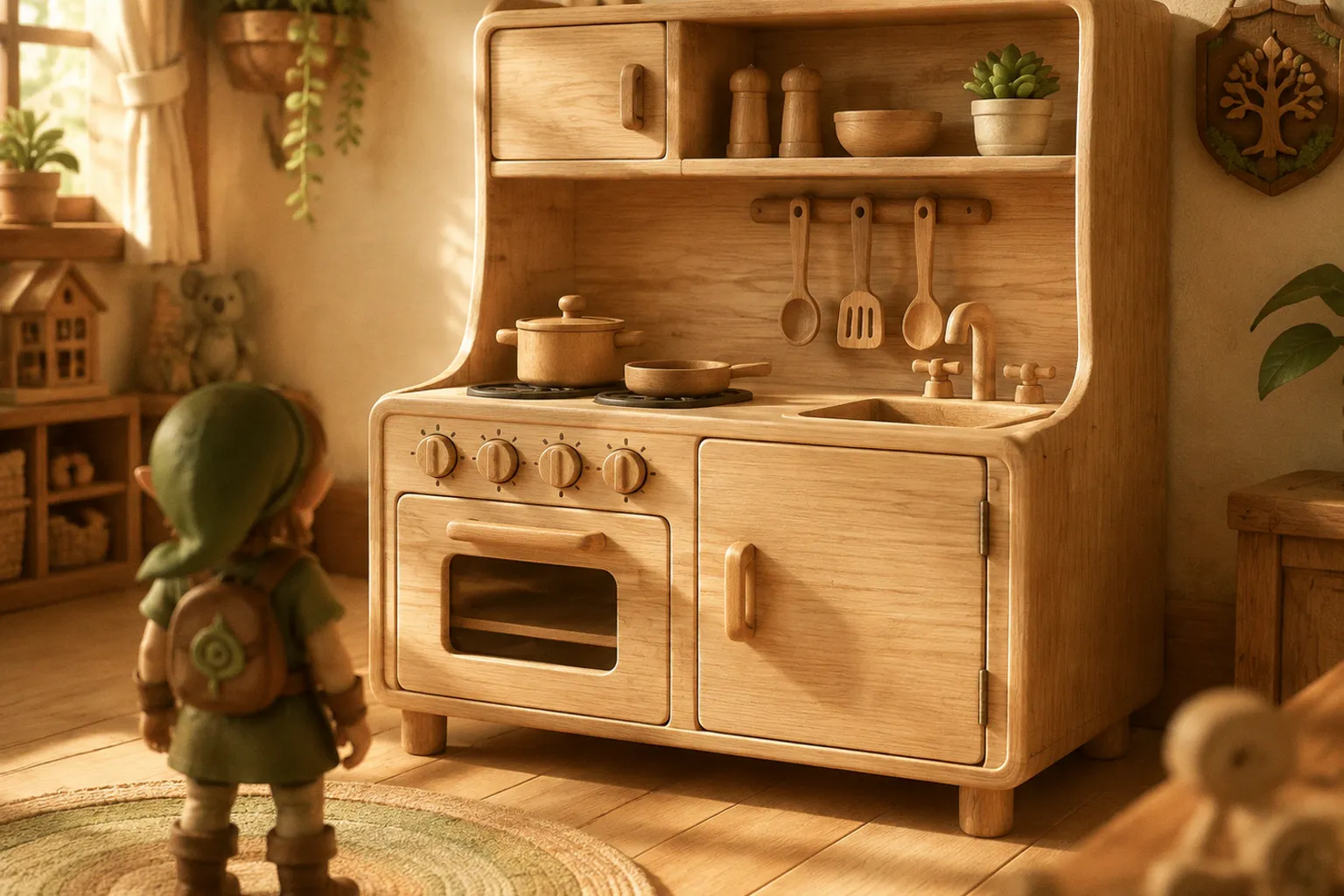
A kitchen that looks attractive but has unstable feet, poorly finished edges, or unclear coating information creates avoidable risks and offers limited developmental value.
A well-designed play kitchen supports several distinct forms of learning. Opening doors and turning knobs require fine motor precision. Arranging food and cookware develops spatial reasoning. Repeating sequences such as washing, preparing, cooking, and serving introduces procedural memory and early algorithmic thinking. These benefits depend on whether the product is physically accessible and cognitively appropriate for the child—not simply whether it resembles a real kitchen.
Start with safety compliance, not appearance
A wooden play kitchen is a toy with multiple mechanical and chemical risk points. It may include doors, hinges, removable components, knobs, hooks, cookware, and decorative hardware. Each part must remain secure during repeated handling. The surface finish also matters because pretend kitchens are commonly used by toddlers, who may mouth objects or touch their faces after handling them.
For products sold in North America, ASTM F963 is the principal toy safety standard. The standard addresses mechanical and physical hazards, small parts, flammability, and limits for certain heavy metals. The current standard update is ASTM F963-23. For products intended for the European market, EN71 is the relevant framework. Its sections include:
- EN71-1: mechanical and physical properties, including hazards from construction, edges, projections, and small components.
- EN71-2: flammability requirements.
- EN71-3: migration of certain elements, including heavy metals from accessible materials and coatings.
These standards do not mean that every wooden kitchen on the market has been tested to the same level. A responsible product description should identify the applicable standard, testing information, or certification documentation. General claims such as “safe,” “natural,” or “eco-friendly” are not substitutes for product-specific compliance information.
What to inspect in the product documentation
When choosing a wooden play kitchen, look for specific information rather than broad marketing language:
1. The intended age range. A kitchen designed for children under three must be assessed with stricter attention to small parts and mouthing behavior.
2. The applicable safety standard. ASTM F963 or the relevant EN71 sections should be named where appropriate.
3. Material and coating information. The description should identify whether the finish is water-based and whether it is free from lead, BPA, and phthalates.
4. Assembly and hardware instructions. The instructions should explain how the unit is secured and whether any anti-tip hardware is included.
5. Warnings for removable components. Small cups, utensils, knobs, hooks, and decorative pieces require closer evaluation than the fixed cabinet structure.
6. Manufacturer traceability. A model number, manufacturer identity, and customer support information are useful if a safety notice or recall affects the product.
A certification mark alone is not a complete assessment. It indicates that a product or product range has been associated with a testing framework, but the buyer still needs to confirm that the documentation applies to the specific model and market.
Safety compliance is a property of the complete product, not a consequence of the word “wooden.”
Material integrity: solid wood, MDF, and surface finishes
Wooden play kitchens are commonly constructed from solid wood, fibreboard, or a combination of materials. MDF is an engineered wood product made from compressed wood fibres. It can provide a uniform surface and stable panel dimensions, while solid wood may offer greater resistance to certain forms of impact and wear. Neither material is automatically safer than the other. Construction quality, edge treatment, fasteners, and coating composition determine the practical result.
FSC certification addresses the source of the wood. It indicates that the wood comes from forests managed under the relevant FSC certification system. This is a sustainability attribute, not a direct guarantee of toy safety, structural quality, or non-toxic finishing. A kitchen can use responsibly sourced wood and still require careful evaluation of its paint, adhesive, hardware, and stability.
Surface quality is a functional issue
Children interact with a play kitchen through repeated touching, gripping, pushing, and occasionally chewing. The surface should therefore be:
- Smooth and free from splinters.
- Rounded at exposed corners and edges.
- Evenly coated without flaking, bubbling, or exposed fibreboard.
- Free from strong persistent chemical odour.
- Finished with a coating identified as water-based where that claim is made.
- Supported by clear information about lead, BPA, and phthalate restrictions.
Paint chipping is not only a cosmetic defect. It can create sharp fragments and expose underlying material. Pay particular attention to the front edges of doors, the corners of shelves, the rim of a sink, and the underside of the worktop. These areas receive frequent contact and are more likely to show premature wear.
The material thickness of panels also affects durability. Thin boards may reduce product weight, but they can flex around hinges and screw points. Flexing accelerates loosening and can cause doors to sag. A heavier panel is not automatically better, yet a product intended for repeated use should not feel excessively light or fragile once assembled.
A practical material comparison
| Parameter | Solid wood construction | MDF or fibreboard construction |
|---|---|---|
| Surface consistency | Natural variation in grain and hardness | Uniform, predictable panel surface |
| Resistance to moisture | Depends on species and finish; exposed edges require care | Vulnerable to swelling if water reaches unfinished or damaged edges |
| Weight | Often heavier, depending on design | Can be lighter and easier to move |
| Edge durability | Can be strong when properly rounded and sealed | Depends heavily on edge banding, coating, and panel thickness |
| Sustainability information | May carry FSC certification if sourced accordingly | Can also use FSC-certified wood fibres |
| Safety implication | Not inherently non-toxic or safer | Not inherently hazardous when properly manufactured and finished |
The correct conclusion is not that one material should always be selected. Instead, evaluate how the material is used. A well-sealed MDF cabinet with rounded edges and secure hardware may be more suitable than a poorly finished solid-wood unit. Conversely, a solid-wood kitchen with an unstable base remains unsafe despite its material label.
Structural stability and toddler ergonomics
The best wooden play kitchen for toddlers must tolerate an uneven pattern of force. Children do not interact with the unit only from the front. They lean on the worktop, pull cabinet doors, reach sideways, carry accessories, and sometimes attempt to climb. The kitchen should be designed to resist these forces without shifting or tipping.
A stable structure usually has a broad base, a low centre of mass, secure joints, and a worktop that does not flex under ordinary contact. The back panel can contribute to rigidity, but only if it is firmly attached. A narrow or tall unit with a light base has a higher tipping risk than a lower, wider design with similar overall dimensions.
No wooden play kitchen is completely immune to tipping. Actual performance depends on weight distribution, floor conditions, assembly accuracy, and the force applied by the child. If anti-tip hardware is included, use it. If the product is tall or top-heavy, anchoring it to the wall is a sensible additional control.
Stability checks after assembly
Assembly quality is part of product safety. A kitchen that is stable in the box can become unstable if screws are not fully tightened or if panels are installed out of alignment. After assembly:
1. Place the unit on a hard, level surface.
2. Apply moderate forward and sideways pressure to the worktop.
3. Check whether the base lifts, slides, rocks, or twists.
4. Open each door and drawer separately to see whether the unit shifts.
5. Inspect hinges and handles for looseness.
6. Confirm that the back panel and any stabilising crosspieces are fully secured.
7. Repeat the inspection after several play sessions, because fasteners can loosen through vibration and repeated pulling.
A soft rug can reduce sliding but may also make a tall unit less stable. If the kitchen rocks on carpet, correcting the assembly or using a suitable stable position is preferable to improvising with loose objects under the feet.
Worktop height and reach
There is no single standard worktop height across all manufacturers. Wooden play kitchens vary significantly, with examples commonly falling within a broad range such as approximately 45 to 55 centimetres. The correct height depends on the child’s stature, arm reach, and the activities the kitchen is intended to support.
A worktop that is too high forces the child to raise the shoulders or stretch the arms forward. That increases physical effort and reduces precise manipulation. A worktop that is too low may require prolonged bending and can make the sink, hob, or preparation area difficult to access.
Compare the product dimensions with the child’s standing height rather than relying only on the recommended age. The child should be able to reach the main play surface with relaxed shoulders and manipulate knobs or utensils without leaning heavily into the unit. If more than one child will use the kitchen, consider the smallest regular user as well as the tallest.
Other dimensional points deserve attention:
- Door clearance: doors should open without striking nearby furniture or trapping fingers against a wall.
- Shelf position: storage should be accessible without requiring the child to reach above shoulder level.
- Hob and sink placement: the main interaction areas should not be crowded together.
- Base depth: a deeper base generally improves stability, but it also increases the floor area required.
- Accessory storage: hooks and shelves should hold items securely without creating protrusions at face level.
Ergonomics influences developmental use. If a child can reach the controls and storage areas independently, the product supports self-directed sequencing. If every action requires adult repositioning or intervention, the kitchen becomes a less effective environment for independent pretend play.
Interactive elements and cognitive load
Interactive features are useful when they provide a clear action-and-response relationship. A rotating knob that produces a mechanical click gives immediate auditory feedback. An opening oven door provides a predictable spatial transformation. A functional-looking faucet and sink establish a sequence involving filling, washing, draining, and storing.
The developmental value is not in realism alone. It comes from the relationship between the child’s action, the object’s response, and the resulting play sequence.
Several common features can be evaluated this way:
| Feature | Primary interaction | Potential developmental function | Main risk or limitation |
|---|---|---|---|
| Rotating stovetop knobs | Rotation and directional control | Fine motor precision, cause-and-effect reasoning | Loose or detachable knobs may create small-part hazards |
| Clicking controls | Auditory feedback after movement | Sensory discrimination and action confirmation | Excessively loud or abrupt sounds may increase sensory load |
| Light-up hobs | Visual response to activation | Attention shifting and symbolic association | Requires batteries and creates additional maintenance points |
| Opening oven or refrigerator doors | Hinge movement and spatial access | Spatial reasoning, sequencing, object permanence | Finger pinch points and protruding doors |
| Sink and faucet | Simulated washing and pouring | Procedural sequencing and tactile roleplay | Decorative parts may loosen; real water use may damage MDF |
| Shelves and hooks | Sorting and retrieval | Categorisation, planning, and independent organisation | Poorly secured hooks can detach under pulling force |
The most effective design usually provides a moderate number of interactions. A kitchen with every surface producing sound or light can increase cognitive load without improving the quality of play. Children need to identify the relationship between controls and outcomes. If several features activate unpredictably, the environment becomes less legible.
Mechanical versus electronic features
Mechanical features have a practical advantage: they do not require batteries and often provide more consistent feedback. A turning knob with a defined stop or click can support rotational control without adding electrical components. Opening doors and drawers also create natural opportunities for sequencing and spatial exploration.
Electronic features can extend sensory play, but they introduce additional variables:
- Battery compartments must be secured.
- Light and sound modules can fail or become distracting.
- Electronic parts may increase repair difficulty.
- The product may require more adult supervision during maintenance.
- A realistic effect does not necessarily create additional developmental value.
For toddlers, simple mechanical feedback is often sufficient. The priority should be a clear action, a predictable response, and a structure that remains safe under repeated handling.
The strongest pretend-play feature is not maximum realism. It is a predictable interaction that allows the child to complete a sequence independently.
Pretend play as structured cognitive practice
Pretend play is often described as imagination, but the observable mechanics are more specific. A play kitchen gives children a compact environment in which they can represent objects, assign functions, order actions, and coordinate social roles. These processes involve symbolic representation, working memory, language, motor planning, and executive control.
A child may first imitate a single action, such as placing food on a hob. Later, the same environment can support a longer chain:
1. Select an item from storage.
2. Place it on the preparation surface.
3. Use a utensil or container.
4. Move the item to the oven or hob.
5. Wait or perform another action.
6. Transfer the result to a plate.
7. Serve it to another person.
8. Return the accessories to storage.
The kitchen does not automatically teach this sequence. The design simply makes the sequence physically available. Adults can support development by introducing one additional step at a time without taking control of the entire activity.
A well-organised layout reduces unnecessary cognitive load. Separate zones for storage, preparation, cooking, and serving make the sequence easier to understand. If the sink blocks the oven door or accessories have no consistent storage location, the child must manage avoidable physical problems before engaging with the pretend scenario.
Features that support independent play
When assessing roleplay toys for kids, look for design choices that make the product usable without continuous adult assistance:
- Handles large enough for a toddler’s grip.
- Knobs that rotate with moderate resistance.
- Doors that open smoothly but do not swing freely into the child.
- Shelves positioned within reach.
- Accessories that are easy to identify and return to their location.
- Visual distinctions between the hob, sink, oven, and storage areas.
- Sufficient floor clearance for the child to stand directly in front of the work surface.
Independence should not be confused with unsupervised use. A child can operate a kitchen independently during play while still requiring supervision because of removable accessories, furniture movement, or interactions with siblings.
Dimensions, room placement, and sensory access
A wooden kitchen set buying decision should include the available floor area. The product needs more than its listed width and depth. Doors require clearance, children need standing space, and adults may need access for supervision or assistance. A unit placed tightly between a wall and another piece of furniture can create pinch points and restrict movement.
Measure three zones:
- The footprint of the assembled kitchen.
- The clearance needed for doors, drawers, and the child’s body.
- The surrounding circulation space for adults and other children.
Also consider the floor surface. A heavy kitchen may remain stable on a hard floor but slide if its feet are smooth. On a thick rug, the same unit may rock. The placement should allow the child to approach the kitchen directly rather than from an awkward angle.
Sensory access is another design variable. Pretend and sensory play products should offer tactile information without overwhelming the child. Wood grain, smooth painted panels, clicking controls, movable doors, and removable utensils each provide different forms of feedback. A balanced product combines tactile, visual, and auditory interaction while keeping the controls understandable.
For children with sensory sensitivities, avoid assuming that more stimuli are better. Mechanical clicks, bright lights, crowded patterns, and numerous loose accessories may create unnecessary sensory load. A simpler kitchen with clear surfaces and quieter controls can provide a more usable play environment.
Storage is part of the design
Storage is not a minor convenience. It affects how the child categorises objects and whether the play sequence can be completed. Open shelves support visual access and retrieval. Closed cupboards introduce object permanence and sorting but may hide accessories from younger children. Hooks can keep utensils visible, although they must be securely attached and positioned away from face height.
Choose a storage system according to the child’s current planning ability:
- Open shelves are easier for early retrieval and independent cleanup.
- One or two compartments provide a manageable sorting task.
- Multiple small drawers increase organisational demand and may be frustrating for toddlers.
- Hooks and rails support categorisation but require reliable attachment.
- A dedicated bin or basket can contain loose food and utensils without scattering them across the room.
If the kitchen includes many accessories, the storage capacity should be evaluated before purchase. An overloaded shelf changes the product’s use: instead of supporting sorting, it becomes a source of falling objects and visual clutter.
Common selection errors
Several purchasing errors recur because buyers focus on appearance or accessory count rather than the interaction between the child and the structure.
Treating wood as proof of safety
Wood is a material category, not a safety certification. Solid wood, MDF, paint, adhesive, screws, and plastic accessories all contribute to the final risk profile. Check the finish, testing information, edge treatment, and hardware separately.
Selecting by age label alone
Age labels are useful but incomplete. A three-year-old with a smaller stature may need a different worktop height from another child of the same age. Motor ability, reach, sensory preferences, and the intended level of supervision also matter.
Choosing the largest available model
A larger kitchen can provide more storage and roleplay zones, but size does not guarantee better developmental use. An oversized unit may restrict room circulation, reduce access to the controls, and encourage climbing if the worktop is difficult to reach.
Overvaluing electronic effects
Lights and sounds attract attention, but attention is not the same as sustained cognitive engagement. Evaluate whether the feature improves the child’s ability to plan, sequence, manipulate, or communicate. If it only produces stimulation, it may add complexity without adding function.
Ignoring maintenance access
Moving parts require periodic inspection. Doors, hinges, knobs, hooks, and fasteners loosen through use. A product that cannot be checked or repaired easily will have a shorter practical lifespan. Keep the assembly instructions and inspect the unit as part of ordinary toy maintenance.
Assuming a display-quality finish will survive water play
Many play kitchens include a sink or faucet as a representational feature, not as a reservoir for real water. MDF and fibreboard can swell when water reaches damaged or unsealed edges. Follow the manufacturer’s use instructions and do not convert a decorative sink into a water-play station unless the product is specifically designed for it.
A method for choosing the right model
A structured selection process makes it easier to separate essential features from decorative additions.
First, define the child’s developmental and physical requirements. Record approximate standing height, reach, motor ability, and whether the kitchen will be used by one child or several.
Next, evaluate the product in this order:
1. Confirm safety information. Look for ASTM F963 or EN71 references, material details, coating specifications, and age warnings.
2. Inspect the construction. Check rounded edges, smooth surfaces, panel integrity, hinge quality, and the security of handles and knobs.
3. Assess stability. Consider base width, weight distribution, anti-tip hardware, and the floor where the kitchen will be placed.
4. Compare worktop dimensions. The child should reach the primary activity zones without excessive stretching or bending.
5. Map the interaction design. Identify which features support rotation, opening, sorting, carrying, sequencing, and sensory feedback.
6. Review storage. Make sure accessories can be retrieved and returned without creating clutter or falling-object risks.
7. Calculate the room footprint. Include door clearance, standing space, and adult access.
8. Plan maintenance. Determine whether fasteners, battery compartments, and moving components can be inspected after assembly.
This order is deliberate. A kitchen with an excellent roleplay layout is not a good choice if it fails the basic requirements for stability or material safety. Developmental features only matter after the physical environment is adequately controlled.
Definitive assessment
The central wooden play kitchen features to look for are measurable and practical: recognised safety testing, water-based and clearly specified finishes, rounded splinter-free surfaces, secure hardware, a stable base, child-appropriate worktop access, and interaction features that produce understandable feedback.
Solid wood can provide durability, while MDF can provide consistent construction and efficient weight control. FSC certification can indicate responsible sourcing, but it does not replace toy safety testing. Light-up hobs and clicking knobs can enrich sensory play, but they should not outweigh structural quality. A realistic design has value only when the child can reach, manipulate, sequence, and store its components independently.
For most families, choosing a wooden play kitchen should therefore begin with the assembled structure and end with the accessories. The best model is not the one with the most functions. It is the one that fits the child’s stature, remains stable during active use, withstands repeated handling, and presents a clear physical system for pretend play.