Sensory Bin Mistakes That Ruin Toddler Engagement
Toddler sensory bin setup mistakes are often treated as problems with a child’s attention. That interpretation is convenient, but it is rarely accurate. A child does not ignore a carefully prepared activity simply to frustrate an adult.
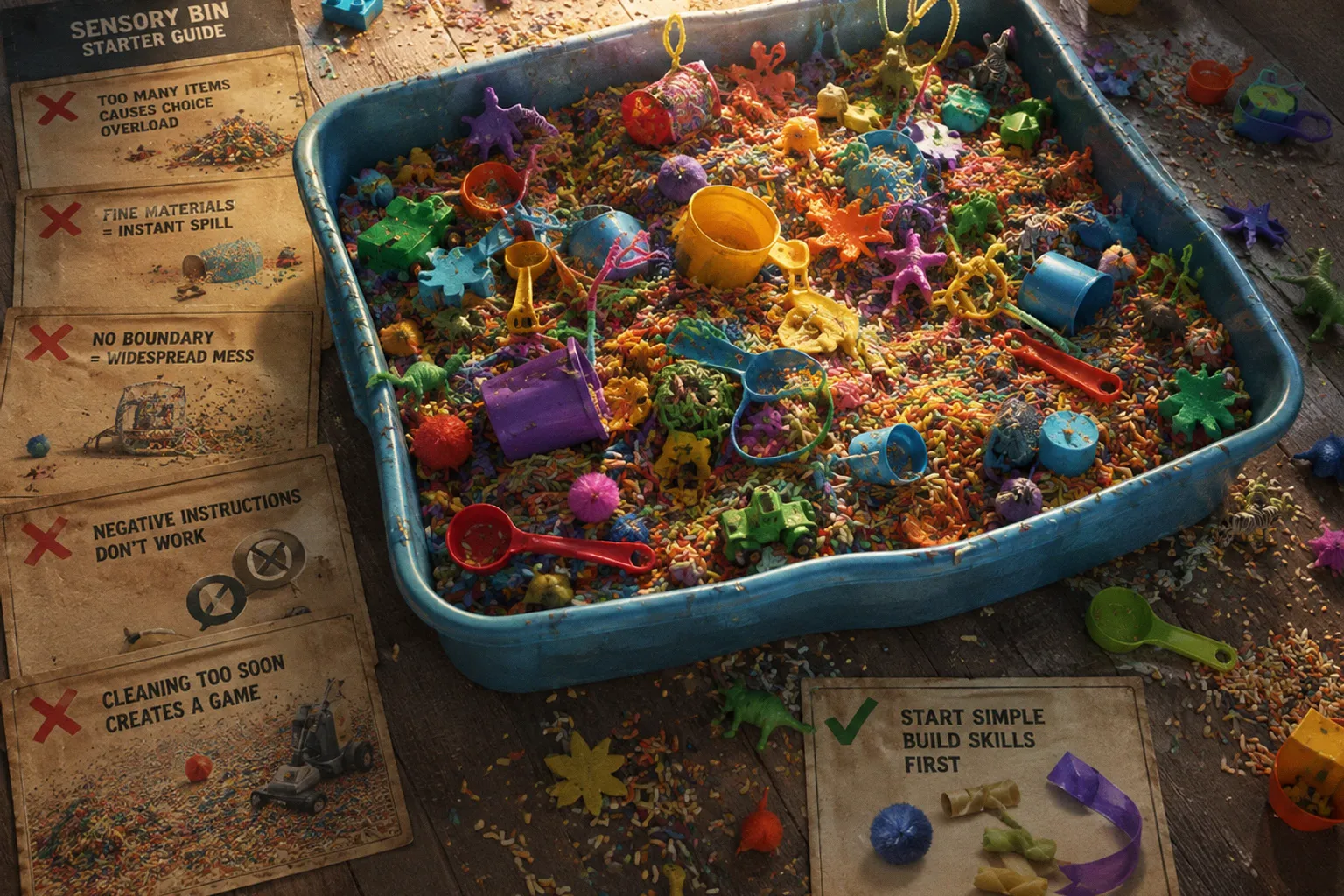
More often, the setup has failed the child: too many objects compete for attention, the material is difficult to contain, the boundary is unclear, or the child has never been shown how the activity is supposed to work.
The result is predictable. Pom-poms end up under the sofa. Rice travels far beyond the tray. A beautiful collection of cups, scoops, figurines, shredded paper, and brightly colored tools becomes a pile of choices with no obvious beginning. The problem is not a lack of developmental stimulation. It is a lack of material discipline.
A successful sensory bin begins with fewer objects, clearer physical limits, and materials that behave honestly under small hands. Before adding another themed collection to the shopping list, examine what the current setup is asking the child to manage.
The Trap of Visual Overload: Why Less Is More
Visual overload is the easiest sensory bin mistake to make because it is mistaken for generosity. More colors, more tools, more textures, and more miniature categories appear to offer more developmental value. In practice, they compete for the same limited attention.
A toddler should be able to see the intended action almost immediately: fill a cup, pour into a bowl, scoop and return, or move material from one container to another. When every object suggests a different game, none of those actions becomes the focus. The child scans, switches, empties, or walks away. Choice overload can produce the same restless behavior commonly blamed on a short attention span.
Minimal does not mean uninspiring. It means the materials have enough space to register. A single scoop and one dominant filler can reveal weight, texture, movement, and resistance far more clearly than a crowded tray full of competing shapes.
A sensory bin does not need more stimulation; it needs a clearer place to begin.
Watch the child’s first few minutes rather than evaluating the setup by its appearance. Several signs suggest that the bin is carrying too much:
| What the child does | What the setup may be communicating | Productive adjustment |
|---|---|---|
| Moves rapidly from one object to another | Too many tools or material categories | Remove everything except one tool and the primary filler |
| Mixes everything without pausing | Colors and shapes are competing for attention | Remove decorative pieces and add one contrasting object |
| Dumps contents repeatedly | The desired action is not visually obvious | Demonstrate scooping and transferring into a second container |
| Becomes restless or throws materials | Stimulation is exceeding the child’s current capacity | Reduce the bin’s contents and narrow the available choices |
| Leaves almost immediately | The activity has no accessible entry point | Model one action before inviting independent play |
Do not solve visual overload by removing a random half of the objects. Make the activity legible. Keep the container, one main material, one transfer tool, and possibly one contrasting object. Once the child can sustain that structure, introduce another variable.
Color deserves particular attention. A few saturated objects can be useful, especially when the purpose is visual contrast, but an entire miniature scene packed into one tray creates a noisy field. The child has to filter irrelevant shapes before identifying what can be held, moved, or contained.
That is sensory play without sensory focus.
Establishing Spatial Boundaries Before the First Scoop
A sensory bin needs a visible boundary. The edge of a plastic tub may look sufficient from an adult height, but a toddler does not automatically understand that every pom-pom, ribbon, and grain belongs inside it. The floor is simply more space, and more space appears useful when the child is experimenting with gravity.
Begin with a dedicated play surface. An old bedsheet, towel, or shower-curtain liner can establish a tactile boundary before any filler is poured. The sheet matters because it gives spilled material a finite destination. A towel adds a different texture beneath the hands. A liner provides a surface that can be gathered or shaken, provided the manufacturer’s care instructions allow it.
Container scale also affects the problem. A 28-quart under-bed bin is a common sensory-bin format, but its generous capacity also expands the possible spill zone. Size is useful only when the child can reach the material comfortably and understand where the activity begins and ends.
A useful boundary has three parts:
1. The main container, positioned where the child can reach it without stretching.
2. A surrounding play surface, clearly separating the activity from the room.
3. A receiving container, giving scooping and pouring a visible destination.
Set those elements up before introducing the filler. An empty bin placed directly on an undefined floor does not teach containment. It teaches that the room is available.
Cleanup is part of the sensory experience, not an administrative task performed after play. Demonstrate how material leaves the floor and returns to storage. Let the child scoop, tip, or place items back within the boundary. The return action reinforces the same hand control developed during filling and pouring.
If the child is actively spreading everything across the sheet, do not turn every item into part of an immediate retrieval game. A repeated chase can become an attention-seeking activity in which the adult unintentionally provides the escalating interaction. Pause, reduce the available material, and visibly re-establish the destination. Clean up together once the throwing has stopped.
The goal is not a spotless floor in thirty seconds. It is a child learning that the material has a place, a path, and a permissible destination.
Choosing Age-Appropriate Fillers to Prevent Dumping
The filler determines how the entire activity will behave. A two-year-old may understand the words associated with a bin while still lacking the hand control needed to keep fine grains inside it. Expecting immediate containment is like expecting a new walker to navigate a crowded staircase without modeling the movement.
For children around one to two years old, begin with larger, easier-to-manage materials. Large pom-poms provide enough volume to grasp. Large dry pasta is light and moves predictably when scooped. Fabric or ribbon strips are easier to retrieve than scattered grains and can be gathered in visible bundles.
The purpose of this stage is not to produce a polished activity. It is to develop the mechanics of containment: grasp, lift, transfer, tip, and release. Fine materials come later, if they are needed at all.
Dry uncooked rice is a familiar basic filler, and two to three pounds is a common quantity for a 28-quart container. Quantity, however, should not be treated as a performance target. A large volume may look abundant while making control harder for a first-time user. Begin with less material, add to the central container, and build depth only as the child can keep the filler within the established boundary.
The failure patterns of common fillers are easy to understand:
| Filler | Advantage | Typical setup failure | Best use |
|---|---|---|---|
| Large pom-poms | Easy to grasp, transfer, and gather | Too many colors can create visual clutter | First introduction to scooping and containment |
| Large dry pasta | Light, movable, and simple to pour | Can scatter if the bin is crowded or too full | Supervised dry transfer activities |
| Ribbon or fabric strips | Visible and easy to collect | Long pieces can tangle or show wear | Pulling, gathering, and filling larger containers |
| Dry uncooked rice | Familiar, inexpensive, and easy to store | Fine grains invite dumping before containment is learned | Later practice after larger materials are manageable |
| Cornmeal or flour | Soft and powdery | Highly scatter-prone and difficult to contain | Better avoided in toddler bins and high-mess settings |
| Water beads | Often marketed through visual novelty | Significant ingestion-related safety concerns | Not appropriate for toddler or young-child sensory bins |
The last row requires no compromise. In 2025, U.S. federal safety standard regulations specifically addressed hazards associated with water beads. A product’s popularity on social media is not evidence of material safety, and supervision does not make a hazardous filler appropriate.
Age appropriateness is also not established by a product name. Large pasta can break. Ribbon can fray. Paint or surface coatings can deteriorate. Nothing becomes safety-proof because it is sold as educational, sensory, or non-toxic.
Choose materials appropriate to the child’s current abilities, inspect them before use, and remove anything damaged during play. Material size is important, but material behavior under grabbing, dropping, wetting, and chewing is just as important.
The Art of Modeling: Moving Beyond Negative Redirection
Toddlers are not born knowing how to play with a sensory bin. Scooping requires grip control. Pouring requires coordinating both hands and judging direction. Keeping material inside requires resisting an interesting experiment with gravity.
Without demonstration, a bin full of attractive objects can feel like a tray of unusable instructions. The child may empty it simply to obtain immediate access to everything.
Adult co-play should therefore come before independent play. Sit at the boundary and make the sequence visible:
1. Press the scoop into the main material.
2. Lift it without dragging the container.
3. Move the scoop over the receiving bowl.
4. Tip the material out.
5. Return the empty scoop to the bin.
Repeat the sequence without adding layers of complexity. Then place the tool within the child’s reach and allow the same movement to be attempted. Staying nearby is often more useful than directing every motion. The adult hand provides a model, while the child retains control of the activity.
Negative instructions provide little help during active sensory play. A prohibition identifies an action that must stop, but it does not establish where the material should go. Redirection is stronger when the accepted action has a visible target.
Place a bowl on the sheet, narrow the number of tools, and make the receiving container easy to reach. If the child is throwing pom-poms, reduce the playing field. If the child is scraping material out of the bin, add a second container and model the transfer again.
Overstimulation is not a moral failure, and neither is throwing. It is a signal that the current level of stimulation no longer matches the child’s capacity. Restlessness, abrupt movement, repeated dumping, and inability to settle on an action can all indicate that the setup needs reduction rather than correction.
The first developmental tool in a sensory bin is the adult’s attention, not another accessory.
When the child is overwhelmed, do not strip the activity down to an empty plastic box. Remove one competing source first. Keep the familiar container, filler, and primary action intact. Changing every variable at once makes it impossible to identify what caused the reaction.
Safety Hazards and Modern Material Standards
A sensory bin should pass the same basic scrutiny as any object placed in a playroom: What is it made from, how can it fail, and what happens when it is dropped, wetted, chewed, or scraped?
For wooden scoops, cups, or tongs, look for FSC-certified wood, smooth edges, and a verifiable non-toxic finish. Certification can support responsible sourcing, but it does not replace physical inspection. Check for splinters, cracks, loose components, and damaged coatings. A polished appearance cannot restore poor tactile integrity once the surface begins to chip.
Plastic, metal, foam, and synthetic fabric each have different failure modes. A material should be evaluated by its actual composition rather than its color or marketing language. Terms such as non-toxic, biodegradable, recyclable, and eco-friendly are claims, not decorations. Request documentation when the claim affects the purchasing decision.
Biodegradable is especially easy to misuse. A material may require particular conditions, exclude dyes or adhesives, or be intended for industrial rather than home composting. If no disposal conditions are available, the claim has little practical value. Similarly, a muted palette is not proof of environmental responsibility, and a bright palette is not automatically unsafe. Skepticism should be material-specific, not aesthetic.
Water beads belong outside toddler sensory play altogether. Updated federal safety standards in 2025 reflect the hazards associated with these products. No level of direct supervision turns them into an acceptable first sensory material.
Every reusable component also needs a realistic cleaning method. A tray full of narrow grooves, soft decorative attachments, and inaccessible corners may photograph beautifully but resist actual sanitation. Follow the manufacturer’s care instructions, dry materials completely, and keep storage dry between sessions. Food-based materials should be discarded if they become damp, contaminated, or softened.
A sensory filler should not be treated as disposable merely because it is small. The lower-cost setup is not necessarily the more responsible one when it creates waste, replacement purchases, and difficult disposal.
The Long-Term Test: Does the Setup Survive Real Play?
The true test of a sensory bin begins after the activity is over. Does the container store neatly? Can the tools be cleaned? Will the filler remain dry and separated? Can one component be replaced without buying an entire themed kit? Can the setup be simplified without losing its purpose?
A durable container with reusable, washable components and a modest supply of interchangeable materials usually has greater practical value than a large novelty collection. Natural materials are not automatically superior, just as synthetic materials are not automatically wasteful. Durability, repairability, responsible sourcing, cleanability, and realistic end-of-life options matter more than an attractive label.
A defensible long-term setup generally has:
- One sturdy container with a defined play boundary.
- One or a small number of reliable transfer tools.
- Dry, age-appropriate materials stored in a labeled container.
- No damaged, recalled, or developmentally inappropriate fillers.
- Documentation for sourcing, finish, cleaning, and disposal claims.
- Enough flexibility to change one material or action at a time.
Keep successful materials in rotation rather than forcing novelty. If scooping sustains attention, return to it with a different cup or a more contrasting receiving bowl. If pouring works, change the material’s weight or volume. Small changes preserve the developmental action while testing the child’s response.
The environmental question should follow the same discipline as the safety question. Avoid replacing a working material because a newer product uses the language of sustainability more loudly. Do not confuse a product’s developmental claims with proof that it supports development. Ask what the object is, what it does, and what remains after the play session ends.
A sensory bin succeeds when the child can see where the material belongs, understand one possible action, and return it to a defined space. It does not succeed because the setup is crowded, expensive, visually themed, or covered in claims about learning.
Choose fewer materials with greater tactile integrity. Establish the boundary before the first scoop. Model the action before demanding containment. Let safety standards override social-media trends.
Most importantly, judge the bin by the child’s behavior, not its appearance. Engagement begins where clutter ends.