Formaldehyde emissions in nursery furniture: a parent's guide
Nursery furniture is often marketed as calm, natural, and non-toxic while being made from MDF, particleboard, or composite plywood held together with formaldehyde-containing resins. The painted surface may look immaculate.
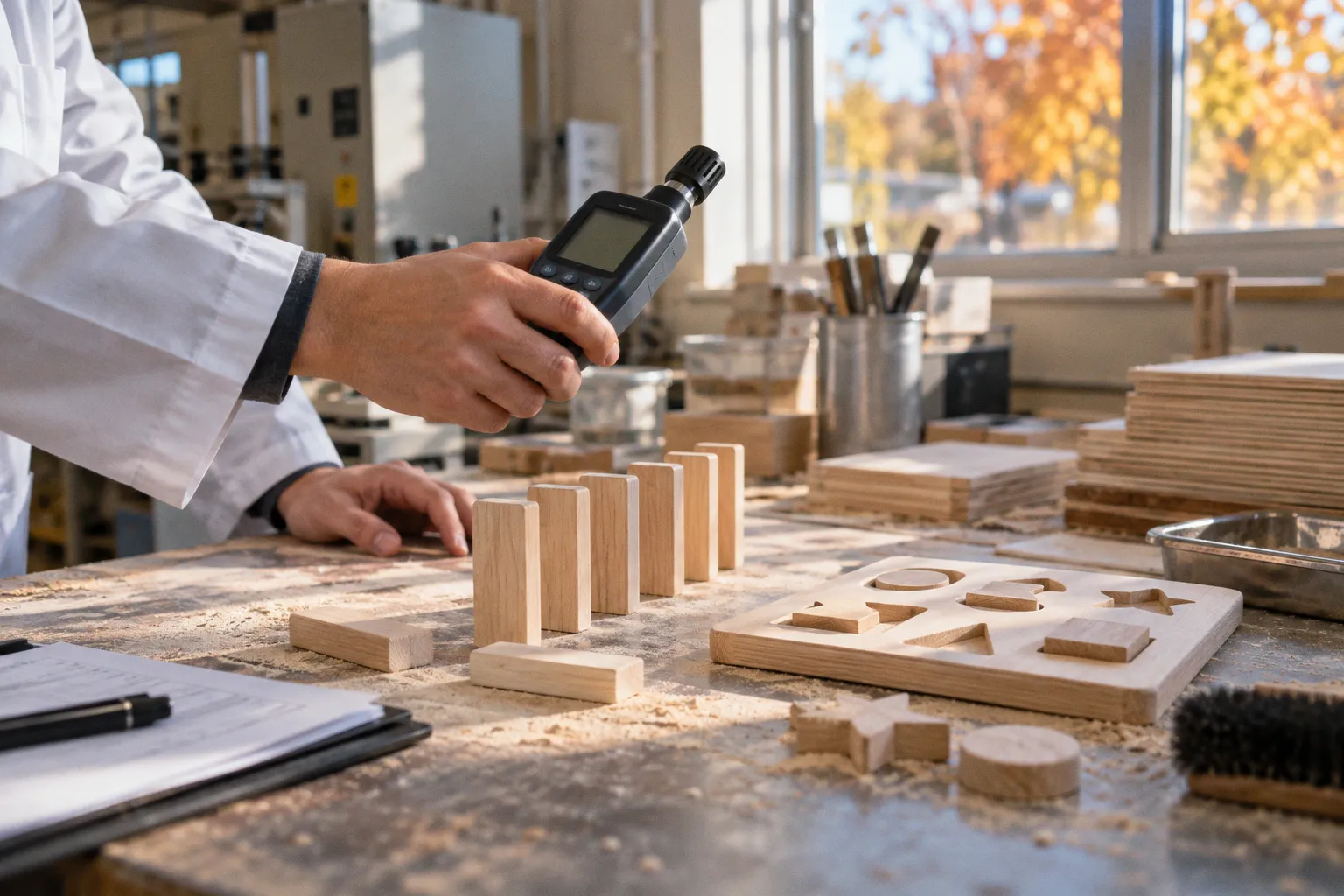
The material beneath it can still release formaldehyde into the room air.
That does not mean every engineered-wood changing table or cot is unsafe. It means the product requires closer inspection than a reassuring label or a pale wood finish. Formaldehyde emissions in nursery furniture depend on the board type, adhesive system, surface sealing, manufacturing standard, age of the product, room temperature, humidity, and ventilation. A responsible assessment begins with the material structure, not the styling.
The chemistry of off-gassing: why engineered wood matters
What is off-gassing in nursery furniture?
Off-gassing is the gradual release of volatile organic compounds, or VOCs, from manufactured materials into indoor air. In nursery furniture, formaldehyde is most commonly associated with the resins used to bond wood fibers, chips, veneers, or particles into a rigid panel.
The main sources are:
- MDF, made from refined wood fibers compressed with binders;
- Particleboard, made from wood particles bonded under heat and pressure;
- Composite plywood, which may contain adhesive layers between thin wood veneers;
- Laminate furniture, where a decorative outer layer is attached to an engineered-wood core;
- Paints, lacquers, varnishes, and edge treatments, which may introduce additional VOCs even when the board itself has relatively low emissions.
Formaldehyde does not sit on the surface as a visible residue. It can migrate out of the panel over time, particularly from exposed edges, drilled holes, unfinished undersides, back panels, and damaged laminate. A sealed exterior can reduce emissions, but it does not change the composition of the board beneath it.
The rate of release is not fixed. Warm, humid rooms generally encourage faster emissions than cool, dry conditions. Poor ventilation allows concentrations to build. New furniture may emit more than older furniture, but the exact timeline varies according to the resin chemistry, panel density, coating quality, construction details, and room conditions.
This is why a simple claim such as "the smell will disappear in a few days" is not a meaningful safety assessment. Odor is an unreliable indicator. Some people notice a sharp chemical smell at relatively low concentrations; others may detect little odor even when ventilation is inadequate. Formaldehyde can irritate the eyes, nose, throat, and airways, but the absence of irritation is not proof of clean indoor air.
Why babies' rooms deserve a stricter standard
Infants spend long periods in the same indoor environment, often close to furniture surfaces and enclosed storage. A cot, dresser, changing unit, or wardrobe may occupy a substantial part of a small room. When several new products are introduced at once, their emissions combine within the same air volume.
The concern is not limited to direct contact with the furniture. Formaldehyde is primarily an indoor-air issue in this context. The most relevant questions are:
1. What materials make up the furniture?
2. Which adhesives, coatings, and finishes were used?
3. Was the finished product tested, rather than only the raw board?
4. How much furniture was placed in the room?
5. How well is the room ventilated?
A nursery made entirely from engineered wood is not automatically hazardous, just as a solid-wood dresser is not automatically chemical-free. Solid wood naturally lacks the added urea-formaldehyde adhesive resins used in MDF and particleboard, but synthetic varnishes, paints, sealants, and glues can still introduce VOCs. Material integrity requires looking at the whole construction, not selecting one appealing phrase from a product description.
"Natural-looking" is a visual category. Low-emission is a tested performance claim.
Formaldehyde limits: what the standards actually tell you
US TSCA Title VI
In the United States, the federal TSCA Title VI standard regulates formaldehyde emissions from composite wood products. It is aligned with California's CARB Phase 2 requirements but should not be treated as interchangeable labeling.
The emission limits are:
| Composite wood product | TSCA Title VI formaldehyde emission limit |
|---|---|
| Hardwood plywood | 0.05 ppm |
| Particleboard | 0.09 ppm |
| MDF | 0.11 ppm |
| Thin MDF | 0.13 ppm |
Since March 22, 2019, regulated composite wood panels and finished furniture manufactured in or imported into the United States must be labeled as TSCA Title VI compliant. For a nursery dresser, wardrobe, shelving unit, or changing table, the relevant question is not merely whether one panel supplier uses compliant board. The finished furniture must be covered by the appropriate compliance documentation and labeling requirements.
A product page that says "CARB compliant" may be incomplete for a US buyer. CARB Phase 2 is an important emissions standard, but it should not be presented as a substitute for current federal TSCA Title VI labeling where that requirement applies.
Look for:
- a clear TSCA Title VI compliance statement;
- manufacturer or importer identification;
- information covering the finished furniture, not only the raw panel;
- a material description that identifies MDF, particleboard, plywood, or solid wood;
- documentation available from the manufacturer rather than vague marketplace language.
A small logo without a product-specific explanation is weak evidence. Certification and compliance systems are useful precisely because they should be traceable.
EU REACH and the new emissions ceiling
The European Union has adopted Regulation (EU) 2023/1464, which restricts formaldehyde emissions from furniture and wood-based articles placed on the market. The maximum ceiling is 0.062 mg/m³, with EU-wide enforcement from August 6, 2026.
That date matters when buying nursery furniture expected to remain in use for years. A product that was accepted under an older or less demanding market convention does not carry the same assurance as a newer product tested against the restriction now in force.
The European regulatory landscape also includes emissions classifications and testing practices that are not automatically equivalent to one another. An E1 classification, for example, should not be treated as a universal guarantee of compliance with the EU market standard after August 6, 2026. Standards evolve, and product documentation needs to be read against the applicable date and market.
For US and European buyers alike, the practical lesson is straightforward: identify the jurisdiction, identify the applicable standard, and ask whether the finished item, not just its board supplier, has been assessed.
WHO indoor-air guidance
The World Health Organization's indoor air quality guideline sets a maximum formaldehyde concentration of 0.1 mg/m³, or 100 µg/m³, averaged over 30 minutes, to prevent sensory irritation.
This is an indoor-air guideline, not a furniture certification. It does not tell you that a particular dresser is compliant, nor does a compliant furniture label prove that the entire nursery will remain below the guideline once multiple products, cleaning products, paints, and textiles are present.
That distinction is easy to lose in marketing copy. Product emissions standards and room-air guidance answer related but different questions:
- Product standards assess how much a material or finished item emits under defined test conditions.
- Indoor-air guidance addresses the concentration present in the room over a specified period.
- Certification programs may combine emissions testing, restricted substances, and auditing requirements.
Treat them as layers of evidence, not interchangeable badges.
Reading certifications without being distracted by greenwashing
GREENGUARD Gold and low-VOC nursery furniture standards
UL GREENGUARD Gold is one of the more relevant third-party certifications for nursery furniture because it is designed for sensitive environments, including nurseries, healthcare settings, and educational spaces. The program tests finished products for more than 10,000 VOCs and applies stringent formaldehyde emission limits.
The word finished is significant. A raw panel may meet a low-emission requirement while the completed product adds paint, adhesive, edge banding, hardware coatings, or other components. Testing the assembled item gives a more realistic picture of what enters the room.
Still, no certification should be stretched beyond its scope. GREENGUARD Gold is not a declaration that a product contains no chemicals. It is not proof that every component is biodegradable, recyclable, or made from sustainably harvested timber. It is an emissions-focused certification, and that is valuable, but specific.
When evaluating a certification, ask four questions:
1. What exactly was tested? The whole furniture item, a panel, a finish, or a sample material?
2. Which substances were covered? Formaldehyde alone, a broad VOC panel, heavy metals, phthalates, flame retardants, or something else?
3. Who performed the assessment? A recognized independent certifier, the manufacturer's internal laboratory, or an unnamed testing provider?
4. Is the certification current and traceable? Standards, product versions, factories, and formulations can change.
A marketing phrase such as "eco-friendly," "clean," or "chemical-free" tells you almost nothing without a defined test method. "Chemical-free" is particularly misleading: wood, water, paint, adhesives, and human beings are all made of chemicals. The useful question is which substances are present, at what levels, and under what exposure conditions.
FSC certification is about forestry, not indoor emissions
FSC-certified wood can be a strong indicator of responsible forest sourcing. It addresses chain-of-custody and forest management issues, not formaldehyde emissions from the finished furniture.
A dresser can use FSC-certified timber and still contain MDF panels bonded with formaldehyde-emitting resins. Conversely, a low-emission engineered-wood item may not carry FSC certification. These attributes should be evaluated separately:
- FSC-certified: concerns the origin and chain of custody of the wood fiber.
- Low-emission or VOC-tested: concerns indoor-air emissions.
- Non-toxic finish: should identify the coating chemistry and test basis.
- Durable construction: concerns repairability, service life, and replacement frequency.
When a brand presents FSC certification as if it proves the entire product is non-toxic, it is collapsing several different claims into one attractive narrative. That is not material transparency.
Solid wood versus composite: assessing nursery furniture
The core material changes the risk profile
Solid wood furniture has a simpler material structure in one important respect: it does not require the added urea-formaldehyde adhesive resins used to bind MDF or particleboard. But "solid wood" can be used loosely in product descriptions. A piece may contain solid-wood legs and rails while its shelves, drawer boxes, back panel, or base are made from composite board.
The hidden panels often matter most. They may be thin, poorly sealed, and placed inside enclosed sections where ventilation is limited. A beautifully finished oak frame does not tell you what the drawer bottoms or wardrobe back are made from.
Use the following distinction when reading a product specification:
- Solid wood: boards milled from timber, with no composite core.
- Veneer over plywood: a thin real-wood surface over layered engineered construction.
- Laminate over MDF or particleboard: a decorative surface over a bonded fiber or chip core.
- Mixed construction: solid wood in visible structural components and composite material in concealed panels.
None of these categories automatically determines safety. They determine what questions to ask.
A practical material audit
Before purchasing or assembling nursery furniture, work through the product rather than the product photograph:
1. Find the full material list. Look for the core board, drawer bottoms, back panels, shelving, edge banding, paint, lacquer, and adhesive.
2. Separate solid wood from wood-derived panels. "Wooden furniture" may include large amounts of MDF or particleboard.
3. Inspect exposed edges and unfinished areas. Raw panel edges can reveal the construction and may be a more relevant emissions pathway than a sealed front face.
4. Ask for the applicable emissions standard. In the United States, look for TSCA Title VI compliance where relevant. In Europe, ask which testing and regulatory requirements apply to the product and market date.
5. Check the finished-product certification. A board certificate is not necessarily a finished-furniture certificate.
6. Evaluate the finish separately. A water-based finish may reduce some solvent emissions, but "water-based" does not mean emission-free or automatically non-toxic.
7. Consider repair and replacement. Durable joinery, replaceable hardware, and refinishable surfaces reduce the environmental burden across the furniture's lifecycle.
The strongest product descriptions tend to be precise: they name the board, the finish, the standard, the testing body, and the manufacturing location. The weakest rely on a cluster of soft adjectives, natural, clean, pure, conscious, without a technical specification behind them.
Where a higher price can be justified
Solid wood is not automatically the sustainable choice if it is poorly made, difficult to repair, shipped long distances unnecessarily, or coated in a high-emission finish. Composite furniture is not automatically irresponsible if it uses certified low-emitting panels, durable construction, and replaceable parts.
The environmental calculation includes:
- expected service life;
- repairability;
- recycled or responsibly sourced content;
- adhesives and coatings;
- shipping volume and weight;
- resistance to moisture and repeated cleaning;
- whether the furniture can be reused by another family;
- whether damaged components can be replaced instead of discarding the whole unit.
A durable, repairable piece with a modest visual design often performs better over time than a trend-driven nursery set designed for a single stage of childhood. The most sustainable nursery furniture is rarely the item with the loudest sustainability language. It is the item that remains structurally sound, chemically transparent, and useful after the nursery aesthetic has changed.
The right question is not "Does this furniture look natural?" It is "What is every component made of, and how long will it remain useful?"
Managing indoor air quality in the baby's room
Ventilation is a control measure, not a substitute for good materials
Ventilation can reduce indoor concentrations by replacing contaminated air with outdoor air. It cannot turn high-emission furniture into low-emission furniture, and it should not be used to excuse poor manufacturing disclosure.
For new nursery furniture, a practical approach is to:
- unpack and assemble it in a well-ventilated area when possible;
- allow time for airing before placing it in the baby's sleeping room;
- keep windows or mechanical ventilation operating according to weather and outdoor-air conditions;
- avoid introducing several newly painted, varnished, or composite-wood items at once;
- keep the room at a moderate temperature and humidity rather than making it unusually warm;
- remove packaging materials promptly;
- avoid masking chemical odors with fragrances, scented candles, or essential-oil diffusers, which add their own VOCs without addressing the underlying emissions;
- clean finished surfaces with a damp cloth rather than solvent-heavy polishes during the first weeks.
The airing-out window is not a fixed rule. Some low-emission panels barely off-gas after a few days; older, higher-emission boards can release measurable formaldehyde for months under warm, humid conditions. Treat any timeline offered by a retailer as approximate rather than guaranteed.
Temperature, humidity, and the room itself
Formaldehyde release increases with temperature and relative humidity. A nursery kept around 18 to 20 °C with moderate humidity tends to produce lower emissions than one kept warmer and more humid. This aligns with general sleep-comfort guidance for infants, which already favors a cooler room.
A few additional room-level considerations worth factoring in:
- Textiles and fabrics. New curtains, mattresses, rugs, and upholstery can each contribute VOCs in their own right. Introduce them gradually and ventilate during and after installation.
- Wall paint. Low-VOC or zero-VOC interior paints have become widely available, but a freshly painted room still benefits from open windows for several days.
- Cleaning products. Many conventional household cleaners introduce their own volatile compounds. Rinsing surfaces with water and mild soap, then drying them, generally produces less indoor-air contamination than heavy detergent fragrances.
- Baby care products. Lotions, wipes, and detergents stored in the nursery add to the room's chemical background even when they are not applied at that moment.
The nursery is a system, not a single piece of furniture. Even a carefully selected dresser can sit in a room whose overall air quality is undermined by other recent additions.
When to be concerned
Sustained eye or throat irritation, persistent coughs, or unusual odors that do not fade with normal ventilation are signals worth taking seriously, particularly if they began after new furniture or renovation work was introduced. In that situation, the response is not panic: it is to increase ventilation, identify the most likely new sources, and contact the manufacturer for the relevant emissions documentation. Professional indoor-air testing is also an option in extreme cases, though it rarely changes the practical steps.
The parent's working position
Reading about formaldehyde in nursery furniture can quickly become overwhelming. The honest summary is this: engineered wood is not inherently dangerous, solid wood is not automatically safe, certifications vary widely in scope, and "natural" is a style, not a safety claim. The work of a parent or caregiver is to ask better questions, accept that perfect answers rarely exist in product marketing, and treat ventilation as ongoing maintenance rather than a one-time fix.
The furniture you bring into a nursery will live with your child for years. It deserves the same curiosity you would bring to a food label or a cleaning product, and a little more patience than a glossy product page usually allows.