Nursery furniture off-gassing: a safety checklist for parents
New nursery furniture can release volatile organic compounds (VOCs) into indoor air, especially during the first days after unboxing.
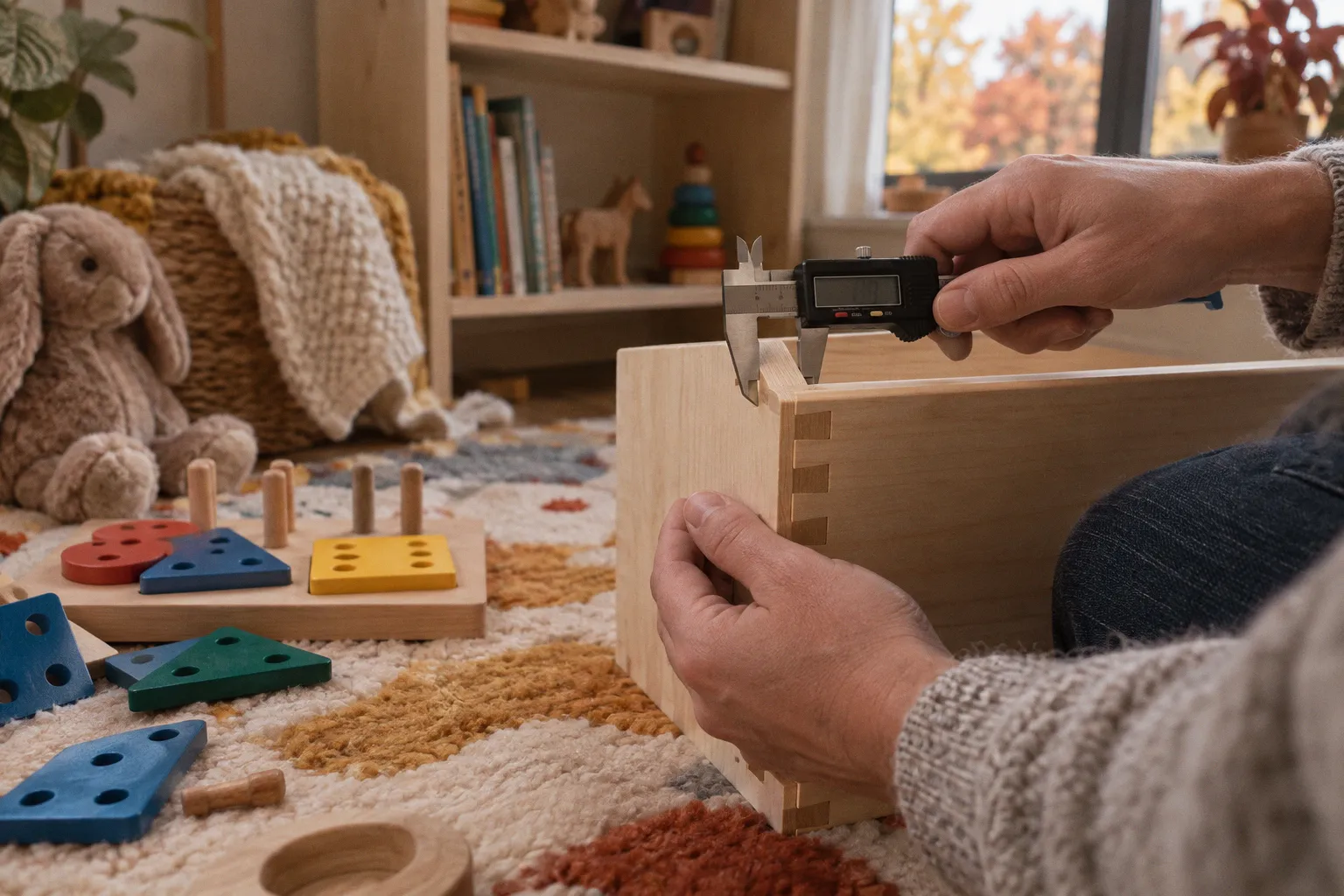
The source may be engineered wood resins, adhesives, paints, stains, sealants, or composite panels used inside what appears to be a simple crib, dresser, changing table, or shelf.
The practical problem is that a nursery is a small, enclosed room where a baby may sleep for many hours. Infants also breathe more air per pound of body weight than adults, increasing their relative exposure to airborne chemicals released near the sleeping environment. A convincing wood-grain finish or the phrase “eco-friendly” does not resolve that issue. The material specification, emissions certification, assembly timing, and ventilation plan do.
This non-toxic nursery furniture off-gassing check gives parents a way to inspect a product before it enters the room, manage the first 72 hours after unboxing, and use the two to four weeks before the baby arrives to reduce avoidable exposure.
1. Start with the material, not the marketing
The first inspection takes place before assembly. Look at the furniture’s construction and ask what is actually releasing emissions.
A piece described as “wooden” may be made from several different materials:
- Solid wood is cut from natural timber and does not rely on a pressed wood core, although its glue joints, paint, stain, varnish, or sealant may still emit VOCs.
- Plywood consists of thin wood veneers bonded with adhesive. Its emissions depend on the adhesive formula, the panels used, and the finish applied to the surface.
- Particleboard is manufactured from wood particles held together with resin. It is commonly used in budget furniture and can be a significant source of formaldehyde emissions.
- MDF is made from fine wood fibres combined with resin and compressed into dense panels. Its smooth surface is useful for painted furniture, but the resin system remains part of the emissions profile.
- Laminated or veneered panels may have a relatively clean outer surface while the core, edge banding, adhesives, and unfinished underside still contribute to off-gassing.
A solid-wood frame is not automatically non-toxic, and engineered wood is not automatically unsafe. The useful question is more specific: which components are present, what emissions limits apply to them, and has the finished product been tested as a complete piece of furniture?
That last point matters. A board-level standard does not describe every coating, hardware adhesive, edge treatment, or assembly product added later. A finished-product certification gives a more relevant picture of what the furniture releases in the form the family will actually use.
What to look for in the product description
Before buying, locate the technical specification rather than relying on a lifestyle label. Look for:
- The exact material used for the frame, panels, back, drawer bottoms, and shelves.
- Whether the product uses solid wood, plywood, MDF, particleboard, or a combination.
- The type of finish: water-based paint, oil, wax, lacquer, polyurethane, or an unspecified coating.
- A finished-product emissions certification such as GREENGUARD Gold.
- A clear reference to CARB Phase 2 compliance for composite wood panels.
- The manufacturer’s care and ventilation instructions.
- A full materials disclosure rather than a broad statement such as “natural,” “clean,” or “chemical-free.”
“Chemical-free” is not a useful description of a manufactured object. Wood, pigments, coatings, adhesives, and cured finishes are all made of chemicals. The meaningful distinction is whether the materials are disclosed, whether emissions have been measured, and whether the product meets a defined standard.
A nursery product can be visually natural and chemically opaque. Material integrity begins where the marketing language ends.
2. Understand what GREENGUARD Gold and CARB Phase 2 actually tell you
Certifications are useful only when their scope is understood. They are not interchangeable, and neither one means that a piece of furniture emits absolutely nothing.
GREENGUARD Gold
GREENGUARD Gold applies to finished products and tests emissions across more than 360 VOCs. Certified products must keep formaldehyde emissions below 7.3 parts per billion and total VOC emissions below 220 micrograms per cubic metre.
That is a low-emission threshold, not a zero-emission promise. The certification allows emissions within specified limits, and the furniture may still release small amounts of VOCs, particularly when new.
For nursery furniture, the value of GREENGUARD Gold is that it evaluates the assembled product category rather than offering only a claim about one raw panel. The certification is therefore more relevant to a crib, changing table, or dresser that will occupy an infant’s room.
When checking a certification claim:
1. Search for the exact product or model, not merely the manufacturer’s name.
2. Confirm that the certification applies to the furniture category and finished product.
3. Check whether the certification covers the current model and not an older version.
4. Treat “GREENGUARD tested” and “GREENGUARD Gold certified” as different claims.
5. Do not infer that certification makes ventilation unnecessary.
A product page that places a certification logo beside a general collection name may not establish that every piece in the collection carries the same status. The model number is more useful than the photograph.
CARB Phase 2
CARB Phase 2 regulates formaldehyde emissions from raw composite wood products. The limits are:
| Composite wood panel | CARB Phase 2 formaldehyde limit |
|---|---|
| Hardwood plywood | 0.05 ppm |
| Particleboard | 0.09 ppm |
| MDF | 0.11 ppm |
These limits help control emissions from the panel itself. They do not replace a finished-product emissions test for the entire item, and they do not describe every coating or adhesive used in assembly.
CARB Phase 2 is therefore a material-level safeguard. GREENGUARD Gold is a broader finished-product emissions certification. When both are available and verifiable, they answer different parts of the same question.
FSC certification belongs to a different category
FSC certification addresses responsible forest management and the chain of custody for wood products. It can support a more responsible sourcing decision, but it does not function as a VOC emissions certification.
This distinction is frequently blurred in green product marketing:
- FSC-certified speaks primarily to forest sourcing.
- CARB Phase 2 addresses formaldehyde emissions from specified composite wood panels.
- GREENGUARD Gold addresses emissions from a finished product across a broad set of VOCs.
A nursery dresser may be FSC-certified and still require a careful emissions review. Sustainable forestry, low emissions, non-toxic finishes, and durable construction are related goals, not one universal label.
3. Inspect the finish and the hidden surfaces
The finish is part of the exposure profile. Paint, stain, lacquer, varnish, sealant, and oil-based coatings can release VOCs during curing. The visible top surface is only one part of the inspection.
Examine the following areas:
- The underside of shelves and tabletops.
- The inside of drawers and cabinet compartments.
- The back panel, especially if it is composite board.
- Exposed edges where the panel core can be seen.
- Joints, dowels, and areas with visible glue residue.
- The inside of crib rails, where babies may place their mouths.
- Areas where the finish appears uneven, tacky, powdery, or incompletely cured.
A smooth, tactile surface is not merely an aesthetic feature. Poorly sealed edges can absorb moisture, shed fibres, or expose composite material to repeated handling. In a crib, the finish must also be durable enough to tolerate cleaning and ordinary contact without flaking or becoming sticky.
The safest finish is not necessarily the one with the most natural-sounding name. “Plant-based,” “organic,” and “natural oil” can describe an ingredient without revealing the complete formulation or curing behaviour. A low-odour coating may still emit VOCs, while a strongly scented coating may contain fragrance compounds that mask rather than eliminate other smells.
For an eco-friendly crib finish inspection, use a physical and documentary approach:
1. Read the finish specification.
2. Check whether the finish is described as non-toxic after curing.
3. Look for an emissions certification on the finished product.
4. Inspect for tackiness, residue, peeling, or incomplete curing.
5. Keep the furniture out of the nursery until the manufacturer’s curing and ventilation instructions have been followed.
If the manufacturer cannot identify the finish or provide meaningful emissions information, the product has a documentation problem even if the surface looks attractive.
4. Use the first 72 hours as a controlled exposure window
VOC emissions are generally highest during the first 24 to 72 hours after unboxing. This is when the packaging is removed, fresh surfaces are exposed to air, and assembly may spread the smell through the room.
Do not unbox a large piece of new nursery furniture beside the crib on the day the baby comes home. The timing creates unnecessary pressure and makes the room the testing environment.
A more controlled sequence looks like this:
Before unboxing
Choose a well-ventilated area away from the baby’s sleeping space. A garage, covered outdoor area, or separate room may work depending on weather, security, humidity, and the manufacturer’s instructions. Furniture should not be exposed to rain, condensation, extreme heat, or direct sunlight that could damage finishes.
Keep all packaging materials away from the nursery. Cardboard, plastic wrapping, printed materials, and protective foams can also carry odours, and leaving them in a closed room defeats the purpose of early ventilation.
During assembly
Follow the manufacturer’s assembly instructions exactly. Avoid adding unapproved adhesives, sealants, oils, or paints. A home-applied coating can alter the emissions profile and may void a certification or introduce new chemicals.
Use gloves if the finish feels tacky or leaves residue, and wash hands after assembly. This is not a substitute for ventilation; it simply prevents fresh surface residue from being transferred to skin or other objects.
During the first three days
Keep the furniture in a ventilated location. If it must be assembled indoors, open windows where safe and practical, keep the room unoccupied, and avoid placing bedding, clothing, or toys inside the furniture while it is new.
A strong odour is a reason to extend the ventilation period, not a reliable measurement of danger. Odour intensity varies between chemicals and between people. Some VOCs have a detectable smell at low concentrations, while others may be difficult to notice. People can also become accustomed to a smell after spending time in the room.
5. Build a two-to-four-week nursery ventilation plan
The strongest practical control is time. Assemble nursery furniture two to four weeks before the baby arrives and ventilate the room continuously whenever conditions allow.
This period is not a claim that all off-gassing reaches absolute zero. Exact decay rates depend on temperature, humidity, ventilation, the specific adhesive formula, the materials used, and the construction of the furniture. Low-level emissions from engineered wood may persist for months or even years, although the initial release is usually much higher.
The goal is to lower the concentration before the room becomes a sleeping environment.
A simple four-week sequence
Weeks four to three before arrival:
Unbox and assemble the furniture outside the nursery whenever possible. Begin ventilation immediately. Keep drawers and doors open so interior surfaces can release emissions rather than trapping them.
Weeks three to two:
Move the furniture into the nursery only after the initial high-emission period has passed, if the product has been ventilated elsewhere. Continue airing the room and leave storage compartments open.
Weeks two to one:
Add nursery textiles gradually. Wash organic cotton bedding, curtains, and clothing before use, and do not pack them into a newly assembled dresser while the furniture still has a strong odour or tacky finish.
Final week:
Close the room briefly, then return and assess whether the odour has returned or intensified. Check the furniture again for residue, peeling, warped panels, or unfinished edges. Maintain ventilation rather than sealing the room for the sake of temperature or appearance.
Ventilation is more than opening a window once
A room may smell better after a short airing while still containing emissions from furniture interiors and composite panels. Continuous or repeated air exchange is more effective than a single burst of ventilation.
Use the building’s normal ventilation system where available, but do not direct a fan at a damp or uncured finish if the manufacturer warns against it. The objective is air exchange, not rapid drying at any cost.
The US Environmental Protection Agency notes that indoor pollutant concentrations can be two to five times higher than outdoor levels. A closed nursery with newly installed furniture can therefore concentrate emissions more readily than a larger, well-ventilated living area.
The nursery should be the last place new furniture is allowed to cure, not the first.
6. Know what a smell can—and cannot—tell you
Smell is a useful warning signal but a poor safety test.
A sharp chemical odour, solvent smell, sour adhesive scent, or persistent “new furniture” smell tells you that volatile compounds are present in the air. It does not identify which compounds are present, their concentration, or whether they fall below a particular standard.
The reverse is also true: the absence of smell does not prove that off-gassing has stopped. Olfactory adaptation can make a person less sensitive after spending time in the same room. Some substances are also difficult to detect by smell at concentrations that still matter for indoor air quality.
This makes several common home tests unreliable:
- Smelling the furniture once after opening the box.
- Asking whether the product smells “natural.”
- Leaving it in the nursery overnight and judging the room the next morning.
- Using fragrance sprays, candles, or essential oils to cover the odour.
- Assuming a dry surface is fully cured.
- Treating a product with no visible residue as emission-free.
Fragrance is especially unhelpful. It adds more volatile compounds to the room and makes it harder to distinguish the original furniture emissions. A nursery should not need perfume to pass an air-quality inspection.
How to test nursery furniture for VOCs
There is no simple, reliable household test that identifies every VOC released by a crib or dresser. Consumer air monitors may detect broad changes in indoor air or track certain pollutant categories, but they do not automatically provide a complete formaldehyde or total VOC assessment for a specific piece of furniture.
For a meaningful evaluation, rely first on:
- Finished-product emissions certification.
- Verifiable material documentation.
- A clear manufacturer specification.
- A controlled ventilation period.
- Professional indoor-air testing when there is a persistent concern, strong reaction, or known exposure issue.
Professional testing also requires interpretation. A single reading reflects conditions at one time and can be influenced by temperature, humidity, ventilation, other furnishings, cleaning products, and outdoor air. It should not be treated as a universal verdict on every item in the room.
If a parent experiences eye, throat, or respiratory irritation after a piece is installed, remove the furniture from the occupied room if feasible, ventilate the area, and seek appropriate medical or professional advice. Do not keep using the room simply because the product carries a sustainability label.
7. Use a material hierarchy when information is incomplete
When certification and materials disclosure are limited, construction quality becomes part of the decision. This is not a perfect ranking, but it helps identify where uncertainty is concentrated.
| Furniture choice | Main material concern | What strengthens the choice |
|---|---|---|
| Solid wood with a disclosed cured finish | Coatings, sealants, and adhesives can still emit VOCs | Finished-product emissions testing and clear finish documentation |
| Plywood with disclosed adhesive system | Bonding resins and exposed panel edges | CARB Phase 2 compliance plus a low-emission finished-product certification |
| MDF furniture | Resin-bound fibres and painted or sealed surfaces | Verified emissions testing, sealed edges, and a controlled ventilation period |
| Particleboard furniture | Resin emissions from the core and edge treatments | CARB Phase 2 documentation, finished-product testing, and careful pre-use ventilation |
| Furniture with unspecified composite panels | Unknown resin, coating, and adhesive profile | Full material disclosure before purchase; otherwise, select a better-documented alternative |
The most sustainable product is not necessarily the cheapest natural-looking product. Durability matters because a piece that swells, delaminates, sheds finish, or fails after a short period creates another environmental burden. A durable, repairable item with verified low emissions may have a stronger lifecycle profile than a fashionable product that must be replaced.
At the same time, durability cannot excuse poor emissions documentation. A long-lasting dresser that releases avoidable pollutants into a baby’s room is not a complete sustainability success.
8. Common mistakes that undermine the inspection
Parents usually encounter off-gassing problems through timing and incomplete information rather than deliberate negligence. The same mistakes appear repeatedly.
Buying by label alone
Words such as “eco,” “green,” “natural,” and “clean” describe a brand position, not a measurable emissions profile. Look for the standard behind the claim.
Confusing FSC with low-VOC performance
Responsible timber sourcing is valuable, but FSC certification does not establish formaldehyde or total VOC emissions. Keep forestry certification and indoor-air certification in separate categories.
Checking only the visible frame
The back, drawer bottom, shelf underside, and cabinet interior may use different materials from the front-facing frame. The hidden panel is still inside the nursery.
Assembling on the due date
This puts the highest emission period directly beside the baby’s sleeping area. The two-to-four-week preparation window exists to remove that pressure.
Covering the smell
Air fresheners, scented sachets, candles, and essential oils do not neutralize formaldehyde or prove that emissions have ended. They add another layer of volatile compounds.
Treating “water-based” as a complete safety statement
Water-based does not mean emission-free. The full formulation, curing process, and finished-product test still matter.
Assuming ventilation makes every product acceptable
Ventilation lowers exposure but does not repair a poorly documented material system, a damaged finish, or a product that continues to produce a strong odour. Sometimes the correct decision is to return the furniture.
The final nursery furniture air quality checklist
Before the furniture enters the room, confirm that you can answer these questions:
- Do I know whether the major panels are solid wood, plywood, MDF, or particleboard?
- Is the finish identified rather than described only as natural or non-toxic?
- Does the exact product have a verifiable finished-product emissions certification?
- If composite wood is used, is there documentation for CARB Phase 2 compliance?
- Have I separated FSC sourcing claims from indoor-air quality claims?
- Was the furniture unboxed and assembled outside the nursery where practical?
- Has it been ventilated for at least two to four weeks before the baby arrives?
- Did I leave drawers, doors, and compartments open during the ventilation period?
- Does the room remain comfortable without fragrance products masking the furniture odour?
- Are the edges sealed, the surfaces fully cured, and the finish free from tackiness or peeling?
- Have I removed the furniture from the nursery if the smell remains strong or causes irritation?
The best result is not a nursery stripped of every manufactured object. It is a room furnished with materials that are disclosed, durable, appropriately certified, and given enough time to settle before occupation.
Off-gassing is a manufacturing and indoor-air issue, not a decorative detail. Read the panel composition, inspect the finish, verify the certification, ventilate through the first 72 hours, and use the full two-to-four-week preparation window. A genuinely responsible nursery product should withstand that level of scrutiny—from the factory floor to the room where a child sleeps.