Montessori Pink Tower: What It Is and How It Works
A child places one wooden cube on another, pauses, takes it down, and tries again. The activity may look simple—almost too simple for an adult watching from across the room.
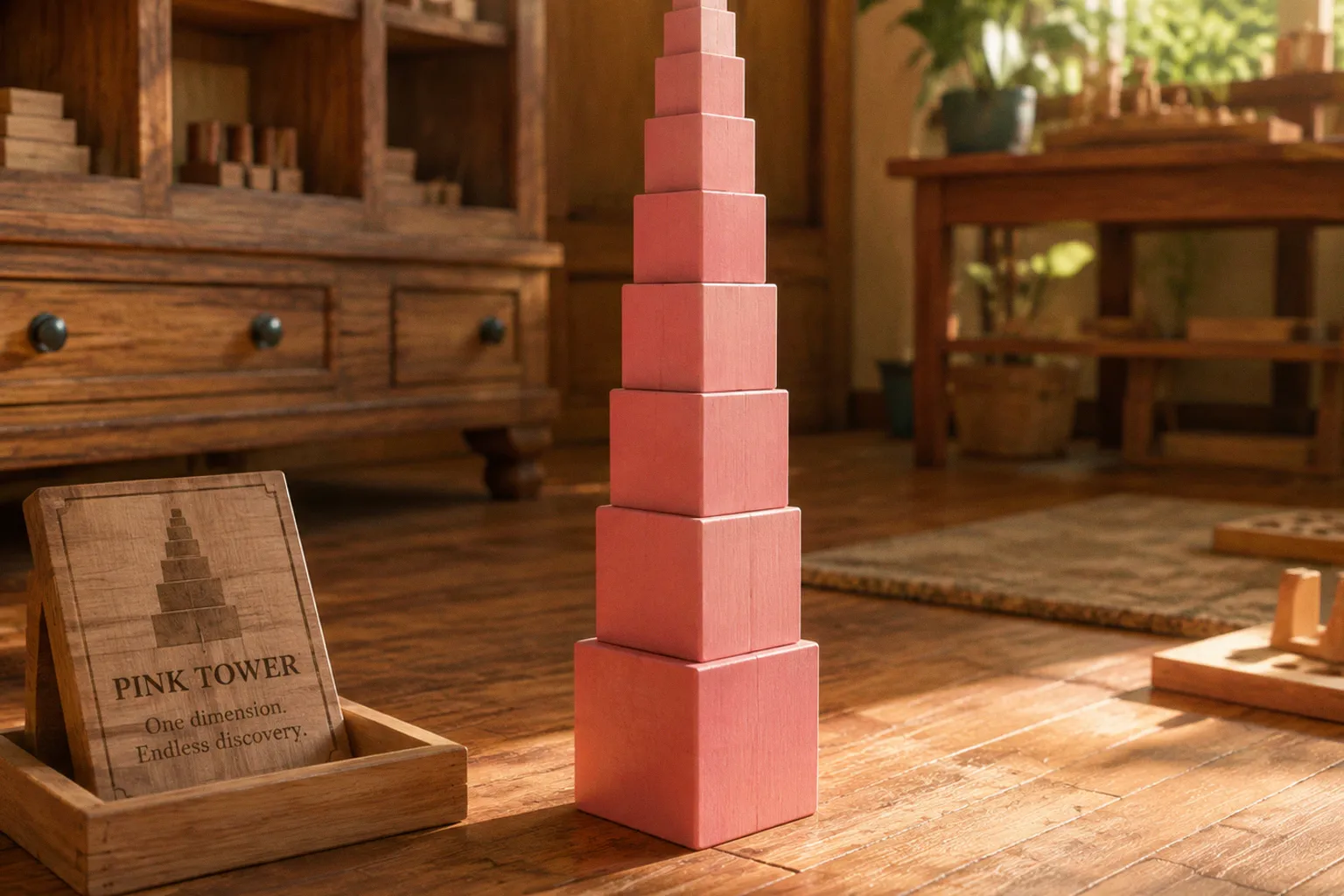
Yet this quiet sequence asks the child to compare size, coordinate both hands, judge balance, control movement, and notice a mistake without being told where it happened.
That is the purpose of the Montessori Pink Tower. It is not simply a set of wooden blocks, and it is not primarily intended for building houses, bridges, or pretend-play structures. The material presents one carefully controlled challenge: arranging ten solid wooden cubes from largest to smallest, using visual and tactile information to create a stable tower.
Understanding the Montessori Pink Tower purpose and benefits begins with this distinction. The value is not in the number of things a child can construct with the cubes. It lies in the focused experience of comparing three-dimensional size and gradually organising that information into a precise order.
What is the Montessori Pink Tower?
The Montessori Pink Tower consists of ten solid wooden cubes, usually painted the same uniform pink. The cubes have identical proportions and the same surface quality, but each one differs in size.
The smallest cube measures 1 cm on each edge. The largest measures 10 cm on each edge. Between them are eight cubes increasing by 1 cm at every step:
- 1 cm × 1 cm × 1 cm
- 2 cm × 2 cm × 2 cm
- 3 cm × 3 cm × 3 cm
- and so on, up to 10 cm × 10 cm × 10 cm
This means the material contains a mathematical progression based on the third power: 1³, 2³, 3³ through 10³. The cubes do not merely become a little larger in a flat, two-dimensional way. Their volume changes much more dramatically as all three dimensions increase.
A child does not need to know the word volume to experience this difference. The hands feel it when lifting a cube. The eyes see it when one cube is placed beside another. The body senses the changing weight and balance as the tower grows.
In a Montessori environment, the Pink Tower is typically introduced during the early childhood years, often between approximately 2.5 and 4 years. That range is a useful guide for presentation, not a rigid gate. Children vary in their motor control, visual attention, previous experience with construction materials, and readiness to work through a sequence. A younger child may explore one or two cubes first. Another child may be ready to build the complete tower but still need time to refine the placement.
The material’s direct aim is visual discrimination of size. Its indirect benefits extend into fine motor coordination, spatial reasoning, muscular perception of weight, and early mathematical thinking.
The Pink Tower teaches size through the whole child: eyes compare, hands carry, muscles judge, and the mind orders.
The geometry of the Pink Tower: one variable, ten relationships
The design is powerful because the cubes change in one essential way: size.
Their colour remains the same. Their shape remains the same. Their material and finish remain consistent. The child is not being asked to compare a red cylinder with a blue prism or decide whether a rough surface feels larger than a smooth one. The visual field is deliberately quiet.
This is what makes the Pink Tower a sensorial learning material rather than a general construction toy. It isolates the quality being explored. When a child looks at the cubes, size is the most meaningful difference available.
That isolation reduces unnecessary mental noise. A child can focus on questions such as:
- Which cube is larger?
- Which cube comes next?
- How much does the size change from one cube to another?
- Where should the cube be placed so the tower remains centred?
- What does the arrangement look like from the side?
The child is not expected to answer these questions verbally. Montessori materials often allow the hands to work before language catches up. A child may demonstrate an understanding of relative size by choosing the correct cube long before being able to explain the comparison.
Why the cubes are solid
Each cube is a complete, solid object rather than a hollow frame. This gives the hands meaningful tactile feedback. The child feels that the largest cube requires a different kind of lifting and carrying from the smallest one. The work is not purely visual: muscular perception becomes part of the comparison.
The smallest cube demands careful finger control. It can be picked up with a delicate grasp and may be easily displaced by an imprecise movement. The largest cube invites a broader hand position and more deliberate carrying. Moving through the set gives the child repeated opportunities to adjust grip, pressure, pace, and placement.
These are modest actions, but they are exactly the kind of actions through which fine motor skill develops. Precision is built through repeated, purposeful movement rather than through isolated hand exercises alone.
The cubic progression and early mathematical thought
The increase in volume is also significant. Although a child may only see that one cube is bigger than another, the mathematical structure underneath the material is exact.
The second cube has a volume of 8 cm³, compared with 1 cm³ for the first. The third has a volume of 27 cm³. By the time the child reaches the 10 cm cube, the volume is 1,000 cm³.
This relationship is not presented as a worksheet or a calculation. It is encountered physically. A small change in edge length produces a much larger change in the amount of wood. The child’s experience therefore contains an early, embodied encounter with cubic relationships.
It would be too strong to say that using the Pink Tower guarantees later mathematical success. There is no established claim in the available evidence that isolates the material as a direct cause of long-term maths performance. A more accurate description is that the Pink Tower provides preparation: it gives children a concrete way to notice order, proportion, dimension, and quantity before these ideas are represented symbolically.
How the Montessori Pink Tower works in practice
The presentation is usually calm and economical. The adult does not need to entertain the child or fill the activity with questions. The material itself should remain the centre of attention.
A typical sequence looks like this:
1. Invite the child to carry the cubes.
The cubes are moved individually rather than gathered into a large pile. Carrying each piece encourages careful walking, controlled grasping, and awareness of the object’s size.
2. Place the cubes on a clear working space.
They may be arranged in a scattered but accessible way, allowing the child to see the differences without being handed the final order.
3. Begin with the largest cube.
The largest cube provides a stable base. The adult models slow, accurate placement rather than rushing to complete the tower.
4. Search for the next largest cube.
The child compares the remaining cubes visually and selects the one that belongs on top.
5. Centre each cube carefully.
The goal is not merely to stack the pieces. The child refines alignment so that the tower looks balanced and remains stable.
6. Observe the completed tower.
The finished structure offers a clear visual pattern: a large base narrowing gradually toward a small top cube.
7. Return the material with the same care.
Carrying the cubes back is part of the work. It reinforces order and helps the child practise the sequence in reverse.
The adult’s movements matter. If the presentation is quick, chatty, or overly corrective, the child may focus on pleasing the adult rather than noticing the material. A slower demonstration gives the child time to absorb the rhythm of the activity.
This does not mean the child must copy a perfect performance immediately. Exploration may come first. A child might line up the cubes, stack only three, or repeatedly lift the smallest one. Those actions can reveal what the child is noticing and where additional scaffolding would be useful.
Co-play without taking over
Parents often feel tempted to help when the tower wobbles. In practice, the most useful support is often a short pause rather than a quick correction.
You might say:
- “The tower is leaning.”
- “Let’s look at the sides.”
- “Which cube could make the base wider?”
- “Your hands moved that cube very gently.”
These comments draw attention to the process without supplying the answer. They support language, emotional regulation, and visual attention at the same time.
If the child becomes frustrated, co-play can preserve the learning without turning the moment into a test. You can offer to carry the largest cubes while the child works with the smaller ones, or invite the child to rebuild just the lower part. The aim is not to insist on completion at all costs. The aim is to keep the challenge within reach.
Isolating the variable: why uniformity matters
Many educational toys are intentionally colourful and varied. That can be useful for symbolic play, matching, storytelling, and open-ended exploration. The Pink Tower follows a different logic.
The uniform pink colour prevents colour from becoming an alternative sorting rule. The identical cube shape means the child is not comparing different geometric forms. The consistent wooden texture prevents surface contrast from distracting from the main relationship.
This simplicity may look plain to an adult, but young children often benefit from a material that does not compete for attention. The fewer irrelevant differences there are, the easier it becomes to notice the one that matters.
This principle appears across sensorial education. A material can be designed to help children distinguish height, diameter, texture, sound, weight, or colour. The Pink Tower concentrates on three-dimensional size.
That concentration also supports memory. Each cube becomes part of a meaningful sequence rather than an isolated object. The child gradually develops an internal reference for the largest, the next largest, and the smallest. Over time, the eyes and hands begin to anticipate the order.
The role of tactile feedback
The Pink Tower is often described through its visual purpose, but the tactile experience deserves equal attention.
Wood has a particular weight, temperature, and resistance. A child feels the difference between lifting a cube with one hand and carefully holding a larger one with both hands. The small cube requires gentle pressure because it is easy to knock aside. The larger cubes offer more stability but also demand more deliberate movement.
This combination of visual and tactile information creates richer scaffolding than looking at pictures of large and small objects. The child is not memorising a label. The child is coordinating perception with action.
That coordination is especially valuable in the early years, when thinking is closely linked to movement. Children often understand an idea more securely after they have handled it repeatedly. Size becomes something the child can see, feel, compare, transport, and organise.
From visual discrimination to spatial reasoning
The first challenge is identifying the largest cube. The deeper challenge is maintaining the relationship between all ten cubes.
The child must notice gradual differences that can be easy to miss when the pieces are viewed separately. A cube may appear large on its own but be too small for a particular position in the sequence. This encourages comparison rather than isolated judgement.
As the tower develops, several forms of spatial reasoning are involved:
- estimating relative size;
- judging whether a cube is centred;
- noticing symmetry from different viewpoints;
- predicting whether the next piece will fit the visual pattern;
- adjusting hand position to place an object accurately;
- recognising how a small error affects the stability of the whole structure.
The tower is three-dimensional, so the child must attend to more than a single line or flat outline. The top cube should sit over the centre of the cube below, and the visible edges should create a balanced progression. This creates a gentle but genuine demand for spatial organisation.
The work also supports executive function. The child needs to hold the goal in mind, resist grabbing whichever cube is closest, and return to the comparison after an unsuccessful attempt. These small acts of inhibition and working memory are part of the learning, even though the activity is presented as play.
Why repetition is productive
Adults sometimes worry that repeating the same tower means the child is not progressing. In early childhood, repetition is often the mechanism of progress.
On the first attempt, a child may focus on carrying. On the next, the child may notice that the cubes need to be ordered. Later, the child may refine centring and begin to detect a slight mismatch before the tower is complete.
Each repetition can have a different purpose. The material remains the same, but the child’s perception changes.
This is one reason not to rush in with extra challenges such as building the tower with closed eyes, mixing it with unrelated blocks, or turning it into a timed competition. The original task already contains several layers of complexity. Mastery comes from seeing more within the same experience.
Repetition is not a lack of imagination when the child is discovering a new relationship each time.
The hidden maths: preparing for volume and decimal concepts
The Pink Tower is not a lesson in arithmetic, but it has a strong mathematical structure.
The ten cubes form an ordered series. The child experiences:
- one object being larger or smaller than another;
- a continuous progression rather than a random collection;
- the idea that each step has a place;
- the relationship between part and whole;
- spatial interval and proportion;
- a base-ten sequence of ten graduated pieces.
The decimal connection should be described carefully. The material does not teach the decimal system through written numerals, place value, or formal calculation. Instead, it offers preparation through ordered quantity and a complete series of ten. Later mathematical work can build on the child’s comfort with sequence, comparison, and graded relationships.
The cubic pattern adds another layer. Because all three dimensions change together, the difference between the cubes is not merely a change in length. The amount of material expands in a way that the child can physically sense.
A child may not say, “This cube has eight times the volume of the first.” That is not the expectation. The body encounters the relationship first; language and symbolic mathematics can come later.
Extending the maths without turning play into a worksheet
Once a child is familiar with the material, an adult can offer language that names what is already being experienced:
- large, larger, largest;
- small, smaller, smallest;
- between;
- next;
- wider;
- narrower;
- balanced;
- centred;
- heavy;
- light.
You can also place two cubes beside one another and invite the child to compare them, rather than asking for a memorised answer. If the child uses an imprecise word, respond to the meaning rather than correcting every phrase. “Yes, this one is bigger. It is also wider and taller.”
For older preschool children, the tower can become a starting point for drawing, measuring, or discussing how the cubes differ. These extensions should remain connected to the concrete experience. If the conversation becomes more interesting to the adult than the child, it is time to return to the hands-on work.
The control of error: learning to notice and repair
One of the most thoughtful features of the Pink Tower is its built-in visual control of error.
When the cubes are arranged correctly, the tower has a gradual, symmetrical form. If a cube is placed out of order, the change is visible. The tower may look uneven, the progression may suddenly widen or narrow, or the upper cube may appear off-centre.
The material does not need a flashing light, a buzzer, or an adult saying, “That is wrong.” The child can often see that something does not look right.
This matters for more than independence. It changes the emotional shape of a mistake. Instead of waiting for an adult’s judgement, the child receives information from the work itself. The child can pause, inspect, remove a cube, and try another arrangement.
That process supports emotional regulation. A mistake is still frustrating, particularly when the tower falls, but the child has a pathway back into the activity. The adult can help by keeping the tone neutral and avoiding praise that depends only on perfection.
Useful responses include:
- “You noticed the shape changed.”
- “The top is not centred yet.”
- “The tower fell. We can decide which part to rebuild.”
- “You are looking closely.”
The point is not to make every child persist indefinitely. A child may need a break, a smaller version of the activity, or a different form of movement. Independence grows when children are supported in solving problems, not when adults withdraw all assistance.
Common adult mistakes
The Pink Tower is simple enough that adults sometimes introduce unnecessary complications. A few patterns are especially common.
1. Treating it as ordinary free construction
The cubes can technically be used to make other structures, but that changes the material’s purpose. If the goal is sensorial size discrimination, present the tower as a sequence rather than as a general block set.
2. Correcting too quickly
Removing a misplaced cube before the child has noticed it takes away the opportunity for self-correction. Give the child time to look.
3. Adding too much language
A long explanation can draw attention away from the visual work. Demonstrate first, then use brief words when they serve the child’s observation.
4. Turning the activity into a performance
Speed, applause, and comparison with siblings can make careful exploration feel like an exam. The material is about precision, not winning.
5. Insisting on the full set immediately
Ten cubes can be a substantial motor and attention challenge. Beginning with fewer pieces may be appropriate when a child is tired, overwhelmed, or new to this kind of work.
6. Using age as a verdict
A child within the typical introduction range may not be ready on a particular day. Another child may show interest earlier. Watch the child’s engagement and coordination instead of treating an age label as a deadline.
Choosing and presenting a Pink Tower at home
A Montessori Pink Tower should preserve the qualities that make the material useful. The cubes need to be genuinely graduated, solid, stable, and consistent in shape and finish. If the size differences are irregular, the sequence becomes confusing. If the smallest pieces are too light or poorly made, tactile feedback is weakened.
A good home setup is usually quieter than parents expect. The tower needs enough clear floor or table space for the child to lay out the cubes and step back to view the whole arrangement. A shelf or basket can keep the pieces together, but the child should be able to access and return them without turning the activity into a rescue operation.
Before introducing it, consider the child’s current play patterns:
- Does the child enjoy carrying and arranging objects?
- Can the child place objects carefully rather than only knocking them down?
- Is the child beginning to notice big and small?
- Does the child return to an activity after a small mistake?
- Is the child interested in repeating a sequence?
These observations are more useful than asking whether the child is old enough in the abstract.
The first presentation should be unhurried. Show how to carry one cube at a time and how to place it with two hands when needed. Then allow the child to participate. If the child wants to explore before building, that is information, not failure.
How to extend the play value
Once the child understands the basic work, you can extend the experience without changing its central purpose.
- Invite the child to find the largest cube from a small group, then gradually increase the number.
- Compare two cubes and use relational language such as larger, smaller, wider, and narrower.
- Build the tower together, with the adult carrying the largest cubes and the child placing the smaller ones.
- Stand at different angles and notice how the tower looks from the side, front, or above.
- Place a neutral object beside the cubes and discuss which one is taller or shorter.
- Offer paper and crayons after the activity so the child can draw the tower’s narrowing shape.
- Use the cubes as a calm co-play invitation for two children, giving each a role in carrying, ordering, or observing.
With two children, social interaction can become part of the learning. One child may select a cube while another decides where it belongs. They may need to negotiate whose turn it is, wait, communicate a disagreement, and repair the tower together. The adult can support the exchange with simple language rather than deciding every turn.
The material should not become a test of cooperation. If conflict grows, reduce the demand: work side by side, take turns with a smaller number of cubes, or return to individual exploration.
Why the Pink Tower still matters in a world of STEM kits and screens
Modern early learning products often promise coding, engineering, or problem-solving through bright mechanisms and multiple functions. Those materials can be engaging and worthwhile. The Pink Tower offers something quieter: a single relationship made visible and touchable.
It does not flash a reward when the child makes a correct choice. It does not require a battery, an app, or a sequence of instructions on a screen. Its feedback comes through balance, symmetry, weight, and the child’s own visual judgement.
That restraint is not a weakness. Young children need opportunities to concentrate on one meaningful difference without being flooded by novelty. They also need experiences in which their hands can move slowly enough for perception to guide action.
The Pink Tower’s contribution to early STEM learning is therefore foundational rather than flashy. It supports habits that later engineering and mathematics will continue to use:
- observing carefully;
- comparing measurable properties;
- ordering objects;
- predicting outcomes;
- noticing instability;
- revising a plan;
- describing relationships;
- using evidence from the material itself.
No single educational toy can provide a complete developmental programme. The Pink Tower works best alongside practical life activities, language-rich conversation, open-ended construction, sensory play, outdoor movement, and social pretend play. Its strength is its precision.
The lasting lesson of the Pink Tower
The Montessori Pink Tower purpose and benefits are easiest to understand when we stop asking what the cubes can produce and start asking what the child is learning to notice.
The child is learning that size can be compared, ordered, and checked. That hands can become more accurate with practice. That a mistake can be seen and repaired. That a physical object can carry a mathematical relationship before the child has the words or symbols to name it.
For parents and educators, the practical lesson is equally clear: present less, observe more, and allow the material to do its work. Offer steady scaffolding when the challenge is too great, but leave room for the child’s own judgement. Keep the experience calm enough for concentration and open enough for repetition.
A tower of ten cubes may occupy only a small space on the floor. The learning inside it is much larger: visual discrimination, tactile feedback, spatial reasoning, fine motor control, early mathematical preparation, and the confidence that comes from discovering an error without being rescued from it.