Nursery rug chemical odors: common mistakes and remediation
A new rug should not make a nursery smell like a chemical plant. Yet an acrid, plasticky, or cloying odor can appear as soon as a freshly delivered synthetic rug is unrolled.
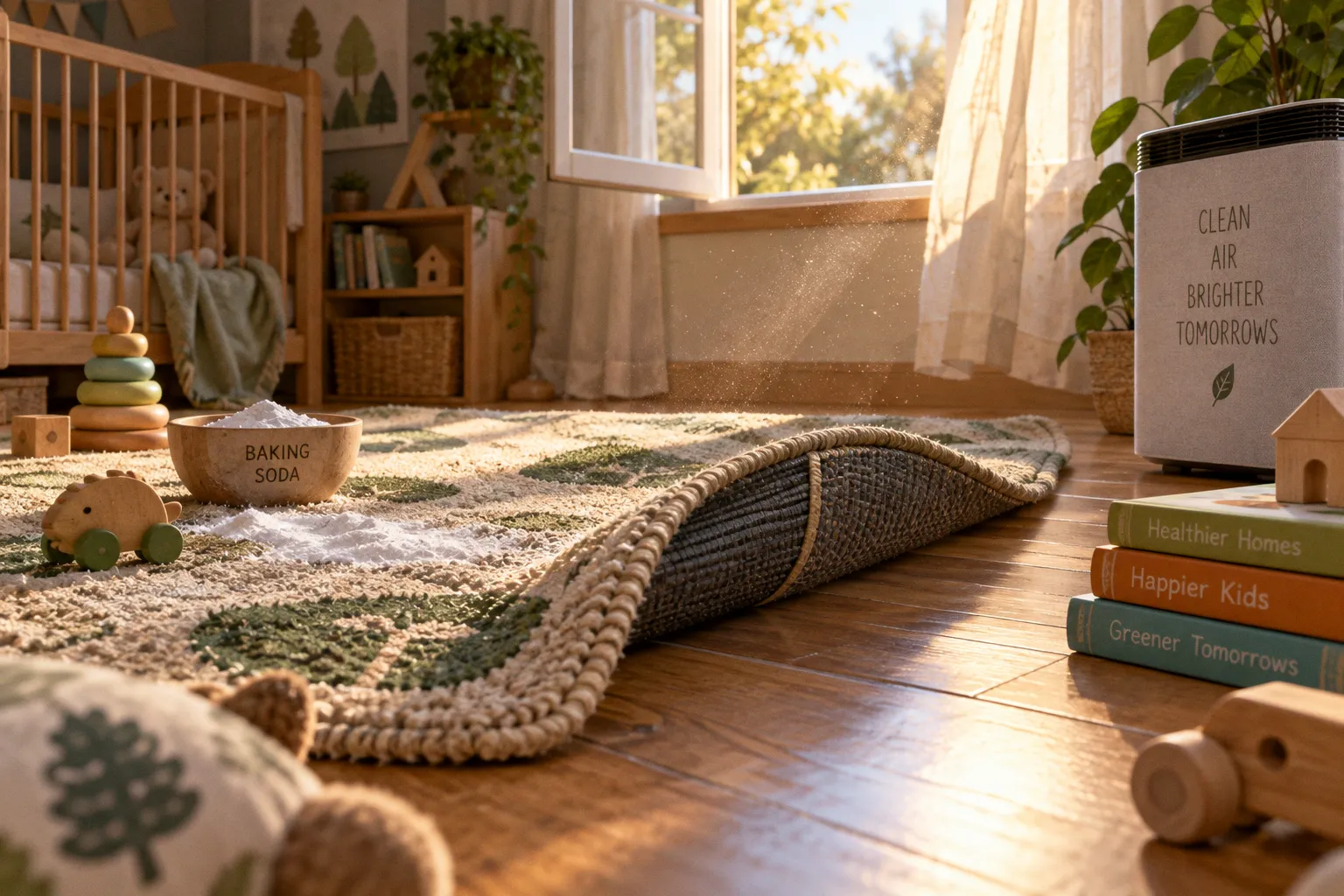
That smell may come from a mixture of volatile organic compounds (VOCs) released by the rug’s fibers, backing, dyes, finishes, and adhesives. The textile industry generally describes the process as off-gassing.
The chemistry is not identical from one product to the next. A rug may contain synthetic latex, polyurethane, rubber, dye residues, stain-resistant treatments, or adhesive binders, and each material can contribute differently to the odor. Some emissions are strongest immediately after unpacking; others may continue at lower levels as the rug is exposed to warmth, air movement, sunlight, or cleaning products.
The first mistake parents make is treating the smell as purely cosmetic—something a spray or scented candle can cover. The second is trusting a product description that says low-VOC without naming the standard behind the claim. Neither approach answers the more useful question: what is the rug made of, and how much of its odor-producing chemistry can be allowed to leave the product before a baby spends time on it?
A strong smell does not automatically prove that the rug is dangerous. It does, however, give you a practical reason to ventilate the rug away from the nursery, inspect its construction, and avoid placing it in the room until the odor has substantially diminished.
The chemistry of new rug odors: identifying VOCs and 4-PCH
Off-gassing from a nursery rug is not one universal smell. It is a mixture of compounds migrating from different layers of the product. VOCs are carbon-based chemicals that can evaporate into indoor air at room temperature. Depending on the materials used, emissions may include substances such as toluene, styrene, benzene, aldehydes, residual solvents, and other compounds associated with synthetic fibers, coatings, or adhesives.
One compound often discussed in connection with carpet and synthetic latex backing is 4-phenylcyclohexene, commonly shortened to 4-PCH. It can form during the production of certain synthetic latex materials and is known for having a noticeable odor at very low concentrations. That makes it a plausible contributor to the smell from some latex-backed carpets and rugs.
It is not accurate to treat 4-PCH as the dominant odorant in every new rug. Products use different fibers, backings, dyes, and finishing systems, and a similar smell can come from several compounds at once. The presence of an odor also does not identify the compound responsible. Only laboratory analysis can establish which chemicals are present and at what concentration.
The often-cited detection level for 4-PCH is around 0.5 parts per billion (ppb) under particular testing conditions. That number illustrates how sensitive the human nose can be to some odorants; it does not provide a universal safety limit for a nursery, nor does it describe the total VOC concentration of a rug. Odor detection and health risk are related questions, but they are not the same measurement.
The rest of the rug may contribute just as much to the overall experience:
- Synthetic dyes and pigments can leave residual chemicals from processing, especially in heavily saturated colors. The dye itself is not automatically the source of an odor, but the full finishing process matters.
- Stain-resistant coatings may contain treatment chemicals that affect emissions and indoor air quality. The product label may not identify every component of a proprietary finish.
- Adhesive binders can be present between primary and secondary backing layers. They may release odor after production and may respond to heat or humidity.
- Synthetic latex or rubber backing can have its own odor profile and may be the main source of smell in some tufted or non-slip rugs.
- Flame-retardant or other performance treatments, where used, can add another layer of chemistry. Their presence and regulatory treatment vary by product and market.
The physical construction matters because the rug is not chemically uniform. The face fiber, backing, printed design, anti-slip layer, and adhesive may each behave differently. A rug that smells mild on the surface may have a much stronger odor underneath. Conversely, a noticeable odor from a natural fiber does not tell you that the product contains the same materials as a synthetic latex-backed rug.
A strong smell is not a chemical analysis, but it is a sensible reason to pause, ventilate the rug elsewhere, and look past the product photography.
A consumer VOC meter can sometimes show changes in total volatile compounds, but it usually cannot identify a specific substance or determine whether one particular rug is responsible. Household monitors are most useful for observing broad trends alongside ventilation—not for declaring a product safe or unsafe from a single reading.
Physical warning signs: why infants are vulnerable to off-gassing
The possible effects of indoor air irritants are easy to misattribute in a nursery. Eye, nose, and throat irritation, headache, dizziness, nausea, and respiratory discomfort are commonly associated with exposure to irritating indoor pollutants, but these symptoms are not specific to rug emissions. They can also arise from cleaning products, paints, furnishings, poor ventilation, dust, mold, or an unrelated illness.
Infants cannot describe a headache or a scratchy throat. Instead, a parent may notice unusual fussiness, coughing, sneezing, watery eyes, congestion, or a refusal to remain on the floor. None of these signs identifies a VOC source by itself. If symptoms appear soon after a rug is introduced and improve when the rug is removed from the room, that timing is useful information—but it is not a medical diagnosis.
Babies also spend more time close to floor-level materials than adults do. They crawl, roll, nap, and play with their faces near the rug. They breathe more air relative to their body size than adults, and their respiratory and immune systems are still developing. Those facts justify a cautious approach to avoidable indoor pollutants, but they do not support the claim that VOCs universally form a concentrated layer at floor level.
Indoor air is moved by heating, cooling, ventilation, people walking through the room, and the temperature of the floor and surrounding surfaces. Some gases are heavier than air, but that does not mean every VOC released by a rug simply sinks and remains in a stable layer around a crawling baby. Concentrations depend on the compound, emission rate, room volume, air movement, temperature, humidity, and distance from the source.
The more practical point is simpler: a baby’s breathing zone is often close to the rug, so the source deserves attention even when the room appears well ventilated. Moving the rug away from the nursery during the strongest odor period reduces the direct source instead of asking an air purifier or an open window to compensate.
There is no need to dramatize this into a claim that one rug will inevitably cause lasting harm. Nor is there a good reason to dismiss a persistent smell because the product is marketed for children. If the odor causes irritation, if the room smells strongly after ventilation, or if a child reacts whenever the rug is present, remove the rug and reassess the room.
Seek medical advice for breathing difficulty, wheezing, persistent coughing, marked lethargy, or any symptom that concerns you. Ventilation and product replacement are household measures; they are not substitutes for medical care.
The 72-hour rule: effective strategies for airing out synthetic textiles
The most useful first step in reducing a new rug’s odor is also the least glamorous: ventilate it before installation. A period of roughly 72 hours is a practical minimum for many newly unrolled synthetic textiles, not a guarantee that every rug will be fully emission-free by the end of that time. Some products lose most of their initial odor within a few days; others continue to smell for much longer.
The goal is to move the rug’s strongest emission period away from the nursery and provide enough air exchange around both sides of the material.
1. Unroll the rug outside the nursery. A covered, dry, well-ventilated area is preferable to a closed bedroom or living room. Keep the rug protected from rain, soil, exhaust, and direct conditions that could damage the fibers or backing.
2. Expose both surfaces where possible. Standing the rug upright or draping it over a clean railing can allow air to reach the face and backing. Do not create a tight fold that traps odor between layers.
3. Use gentle air movement. A fan directed across the rug can help carry away air near the surface. It should not create a safety hazard, blow dust toward a child, or be used in damp outdoor conditions.
4. Check the underside as well as the face. A rubberized or adhesive backing may produce more odor than the visible pile. If the underside remains sharply pungent, more airing time is warranted.
5. Wait beyond 72 hours when the smell remains strong. The calendar is less important than the condition of the product. If the rug still dominates the room’s odor after several days, keep it out of the nursery rather than treating the deadline as a pass/fail rule.
6. Vacuum according to the care instructions. A sealed vacuum with suitable filtration can remove loose fibers and dust from manufacturing and shipping. It will not remove VOCs that are dissolved in the backing or released as gases.
The common error is airing out a rug for two or three hours and then bringing it indoors because the surface feels dry. That may simply relocate the strongest part of the emission period to the baby’s room. Another error is sealing the rug in plastic while trying to off-gas it. Plastic packaging limits air exchange and can hold odor close to the material. Remove the wrapping unless the manufacturer specifically requires a different storage method.
Cold conditions deserve a little nuance. Lower temperatures can slow the release of some compounds, but a cold garage is not automatically unsafe or useless. The rug still needs to remain dry, clean, and undamaged. If it is brought inside before the odor has diminished, allow continued ventilation in an unoccupied, well-aired space rather than assuming that time spent wrapped or folded has completed the process.
Do not use heat guns, hair dryers, steam, or strong sunlight to accelerate off-gassing. Heat may increase emissions, but it can also deform synthetic fibers, damage adhesives, or create an uncontrolled indoor-air problem. The sensible strategy is steady ventilation, not aggressive treatment.
Speed is not the goal. The useful question is whether the rug still changes the smell of the room after it has had enough air, space, and time.
If the smell becomes stronger after installation, especially in warm weather or after floor heating is turned on, consider temperature as part of the problem. A rug that seemed acceptable in a cool warehouse may release more odor in a warm nursery. Remove it again rather than trying to cover the change with fragrance.
Beyond masking: using activated carbon and baking soda for odor control
Once the rug is in the room, residual emissions may continue at lower levels. The exact duration depends on the rug’s materials, construction, age, temperature, ventilation, and cleaning history. This is where many households reach for products that make the room smell different without reducing the original source.
Scented sprays, fabric refreshers, and essential-oil diffusers do not neutralize VOCs. They add fragrance chemicals and may make it harder to tell whether the original odor is fading. Fragrance can also irritate children and adults who are sensitive to scented products. If the room smells strongly, use ventilation and source removal rather than adding another smell.
Activated carbon and baking soda have different and limited roles:
| Method | What it can do | Main limitation |
|---|---|---|
| Activated carbon in an air purifier | Adsorb some gas-phase compounds from the air as it passes through the filter | Performance depends on the amount and quality of carbon, airflow, filter design, and replacement schedule; it does not stop emissions at the source |
| Baking soda on a washable rug surface | Reduce some surface odors and absorb moisture or odor-active residues | It does not extract VOCs from latex, rubber, foam, or adhesive layers and is not a substitute for ventilation |
| HEPA filtration | Capture particles such as dust, fibers, pollen, and other particulate matter | A HEPA filter alone is not designed to remove gas-phase VOCs |
| Fresh outdoor air | Dilute and remove airborne compounds from the occupied space | It may be limited by weather, outdoor pollution, building design, or safety concerns |
For baking soda, check the manufacturer’s care instructions first. On a compatible, dry rug, a light and even application can be left for several hours and then vacuumed thoroughly. Avoid scattering powder where a crawling child can inhale or ingest it, and do not use it on a damp rug where residue may become difficult to remove. Baking soda is an odor-control measure, not a chemical test and not a reliable treatment for emissions from the backing.
An air purifier with a substantial activated-carbon stage may help reduce airborne VOCs. Product packaging often uses the word carbon for a very thin, lightly treated layer that has limited capacity. Look for clear information about the carbon filter, airflow, replacement interval, and the room in which the unit is intended to operate. Keep the purifier away from the child’s reach, and do not interpret cleaner air after filtration as proof that the rug itself has stopped emitting.
The most effective sequence remains source control: remove the packaging, air out the rug, ventilate the room, and take the rug away if the odor persists. Carbon filtration is useful support. It is not permission to install a strongly smelling rug in a closed nursery and rely on a machine to make the problem disappear.
Navigating safety standards: choosing low-chemical rug certifications
Prevention is usually easier than remediation. When selecting a nursery rug, look for the exact certification, the product or model covered, and whether the claim applies to the finished rug rather than only to one fiber or raw material.
Certifications are not interchangeable. They may assess indoor emissions, restricted substances, organic fiber content, processing chemicals, or environmental performance. A label can be valuable without answering every question about odor or VOC release.
| Certification or label | Primary focus | What a parent should understand |
|---|---|---|
| GREENGUARD Gold | Emissions from finished products into indoor air | Relevant to low-emitting product claims, with criteria intended for sensitive environments such as schools and healthcare settings; verify that the specific rug is certified |
| OEKO-TEX Standard 100 | Testing finished textile components for specified harmful substances | It is not a test of every stage of textile production. The applicable product class and certificate details matter, especially for items intended for babies |
| GOTS | Organic fiber content and ecological and social processing requirements | It addresses the certified supply chain and processing requirements; it does not mean that every natural-fiber rug has identical odor or emission behavior |
| CRI Green Label Plus | Emissions from carpet and related floor-covering products | It is relevant to finished-product emissions where the specific product is covered by the program |
| Blue Angel | Environmental and product criteria under a German ecolabel | The relevant product category and current certification scope should be checked rather than inferred from the logo alone |
| Nordic Swan Ecolabel | Environmental impacts across defined parts of a product’s life cycle | It evaluates more than point-of-sale odor, but it is not a universal guarantee that a rug will have no smell when unpacked |
A label that says low-VOC without naming a certifying organization is difficult to evaluate. Ask whether the claim refers to the finished rug, the backing, the adhesive, or only one component. Also check the certificate number or product listing where available. A manufacturer may use certified fibers in a rug whose backing or finish is not covered by the same claim.
Nor should certification be treated as a promise that a rug will have no odor on arrival. A certified product can still have a material-specific smell, especially when it has been enclosed in packaging. Certification usually means that the product met the requirements of a defined program; it does not erase the differences between wool, cotton, synthetic latex, rubber, foam, dyes, coatings, and adhesives.
Natural fibers deserve the same careful reading. Wool can have a lanolin-like or animal-fiber odor. Cotton can carry smells from storage, dyeing, or finishing. A natural-fiber rug may also include synthetic thread, dye, backing, adhesive, or an anti-slip treatment. The word natural describes a material category, not a complete emissions profile.
This is why the construction label matters as much as the marketing headline. A low-pile wool rug with no backing has a different set of questions from a cotton-faced rug with a rubberized underside. An organic fiber certificate may tell you about the fiber and processing requirements, while a finished-product emissions certification addresses a different concern.
A lifecycle view: what the rug does after remediation
The immediate question is whether the rug smells strongly enough to keep out of the nursery. The longer question is how it will behave over years of crawling, spills, cleaning, sunlight, and temperature changes.
Emissions generally decline as volatile compounds leave a product, but they do not follow one identical curve. Heat and sunlight can change the release rate. Repeated cleaning may remove some surface residues while affecting other materials. Adhesives, foams, rubberized backings, and protective coatings can each age differently. A rug that no longer smells strongly is not necessarily chemically identical to a rug that was never treated or finished, but odor alone cannot quantify the difference.
Material choice can reduce uncertainty, although it does not eliminate it. A wool or cotton rug with a simple, disclosed construction may contain fewer synthetic layers than a heavily treated machine-made rug. That can make the product easier to understand and easier to replace or repair. It does not make every natural-fiber product automatically non-toxic, odor-free, or suitable for a baby.
For nursery use, practical details matter alongside chemistry:
- A rug should lie flat and have a stable, compatible anti-slip solution so that it does not create a fall hazard.
- Loose fibers, shedding, and small detachable parts are relevant when babies crawl, mouth, or pull at the surface.
- The care label should allow cleaning without harsh fragranced products.
- The backing should not become brittle, sticky, or powdery with age.
- A rug that cannot be thoroughly cleaned after spills may become a hygiene problem even if its initial odor was mild.
- Any certification should be tied to the exact product, not merely to the manufacturer or a similar-looking collection.
If a new rug remains sharply chemical-smelling after extended airing, makes the room smell again after installation, or coincides with respiratory or irritation symptoms, replacement is a reasonable decision. There is no prize for persuading yourself that a persistent odor is normal.
The most honest approach to nursery rug off-gassing signs and removal is straightforward: treat odor as a prompt to investigate, not as proof of a particular chemical; ventilate before installation; avoid masking products; use activated carbon only as supporting filtration; and read certifications by their actual scope. Choose non-toxic nursery rug materials where the construction is clear, but remember that a natural fiber can still be dyed, finished, bonded, or backed with other materials.
A nursery rug should be selected for what it is made of, how it is constructed, and how it behaves in the room—not only for its pattern, softness, or discount sticker. When the product cannot answer basic questions about its backing, finishes, emissions, or certification, leaving it out of the nursery is often the cleanest form of remediation.