Non-Toxic Baby Play Mats: Checklist Before First Tummy Time
You lay your three-month-old down on a new play mat, phone in hand to capture the milestone — and within seconds, your baby is fussing, arching away from the surface, or pressing their cheek into the…
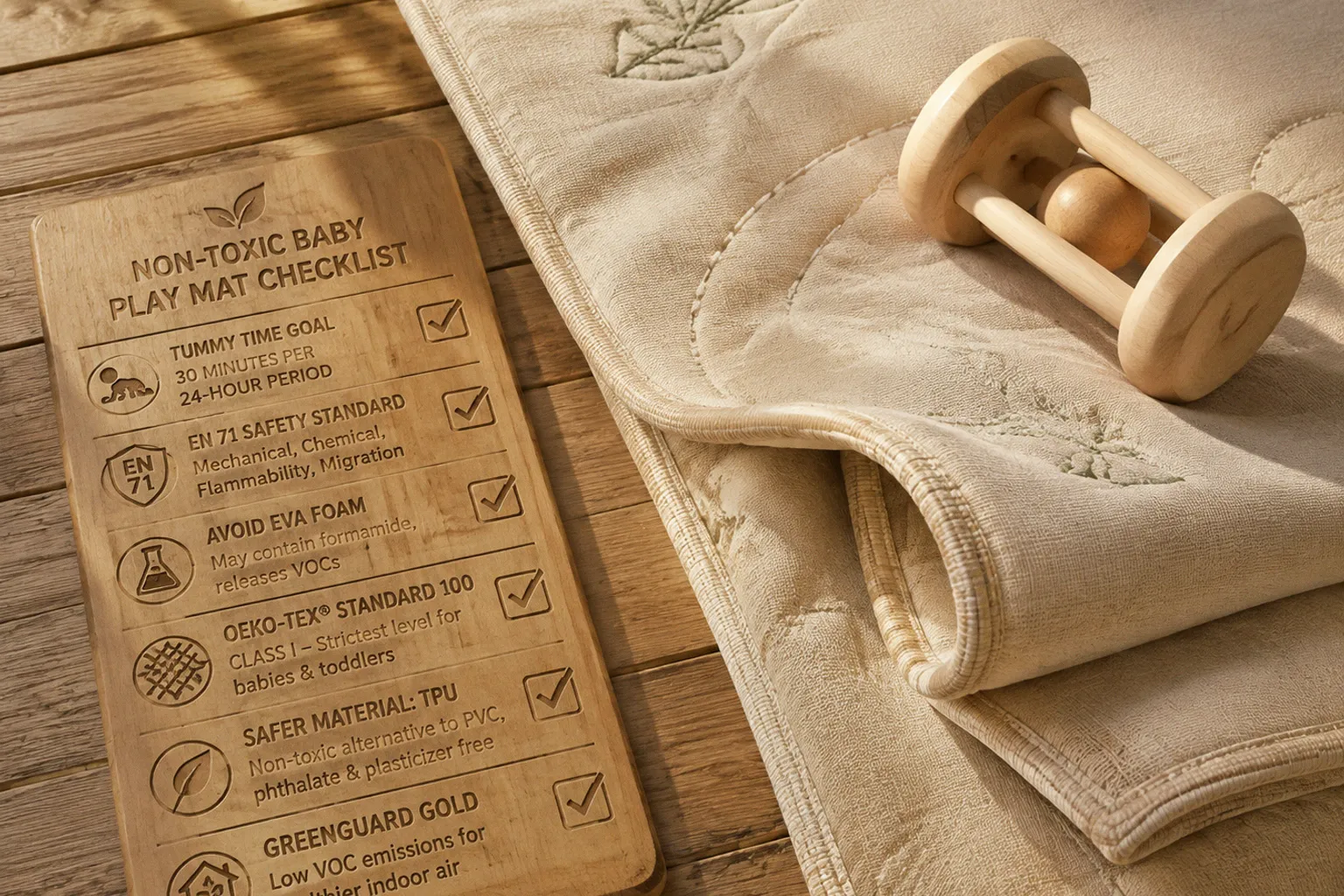
You lay your three-month-old down on a new play mat, phone in hand to capture the milestone — and within seconds, your baby is fussing, arching away from the surface, or pressing their cheek into the foam with an expression that makes every parental instinct flare up. The mat may look perfect: soft colours, a reassuring label, a neatly designed nursery setting. Yet the question remains uncomfortably simple: what, exactly, is your baby breathing in and touching?
The phrase “non-toxic” is not a guarantee. In most markets, it is a broad marketing descriptor rather than a single regulated safety category. One manufacturer may use it to describe a mat without PVC; another may mean that the product contains no particular group of plasticisers. A third may provide no meaningful definition at all.
That does not make every colourful foam mat dangerous. It means the label cannot do the work of a proper assessment. Before first tummy time, look at the material, the relevant testing, the intended age range, the condition of the surface, and the way the mat behaves after it has been unpacked. This is the practical version of a non toxic baby play mat checklist: less about finding a magic word on the box, more about understanding what the product has actually been evaluated for.
Decoding Material Safety: Beyond the “Non-Toxic” Label
The first thing I tell parents is to turn the mat over and read the fine print. The front of the packaging is designed to make a quick impression; the underside, product page, technical file, or care instructions usually reveal much more.
A mat can carry a “non-toxic” claim while leaving important questions unanswered. What is the primary material? Does the product have a printed or coated surface? Which substances were tested, and under what standard? Was the testing performed on the finished product or only on a raw material supplied earlier in the manufacturing chain?
When I assess a mat for a nursery or home play area, I start with the material composition because it gives the rest of the claims some context.
What to look for before buying
1. Identify the main material.
Is the mat made from TPU, natural rubber, organic cotton, EVA foam, PVC, or a mixture of materials? “Eco-friendly” is not a material specification. It may describe one component while leaving the backing, inks, adhesives, or surface coating unexplained.
2. Look for a product-specific technical document.
Manufacturers may use different names for their documentation, including a safety data sheet, technical data sheet, test report, or declaration of conformity. The useful document is one that identifies the actual product and explains what was tested. A generic statement about a material category is less informative than documentation tied to the finished mat.
3. Separate a claim from a test result.
“BPA-free” or “phthalate-free” tells you what the manufacturer says the product does not contain. It does not, by itself, explain how the claim was verified. Stronger documentation identifies the testing laboratory, the applicable method or standard, and the product or batch covered by the report.
4. Ask about EVA foam and formamide.
EVA has long been used in interlocking and folding play mats. Some EVA manufacturing processes can leave residual formamide, a volatile compound associated with foam production. Better-documented products may provide formamide screening or removal-test information. If the brand gives no material details and no testing information, the attractive pattern is not enough to fill the gap.
5. Inspect dyes, inks, laminates, and coatings.
A base material may have one safety profile while the finished surface has another. Printed designs, coloured films, anti-slip layers, and bonding agents can all form part of the baby’s contact surface. This is particularly relevant when a manufacturer describes the mat as “natural” but does not explain how the pattern or protective finish was made.
6. Consider the contact pattern, not only the ingredient list.
During tummy time, babies press their mouths, cheeks, hands, and forearms against the mat. They drool, rub their faces across the surface, and may remain there for several short sessions each day. A product intended for this kind of close contact deserves more scrutiny than a decorative rug that a child rarely touches.
“Non-toxic” without product-specific verification is a marketing position, not a complete safety assessment.
There is also a practical distinction between a material being free from one concerning substance and the entire product being suitable for an infant environment. A mat can be free from phthalates and still have a strong odour, an irritating finish, loose layers, or poor cleaning performance. Chemical composition is important, but it is only one part of the decision.
The Role of Third-Party Certifications in Nursery Environments
Third-party certification is useful because it moves the conversation away from what a brand wants to call its product. It does not make every certification interchangeable, however. Each programme has its own scope, testing criteria, product categories, and limits.
The question is not simply whether a logo appears on the packaging. Ask what the certification covers and whether it applies to the exact mat you are buying.
| Certification or standard | What it generally addresses | What to keep in mind |
|---|---|---|
| OEKO-TEX Standard 100, Class I | Harmful-substance testing for textile products, with Class I intended for items used by babies and young children | Most relevant to fabric, cotton, covers, and textile components; it does not automatically describe every foam layer or accessory |
| GREENGUARD Gold | Low VOC emissions from a finished product under the programme’s certification criteria | It is relevant to indoor air quality in sensitive environments, but it does not mean zero emissions or guarantee the absence of every chemical hazard |
| EN 71 | Safety requirements for certain toys, including relevant mechanical, chemical, and flammability considerations | Check the applicable part of the standard and whether the mat is actually covered by the manufacturer’s declaration |
| ASTM F963 | U.S. toy-safety requirements covering specified physical, mechanical, chemical, and other hazards | A toy-safety standard is not a universal substitute for material, emissions, or textile certification |
| GOTS | Organic-fibre content and processing requirements across the textile supply chain | Useful for organic cotton or other textile mats; it does not turn a non-textile foam core into an organic material |
What GREENGUARD Gold does — and does not — tell you
GREENGUARD Gold is often described too broadly in nursery marketing. The certification verifies that a product meets specified low-VOC emissions criteria for indoor environments. That can be meaningful when a mat will be used in a nursery, where a baby spends time close to the floor and where ventilation may be limited.
It does not certify that a mat releases no chemicals at all. It does not guarantee zero off-gassing, and it does not establish that the product is free from every possible chemical hazard. Its scope is narrower: under the certification programme’s criteria, the product has been assessed for VOC emissions and meets the relevant low-emission requirements.
That distinction matters because “low VOC emissions” and “no chemical risk” are not the same statement. A careful product description should preserve that difference rather than turning an emissions certification into a universal safety promise.
Read the age rating alongside the certification
A certification logo can still leave an important question unanswered: for which age group was the product evaluated?
Some interlocking mats are sold as children’s products but carry a 3+ age rating or a warning that they are not suitable for children under 36 months. That may relate to small parts, detachable edges, product construction, or the way the item was classified for testing. It does not automatically mean the mat is appropriate for a baby who will put their face and hands against it during tummy time.
If you are buying for an infant, look for documentation that clearly identifies use from birth or 0+ months where applicable. Do not infer an infant rating from a photograph of a baby on the product page. The image is advertising; the age statement and safety documentation are the more useful evidence.
I have seen beautifully designed mats with impressive branding that carry a different age rating in their technical documentation. For a toddler’s playroom, that may be a reasonable product. For a newborn’s first floor sessions, it is not the same level of assurance.
Age-Appropriate Testing: Why 0+ Months Standards Matter
The phrase “child-safe” covers a wide age range. A product suitable for an older toddler is not automatically suitable for a baby who cannot yet move away from an uncomfortable surface or a loose component.
An infant on a play mat behaves differently from an older child. A baby may mouth the edge, push their face into a seam, pull at a printed layer, or remain in one position until an adult intervenes. The mat therefore needs to be assessed in the context of the way an infant actually uses it, not merely the way an adult imagines it will be used.
Age-appropriate evaluation can affect several aspects of the product:
- Small-part and detachment concerns: loose tabs, peeling films, decorative pieces, or damaged edges become more significant when a baby can mouth them.
- Chemical migration and contact: infant use involves frequent skin contact, drool, and close facial contact with the surface.
- Flammability and construction: the relevant requirements depend on the product category and intended use, but an infant cannot reliably remove themselves from a hazard.
- Surface condition: cracks, gaps, and flaking layers are not just cosmetic defects when the user is crawling, chewing, and pressing their face against the mat.
- Instructions and warnings: an age statement may reveal that the product was not intended for early infancy, even if the marketing imagery suggests otherwise.
A practical 0+ months check
1. Confirm that the packaging or official product page states an infant-appropriate age range, such as 0+ months or suitable from birth, where that claim is applicable.
2. Check whether the stated standard or declaration applies to that age category rather than to a general children’s classification.
3. If the product lists only broad toy-safety compliance, ask the manufacturer which age group was used for the assessment.
4. Treat “baby-safe” as a description to investigate, not as proof of an age rating.
5. Recheck the warning label if you are buying an interlocking mat with removable pieces, detachable borders, or small accessories.
This is not about demanding that every mat carry every possible certification. It is about matching the evidence to the child who will use the product. A thick toddler mat and a washable infant play surface can both be well made, but they are not necessarily tested, labelled, or constructed for the same use.
Navigating Foam Alternatives: TPU vs. Traditional EVA
Foam mats remain popular because they solve a real nursery problem: they create a more forgiving surface over a hard floor while still giving a baby something firm enough to push against. The useful question is not whether foam is automatically good or bad. It is which formulation, finish, and construction have been documented clearly enough for your needs.
How the common options compare
| Parameter | Traditional EVA foam | TPU |
|---|---|---|
| Material profile | A widely used closed-cell foam that may vary considerably between manufacturers | A thermoplastic polymer often selected for flexibility, durability, and a smoother finished surface |
| Formamide question | Some EVA products require specific screening because residual formamide can be associated with foam production | Not generally associated with the same formamide concern, though the finished product still needs appropriate testing |
| Feel under a baby | Often soft and cushioned, depending on density and thickness | Commonly firmer and more resilient, which some babies find easier to push against |
| Surface durability | Can compress, dent, or develop worn edges with repeated use | Often resistant to compression and surface wear, although construction quality varies |
| Documentation to request | Material composition and formamide testing or removal information | Full composition, emissions or chemical testing where available, and details of any coatings or laminated layers |
| End-of-life | Recycling options are limited in many areas | Specialist recycling may exist, but availability depends on local programmes and product construction |
Not all EVA mats are unsafe. A well-documented EVA product that has been tested for relevant concerns can be an appropriate choice. The problem is the vague EVA mat: no clear manufacturer, no explanation of the foam, no information about formamide, and a strong smell that the product page never mentions.
TPU is often chosen by parents who want a cushioned surface without relying on traditional EVA foam. It can feel slightly firmer, which is not necessarily a disadvantage. Tummy time is not meant to be a sinking experience. Babies need to press through their hands, shift their weight, and gradually learn how the surface responds to their body. A stable surface can make those movements easier to organise.
Natural rubber is another option, particularly in floor mats with a dense, flexible construction. It is not automatically the safest choice simply because it is natural. Latex sensitivity, added coatings, dyes, adhesives, and odour still matter. A natural rubber baby floor mat safety check should include whether the manufacturer identifies the rubber content, discloses potential latex allergens, explains the finish, and provides age-appropriate testing for the completed product.
Fabric and organic cotton mats have their own advantages: they can feel warm, fold easily, and fit comfortably into a nursery. They also need more attention to laundering and drying. A cotton cover that remains damp inside a thick padded mat can create hygiene problems even when the fibre itself is organic. Organic fibre certification is valuable, but it does not replace inspection of the padding, backing, waterproof layer, or stitching.
Best Practices for Initial Setup and Off-Gassing
You have checked the material, reviewed the age rating, and found credible testing information. The mat arrives. The next step is not to put it straight on the nursery floor with the baby on top.
A new product may have a noticeable manufacturing or packaging odour. Odour alone cannot tell you whether a product is safe or unsafe, and the absence of odour is not proof of chemical purity. Still, allowing the mat to air out gives you an opportunity to assess it before close infant contact and to notice defects that were hidden in the packaging.
Before first use
1. Unpack it in a ventilated area.
Open the mat away from the baby’s sleeping space and allow air to circulate. Follow the manufacturer’s instructions if they specify a ventilation period. A general recommendation found in marketing copy is not a substitute for the product’s own care guidance.
2. Wipe the surface as instructed.
For many foam or TPU mats, a clean damp cloth is appropriate. Avoid adding household disinfectants, essential oils, fragranced sprays, or harsh solvents unless the manufacturer specifically approves them. These products can leave residues, damage the surface, or create a new source of irritation.
3. Assess any persistent odour.
A mild new-product smell may fade with ventilation. A sharp, acrid, or strongly plasticky odour that remains pronounced should not be ignored. Contact the manufacturer with the product details, ask for clarification, and consider returning the mat rather than trying to mask the smell with fragrance.
4. Inspect every edge and join.
Look for peeling layers, exposed foam, uneven seams, cracks, loose tabs, and areas where the surface feels unusually sticky or brittle. Run your hand across the whole mat. A defect that seems minor from a standing position may be directly under a baby’s mouth.
5. Check the floor beneath it.
The mat should lie flat without creating a sliding hazard. Interlocking tiles need to fit tightly, while folding mats should not have gaps that can trap fingers. A cushioned surface is only useful if it remains stable during movement.
6. Keep it away from heat sources.
Radiators, heaters, hot pipes, and prolonged direct sunlight can affect some foams, coatings, and adhesives. Follow the care instructions and avoid placing the mat where heat is concentrated.
7. Establish a cleaning routine that suits the material.
Foam and TPU surfaces may need regular wiping, especially after drool, spit-up, or food contact. Fabric mats require proper laundering and thorough drying. Do not assume that a waterproof top layer means the inner padding can tolerate soaking.
The first few uses are also a form of observation. Does the surface become slippery when damp? Does a printed layer begin to lift? Does the mat curl at the corners? Does the baby react to the texture, temperature, or smell? A baby’s fussing is not a chemical test, but it is still useful information. If the product is uncomfortable, unstable, or deteriorating, it has failed the practical part of the assessment.
Extending the Play Value Beyond Tummy Time
A good play mat is rarely a single-stage purchase. The same surface may support early tummy time, reaching and pivoting, crawling, sitting, block play, and quiet floor activities later on. That makes durability and cleanability just as relevant as the initial material claim.
As your child becomes more mobile, the risk profile changes. A mat that was fine for a supervised three-month-old may need a closer inspection once a baby begins pulling at edges and carrying pieces around. Interlocking tiles can separate. Seams can open. Surface films can lift. Fabric can develop damp patches if it is washed frequently but not dried thoroughly.
Revisit the mat periodically:
- Check the underside for trapped moisture or mould-like spotting.
- Replace pieces that have cracked, crumbled, or become sticky.
- Remove any loose decorative elements.
- Reassess the age and use warnings as your child’s behaviour changes.
- Clean according to the material rather than according to a generic nursery routine.
- Retire the mat if the surface can no longer be cleaned properly or if the structure has become unstable.
The safest material on paper is not a good choice if the mat cannot be maintained in real life. Conversely, a less fashionable material may serve a family well when its composition is documented, its age rating is appropriate, and its condition is checked consistently.
Before first tummy time, look past the word “non-toxic.” Identify the material. Read the relevant documentation. Distinguish low-VOC certification from a guarantee of zero emissions or universal chemical safety. Confirm that the product is intended for the age of the child who will use it. Ventilate, clean, inspect, and keep watching after the packaging has gone in the recycling.
The mat is not the developmental work. Your baby provides that through movement, repetition, and curiosity. The mat’s job is more modest — to offer a stable, clean, well-understood surface on which that work can begin.