Spatial reasoning games: how these puzzles build brain power
Spatial reasoning develops through repeated manipulation of objects, not through verbal explanation alone.
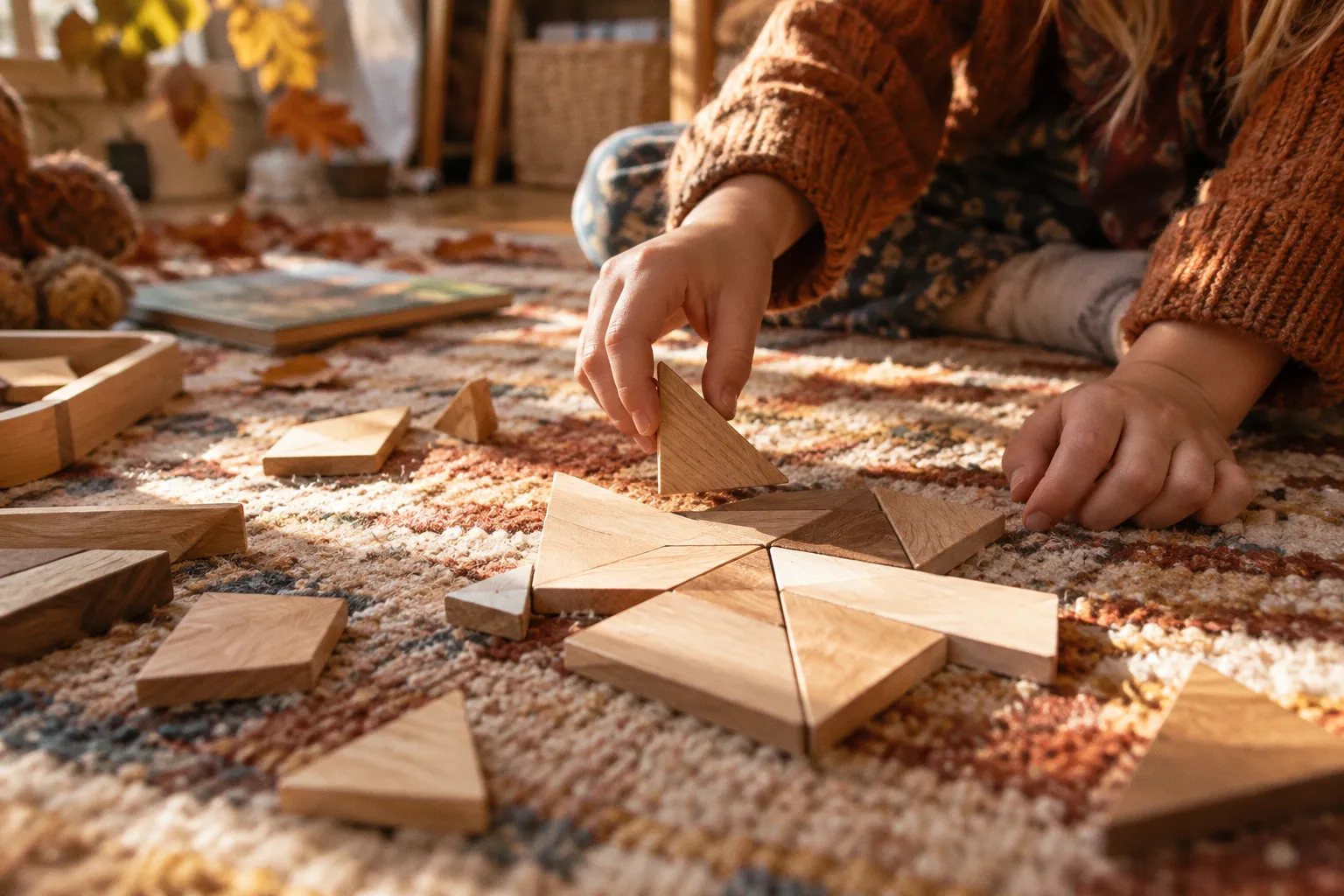
When a child rotates a shape mentally, compares two pieces, follows a route on a board, or reconstructs a three-dimensional object, the task exercises specific cognitive operations that later support mathematics, engineering, geometry, and other STEM activities.
The phrase “spatial reasoning games for kids” covers several different mechanics. A wooden jigsaw puzzle, a tangram, a block-building set, and a 3D bolt puzzle do not train exactly the same ability. Their developmental value depends on the transformation the child must perform, the quality of feedback, and whether the game presents varied problems rather than a single pattern to memorize.
The four pillars of spatial cognition
Cognitive psychologists generally distinguish four related spatial skills. They overlap during play, but each describes a different mental operation.
Mental rotation
Mental rotation is the ability to imagine an object turning in two or three dimensions without physically moving it. A child may need to decide whether a puzzle piece fits a gap after being rotated, or determine whether two irregular shapes are identical from different viewpoints.
This mechanic appears in:
- Wooden jigsaw puzzles with nonuniform pieces.
- Shape-matching games.
- Rotating block challenges.
- Tangram arrangements.
- Three-dimensional construction puzzles.
A simple matching activity can require mental rotation when the correct piece is not presented in the same orientation as the target. The child must compare the underlying geometry rather than rely on the piece’s current position.
The cognitive load increases when the object has several asymmetrical features. A square is easy to recognize after rotation because its profile remains highly predictable. An irregular wooden animal piece, an interlocking bolt, or a shape with a notch and a protrusion requires more precise comparison.
Spatial visualization
Spatial visualization involves a sequence of transformations. The child does not merely rotate one object; they must predict what will happen after several operations, such as folding, slicing, combining, or rearranging pieces.
Tangram puzzles are a clear example. A traditional tangram uses seven geometric pieces that must be combined to reproduce a larger shape, often an animal or an abstract silhouette. The child may need to rotate a triangle, reflect its position, fit it against another piece, and preserve the overall contour at the same time.
This is more demanding than identifying a single matching shape because the solution depends on relationships among multiple components. The child must maintain an internal representation of the whole figure while manipulating its parts.
Spatial visualization is also involved in:
- Multi-step block construction.
- Magnetic tile structures.
- Folding and unfolding puzzles.
- Pattern-reproduction boards.
- 3D wooden puzzles that require assembly in a specific order.
Spatial perception
Spatial perception concerns orientation relative to a frame of reference. It includes judging the position of an object when the surrounding perspective changes.
A board game can exercise spatial perception when a child must interpret a route from a particular viewpoint, determine which direction is left or right on a map, or identify whether an object is above, below, behind, or beside another object.
This skill is often overlooked because the game may appear simple. A maze, path board, or visual sequence task does not necessarily require advanced geometry. It may instead require the child to maintain orientation while the reference frame changes.
Spatial perception becomes more complex when:
- The board is viewed from different sides.
- The child must follow an illustrated map.
- Several objects overlap.
- The goal is defined relative to another object.
- The game uses diagonal, vertical, and horizontal relationships.
Spatial relations
Spatial relations involve understanding how objects occupy space in relation to one another. The relevant questions are structural: Which piece is adjacent? Which object fits inside another? Which edge aligns with the target? What arrangement produces a stable structure?
Construction games depend heavily on this ability. The child must evaluate dimensions, contact points, balance, and the relationship between separate components. A successful arrangement is not based only on recognizing shapes. It requires an understanding of how shapes function together.
Spatial relations are also central to jigsaw puzzles. A piece can have the correct color and general subject but still fail because its edge geometry does not correspond to the neighboring pieces. The child must integrate visual features with positional information.
Spatial reasoning is not one skill. It is a group of operations involving rotation, transformation, orientation, and relationships among objects.
How game mechanics drive cognitive growth
The developmental effect of a spatial game comes from its task structure. The label “educational” is less informative than the actual operation required to solve the problem.
Manipulation creates an external model
Physical pieces make spatial information available through multiple sensory channels. The child can see the object, move it, compare it with a target, and observe the result. This reduces the distance between a mental hypothesis and its physical test.
For example, a child solving a wooden puzzle may form the hypothesis that a piece belongs in a particular opening. The child then rotates the piece, places it against the opening, and receives immediate information about the fit. The physical object functions as an external model of the problem.
This does not mean every physical puzzle automatically produces strong spatial learning. The task must require active comparison or transformation. A puzzle that can be completed by matching identical printed images may place greater demand on visual recognition than on spatial reasoning.
Constraints make the reasoning measurable
Good spatial games impose constraints. A piece must fit within a boundary. A structure must remain stable. A route must follow a defined sequence. A pattern must be reproduced without changing its orientation.
Constraints create a clear relationship between the child’s action and the result. When the arrangement is impossible, the child has to revise the representation or the action. This is more cognitively productive than unrestricted construction when the goal is specifically spatial reasoning.
Open-ended building still has developmental value, particularly for spatial relations and planning. However, it does not always reveal whether the child can reproduce a structure, maintain a pattern, or perform a transformation under defined conditions.
Varied stimuli prevent pattern memorization
Repeated play with one fixed configuration can produce familiarity without equivalent growth in spatial reasoning. Once the child remembers the location of every piece, the task may shift from mental rotation and visualization to memory retrieval.
Variation is therefore a central design feature. Effective spatial reasoning games should change at least one meaningful property:
- The orientation of the target.
- The number or arrangement of pieces.
- The route through the board.
- The perspective from which the object is shown.
- The relationship between component shapes.
- The sequence required to complete the construction.
The objective is not constant difficulty. It is exposure to the same underlying operation in different visual conditions.
A child who solves only one familiar wooden puzzle may become efficient at that puzzle. A child who solves several puzzles with different shapes, orientations, and construction rules receives broader spatial practice.
Progressive cognitive load
Difficulty should increase through the mechanics, not through arbitrary complexity. A developmentally appropriate progression might begin with simple shape insertion and move toward multi-step transformation.
For younger children, large wooden blocks and basic shape sorters can establish the relationship between form, orientation, and location. Magnetic tiles can introduce planar construction and, later, three-dimensional structures. Tangram-style tasks add decomposition and recombination. More advanced 3D puzzles require the child to coordinate several directions and preserve a mental model while assembling parts.
The age ranges in product descriptions are useful starting points but not complete developmental assessments. Simple wooden blocks commonly suit children from approximately 2 to 6 years. Magnetic tile systems are often designed for roughly 3 to 10 years, depending on the complexity of the set. Tangram Jr.-type puzzles are generally aimed at children aged 4 and above, while more demanding three-dimensional, multidirectional puzzles may be intended for children aged 8 and older, including adults.
The decisive variable is the operation the child can perform independently. If the child can only guess, the cognitive task is poorly calibrated. If the child completes the puzzle without transformation or planning, the task may no longer provide sufficient challenge.
Immediate feedback and spatial skill acquisition
Feedback determines how quickly the child can connect an action with a consequence. In spatial puzzles, immediate feedback usually comes from physical fit, visual alignment, structural stability, or a clear completion state.
A piece either enters the opening or it does not. A tower remains upright or collapses. A pattern matches the model or differs from it. These outcomes allow the child to test a mental representation without waiting for an adult to judge the answer.
Immediate feedback supports several learning processes:
1. Error localization. The child can identify which piece, rotation, or step produced the problem.
2. Hypothesis revision. The child can change one variable instead of abandoning the entire solution.
3. Action-consequence mapping. The child learns how a specific rotation or placement affects the larger arrangement.
4. Reduced dependence on verbal correction. The object provides information directly through its mechanics.
5. Faster adaptation. Repeated attempts become comparisons between alternative strategies rather than random trial and error.
Delayed feedback is less efficient for this type of learning because the child may no longer remember which action produced the error. A game that offers no meaningful indication of progress also places a heavier burden on external explanation.
This does not require the puzzle to provide a binary right-or-wrong signal at every step. Subtle feedback can be useful. A structure that becomes unstable, a pattern that leaves one unmatched edge, or a route that reaches a dead end all communicates information. The key condition is that the child can interpret the outcome and use it to modify the next attempt.
Language and gestures make spatial play more precise
Spatial games become more effective when adults use precise spatial language during play. The words should describe the operation or relationship, not merely announce success.
Useful terms include:
- Rotate
- Flip
- Turn
- Left and right
- Above and below
- Inside and outside
- Near and far
- Diagonal
- Edge and corner
- Pointed and flat
- Parallel and opposite
The purpose is not to turn play into a vocabulary lesson. It is to connect verbal labels with visible and tactile relationships. When an adult says that a piece needs to rotate rather than simply move, the child receives a more accurate description of the required operation.
Gestures provide a second representation. An adult may trace the direction of a turn, point to the matching edge, or indicate the position of a piece relative to the board. Research on spatial play indicates that parental use of spatial language and gestures is associated with stronger spatial test performance and more developed conceptual vocabulary.
The interaction should preserve the child’s problem-solving role. Giving the correct placement immediately removes the central cognitive operation. A more useful sequence is:
1. Describe the relationship without naming the answer.
2. Ask the child to compare the relevant edges, angles, or orientations.
3. Use a gesture to clarify direction if necessary.
4. Allow the child to test the proposed movement.
5. Confirm the result through the puzzle’s own feedback.
For example, instead of placing a piece into the board, an adult can direct attention to the pointed corner and ask whether it is facing the same direction as the opening. This keeps the reasoning with the child while supplying precise perceptual information.
Choosing tools from tangrams to 3D puzzles
Different puzzle formats place different demands on spatial cognition. The following comparison is more useful than treating all educational games as interchangeable.
| Game format | Primary spatial operations | Typical source of difficulty | Best developmental use |
|---|---|---|---|
| Wooden shape puzzles | Spatial perception, basic spatial relations, early rotation | Matching orientation and contour | Establishing form-location relationships |
| Wooden jigsaw puzzles | Spatial relations, visual comparison, limited mental rotation | Integrating edge geometry, color, and position | Practicing part-to-whole construction |
| Building blocks | Spatial relations, balance, visualization | Predicting stability and combining components | Developing structural planning |
| Magnetic tiles | Spatial relations, visualization, basic geometry | Converting flat pieces into three-dimensional structures | Exploring planes, enclosures, and volume |
| Tangrams | Mental rotation, visualization, decomposition | Reconstructing a target from seven geometric pieces | Practicing transformation and whole-part reasoning |
| Spatial board games | Spatial perception, orientation, route planning | Tracking position within a changing reference frame | Applying spatial language and directional decisions |
| 3D mechanical puzzles | Mental rotation, visualization, sequential planning | Maintaining a model across several assembly steps | Extending multidirectional spatial reasoning |
For ages 2 to 6: establish manipulation and orientation
At this stage, the main objective is to make shape, position, and movement distinguishable. Large pieces, simple boards, and stable construction materials reduce unnecessary fine motor demands while preserving the spatial task.
A well-designed early puzzle should allow the child to see why a piece does or does not fit. Excessively tight tolerances can convert a spatial problem into a frustration problem. The child should be able to manipulate the object with sufficient fine motor precision to test different orientations.
For ages 3 to 10: expand construction and transformation
Magnetic tiles and modular blocks can introduce increasingly complex arrangements. The child can move from stacking and lining up pieces to creating enclosures, symmetrical forms, bridges, and multi-part structures.
At this stage, variation is particularly important. If the child builds only familiar towers, the activity may emphasize routine assembly. Adding a model to reproduce, a stability constraint, or a requirement to use specific pieces increases visualization and planning demands.
From age 4: introduce tangram-style decomposition
Tangrams provide a compact system for studying how parts form a whole. The seven pieces can be combined into many silhouettes, and the child must often use rotation, reflection, and positional adjustment to reach the target.
Begin with visible outlines and a small number of obvious transformations. More advanced tasks can remove internal piece boundaries, requiring the child to infer the arrangement from the external contour alone. The goal is not speed. A slower solution that involves deliberate comparison provides more information about the child’s spatial strategy.
From age 7: use sequence and grid-based tasks
A 4×4 grid is an accessible format for introductory visual-spatial sequence training in children around ages 7 to 10. Grid patterns can require the child to identify a transformation, reproduce a sequence, or infer the next arrangement.
These games connect spatial reasoning with rule detection. The child must identify not only where an object is located but how its location changes according to a consistent system. This introduces a bridge between spatial visualization and algorithmic thinking.
From age 8 and beyond: increase multidirectional complexity
Three-dimensional puzzles place heavier demands on mental rotation and sequential visualization. The child must maintain the orientation of hidden surfaces, understand how parts connect, and often reverse an earlier action when the assembly fails.
The mechanics of 3D wooden puzzles are most productive when the construction process remains interpretable. If the internal structure is opaque and the child cannot identify why an assembly fails, the task may become unstructured trial and error. Advanced difficulty should come from spatial relationships and sequencing, not from poor manufacturing tolerances or ambiguous instructions.
Common design errors in spatial games
Several features can weaken the intended developmental effect.
Fixed patterns
A puzzle with only one repeated configuration may become a memory task. Repetition is useful for fluency, but it should be supplemented with new orientations and arrangements.
Excessive visual decoration
Color and thematic illustrations can support motivation and recognition, but they may also provide shortcuts. If a piece is identified only by a printed image, the child may not analyze its geometry. At least some challenges should require comparison of shape, orientation, and position.
Feedback that is too vague
If the child cannot determine whether an action improved the arrangement, learning slows. Good physical design makes errors visible through misalignment, instability, or incomplete structure.
Difficulty disconnected from the target skill
A puzzle can be hard because pieces are too small, surfaces are slippery, or instructions are unclear. Those factors do not necessarily represent higher spatial reasoning demand. Developmental difficulty should arise from the mental operation being practiced.
Adult takeover
When an adult rotates every piece or supplies every next step, the child observes a solution but performs little spatial reasoning. Assistance should clarify the relationship and return the task to the child.
The strongest spatial game is not the one with the most pieces. It is the one that makes the intended transformation necessary and the result interpretable.
The relationship to mathematics and STEM learning
Spatial reasoning is relevant to early mathematics because many mathematical tasks involve form, position, measurement, geometry, and transformation. Children who frequently engage with puzzles, building blocks, and spatial board games show stronger spatial reasoning performance in research associated with psychological scientist Jamie Jirout.
This relationship should be described accurately. Spatial games do not guarantee a fixed increase in IQ or mathematics scores. They provide practice with cognitive operations that are also used in mathematical and STEM contexts. Transfer depends on the quality of the task, the child’s developmental stage, the variety of activities, and whether adults connect play with precise spatial language.
The most direct connection occurs when the game requires the child to reason about structure rather than simply recognize a picture. Rotating a shape, predicting a construction, reading a route, and reconstructing a pattern all provide different forms of practice. None is a complete substitute for formal instruction, but each can strengthen the underlying representations that formal instruction uses.
Final assessment
Spatial reasoning games for kids are effective when their mechanics require genuine transformation: rotating, folding, orienting, combining, separating, or positioning objects in relation to one another. Wooden puzzles, tangrams, block sets, spatial awareness board games, and 3D construction puzzles should therefore be evaluated by the operation they demand, not by their educational label.
The most reliable selection process is straightforward:
1. Identify the primary spatial skill: mental rotation, visualization, perception, or relations.
2. Check whether the child can manipulate the pieces accurately enough to test ideas.
3. Prefer varied configurations over a single memorized pattern.
4. Select games with immediate and interpretable feedback.
5. Use spatial language and gestures without taking over the solution.
6. Increase complexity through transformations and relationships, not through arbitrary frustration.
The definitive verdict is that spatial play supports cognitive development most effectively when it makes the child construct, test, and revise an internal model of space. The product is secondary to the mechanism. A simple puzzle with varied orientations and clear feedback can provide more meaningful spatial practice than a complex game that rewards memorization or depends on adult intervention.