Wooden base ten blocks: common counting errors and fixes
A four-year-old may hear the word thirteen and count out four unit cubes. A seven-year-old may solve 35 + 26 by writing 511 and still see the result as plausible.
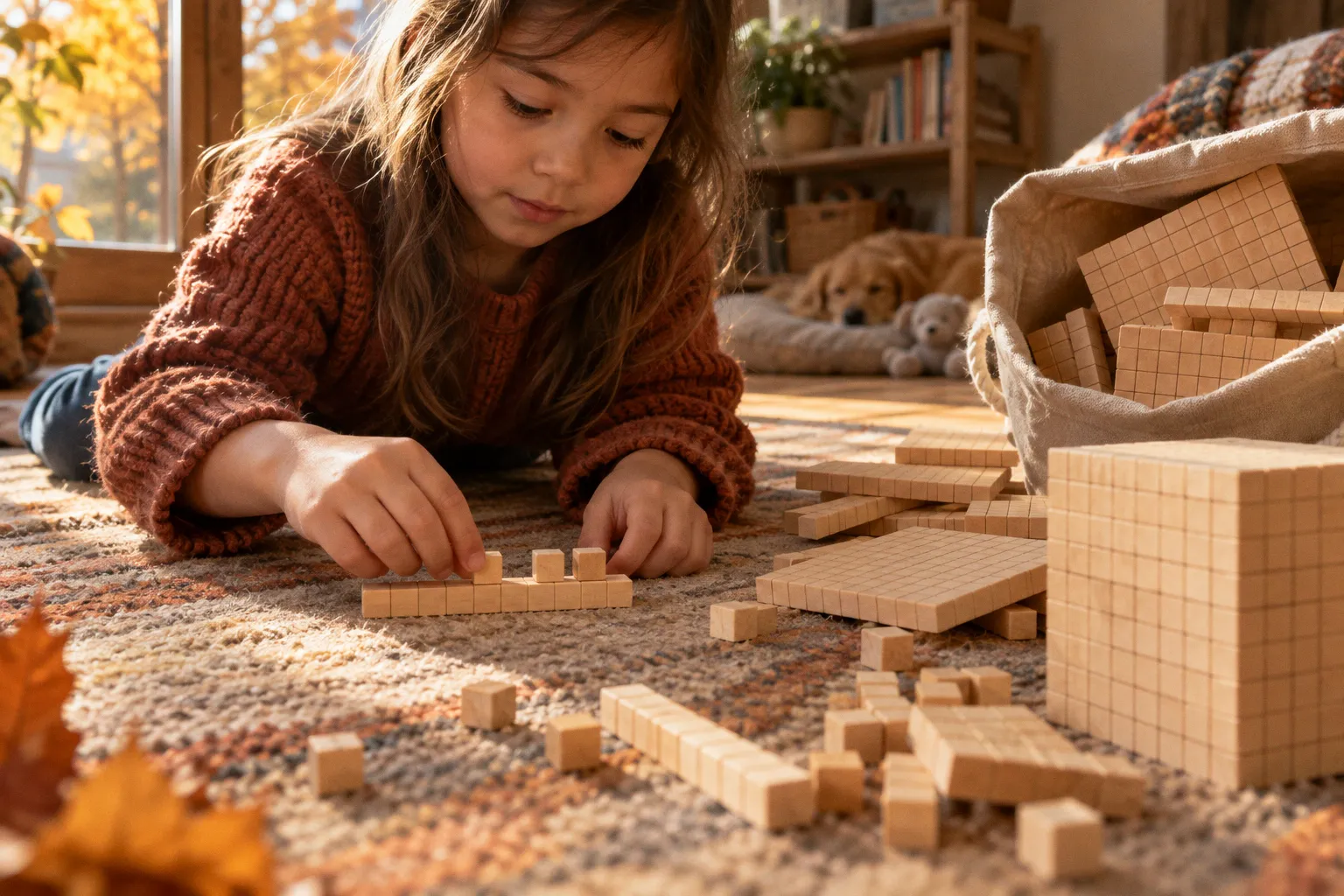
These errors look different on paper, but they often point to the same underlying gap: the child’s sense of quantity has not yet been connected to the positional structure used by written mathematics.
Wooden base ten blocks, also called Dienes blocks, can help make that structure visible and tangible. Their proportions show that ten units can be treated as one ten, ten tens as one hundred, and so on. But the blocks are not self-explanatory. If children are only asked to count, stack, or copy arrangements, the set may remain a collection of attractive counting objects rather than a tool for examining place value. The important question is not simply whether a child can handle the blocks. It is whether the child can connect three representations of the same quantity: loose units, grouped units, and written numerals.
The Anatomy of Place Value: Understanding Proportional Blocks
Base ten blocks encode a mathematical relationship in four physical forms: ten blocks of one size correspond to one block of the next size. The material gives children something they can see and handle while they are learning a rule that is otherwise easy to state but difficult to imagine.
The standard forms are:
| Block type | Composition | Place value represented |
|---|---|---|
| Unit cube | 1 × 1 × 1 | Ones |
| Rod, or long | 10 unit cubes joined linearly | Tens |
| Flat | 100 unit cubes arranged as a 10 × 10 square | Hundreds |
| Large cube | 1,000 unit cubes formed into a 10 × 10 × 10 cube | Thousands |
The critical feature is the relationship between adjacent sizes. Ten unit cubes can be organized to match the length of one rod. Ten rods can be arranged to match one flat. Ten flats correspond to one large cube. The child can therefore compare the parts and the whole without relying on a spoken rule alone.
That physical comparison is useful, but it should not be confused with an automatic understanding of place value. A child can recognize that a rod is longer than a unit cube and still not understand why the rod belongs in the tens column. The teacher or parent has to make the connection explicit: the rod is not merely a longer object; it represents a group of ten units.
The proportional design also supports the idea of equivalence. Ten loose cubes and one rod are physically different arrangements, yet they represent the same quantity. This is the foundation of trading, sometimes called regrouping or exchanging. The child learns that a quantity can be reorganized without being changed.
A wooden block’s value is encoded in its dimensions, not in its surface. The proportional geometry gives place value a form that children can compare, rearrange, and revisit.
Material choice does not change the mathematical proportions. Wooden, plastic, and digital base ten blocks can all represent the same relationships if the virtual or physical models are accurately scaled. Wood may offer a satisfying weight and a stable tactile experience, which can be helpful during repeated handling, especially for younger children. It is not, by itself, a substitute for explanation. A beautifully made set still needs a routine that connects the object to the number.
A useful first distinction is between counting the blocks and interpreting the blocks:
- Counting the unit cubes answers how many individual pieces are present.
- Grouping the pieces answers how the quantity can be organized.
- Naming the groups answers what the organization means in the place value system.
- Recording the arrangement connects the physical model to written notation.
These are related skills, but they do not appear at the same time. A child may be able to count thirteen loose cubes accurately while still struggling to explain that thirteen consists of one ten and three ones.
Decoding Teen Numbers: Why Children See 13 as 1 and 3
The teen-number boundary is an early place where spoken language, quantity, and notation can pull in different directions. A child may hear thirteen as a word containing the familiar parts three and one, or may treat the written digits 1 and 3 as two independent symbols. In practice, the child may count four unit cubes when asked to show thirteen, or may identify the digits without being able to build the corresponding quantity.
This is not necessarily a refusal to count or a lack of effort. It can indicate that the child is still treating each digit as a separate label rather than understanding that the first digit describes a group of ten.
Base ten blocks help isolate the problem because they allow the adult to ask several different questions about the same number:
1. Can the child count thirteen loose cubes one by one?
2. Can the child separate those cubes into a group of ten and three remaining cubes?
3. Can the child replace the group of ten with one rod?
4. Can the child describe the new arrangement as one ten and three ones?
5. Can the child connect the arrangement to the written numeral 13?
The first question is a counting question. The later questions are place value questions. Keeping them separate prevents a common instructional mistake: assuming that failure to trade means the child cannot find the total.
A child can count thirteen loose cubes without trading them for a rod. Counting all thirteen objects is mathematically valid. Trading is an instructional strategy that makes the tens-and-ones structure visible; it is not a condition for obtaining the total. The distinction matters because adults sometimes turn regrouping into a test of whether the child has counted correctly. It is better to acknowledge both representations:
- thirteen loose cubes show a total of thirteen;
- one rod and three cubes show the same total in a place-value arrangement.
The trading step then becomes a way to reorganize the quantity and talk about its structure, not a magical procedure required before the number can exist.
For example, place thirteen loose cubes in front of the child and first invite ordinary counting. Once the child reaches thirteen, ask how the collection could be arranged so that somebody else could recognize the quantity more quickly. The child might line up all the cubes, make a group of ten, or exchange the group for a rod. Each response provides information. If the child counts correctly but cannot make or explain the group of ten, the difficulty lies in grouping and place value rather than in basic one-to-one counting.
The written numeral can be introduced after the physical arrangement has been discussed. The rod goes in the tens position and the three unit cubes go in the ones position. The number 13 is therefore not a picture of four objects or a simple combination of the symbols 1 and 3. It records one group of ten and three individual units.
A place value mat can make this distinction clearer:
| Tens | Ones |
|---|---|
| 1 rod | 3 unit cubes |
The mat is not essential, but it provides a boundary that loose blocks do not. Without a tens-and-ones location, children may build a correct collection and still place the written digits in the wrong order. With the mat, the position of each block becomes part of the meaning.
The same routine works with other teen numbers. Build twelve, count twelve loose cubes first, then reorganize them as one ten and two ones. Build nineteen, count the full collection, then exchange ten units for one rod while leaving nine units beside it. The focus should remain on equivalence: the quantity stays the same while its form changes.
Verbal Alignment: Correcting Place Value Vocabulary Missteps
Another common error appears when children use the right number of objects but the wrong mathematical language. A child may count three unit cubes correctly yet call them three tens. Another may hold one rod and describe it simply as one, without identifying the group of ten it represents. In these cases, the physical action and the vocabulary have not yet been linked.
The mistake is worth taking seriously, but it should not be treated as proof that the child has no understanding. The child may know the quantity while still lacking the language for its place-value role. This is why handling blocks needs to be accompanied by deliberate naming.
A simple routine can pair each action with a short label:
| Physical action | Place-value language |
|---|---|
| Place 1 unit cube | One one, or one unit |
| Place 3 unit cubes | Three ones, or three units |
| Place 1 rod | One ten |
| Replace 10 unit cubes with 1 rod | Ten ones are equivalent to one ten |
| Place 1 flat | One hundred |
| Replace 10 rods with 1 flat | Ten tens are equivalent to one hundred |
The wording can be adapted to the child’s level. With a very young learner, one unit may be more natural than one one. With a child working on written addition, it is useful to use both the quantity and the place name: five ones, two tens, one hundred.
The point is not to force a long explanation after every move. Excessive narration can turn a short activity into a language exercise that obscures the mathematics. The aim is consistent alignment: the child hears the place-value term at the same moment the relevant block is placed, exchanged, or recorded.
A productive adult response also avoids simply saying, No, that is wrong. Instead, return the question to the object. If a child calls a rod one, ask what the rod is made to represent, how many unit cubes would have the same value, and where the rod belongs on the place value mat. The correction becomes an invitation to inspect the relationship.
The following sequence is often more informative than asking for a definition:
1. Show one rod and ask the child to count the units it represents.
2. Place ten unit cubes beside it and compare the two arrangements.
3. Ask whether the two collections have the same value.
4. Move the rod to the tens column and the cubes to the ones column.
5. Ask the child to describe the number using both forms.
This approach separates vocabulary from visual recognition. A child may recognize a rod immediately but need several opportunities to explain that it represents one ten. Conversely, a child may use the phrase one ten correctly while still placing the rod in the wrong column. The adult can then see which part of the connection needs more practice.
Blocks can display a place-value relationship, but language is what lets the child carry that relationship from the table to the page.
The same principle applies to written numerals. When a child writes 13, ask for a physical explanation rather than requiring a memorized sentence. One possible explanation is that the 1 represents one group of ten and the 3 represents three leftover units. This links the symbol, the position, and the concrete arrangement without pretending that the written digit has meaning in isolation.
Beyond Mechanical Addition: Solving Regrouping Misconceptions
With multi-digit addition, a different error can appear. Consider 35 + 26. A child may correctly find 5 + 6 = 11 and 3 + 2 = 5, then write the results side by side as 511. The child has performed two small additions but has not yet coordinated them within the place-value system.
The problem is not necessarily that the child cannot add. It is a place-recording problem. Eleven ones cannot remain represented as an unexamined two-digit result inside the ones column. They need to be reorganized as one ten and one one, after which the new ten is included in the tens column.
Base ten blocks can make that reorganization visible:
- Build 35 as three rods and five unit cubes.
- Build 26 as two rods and six unit cubes.
- Combine the rods and unit cubes in their respective columns.
- Count the five rods and eleven unit cubes.
- Count the eleven unit cubes as a total, then exchange ten of them for one rod.
- Place the new rod with the existing rods.
- Count six rods and one unit cube, giving 61.
The blocks do not prevent a child from counting eleven unit cubes directly. They make it possible to show why the written method changes the form of that result. The instructional value lies in the comparison between eleven loose ones and one ten plus one one.
This is also where the phrase carry the one can cause confusion. It describes what is written, but not always what is happening mathematically. The physical model supplies the missing action: ten ones are exchanged for one ten, and that ten is moved into the tens column. The written 1 in the ones column records the unit left behind; the additional 1 in the tens column records the newly formed ten.
An adult can use an intentionally incorrect arrangement, but the purpose should be examination rather than performance. For instance, after the child has built the sum, write 511 as a proposed record and ask whether the written form matches the blocks. The child can compare the arrangement with the notation:
- There are eleven unit cubes before the exchange.
- The written answer cannot leave eleven as an ungrouped ones-column entry if the notation is meant to show a standard two-column place-value arrangement.
- After exchanging ten units, there is one unit cube left and one additional rod.
- The final collection contains six tens and one one.
This keeps the focus on the representation rather than on catching the child out.
Regrouping is not needed merely because a set of thirteen loose cubes is impossible to count. It is needed when the lesson is asking the child to express the quantity in a particular place-value form, or when an operation produces enough units to create a new group. That distinction prevents the blocks from being presented as a rigid ritual.
The same idea can be extended to subtraction. If a problem requires removing seven ones from a collection containing only three ones, the adult can first exchange one ten for ten ones. The child sees that the total value has not changed; only the distribution between columns has changed. Again, the trade is a representation strategy that supports the written algorithm.
Regrouping is not a rule for making a count possible. It is a way to reorganize a known quantity so that the place-value notation can show it clearly.
Concrete-to-Abstract Routines for Building Mathematical Fluency
Base ten blocks are a tool, not a curriculum. Their usefulness depends on the questions, language, and recording practices surrounding them. A child who repeatedly builds numbers without naming the columns may become skilled at arranging objects while remaining uncertain about written place value. A child who is asked to trade mechanically may learn a procedure without understanding that the total remains unchanged.
A stronger routine moves between representations rather than staying with the blocks for their own sake.
Start with quantity before notation
Begin with a collection the child can count. Ask the child to establish how many units there are before asking for a tens-and-ones description. This makes room for two valid statements: the child can know the total and still be learning how to regroup it.
For thirteen, count thirteen loose cubes first. Then ask how to make the collection easier to recognize as a place-value number. The adult can introduce the rod as one possible exchange, not as evidence that the initial count was incomplete.
Name the arrangement while building
Use concise language at the moment of action. When the child places two rods and four cubes, describe the arrangement as two tens and four ones. When a rod is exchanged for ten cubes, name both sides of the equivalence. Repetition matters, but the words should stay connected to what the child can see.
Trade when the representation calls for it
Trading is especially useful when a column contains ten or more units and the child is moving toward standard written notation. It is not necessary to interrupt every count of loose cubes with an exchange. The adult can ask what form is most useful for the current task:
- loose units for counting;
- grouped units for place-value analysis;
- exchanged blocks for connecting to an addition or subtraction algorithm.
This keeps the strategy purposeful rather than automatic.
Pair the blocks with a place value chart
A chart clarifies that the same block has a different role from a unit cube because it occupies a different column. It also supports the transition to paper. Children can move from a physical arrangement to a chart, then from the chart to a numeral.
A useful sequence is:
1. Build the number with blocks.
2. Place each block in the appropriate column.
3. Say the number as groups and units.
4. Write the digits beneath or beside the columns.
5. Remove the blocks and explain what each digit still represents.
The final step is important. It tests whether the child can retain the structure when the concrete objects are no longer present.
Ask for more than one representation
A child who builds 24 as two rods and four cubes can also build it as twenty-four loose cubes. Both arrangements should be accepted as equal in quantity, while the adult explains why one is more convenient for discussing place value. This prevents a common misunderstanding: that the rod-and-cube arrangement is the only way the number can exist.
The child can also be asked to show a number in reverse. Build two rods and six cubes, then ask for the numeral. Write 26 and ask the child to construct it. Present 20 + 6 and ask whether it describes the same blocks. These conversions reveal whether the child is connecting the representations or merely copying a familiar layout.
Use errors as objects for comparison
Intentional errors can be useful when they are presented as proposals to investigate. A written answer such as 511 for 35 + 26 can be compared with the physical collection. The child can count, group, exchange, and revise the notation. The goal is not to make the child feel that the mistake was silly; it is to show exactly where the written record stops matching the blocks.
A similar comparison works for teen numbers. Show thirteen loose cubes, a rod and three cubes, and the numeral 13. Ask what stays the same across all three and what changes. The child begins to see that counting, grouping, and writing are different ways of representing one quantity.
Gradually remove support
Concrete objects are most useful when they help children build a mental structure that can later operate without the objects. Once a child can explain several examples with blocks and a chart, ask for a prediction before the exchange. In 35 + 26, the child might predict that eleven ones will become one ten and one one before carrying out the trade.
Later, the blocks can remain nearby but unused. The adult can ask the child to solve on paper and then use the blocks only to check a disputed step. This makes the materials a source of verification rather than a permanent substitute for mental reasoning.
The routines can be summarized as a sequence of actions, but the sequence should remain flexible:
1. Count the quantity. Establish how many units are present.
2. Group the quantity. Look for tens, hundreds, or other useful units.
3. Name the groups. Use place-value language while the child can see the arrangement.
4. Trade when appropriate. Exchange ten units for one unit of the next size when the representation or operation requires it.
5. Record the result. Connect the physical arrangement to a chart or numeral.
6. Check the equivalence. Confirm that the trade changed the form, not the total.
The emphasis on equivalence is particularly important for wooden math blocks used with preschoolers and early elementary learners. Children may otherwise interpret a trade as a mysterious replacement: ten objects disappear and a different object appears. The adult should make the conservation of quantity explicit by comparing the two arrangements before moving one out of sight.
The Verdict on Wooden Base Ten Blocks as a Corrective Tool
Wooden base ten blocks are precise, tactile manipulatives for making place value discussable. They are especially helpful when a child can count objects but struggles to organize them into tens and ones, when place-value vocabulary does not match the physical quantity, or when a written addition procedure hides the meaning of regrouping.
Their limits are just as important. A child may count thirteen loose cubes accurately without trading. A child may arrange blocks correctly without understanding the written numeral. A child may perform an exchange because an adult instructed it, yet still be unable to explain why the total remains the same. None of these situations is resolved by the material alone.
The most productive use of the blocks is therefore not to force every quantity into a rod-and-cube arrangement immediately. It is to move deliberately between forms:
- count the loose units;
- organize them into groups;
- compare the group with the equivalent larger block;
- name the place-value relationship;
- record it in a chart or numeral;
- return to the blocks when the written notation becomes unclear.
That sequence respects what children can already do while making the next mathematical idea visible. Trading becomes an instructional strategy for highlighting place value, not a prerequisite for counting a quantity correctly. The blocks do not announce the right answer or compel a particular decision before the child has counted. They provide a physical model that allows the child and the adult to inspect the decision together.
For early STEM counting tools, that is the real advantage of the set. Wooden base ten blocks do not replace explanation, language, or practice. They give those things a stable object to refer to. When the child’s counting, grouping, vocabulary, and written notation begin to describe the same quantity, common counting errors become easier to diagnose—and much easier to fix.