Wooden Unit Blocks: Essential Features to Check Before Buying
The most useful wooden building blocks are not defined by color, packaging, or the label “educational.” Their developmental value depends on physical relationships that remain consistent during play…
The most useful wooden building blocks are not defined by color, packaging, or the label “educational.” Their developmental value depends on physical relationships that remain consistent during play: proportional dimensions, predictable geometry, material resistance, and surfaces that can be handled repeatedly without creating avoidable safety risks.
For parents, educators, and buyers comparing wooden unit blocks, the central question is therefore not simply what the set contains. It is whether the blocks provide a coherent construction system. A well-made set supports spatial reasoning, proportional thinking, fine motor precision, and early algorithmic thinking because the child can test the same physical rules across multiple structures.
The most reliable starting point is the unit block standard: a dimensional relationship of 1:2:4. From there, material, edge treatment, finish, and measurement system determine whether the set will function as a durable construction tool or as a collection of loosely related wooden pieces.
The mathematics of play: why the 1:2:4 ratio matters
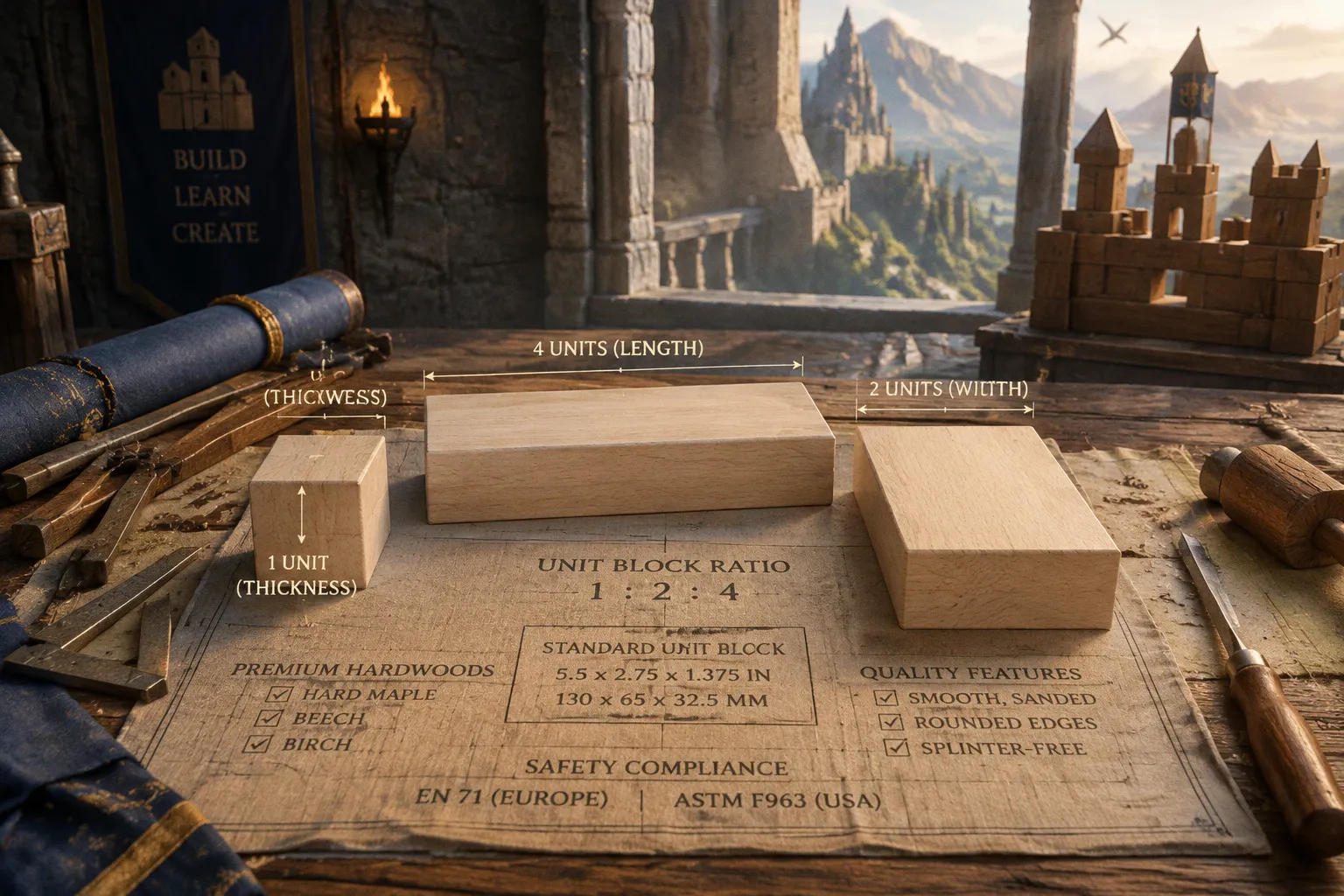
Standard unit blocks are built around a simple mathematical proportion:
- thickness: 1 unit
- width: 2 units
- length: 4 units
In the commonly cited imperial format, a standard unit block measures approximately 5.5 inches long, 2.75 inches wide, and 1.375 inches thick. The metric equivalent is approximately 130 × 65 × 32.5 millimeters.
The dimensions are not arbitrary. They create a system in which blocks can be combined, aligned, divided, and compared. A child does not need to know the numbers to use the mathematical structure. The relationship is embedded in the object.
A block twice as wide as it is thick can be placed beside two narrower units. A piece four times as long as it is thick can span a predictable distance. Repeated construction gradually exposes the child to equivalence, balance, symmetry, magnitude, and fraction-like relationships through direct manipulation rather than verbal instruction.
This is one reason unit blocks differ from random wooden cubes. A mixed set may still support creative construction, but a proportional block system produces more consistent spatial feedback. When a bridge fails, the child can alter the support width, redistribute the load, or change the distance between columns. The construction problem has observable variables.
The 1:2:4 ratio turns a group of wooden pieces into a coherent spatial system.
The educational history of this approach is associated with Caroline Pratt, who developed and popularized standard unit blocks in the early twentieth century. The design drew on earlier kindergarten traditions associated with Friedrich Fröbel and became connected with classroom practice, including at the City and Country School in New York, founded by Pratt in 1914.
The historical label matters less than the practical consequence: the dimensions make comparison possible. A child can repeat an action and receive a similar result. That repeatability reduces unnecessary cognitive load and leaves more attention available for planning, testing, and revision.
What proportional blocks support cognitively
The developmental benefits should be described precisely. Blocks do not automatically produce advanced mathematical understanding, and the presence of a ratio does not make every play session instructional. The benefit arises from the interaction between the child and the structure of the materials.
A proportional block set can support:
1. Spatial reasoning. The child evaluates position, orientation, distance, enclosure, and the relationship between solid forms and open space.
2. Visual-motor coordination. The eyes guide the hands while the child aligns surfaces, centers a piece, or adjusts a structure that is beginning to lean.
3. Working memory. A planned structure requires the child to retain a sequence of placements and remember which supports are already stable.
4. Early mathematical reasoning. Repeated dimensions provide informal exposure to comparison, doubling, halving, balance, and quantity relationships.
5. Algorithmic thinking. Construction often follows an implicit sequence: establish a base, add supports, span a gap, inspect the result, then modify the unstable element.
These effects are not exclusive to wooden toys. However, a standardized block system gives them a particularly clear physical context. The child can see and feel whether an arrangement works.
Standard proportions are useful, but not universal
A common purchasing error is to assume that every product described as a unit block follows one identical worldwide specification. That is not the case. Manufacturers may use imperial dimensions, metric dimensions, or their own interpretation of a proportional system.
The phrase “unit block” can therefore describe different products with different scales. Some sets preserve the 1:2:4 relationship closely. Others include visually similar pieces that do not align with a standard unit. A large number of blocks does not compensate for inconsistent geometry.
Before buying, compare the dimensions rather than relying only on the product name. If the manufacturer publishes measurements, examine whether the width is approximately twice the thickness and whether the length is approximately twice the width. Small manufacturing tolerances are normal. Large inconsistencies are a different matter because they can prevent pieces from combining predictably.
| Feature | Coherent unit-block system | Non-standard mixed set |
|---|---|---|
| Dimensional relationship | Based on a repeatable proportion, often 1:2:4 | Dimensions may vary without a clear relationship |
| Construction feedback | Structures can be reproduced and modified consistently | Results may depend on irregular piece sizes |
| Mathematical comparison | Doubling, matching, and balancing are easier to observe | Comparisons are less systematic |
| Expansion | Additional pieces are more likely to integrate with the existing set | New pieces may not align with earlier purchases |
| Best use | Long-term construction, classroom work, structured free play | Open-ended play where exact compatibility is not required |
The correct choice depends on the intended use. A non-standard set is not automatically defective. It may offer unusual shapes, decorative elements, or a lower entry price. The issue is functional compatibility. If the objective is a genuine unit-block system, dimensional coherence should be treated as a primary specification.
Size and developmental stage
Standard unit blocks are relatively substantial objects. That size supports stable stacking and allows children to grasp pieces with the whole hand. It also means the set requires adequate floor or table space. A child cannot explore the construction logic effectively if there is no room to spread out the components.
For younger children, the relevant question is not whether a set contains the maximum number of pieces. It is whether the pieces can be lifted, rotated, and placed with controlled movement. Fine motor precision develops through repeated successful manipulation. Blocks that are too small may increase handling difficulty without adding useful complexity. Blocks that are too large may restrict the number of combinations available in a limited play area.
The dimensions should also be considered in relation to the child’s existing materials. A set designed around one scale will not necessarily combine well with another. This is particularly relevant when adding arches, columns, ramps, or accessory pieces from a different manufacturer.
Solid hardwood blocks versus softwood blocks
Material selection determines how a block responds to impact, pressure, friction, and repeated stacking. For heavy or long-term use, hardwoods such as hard maple, beech, and birch are generally preferred because they resist dents and edge damage better than softer alternatives.
Softer woods, including limewood or rubberwood, are not inherently toxic. Their limitation is mechanical rather than chemical: under demanding play, they can dent or chip more readily. That distinction matters. A softer block may be appropriate for a lightweight set or for children who use materials gently. It may be less suitable for a classroom, shared playroom, or heirloom set expected to remain dimensionally stable over many years.
Why density affects construction quality
A block is part of a structural system. Its surface must remain sufficiently flat for stacking, and its corners must retain their shape well enough to preserve alignment. Dents alter the contact area between pieces. A damaged edge can introduce instability or make a previously reliable arrangement difficult to reproduce.
Hardwood does not eliminate wear. It changes the rate and type of wear. A dense wood can still split if it is poorly dried, machined incorrectly, or exposed to severe impact. Buyers should therefore evaluate construction quality as a combination of material and workmanship rather than treating wood species as a complete safety or durability guarantee.
Useful material information includes:
- the named wood species rather than only the phrase “natural wood”;
- whether the pieces are solid wood or composite construction;
- whether the grain and surfaces appear consistent;
- whether the manufacturer identifies the finish applied to the wood;
- whether replacement or additional blocks use the same dimensions.
A “solid hardwood” description is more informative than a generic claim about natural materials, but it still does not answer every question. The machining process, drying conditions, and finish quality influence the final product.
Hardwood is not always the only rational choice
The heaviest and densest material is not automatically the best option for every child. Larger hardwood blocks can be difficult for a young child to lift safely, particularly when the child is still developing grip control. Weight also affects what happens when a tower collapses.
Material should be matched to the use case:
- For intensive construction and frequent classroom use, durable hardwood is a strong default.
- For lighter tabletop play, a softer wood may be adequate if the surfaces are well finished.
- For a child still developing controlled placement, manageable weight may matter more than maximum dent resistance.
- For long-term collection building, dimensional consistency is often more important than a premium wood label by itself.
The practical objective is controlled manipulation with predictable results.
Beveled edges, sanding, and surface integrity
The edges of wooden blocks are functional surfaces, not decorative details. Sharp corners can create scrapes and make handling less comfortable. Roughly sanded edges can produce splinters or expose small areas of damaged finish.
High-quality wooden blocks typically use smooth sanding with beveled or rounded edges. The treatment does not need to make every piece visibly curved. A modest bevel can remove the sharp intersection of two faces while preserving enough geometry for stable construction.
There is a trade-off. Excessive rounding can reduce contact precision. A block with heavily softened edges may be comfortable to hold but less stable when stacked. The best edge treatment removes hazardous sharpness without compromising the planar surfaces that make the block useful.
How to inspect the finish
When physical inspection is possible, examine the blocks in the following order:
1. Run a finger across every edge. The surface should feel continuous. It should not catch on the skin or produce a rough, fibrous sensation.
2. Inspect corners under direct light. Look for splintering, cracks, torn grain, or areas where the finish has pooled.
3. Check the flat faces. A face intended for stacking should not show deep tool marks, raised grain, or visible warping.
4. Examine repeated pieces together. Place several blocks of the same type side by side. Major variation in length, width, or thickness may indicate inconsistent manufacturing.
5. Look at damaged or unfinished areas. A chip on one decorative piece is not equivalent to a sharp defect on a structural block, but both should be considered before purchase.
Photographs can be misleading because lighting hides roughness and scale. Product descriptions are useful for dimensions and materials, but surface quality is best assessed through detailed images, retailer inspection, or a clear return policy.
Why precision matters for fine motor development
Fine motor practice depends on the child receiving clear feedback from the object. If a block fails because its edge is rough or its face is warped, the child is solving a manufacturing problem rather than a construction problem.
Predictable surfaces support more precise hand movements. The child can gradually reduce the force used to place a piece, adjust the angle of approach, and learn how much pressure is necessary to maintain stability. This is a controlled sensorimotor task involving grip, wrist positioning, visual alignment, and pressure regulation.
The value is not that every placement succeeds. Failure is informative when it results from the child’s decision. It is less informative when an irregular block creates an inconsistent outcome.
Non-toxic wooden block finishes and safety standards
Wooden block safety has two separate dimensions: mechanical safety and chemical safety. Both need attention.
Mechanical safety concerns splinters, sharp edges, breakage, small detachable components, and structural defects. Chemical safety concerns the materials and finishes that may come into contact with the child’s skin or mouth.
Two standards commonly associated with toy safety are EN 71 in Europe and ASTM F963 in the United States. These standards address areas including mechanical properties and the non-toxicity of materials. A manufacturer’s compliance statement or test documentation is more meaningful than a vague product label such as “eco-friendly” or “natural.”
The term “non-toxic” should not be treated as a complete technical specification. Ask what the finish is, whether testing is identified, and which market’s requirements the product claims to meet. Different jurisdictions use different regulatory systems, and a product sold internationally may present compliance information in several formats.
Look for evidence that the manufacturer has addressed:
- surface splintering and sharp edges;
- coating or finish safety;
- accessible material information;
- applicable toy safety testing;
- age guidance connected to the product’s physical design;
- durability under ordinary handling.
A certification mark alone should not replace common inspection. A block can meet a standard when manufactured and still become unsafe after damage. Cracked pieces, deep chips, and loose fragments should be removed from use.
Finish types and tactile performance
A finish changes more than appearance. It affects friction, cleaning, moisture resistance, and the tactile information received through the hands. A heavily glossy surface may be easier to wipe but can feel slippery during stacking. An unfinished surface may provide more friction while requiring closer attention to splinters, grain lift, and cleaning conditions.
Painted blocks require additional scrutiny because the coating can chip under impact. The question is not whether painted wood is automatically unsafe. The relevant issue is whether the coating is durable, properly bonded, and covered by appropriate safety testing.
Wax, oil, lacquer, and water-based coatings each behave differently, and product descriptions do not always provide enough technical detail to compare them directly. When the finish is not specified, avoid assuming that “natural” means safer or that “untreated” means superior. A well-applied certified finish can provide a more controlled surface than poorly processed unfinished wood.
Metric versus imperial dimensions
Unit blocks are often discussed using imperial measurements, particularly the 5.5 × 2.75 × 1.375 inch format. Many contemporary products use metric measurements instead. A metric set can preserve the same proportional logic without reproducing the exact imperial dimensions.
The important distinction is between scale and ratio.
A manufacturer may create blocks at a different overall size while maintaining a 1:2:4 relationship. That set can still function as a coherent proportional system. Problems arise when the dimensions are described as standard but the individual pieces do not relate consistently.
This becomes especially important when combining sets. Two products may both be marketed as wooden unit blocks while using different base dimensions. One may follow a roughly 130 × 65 × 32.5 millimeter scale, while another may use a different modular measurement. The pieces can look compatible in photographs and still fail to align in practice.
Before combining products, compare:
- the thickness of the smallest rectangular unit;
- the width-to-thickness relationship;
- the length of the full unit;
- the dimensions of arches and columns;
- the scale of accessory pieces;
- the manufacturer’s stated tolerance or measurement system.
Some wooden block systems use a different base scale altogether. For example, certain European design traditions organize pieces around a 4-centimeter base dimension. That does not make them inferior or incompatible with creative play. It simply means they belong to a different dimensional system.
The practical consequence of mixed scales
Mixed-scale sets can still support imaginative construction, but they reduce predictability. A bridge designed with one system may not accept an extension from another. A column may be slightly too short to support a matching arch. A ramp may create an unexpected gap because its slope does not correspond to the height of the blocks beneath it.
For open-ended play, this may be acceptable. For classroom planning, architectural construction, or a collection intended to expand gradually, it is a significant purchasing factor.
The safest approach is to choose a core system first. Add pieces from the same manufacturer only after confirming that the scale and proportions match. Decorative or specialty pieces can then expand the construction vocabulary without undermining the underlying geometry.
A practical buying sequence
The order of evaluation matters. A colorful finish or large piece count can draw attention away from the specifications that determine actual performance. Use this sequence instead:
1. Identify the intended construction system. Decide whether you want standard unit blocks, a modular metric system, or an informal mixed-shape set.
2. Check the dimensions. Look for a stated ratio, especially 1:2:4 for standard unit blocks. Do not assume the label guarantees compliance.
3. Evaluate the material. Hardwood such as maple, beech, or birch is generally more resistant to dents and edge damage than softer wood, but workmanship remains decisive.
4. Inspect the edge treatment. Seek smooth, sanded, beveled, or rounded edges without splinters, cracks, or sharp transitions.
5. Read the finish information. Prefer specific details about coatings and applicable safety testing over broad environmental claims.
6. Confirm the safety framework. EN 71 and ASTM F963 are relevant standards, but the product information should make clear what compliance is being claimed.
7. Consider scale compatibility. If the set will be expanded later, record the dimensions before purchasing accessories or additional units.
8. Match size and weight to the child. A durable block that is difficult to control can reduce the quality of the play experience.
9. Assess the play environment. Standard unit blocks require a stable, open surface. The set should be stored where pieces remain dry and are not exposed to unnecessary impact.
This sequence separates structural quality from marketing language. It also prevents a common error: choosing a set based on the number of pieces before confirming whether those pieces belong to a functional system.
Common purchasing errors
Several mistakes recur when buyers compare wooden building blocks.
Treating “educational” as a technical specification
“Educational” describes intended positioning, not a protected quality standard. It does not establish dimensional accuracy, wood species, finish safety, or manufacturing consistency. Those properties must be evaluated separately.
Assuming all natural wood is equally durable
Wood species differ in hardness and resistance to dents. A natural finish does not change that mechanical fact. Softer woods can be suitable, but they may show damage more readily during intensive play.
Prioritizing piece count
A set with fewer well-proportioned blocks can provide more coherent construction opportunities than a larger assortment of irregular pieces. Count matters only after system compatibility and physical quality have been established.
Confusing rounded edges with rounded faces
Edges should be softened to reduce sharpness. The main faces should remain sufficiently flat for stable stacking. Excessive rounding across the whole block can reduce precision.
Mixing sets without checking scale
Similar appearance does not guarantee compatibility. Compare the smallest unit dimensions before combining products from different manufacturers.
Accepting vague safety language
Terms such as “safe,” “natural,” and “non-toxic” are incomplete without material and testing information. The buyer should look for a defined finish and reference to an applicable toy safety standard.
Final assessment
The best wooden unit blocks are engineered as a consistent physical language. Their value comes from the interaction of proportion, material, surface quality, and safety control.
For a standard system, begin with the 1:2:4 ratio. Confirm the approximate dimensions, then examine whether the manufacturer uses solid wood with sufficient resistance for the intended level of use. Smooth beveled or rounded edges should remove sharpness without compromising flat stacking surfaces. The finish should be clearly identified and supported by relevant safety information, including standards such as EN 71 or ASTM F963 where applicable.
Hardwood is usually the stronger choice for intensive, long-term construction, while softer woods can remain appropriate for lighter use when properly manufactured. Metric and imperial dimensions are not competing measures of quality; the critical issue is whether the pieces maintain a coherent relationship and whether future additions will match.
The definitive buying principle is simple: choose the set whose physical specifications are explicit. When dimensions, wood, edge treatment, finish, and compliance information are all available, the blocks can be evaluated as a developmental tool rather than selected as a decorative product.