Wooden Geoboards: What to Look for in Early STEM Sets
A wooden geoboard is a simple construction tool with a measurable developmental purpose. Children stretch rubber bands across a field of pegs to form polygons, lines, letters, symmetrical patterns, and fraction models.
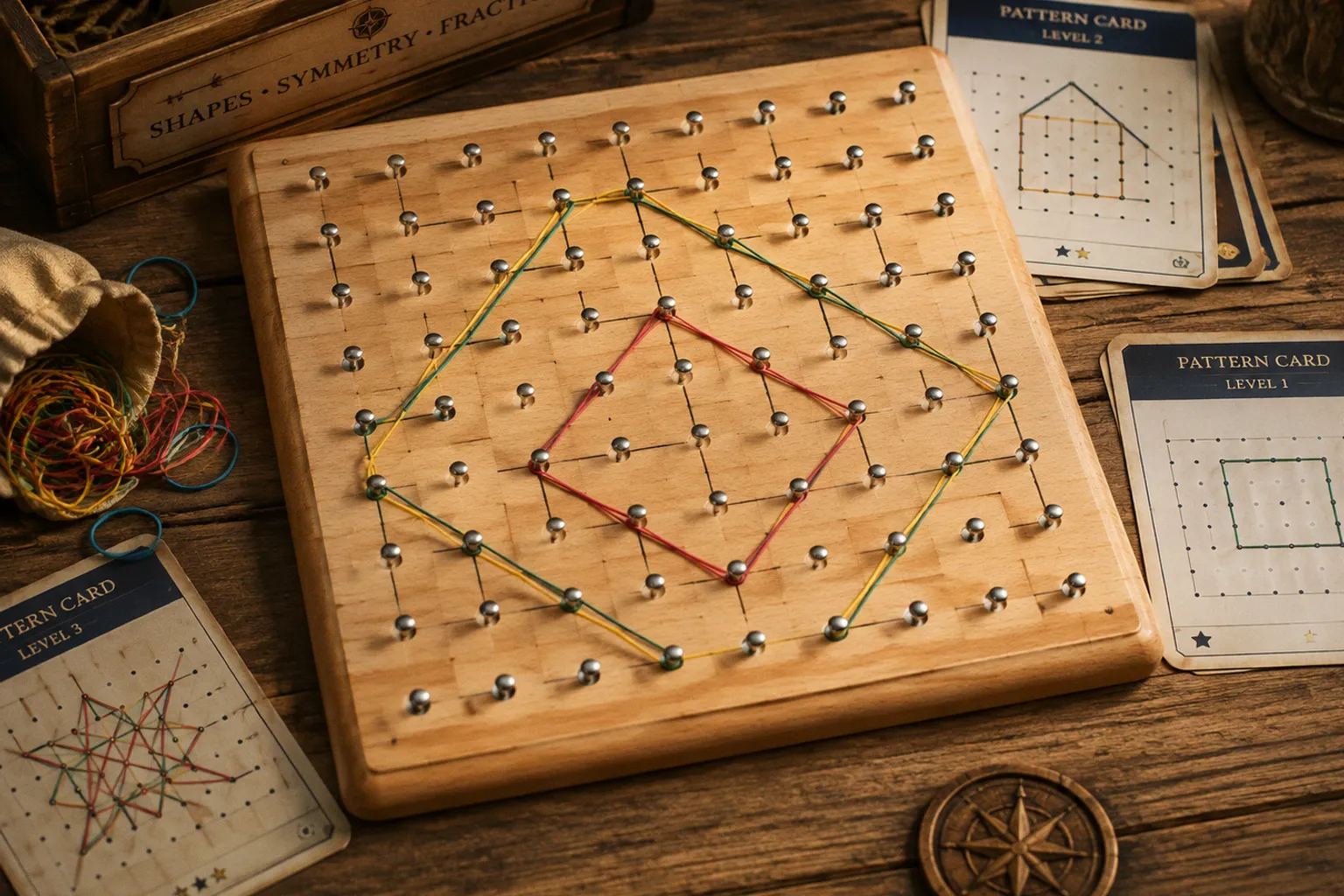
The activity combines fine motor precision with spatial reasoning: the child must plan a route, estimate distance, control tension, and compare the resulting shape with an intended design.
The main selection problem is not whether a geoboard is made of wood. It is whether its grid complexity, peg construction, pattern materials, and safety features match the child’s current developmental stage. A 5x5 board and an 8x8 board support different levels of visual discrimination and planning. A board with poorly finished pegs can undermine the activity regardless of its educational claims.
Understanding Grid Complexity: 5x5 Versus 8x8 Configurations
The grid determines the number of spatial decisions available to the child. In a 5x5 configuration, the board contains 25 peg positions. An 8x8 model contains 64. This difference is not merely a matter of board size. It changes the cognitive load of every construction task.
On a 5x5 board, the child works with a relatively limited coordinate field. Shapes are easier to locate, reproduce, and compare. There are fewer possible routes between pegs, so the visual system can focus on basic relationships:
- horizontal and vertical alignment;
- equal and unequal distances;
- closed versus open forms;
- simple triangles, rectangles, and quadrilaterals;
- bilateral symmetry across a central line.
This configuration is usually more accessible for a child who is learning how a peg grid functions. It also reduces the motor demand of stretching a band over long distances. A shorter span requires less finger strength and produces less unpredictable tension.
An 8x8 board presents a denser spatial field. With 64 pegs, the child can construct more elaborate polygons, nested patterns, diagonal sequences, and scaled versions of the same shape. The additional positions support more advanced comparisons:
- whether two shapes have the same area but different outlines;
- how a shape changes when one vertex moves by a single peg;
- how symmetry is preserved or disrupted;
- how a pattern can be enlarged without changing its basic structure;
- how a diagonal passes through or between grid points.
This is where a wooden geoboard begins to function as an early coordinate system. The child is not formally studying Cartesian geometry, but the activity introduces a related logic: position can be represented by a fixed point, and a shape can be reconstructed from a sequence of spatial relationships.
Grid size controls cognitive load. A smaller board supports accurate imitation; a larger board supports variation, transformation, and multi-step planning.
The correct choice therefore depends on the task rather than on a general ranking of 5x5 and 8x8 boards.
| Feature | 5x5 wooden geoboard | 8x8 wooden geoboard |
|---|---|---|
| Number of peg positions | 25 | 64 |
| Primary developmental use | Basic shapes, matching, simple symmetry | Complex patterns, transformations, spatial analysis |
| Motor demand | Lower band tension and shorter spans | Greater reach, tension control, and finger strength |
| Visual complexity | More limited and easier to scan | Denser field with more possible routes |
| Typical learning progression | Initial construction and guided imitation | Independent design and multi-step pattern reproduction |
| Main limitation | Fewer options for scaling and complex designs | Can overload beginners without graduated guidance |
A board should not be selected solely by chronological age. Age recommendations are useful for identifying choking hazards and general product positioning, but they do not describe spatial reasoning ability with enough precision. A child may have strong visual construction skills but limited fine motor control, or the reverse. The practical assessment is whether the child can place and remove bands without abandoning the task because of excessive resistance or visual confusion.
For an early learner, a 5x5 board provides a controlled environment. Once the child can reproduce basic patterns, identify shapes, and use bands with consistent tension, an 8x8 grid offers more productive complexity.
Evaluating Peg Design and Preschool Geoboard Safety
The pegs are the primary safety interface between the child’s fingers, the rubber bands, and the wooden base. Their geometry affects both usability and risk.
Commercial wooden geoboards frequently use rounded nail or pin heads arranged in a regular grid. A common 8x8 design contains 64 peg heads. Rounded or umbrella-shaped heads help retain rubber bands during construction and reduce the likelihood that a band will slide off unexpectedly. The upper surface should be smooth, without sharp edges, burrs, exposed points, or irregular metal transitions.
The board itself requires the same level of inspection. A solid wooden base should be smoothly sanded and free from splinters along the face, corners, and underside. The pegs must be firmly driven or otherwise securely fixed. A loose peg changes the geometry of the board and creates a direct mechanical hazard: it can shift under tension, detach, or expose an opening in the wood.
Preschool geoboard peg safety should be evaluated before the product is given to a child. The following sequence is more useful than relying on product photography:
1. Run a finger over the board surface. The wood should feel consistently smooth, including the corners and edges.
2. Check every peg for movement. Light pressure should not produce rocking, rotation, or visible separation from the base.
3. Inspect the peg heads. They should be rounded and uniform, with no sharp metal perimeter.
4. Test the bands separately. Look for brittle, excessively thin, or damaged bands that could break under ordinary stretching.
5. Review the age recommendation and small-parts warning. Rubber bands and loose components present a choking hazard.
6. Confirm the stated safety documentation. Relevant references may include ASTM, CPSIA, CPC, or EN71 compliance, depending on the market and jurisdiction.
A certification reference is not a substitute for physical inspection, but its absence makes evaluation more difficult. The buyer should be able to identify the manufacturer, intended age range, and applicable safety information. Generic descriptions that emphasize natural wood or Montessori use without explaining construction standards provide limited evidence of build quality.
Children under three should not use a geoboard with small rubber bands or detachable components as an unmonitored activity. For older preschool children, supervision remains appropriate when the set includes small bands, particularly if the child still mouths objects, pulls bands toward the face, or has difficulty releasing tension in a controlled way.
Safety also includes the behavior of the bands. A child who hooks a band across distant pegs may create substantial tension. If the band slips, it can snap back toward the hands or face. The board should be placed on a stable, flat surface, and the child should be shown how to stretch bands away from the face rather than toward it.
The Role of Double-Sided Boards in Geometric Exploration
Some wooden geoboards use two different peg layouts: a rectangular grid on one side and a circular configuration on the reverse. This design changes the mathematical structure of the play surface.
The rectangular side supports coordinate-like reasoning. Pegs are organized into rows and columns, making it easier to compare length, alignment, area, and symmetry. A child can build a rectangle, move one vertex, and observe how the outline changes. Pattern cards can direct the child to reproduce shapes using specific peg positions, which introduces a basic relationship between a visual model and a spatial procedure.
The circular side supports a different set of observations. The child can explore radial symmetry, repeated intervals, rotation, and the relationship between a center point and an outer boundary. The resulting patterns are not automatically more advanced, but they use different visual rules. Instead of organizing a shape around horizontal and vertical coordinates, the child begins to notice repetition around a central axis.
A double-sided board is most useful when the two surfaces are functionally distinct. Merely duplicating the same grid does not add much instructional value. A rectangular-and-circular design can support a progression such as:
- construct a symmetrical shape on the rectangular grid;
- reproduce a repeated pattern around the circular arrangement;
- rotate the design and compare it with the original;
- identify which features remain constant after rotation;
- create a pattern without a model and explain its organizing rule.
This interaction supports algorithmic thinking in an early, nonverbal form. The child develops a sequence of operations: choose a starting peg, stretch the band to another position, repeat a rule, close the pattern, and inspect the result. When the construction does not match the intended form, the child must locate the error and revise the sequence.
That process is more cognitively significant than producing a visually attractive shape. The board externalizes a plan. The child can see where a route began, where it changed direction, and whether the final structure is closed or incomplete.
Why the board surface matters
A double-sided board also introduces a practical compromise. Reversible products may have a more compact design, but the base must remain thick and stable enough to support pegs on both faces. If the board is too light or poorly finished, it may slide during use or flex under band tension.
Evaluate the reverse side with the same attention as the primary grid:
- Are both surfaces equally smooth?
- Are the pegs evenly seated?
- Does the board lie flat when turned over?
- Are the circular pegs spaced consistently?
- Can the child identify which side is being used without confusion?
For independent play, surface differentiation is valuable only when the visual layout is clear. For guided learning, the contrast between the two arrangements can become an instructional advantage.
Pattern Cards and Graduated Difficulty
A geoboard without pattern cards can support open-ended construction, but a well-designed card set provides an important bridge between perception and action. The child must translate a two-dimensional image into a sequence of motor operations on a physical grid.
The quality of the cards matters. A useful Montessori geoboard pattern cards set should not present a random collection of decorative figures. It should establish a progression from low-complexity tasks to designs requiring sustained attention and spatial transformation.
A practical progression may include:
1. Single-line and open forms. These teach band placement, direction, and controlled release of tension.
2. Basic closed shapes. Triangles, squares, and rectangles introduce vertices, boundaries, and closure.
3. Shapes with unequal sides. These require closer inspection of distance and angle.
4. Symmetrical patterns. The child must compare one side with a visual or central reference.
5. Overlapping figures. These increase visual discrimination and require the child to track multiple bands.
6. Scaled or transformed designs. The child reproduces a shape at a different size or changes its orientation.
7. Fraction and area models. The board becomes a surface for dividing a whole into equal or unequal regions.
Double-sided cards are particularly useful when they show a model on one side and a more detailed solution or coordinate-style guide on the other. The child can first attempt visual reproduction and then use the reverse as support. This preserves problem-solving effort without making the initial task inaccessible.
Pattern cards should also be judged by the relationship between image and grid. If a card depicts a pattern without clearly indicating scale, orientation, or the relevant peg positions, the child may be solving an ambiguity problem rather than a geometry problem. Clear, high-contrast designs are preferable to visually crowded illustrations.
The adult’s role is not to provide the correct sequence immediately. A more productive method is to ask targeted questions:
- Which peg is the starting point?
- Does the next band move horizontally, vertically, or diagonally?
- How many spaces are between these two points?
- Is the pattern symmetrical?
- Where does the shape close?
- What changed when the band was moved?
These prompts direct attention toward spatial relationships. They also reduce the risk that the activity becomes simple copying without analysis.
Matching difficulty to the child
A pattern is appropriately challenging when the child can identify the target structure but must make several decisions to reproduce it. If the design is completed instantly, it may provide insufficient cognitive load. If the child cannot determine where to begin, the visual representation is exceeding current processing capacity.
The most useful signs of productive difficulty include:
- the child pauses to inspect the model before acting;
- errors are localized rather than completely random;
- the child can correct a misplaced band after comparison;
- the final design is close enough to invite refinement;
- the child begins to alter or extend the pattern independently.
By contrast, repeated abandonment, excessive band breakage, or indiscriminate placement suggests that the task should be simplified. A smaller grid, fewer bands, or a card with a clearer outline may produce better learning conditions.
Pattern cards are not decoration. They convert an open-ended manipulative into a sequence of increasingly demanding visual-spatial problems.
Fine Motor Precision and Cognitive Load
The developmental value of a geoboard comes from the interaction between motor action and mental representation. Stretching a band is not an isolated hand exercise. The child has to coordinate visual attention, finger placement, force regulation, and spatial prediction.
Fine motor precision is involved at several points:
- isolating one band from a group of bands;
- positioning the fingers close enough to control the material;
- stretching without losing grip;
- placing the band over a specific peg head;
- maintaining one section of the design while adding another;
- removing a band without disturbing adjacent structures.
These actions require graded force rather than maximum strength. A band that is too difficult to stretch may convert the activity into a struggle with resistance. A band that is too loose may fail to stay in position and provide insufficient feedback. The set should include bands that are elastic enough for construction but not so fragile that normal use produces immediate breaks.
The cognitive load is equally variable. A single triangle made from three bands creates a limited planning problem. A layered pattern with multiple colors and intersecting edges requires the child to track order, location, and visual grouping. Too much complexity can interfere with the intended learning objective because the child spends most of the time recovering from errors.
This is why the board, bands, and cards should be evaluated as a system. A high-density 8x8 board paired with advanced pattern cards may be appropriate for a child already comfortable with construction tasks. The same set may be inefficient for a beginner, even if the product is marketed for a broad preschool age range.
Color can support classification, but it should not carry the entire instructional design. If every card depends on matching a specific band color, the task may become a color-matching exercise rather than a spatial reasoning activity. Stronger materials use color selectively while preserving shape, position, and symmetry as the central variables.
Wooden STEM Geoboard Build Quality and Long-Term Use
Wood is often selected for tactile reasons, but material choice alone does not establish quality. The relevant question is how the base performs under repeated tension and handling.
A wooden STEM geoboard should have a stable base with enough mass to resist movement during construction. The surface should remain flat. The pegs should maintain their original alignment after repeated band placement. Edges should tolerate ordinary handling without splintering or developing rough areas.
Board dimensions vary. Common formats are approximately 7 by 7 inches, or around 18 by 18 centimeters, while larger boards may approach 12 by 12 inches. Larger dimensions can provide more working space, but they also increase reach and may require greater band tension. A larger board is not automatically more educational. Its value depends on whether the child can control the full surface without repeatedly shifting posture or losing sight of the target pattern.
The following build-quality factors have direct functional consequences:
- Peg alignment: Irregular spacing makes pattern reproduction unreliable.
- Peg retention: Loose pegs alter the grid and create a safety concern.
- Wood finishing: Rough surfaces increase splinter risk and interfere with hand placement.
- Base stability: A sliding board makes accurate construction more difficult.
- Band assortment: Multiple sizes or colors can support progression, provided the bands are durable.
- Storage design: A compartment or container reduces the chance of lost small parts and keeps the set usable.
- Card durability: Repeated handling can quickly damage thin or poorly laminated pattern cards.
A board intended for repeated classroom or home use should be evaluated for maintenance as well. Rubber bands degrade with heat, sunlight, and age. They should be replaced when they become sticky, cracked, discolored, or noticeably less elastic. The wooden surface should be kept dry and cleaned according to the manufacturer’s instructions rather than saturated with water.
The distinction between a durable set and a decorative one becomes clear during use. Decorative sets prioritize color, packaging, or a polished appearance. Developmental tools require consistent geometry and predictable physical response. If the peg grid is inaccurate, the cards are poorly scaled, or the bands vary significantly in elasticity, the child receives confusing feedback from the material.
Choosing the Right Configuration
The selection process can be reduced to a sequence of developmental and technical decisions.
First, determine the child’s current construction behavior. If the child is still learning to stretch and release a band, a 5x5 grid with simple shapes is likely to provide better access than a dense 8x8 field. If the child already reproduces basic shapes and seeks more variation, the larger grid can support scaling, symmetry, and composite designs.
Second, inspect the physical interface. The board should have rounded peg heads, a smooth wooden base, securely fixed components, and bands that do not show signs of deterioration. A safety certification reference such as ASTM, CPSIA, CPC, or EN71 can support the evaluation, but it should be read alongside the product’s age recommendation and parts warning.
Third, examine the instructional materials. Pattern cards should show graduated difficulty rather than an unstructured set of images. Double-sided cards are useful when the reverse offers additional guidance without removing the need for independent construction.
Fourth, consider whether a double-sided board genuinely expands the learning space. A rectangular grid paired with a circular peg arrangement provides a meaningful contrast between coordinate-like and radial patterning. Two identical surfaces do not.
Finally, select the board according to the intended activity:
- Shape recognition: favor a clear 5x5 grid and simple outline cards.
- Fine motor development: prioritize manageable band tension and stable peg heads.
- Symmetry and spatial reasoning: choose a grid with enough positions for mirrored designs.
- Early geometry: look for cards involving angles, equal parts, area, and transformations.
- Open-ended STEM play: use an 8x8 board or reversible design with durable, varied bands.
- Guided preschool learning: select a set with graduated cards and clear visual instructions.
A geoboard should increase complexity gradually. The developmental objective is not to complete the most intricate pattern available. It is to make the child’s spatial decisions more precise over time.
Final Verdict
The best wooden geoboards for kids are not defined by the largest grid, the highest number of accessories, or the most elaborate packaging. Their value depends on alignment between developmental stage, grid complexity, peg safety, pattern quality, and material durability.
A 5x5 board is an effective entry point for basic shapes, controlled band placement, and early symmetry. An 8x8 board is better suited to children ready for denser visual fields, scaled designs, and multi-step construction. A double-sided model earns its additional complexity when the reverse surface introduces a genuinely different geometric system, such as a circular peg layout.
For selection, prioritize a smoothly finished solid-wood base, rounded and secure pegs, appropriate small-parts supervision, reliable safety documentation, and pattern cards that progress from imitation to transformation. These features determine whether the geoboard functions as a developmental tool or merely as a collection of bands and pins.
The definitive choice is therefore the simplest board that creates a productive spatial challenge. As the child’s fine motor precision and algorithmic thinking improve, the grid can become denser, the patterns more complex, and the construction increasingly independent.