Wooden Memory Matching Games: Key Features to Compare
Wooden memory matching games for kids are not interchangeable sets of picture tiles.
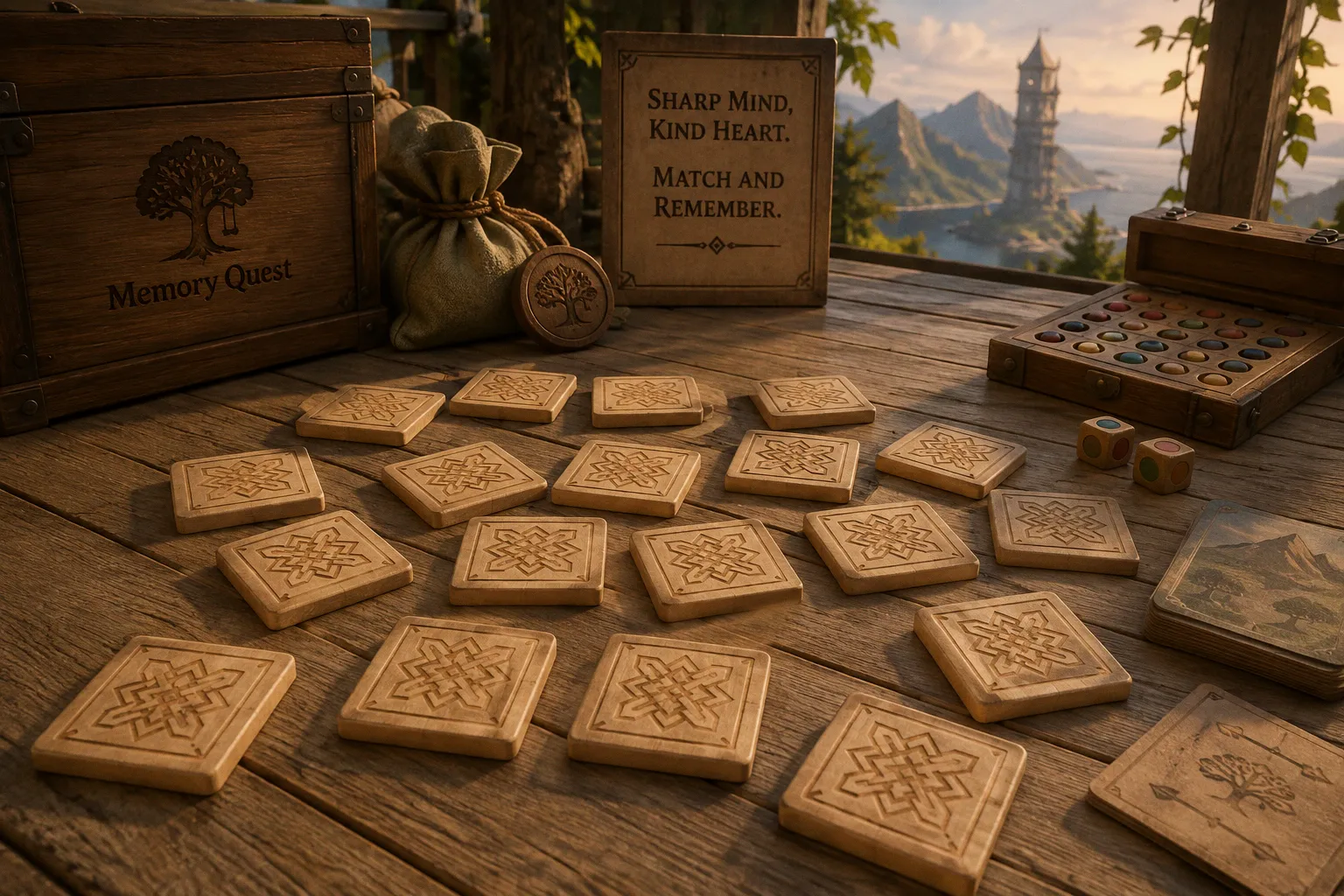
Their developmental demands depend on the number of pieces, the visual structure of the images, the amount of spatial manipulation, and the precision required to turn or place each component. A 16-piece toddler memory matching set creates a different cognitive load from a 48-piece wooden memory tile game or a three-dimensional memory chess board with concealed colored pegs.
The material itself also requires evaluation. Wood does not automatically indicate safe construction, and a durable finish is not necessarily a suitable finish for a child who may mouth or chew game pieces. A sound selection process therefore combines developmental fit, mechanical design, surface quality, and documented compliance with toy-safety standards.
Navigating game formats: from flat tiles to 3D memory chess
The central mechanic of a memory game is retrieval: the child must encode the location or identity of an object, retain that information, and use it when a matching opportunity appears. The physical format determines how much of that process is visual, spatial, motor, or rule-based.
The main wooden formats fall into four groups:
1. Flat wooden tiles. These are the most direct format. Each tile presents an image, symbol, color, or pattern, and the child turns or arranges pieces to find pairs. The format isolates visual recognition and location memory with relatively few additional rules.
2. Wooden flip-flap boards. These travel-oriented boards use integrated flaps or hinged covers. The child reveals and conceals images without managing a loose collection of pieces. This reduces the risk of lost components and adds a physical sequence of opening, inspecting, and closing.
3. Pattern-to-scene matching games. These do not always use identical pairs. A child may match a visual pattern to an object, scene, or category. This introduces semantic association and can require more interpretation than simple image duplication.
4. Three-dimensional memory chess games. These typically use a board with hidden colored pegs, often combined with dice or turn-taking rules. The child must remember locations in a structured grid while also manipulating pegs and following a sequence of play.
A flat tile set is usually the clearest starting point because its rules are easy to isolate. A 3D game adds algorithmic thinking in a limited, age-appropriate form: the player observes a state, stores information about it, and selects a move based on remembered data. The game is not teaching formal programming, but it does require sequential decision-making and state tracking.
Comparing the main formats
| Format | Primary cognitive demand | Motor demand | Typical complexity | Practical limitation |
|---|---|---|---|---|
| Flat wooden tiles | Visual recognition and location memory | Turning, picking up, placing | Low to moderate | Loose pieces can be misplaced |
| Flip-flap travel board | Sequential recall and visual discrimination | Opening and closing flaps | Low to moderate | Smaller visual areas may reduce image detail |
| Pattern-to-scene matching | Categorization and associative reasoning | Positioning or matching components | Moderate | Rules may be less intuitive than identical pairing |
| 3D memory chess | Spatial reasoning, recall, and rule tracking | Precision grasp and peg placement | Moderate to high | Requires stronger fine motor control and sustained attention |
Piece count should not be treated as the sole measure of difficulty. A set with 16 pieces may be demanding if the images are visually similar, while a larger set can remain accessible when the illustrations are clearly differentiated. The arrangement of the board also matters. A regular grid creates stable spatial coordinates. A scattered layout increases the burden on visual scanning and location encoding.
The relevant question is not how many pieces a game contains. It is how many decisions the child must encode, retain, and execute during one round.
Material integrity: wood species and surface construction
Common materials for wooden memory games include beech, birch plywood, linden, maple, and alder. Each can be suitable for toy construction when processed and finished correctly. The species alone does not establish quality.
Solid beech and maple generally provide a firm substrate for repeated handling. Linden is lighter and can be easier to shape, but the final resistance to dents depends on thickness, grain orientation, and surface treatment. Birch plywood can offer dimensional stability because it is built from laminated layers, although the quality of its edges and outer veneer must be assessed separately.
For a child’s memory game, material evaluation should focus on the finished component rather than the marketing label. The relevant variables include:
- Edge treatment: Rounded or well-sanded edges reduce the likelihood of sharp contact during rapid handling. Poorly finished edges can expose splinters or rough fibers.
- Thickness: Very thin tiles may be difficult for toddlers to grasp and may flex or warp. Excessive thickness increases weight and can make a full set cumbersome.
- Dimensional consistency: Tiles that vary noticeably in size or thickness create unstable stacks and inconsistent tactile feedback.
- Surface uniformity: Cracks, open knots, rough patches, and lifted veneer are potential failure points.
- Moisture behavior: Wood can absorb moisture and change shape. Repeated exposure to saliva, spills, or damp storage may affect the finish and the substrate.
- Coating adhesion: Paint or printed layers should remain bonded when the piece is rubbed, turned, or handled repeatedly.
The tactile quality of wood has a functional role. A child receives pressure and friction feedback through the fingertips when lifting a tile, rotating it, and returning it to the table. That feedback supports fine motor precision, but only when the components are easy to grip without excessive force. If pieces slide unpredictably or are too smooth for the child’s hand size, the motor task can interfere with the memory task.
A practical distinction exists between tactile engagement and tactile noise. A slightly textured, well-finished tile gives useful feedback. A rough, chipped, or uneven tile introduces discomfort and distracts from the game’s cognitive objective.
Finish safety: paint, coatings, and mouthing behavior
Young children may place game pieces in their mouths, particularly during the toddler stage. This does not make every wooden toy unsafe, but it changes the standard required for surface evaluation.
Quality manufacturers commonly use non-toxic, saliva-resistant, water-based paints. The phrase “water-based” describes the formulation, not a universal safety guarantee. A water-based coating can still require testing, and a toy should not be assumed safe solely because its paint is described with that term.
The finish should remain stable under ordinary handling and incidental mouthing. Flaking, dissolving, or transferring pigment indicates a surface-integrity problem. The risk is not limited to the paint itself. A damaged coating can expose rough wood, create small detached fragments, and permit moisture to penetrate the substrate.
When reviewing a wooden matching puzzle selection, examine the following evidence:
- The product’s stated age range and whether it corresponds to the component dimensions.
- The presence of safety information from the manufacturer rather than only a general claim that the toy is natural.
- Whether the painted surface is described as saliva-resistant or tested for the intended use.
- Whether the board and pieces have smooth, sealed edges.
- Whether small detachable parts are present.
- Whether the product is intended for supervised use by younger children.
Do not treat a natural finish as automatically superior. Uncoated wood may avoid some paint-related issues, but it can still have splinters, surface contamination, or unsuitable dimensions. Conversely, a painted game is not automatically hazardous. The meaningful distinction is whether the complete product has been tested and constructed for children’s use.
Decoding EN 71, ASTM F963, and CPSIA
Safety standards provide a more reliable evaluation framework than descriptive terms such as “eco-friendly,” “natural,” or “non-toxic.” The applicable standard depends on the market in which the product is sold.
In the European Union, wooden toys are assessed under the EN 71 series. The three sections most relevant to a wooden memory game are:
- EN 71-1: Mechanical and physical properties. This addresses construction-related risks such as accessible sharp points, edges, small parts, and mechanical integrity.
- EN 71-2: Flammability. This concerns the behavior of toy materials in relation to ignition and burning.
- EN 71-3: Migration of certain elements. This evaluates the transfer of specified chemical elements from accessible toy materials, including relevant surface coatings.
In the United States, children’s wooden toys are associated with ASTM F963, the consumer safety specification for toy safety. The Consumer Product Safety Improvement Act, or CPSIA, establishes additional requirements related to material safety, lead, and chemical limits, along with broader product-compliance obligations.
These systems should not be reduced to a single badge on packaging. A standard applies to a product assessed under defined conditions. It does not mean that all wooden toys, all products from a manufacturer, or every replacement part automatically share the same status.
A useful distinction is between a safety statement and a compliance record. A safety statement uses broad language. A compliance record identifies the relevant market, product, and testing framework. The latter provides stronger evidence because it connects the claim to a defined object.
What the standards do—and do not—tell you
| Evaluation area | What a relevant standard addresses | What still requires product-level observation |
|---|---|---|
| Mechanical safety | Edges, points, construction, and accessible components | Whether wear has created new rough areas |
| Flammability | Material behavior under specified test conditions | Storage near heat sources and misuse |
| Chemical migration | Transfer of specified elements from accessible materials | Coating damage after repeated handling |
| Small parts | Risks associated with detachable components | Whether a broken piece has become a new hazard |
| Material limits | Lead and other regulated chemical requirements | The accuracy and relevance of the manufacturer’s documentation |
Standards do not replace supervision. A compliant toy can still become unsuitable if a tile cracks, a flap detaches, or a peg loosens. Compliance is a baseline for design and production. Ongoing inspection addresses the condition of the specific set in the child’s hands.
For a broader explanation of how children’s wooden products are evaluated across materials and construction types, consult this overview of wooden toy safety requirements.
Printing techniques and surface longevity
The image layer is a functional part of a memory game. If two illustrations are difficult to distinguish because of poor printing, glare, fading, or inconsistent color, the game tests visual interpretation and manufacturing quality rather than memory alone.
Wooden tiles may use surface printing, applied labels, painted graphics, or engraved and laser-etched designs. Each method changes the way the image behaves during use.
Printed graphics
Printed images can provide detailed illustrations and clear color separation. They are useful when the game depends on recognizing animals, objects, facial expressions, or thematic categories. Their weak point is the bond between the image layer and the wood. Scratching, moisture, and repeated friction can degrade the surface.
A printed design also requires a suitable substrate. If the wood grain shows through unevenly, fine details may become difficult to interpret. This is particularly relevant for toddlers, whose visual discrimination is still developing and who benefit from high-contrast, uncomplicated images.
Painted graphics
Painted surfaces can offer a thicker visual layer and a more tactile finish. Their durability depends on adhesion, curing, and the protective topcoat. Thick paint at the edges may chip when tiles strike one another or are stacked forcefully.
Color accuracy is less important than contrast and consistency. A memory game does not require photorealistic images. It requires stable cues that remain recognizable after repeated play.
Engraved or laser-etched designs
Engraving places the visual information into the surface rather than leaving it entirely on top. This can reduce the risk of an image layer peeling away. However, engraved designs may have lower color contrast and can be harder to interpret when the symbols are small or visually complex.
Etching is most effective when the shapes are simple, the depth is consistent, and the surface remains smooth around the mark. A recessed design should not create difficult-to-clean grooves or rough edges.
The correct choice depends on the game’s objective. For early visual matching, high-contrast printed or painted images may be more accessible. For older children using abstract symbols, etched patterns can increase discrimination demands without relying on elaborate illustrations.
Surface durability is not merely a manufacturing concern. Faded or damaged images alter the cognitive task and can make a memory game inconsistent from one round to the next.
Selecting complexity by developmental stage
A wooden memory matching set should be selected by the child’s current ability to sustain a rule-based task, not only by chronological age. Age labels remain useful for safety and general orientation, but they do not measure spatial reasoning, language comprehension, visual discrimination, or fine motor precision directly.
The first variable is the number of matching units. A 16-piece set usually contains eight pairs, although product structures vary. A 30-piece set creates a larger search space, and a 48-piece set substantially increases the number of locations a child must encode. The increase is not linear in practical difficulty because image similarity and board arrangement also influence recall.
The second variable is the identity of the images. Identical pairs are cognitively simpler than images that must be associated by category or function. A child who can match two identical animals may not yet be ready to match an animal with its habitat or food source. That is a change in reasoning type, not merely a larger piece count.
The third variable is the rule structure. A basic matching game can be played with one instruction: reveal two pieces and decide whether they correspond. A memory chess game may add a grid, hidden pegs, dice, turn order, and penalties for incorrect recall. Each rule increases cognitive load.
The fourth variable is the motor precision required. Large, thick tiles support a broad grasp. Small pegs and narrow flaps require more controlled finger movement. The physical action should remain feasible enough that the child can devote attention to visual encoding and recall.
A practical progression
1. Begin with a limited field. Place only a portion of the available pairs on the table. This reduces working-memory demand without changing the core mechanic.
2. Use visually distinct pairs. Select images with different shapes and colors before introducing near-duplicates. Clear contrast supports accurate encoding.
3. Increase the set gradually. Add pairs only when the child can follow the rule and retain interest without relying on random guessing.
4. Change the layout. Once the child understands the game, rearrange tile positions between rounds. This prevents rote memorization of a fixed board pattern.
5. Introduce associative matching. Move from identical images to category or pattern-to-scene relationships when visual recognition is stable.
6. Add a three-dimensional mechanism later. Hidden pegs, dice, and grid-based play are appropriate when the child can coordinate precise placement with rule tracking.
This progression also clarifies the difference between challenge and overload. A productive challenge produces errors that can be corrected through attention and recall. Overload produces repeated random selections, abandonment of the rule, or physical handling that dominates the game.
Typical selection errors
Several common errors make wooden memory tile games less effective than their construction suggests.
Choosing by piece count alone
A larger set is not automatically more educational. If the artwork is crowded, the tiles are too small, or the images are nearly identical, the child may be testing visual acuity and frustration tolerance rather than memory. Piece count should be considered alongside image complexity and board organization.
Assuming wood guarantees safety
Wood is a material category, not a certification. A product can have poorly finished edges, unstable paint, loose components, or inadequate chemical testing. Safety depends on the complete construction and the applicable compliance framework.
Ignoring the reverse side of the tiles
In a memory game, the back design affects the information available to the player. If one tile has a different grain pattern, printing irregularity, or visible mark, the child may identify its location through an unintended cue. Uniform backs preserve the integrity of the memory task.
Selecting a game with excessive rule density
A toddler memory matching set with simple identical pairs may be suitable, while a compact-looking travel board with multiple flaps, symbols, and rule changes may be too demanding. The number of physical components does not reveal the number of cognitive operations.
Failing to inspect wear
Paint transfer, lifted veneer, cracked corners, and loose pegs are not cosmetic defects when children handle the pieces closely. The condition of a used game must be evaluated independently of its original packaging or certification claims.
Treating adult assistance as a failure
Guided play can reduce unnecessary cognitive load. An adult may begin with fewer pairs, verbalize the location of a previously revealed tile, or model how to turn pieces without exposing the answer. Assistance is useful when it preserves the memory objective rather than replacing the child’s decisions.
A comparison framework for an actual purchase
A disciplined selection can be completed by recording a few product-level observations rather than relying on broad promotional language.
First, identify the format and the target mechanism. Is the game based on identical picture pairs, associative matching, hidden pegs, or a travel-board sequence? This establishes the type of reasoning the child will perform.
Next, assess the physical components. Note the material, edge treatment, thickness, weight, and stability of the board. Check whether small parts are present and whether they correspond to the stated age range.
Then evaluate the visual system. Images should be legible at the distance from which the child will play. Pair relationships should be unambiguous for a beginner. The backs of the tiles should not reveal locations through accidental differences.
After that, examine the finish and compliance information. Look for clear references to EN 71 where the product is intended for the European market, or ASTM F963 and CPSIA-related compliance where it is intended for the United States. A general claim of non-toxicity is weaker than product-specific testing information.
Finally, consider storage and maintenance. A box or compartment that keeps tiles flat reduces loss and protects the printed surface. Travel boards with integrated flaps reduce component separation but may have smaller visual fields. A set that is difficult to store will often be used less consistently, regardless of its theoretical developmental value.
Definitive assessment
The strongest wooden memory matching games for kids are not defined by wood alone, a high piece count, or an attractive illustration style. Their quality emerges from the alignment of five factors: a coherent memory mechanic, age-appropriate cognitive load, precise and manageable components, stable visual information, and credible safety compliance.
For toddlers, a small set of thick, visually distinct tiles usually provides the clearest entry point. For children with stronger recall and fine motor control, larger sets, associative images, flip-flap boards, and memory chess mechanisms can extend the task. The progression should be based on observed performance: whether the child understands the rule, encodes locations deliberately, and handles the components without excessive effort.
A wooden matching puzzle selection is therefore successful when the physical design supports the intended cognitive operation instead of competing with it. Evaluate the mechanism first, the material second, and the marketing language last. That order produces a more accurate assessment of both developmental usefulness and product safety.