Wooden Play Food Sets: Key Quality and Safety Features
For toddlers, wooden play food is not simply a miniature kitchen accessory. It is a combined system for pretend play, fine motor practice, object classification, sequencing, and early symbolic representation.
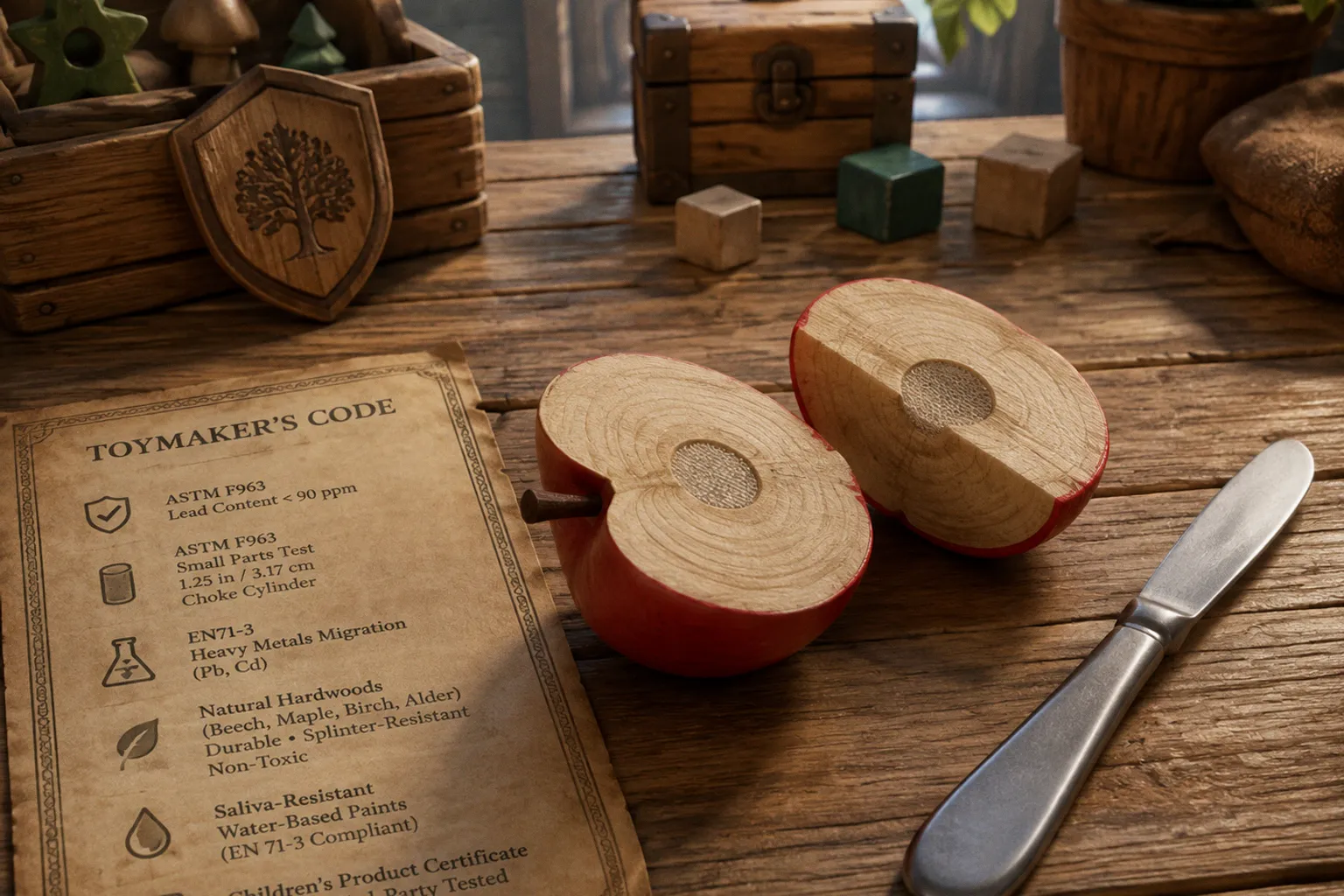
The quality of that system depends on more than visual realism. Paint adhesion, wood density, fastener design, part size, and documented compliance determine whether the set supports development without introducing avoidable mechanical or chemical risks.
The phrase “non-toxic wooden play food” is also insufficient on its own. A product can be made from wood and still have poorly bonded coatings, detachable components, inaccessible safety documentation, or construction features that are inappropriate for children under three. A useful evaluation therefore begins with the toy’s intended age range and proceeds through four technical questions: what is the material, what is on its surface, how are the parts connected, and which safety standard supports the manufacturer’s claims?
Understanding wooden play food safety standards
The two most relevant regulatory frameworks for this category are the United States ASTM F963 standard, used alongside CPSIA requirements, and the European EN71 series.
These standards do not describe the educational value of a play food set. They address physical, mechanical, and chemical safety. That distinction matters. A product may be attractive, durable, and useful for pretend play while still requiring closer examination of its compliance status.
ASTM F963 and CPSIA
ASTM F963-23 is the current version of the US toy safety standard referenced in the supplied research. CPSIA requirements address, among other issues, lead content in accessible materials and surface coatings.
For paints and surface coatings on children’s toys, the lead limit is below 90 parts per million. This is not a marketing preference. It is a measurable chemical threshold that manufacturers and importers must address through testing.
US compliance also involves documentation. Manufacturers and importers selling toys legally in the United States must issue a Children’s Product Certificate, or CPC, supported by testing from a CPSC-accepted third-party laboratory. A responsible product listing should therefore provide more than a general statement such as “safe for children.” The manufacturer should be able to identify the applicable standard and, where appropriate, provide documentation or a clear compliance statement.
A certificate does not mean every part of a product is ideal for every age group. It indicates that the product has been assessed against applicable requirements. Parents and educators still need to compare the toy’s construction with the child’s developmental stage.
The EN71 framework
European toy safety requirements are commonly discussed through three parts of the EN71 standard:
- EN71-1: mechanical and physical properties, including structural integrity and certain small-parts considerations.
- EN71-2: flammability requirements.
- EN71-3: migration of specified elements, including heavy metals from paints and surface finishes.
For wooden play food, EN71-3 is particularly relevant because the coating is often handled repeatedly and may be mouthed by younger children. A statement that the toy uses paint meeting EN71-3 addresses chemical migration testing. It does not, by itself, confirm that the toy has no detachable components or that it is appropriate for a child below three.
The practical implication is simple: standards should be read as separate safety layers rather than as one universal quality label.
A safety standard evaluates defined hazards. It does not convert every wooden toy into an age-appropriate toy.
What to look for in product information
A well-documented wooden play food set should make the following information accessible:
- The recommended age range, stated prominently rather than hidden in a technical section.
- The applicable market standard, such as ASTM F963-23 or the relevant EN71 parts.
- Information about paint or surface finishes, including whether the coating is water-based and saliva-resistant.
- Manufacturer or importer identification.
- Warnings about small parts, magnets, or detachable components.
- A clear explanation of the joining mechanism used in cutting food designs.
Vague wording such as “eco,” “natural,” or “chemical-free” has limited technical value. Almost every finished wooden product uses some substance for bonding, coloring, sealing, or preserving the surface. The useful question is not whether the toy is described with a reassuring adjective. It is whether the manufacturer identifies the relevant tested properties.
Material selection: why hardwood density matters
The wood species influences the mechanical behavior of a play food set. Dense hardwoods such as beech, maple, birch, and alder are widely preferred for wooden toys because they resist wear, tolerate repeated handling, and are less likely to splinter when properly manufactured.
This does not make every hardwood toy automatically safe. A well-selected material can still be undermined by poor machining, thin sections, unfinished edges, or a coating that begins to peel. Material density is one variable in a larger construction system.
The relationship between density and durability
Pretend food is handled differently from a decorative wooden object. Children stack pieces, drop them, strike them against tables, press them into play kitchens, and attempt to separate connected sections. The toy therefore experiences repeated impact and torsional stress.
A dense hardwood generally provides several mechanical advantages:
1. Improved resistance to indentation. Repeated pressing and dropping are less likely to produce deep dents than they would in a soft, low-density material.
2. More stable edges. Properly rounded edges are less likely to deform rapidly during routine use.
3. Lower splintering tendency. This depends on grain direction, machining, and finish quality, but dense, well-finished hardwood is commonly selected for this reason.
4. Better retention of drilled or joined features. Parts connected with stitching, dowels, or embedded components require a substrate that does not crumble easily around the connection point.
5. Longer functional life. Durability matters developmentally because a consistent toy produces more predictable motor feedback over repeated sessions.
The relevant assessment is not simply “solid wood versus plastic.” The correct comparison is between the construction quality of the specific product. A poorly finished hardwood toy can present sharper risks than a carefully molded alternative.
Inspecting the wooden body
Before purchase or first use, examine the set for:
- Rough edges around cut surfaces.
- Splits that follow the grain.
- Deep cracks near attachment points.
- Exposed staples, pins, or sharp fasteners.
- Uneven paint that obscures defects.
- Sections thin enough to snap under moderate hand pressure.
- Strong chemical odor that persists after opening.
- Coating that transfers to a dry cloth or appears loose at the edges.
The last two observations are screening indicators, not laboratory tests. A toy that smells strongly of solvent or sheds visible coating should not be treated as acceptable merely because the product description uses the term “non-toxic.”
Sustainability is not the same as safety
Hardwood selection can also relate to sustainability, but environmental claims and child-safety claims should remain separate. A responsibly sourced wood species does not confirm chemical compliance. Conversely, a toy that meets a safety standard does not automatically establish responsible forestry practices.
For this reason, product evaluation should separate three categories:
| Property | What it addresses | What it does not prove |
|---|---|---|
| Hardwood construction | Impact resistance, edge stability, service life | Absence of toxic coatings or small-part hazards |
| Water-based paint | Type of carrier and potential reduction in solvent exposure | Compliance with every chemical safety requirement |
| EN71-3 or CPSIA testing | Defined chemical migration or lead limits | Suitability for every age group |
| Sustainable wood claim | Sourcing and environmental considerations | Mechanical integrity of the finished toy |
| Age label | Intended developmental and safety range | That the toy will remain safe after damage or wear |
This separation prevents a common reasoning error: treating one positive attribute as evidence for all other attributes.
Chemical safety: decoding non-toxic finishes
Surface coatings are a primary contact point between the child and the toy. They are handled, scratched, rubbed, and potentially mouthed. The coating must therefore be evaluated for its chemical profile and its mechanical adhesion.
Reputable manufacturers commonly use saliva-resistant, water-based paints that meet EN71-3 requirements. The saliva-resistance claim is relevant because it concerns whether the finish can dissolve or rub away during mouth contact. EN71-3 addresses the migration of specified elements from the coating. These are related but distinct properties.
What “water-based” means in context
Water-based paint describes the formulation’s carrier system. It does not mean that the finished coating contains no chemical additives, pigments, binders, or preservatives. It also does not establish lead or heavy-metal compliance without supporting testing.
A more useful product description combines several pieces of information:
- The coating is water-based.
- The finish is intended to resist saliva exposure.
- The product meets the relevant chemical safety requirements.
- Testing or certification documentation is available from the manufacturer or importer.
When only the first statement appears, the evidence is incomplete.
Coating adhesion is a mechanical issue
Paint safety is not only about what substances are present. It is also about whether the finish remains attached to the wooden body. Peeling or flaking creates a new small-part problem: the coating itself can detach into fragments.
Check the areas most likely to experience friction:
- The seam of a cuttable food item.
- Corners and edges.
- The underside of pieces that slide across a table.
- Areas around holes, stitching, or embedded connectors.
- The contact points of lids, handles, or removable toppings.
A small amount of surface wear after extended use does not automatically indicate chemical danger. However, visible flaking, softening, or transfer of colored material should end use until the toy has been assessed. Do not sand and repaint a commercially manufactured toddler toy as a substitute for verified compliance. A home-applied finish has its own unknown chemical and adhesion profile.
Why mouth contact changes the evaluation
Toddlers explore objects orally. This is not an exceptional behavior that can be excluded through optimistic product descriptions. It is a predictable interaction with the product category.
That means the safety margin should be evaluated for the complete object:
- Wood species and surface condition.
- Paint or sealant formulation.
- Adhesive quality.
- Size of every detachable component.
- Stability of the cutting mechanism.
- Presence of magnets or other embedded parts.
A manufacturer that provides detailed information about these elements demonstrates stronger quality control than one that relies solely on the phrase “natural wooden toy.”
Mechanical integrity and small-parts hazards
The most immediate physical hazard in toddler play food is often not the large wooden body. It is the component that separates from it.
Under US ASTM F963 small-parts testing, a component that fits entirely within a 1.25-inch choke-test cylinder fails the relevant standard for children under three. This applies to pieces that detach during testing or through foreseeable use. The risk assessment must therefore include parts that were not originally designed to come off but may become loose after repeated handling.
Parts that require closer examination
In a pretend food set, inspect:
- Decorative leaves, seeds, and toppings.
- Removable labels or fabric details.
- Small hook-and-loop patches.
- Screws, pins, and caps.
- Tiny handles or knobs.
- Miniature utensils included with the set.
- Magnetic inserts.
- Pieces of coating or wood that may fracture.
A product may be labeled for toddlers while containing components that require the child to be older. The age label should be interpreted conservatively when the set includes multiple pieces with different risk profiles.
The durability test is not a home certification
Parents should not attempt to reproduce regulated laboratory testing. Pulling aggressively on a component or dropping the toy repeatedly cannot certify compliance. It can, however, identify obvious defects before routine use.
A basic inspection sequence is:
1. Examine every piece under good lighting.
2. Run a finger over edges and seams to detect roughness or raised fibers.
3. Rotate handles, lids, and connectors gently to detect movement.
4. Look for gaps around embedded parts.
5. Check whether stitching or hook-and-loop material is beginning to separate.
6. Repeat the inspection after several weeks of regular play.
7. Remove any part that becomes loose, cracked, sharp, or visibly degraded.
The final step is essential. Safety is not a permanent property established at purchase. A toy that was intact on day one may become unsuitable after impact damage or repeated chewing.
For toddler play food, the failure mode matters more than the appearance. A loose decorative piece is not a minor cosmetic defect.
Magnets deserve a separate category
Magnetic parts require a stricter approach than ordinary decorative components. Wooden play food containing small magnets should not be assumed safe for children under three. The supplied safety research specifically cautions against claiming that magnetic wooden play food is safe for this age group.
The reason is practical: if a magnet becomes detached, the risk profile is not equivalent to that of a large wooden piece. Parents should follow the manufacturer’s age restriction and warnings precisely. For a toddler-focused set, a non-magnetic design is the more conservative choice unless the product has clear, age-specific safety documentation and the parts are fully secured in a way appropriate to the intended age range.
Wooden cutting food: hook-and-loop fasteners versus magnets
Cutting food is one of the most common designs in pretend play. The child uses a toy knife to separate a fruit, vegetable, loaf, or sandwich and then reconnects the sections. This format introduces a useful motor sequence, but the connector determines both the tactile feedback and the maintenance burden.
The two dominant mechanisms are hook-and-loop fasteners and magnets. They should not be evaluated as interchangeable.
| Parameter | Hook-and-loop fasteners | Magnetic connectors |
|---|---|---|
| Sensory feedback | Produces noticeable resistance and a pulling sound during separation | Produces attraction and release with less surface friction |
| Fine motor demand | Requires alignment, grasp stabilization, and controlled pulling | Requires alignment and directional control, often with lower pulling resistance |
| Wear pattern | Hooks and loops can collect fibers and lose grip over time | Magnets may remain functional longer if fully enclosed, but the enclosure must remain intact |
| Failure mode | Fabric or adhesive may peel away from the wooden body | A detached magnet creates a high-consequence hazard |
| Cleaning | Usually requires attention to lint and moisture trapped in the fastener | Smooth surfaces may be easier to wipe, but damaged housings are difficult to assess |
| Toddler suitability | Still depends on part size, adhesion, and age labeling | Requires particular caution; small magnetic components should not be assumed safe for under-three use |
| Maintenance signal | Reduced grip, fraying, and lifting edges are visible | Cracks, movement, or a loose internal component may be less visible |
Developmental mechanics of hook-and-loop designs
Hook-and-loop food provides a distinct sequence:
1. The child stabilizes one half.
2. The other hand applies a pulling force.
3. The child notices resistance.
4. The connector releases.
5. The pieces are repositioned and pressed together.
This sequence recruits bilateral coordination, grip modulation, and basic cause-and-effect reasoning. It also introduces a simple action pattern that can later support more complex procedural play. The child is not only naming an object; the child is manipulating a system with a predictable rule.
However, the resistance should be proportionate to the child’s strength. An excessively strong fastener can cause abrupt release, loss of balance, or damage to the food body. An undersized or poorly attached patch can become a detachable part.
Developmental mechanics of magnetic designs
Magnets provide a different interaction. They can make reconnection easier because the parts attract one another when brought into the correct orientation. This reduces some alignment demands but increases the importance of containment.
For older children, that attraction can support spatial reasoning and orientation. The child observes that the pieces connect in one position and may not connect in another. For toddlers, the primary question remains mechanical safety, not convenience. If the product contains small magnetic components, the age restriction must be treated as decisive.
A visually seamless wooden food item can conceal the most important safety question: whether the magnet is secured against impact, twisting, chewing, and repeated separation. Without trustworthy documentation, the absence of visible screws does not demonstrate secure construction.
Selecting the mechanism by developmental stage
For children under three, the most defensible design is generally a large, simple set with robustly attached, non-magnetic connectors and no miniature accessories. The set should not depend on the child’s ability to understand a warning that applies to only one component.
For preschool-aged children, magnetic designs may be considered only within the manufacturer’s stated age range and with attention to the integrity of every housing. The child’s increased cognitive control does not eliminate the possibility of component failure. Age changes the expected use pattern; it does not excuse poor construction.
How pretend food supports cognitive development
The developmental value of wooden play food comes from the actions it organizes. A food set can support symbolic representation, categorization, sequencing, spatial reasoning, and language when the components are sufficiently differentiated and mechanically reliable.
Symbolic representation
Pretend food is a representational object. A wooden piece stands for a real food item without being edible or functionally equivalent to one. This requires the child to maintain a symbolic mapping between the object and the concept it represents.
The value increases when the set contains consistent visual and tactile cues: recognizable shapes, stable colors, and distinct categories. Excessive realism is not necessary. Clear differentiation is more useful than decorative complexity.
Sequencing and algorithmic thinking
Cutting food, assembling a sandwich, preparing a meal, and sorting ingredients all involve ordered actions. The child can develop an elementary understanding of sequence:
- Select an item.
- Combine it with another item.
- Apply a tool or action.
- Separate or rearrange the components.
- Repeat the process under a new rule.
This is a basic form of procedural reasoning. It is not algorithmic thinking in the formal computer-science sense, but it uses related cognitive mechanics: ordered steps, conditional actions, and repeatable outcomes.
A well-designed set supports these actions without excessive cognitive load. If the toy includes too many tiny accessories, complicated fasteners, and fragile parts, the child’s attention shifts from symbolic play to managing the object’s physical demands.
Fine motor precision
The most useful play food designs require controlled grasping rather than simple holding. Children may pinch a small but safe edge, stabilize one section, align two halves, rotate a lid, or guide a toy knife through a seam. These actions engage fine motor precision and hand-eye coordination.
The task should remain solvable. A connector that is impossible to separate produces frustration without providing a productive motor challenge. A connector that releases without any resistance provides limited feedback. The functional target is controlled difficulty.
Spatial reasoning
Reconnecting food halves requires the child to understand orientation, surface position, and correspondence. The pieces may align only when their cut surfaces meet correctly. This gives the child immediate feedback about spatial relationships.
The set is more cognitively useful when parts are not identical in a confusing way. Distinct shapes and clear connection points help the child form an accurate internal model of how objects fit together.
Common quality errors in wooden play food
Certain design and purchasing errors recur across this category.
Treating “wooden” as a safety guarantee
Wood is a material category, not a safety certification. A wooden toy can have unsuitable coatings, poorly secured components, sharp edges, or age-inappropriate accessories. Evaluate the finished product rather than the material label.
Choosing realism over mechanical simplicity
Detailed food sets may include tiny toppings, utensils, containers, and decorative elements. Each added component increases the number of possible failure points. For toddlers, a smaller set with larger, robustly finished pieces is often mechanically preferable to a large set with miniature details.
Ignoring the connector after purchase
Hook-and-loop fasteners can accumulate lint, fray, or lift from the wood. Screwed or glued elements can loosen. Magnetic housings can crack. Regular inspection is part of responsible use, especially when the toy is handled daily.
Confusing chemical claims with testing evidence
“Non-toxic,” “natural,” and “eco-friendly” are not interchangeable with a named standard or test report. Look for information connected to ASTM F963, CPSIA, EN71-3, or equivalent applicable requirements.
Combining age groups in one play environment
A play kitchen may be used by a toddler and an older sibling simultaneously. That does not make every accessory suitable for the toddler. Small parts and magnetic components should be stored separately when the manufacturer restricts them to older children.
Using a damaged set because the play value remains high
Once a component has cracked or detached, its developmental usefulness no longer outweighs the mechanical risk. Pretend play can be supported by replacing the item with a simpler, intact alternative. Repair is appropriate only when the repair method restores a durable, safe structure and does not introduce a new coating, sharp edge, or detachable part.
A practical evaluation sequence
When assessing wooden play food sets for toddlers, use the following order rather than starting with color, theme, or the number of included pieces:
1. Confirm the age range. Treat an under-three label and an older-child warning as materially different instructions.
2. Identify the connector system. Note whether the food uses hook-and-loop patches, magnets, stitching, dowels, or another mechanism.
3. Exclude small detachable elements. Inspect toppings, utensils, labels, caps, and decorative inserts individually.
4. Examine the wood. Look for cracks, splinters, rough machining, and weak sections near joints.
5. Assess the coating. Prefer documented water-based, saliva-resistant finishes and relevant chemical safety information.
6. Check standard references. Look for ASTM F963-23 and CPSIA documentation in the US context, or EN71 references in the European context.
7. Review the manufacturer’s warnings. A complete warning is more useful than a generalized safety slogan.
8. Inspect again after use. Mechanical wear can create hazards that were not present at purchase.
This sequence separates evidence from appearance. It also prevents a common purchasing error: selecting a set because it looks educational before establishing whether it can withstand the child’s actual method of play.
Final assessment
The best wooden play food features are not decorative realism or the largest possible assortment. They are stable hardwood construction, smooth and durable machining, firmly attached components, age-appropriate part dimensions, documented chemical compliance, and a connector system whose failure mode is understood.
For toddlers, non-magnetic hook-and-loop designs with large, robust pieces provide a comparatively transparent safety profile, provided the fasteners are securely attached and regularly inspected. Magnetic designs require more caution because a detached small magnet creates a substantially different hazard. No wooden play food set should be considered safe solely because it is labeled natural, handmade, or non-toxic.
A sound evaluation therefore ends with a definitive rule: choose the set whose materials, finish, connector design, age range, and compliance information all agree with one another. Developmental value is strongest when the child can focus on symbolic play, sequencing, and fine motor control rather than interacting with preventable construction failures.