Wooden play kitchen safety: essential features for toddlers
A toddler’s wooden play kitchen gets climbed on, leaned against, and explored with both hands—and sometimes with a curious mouth. So choosing one is about more than finding a charming set of cupboards.
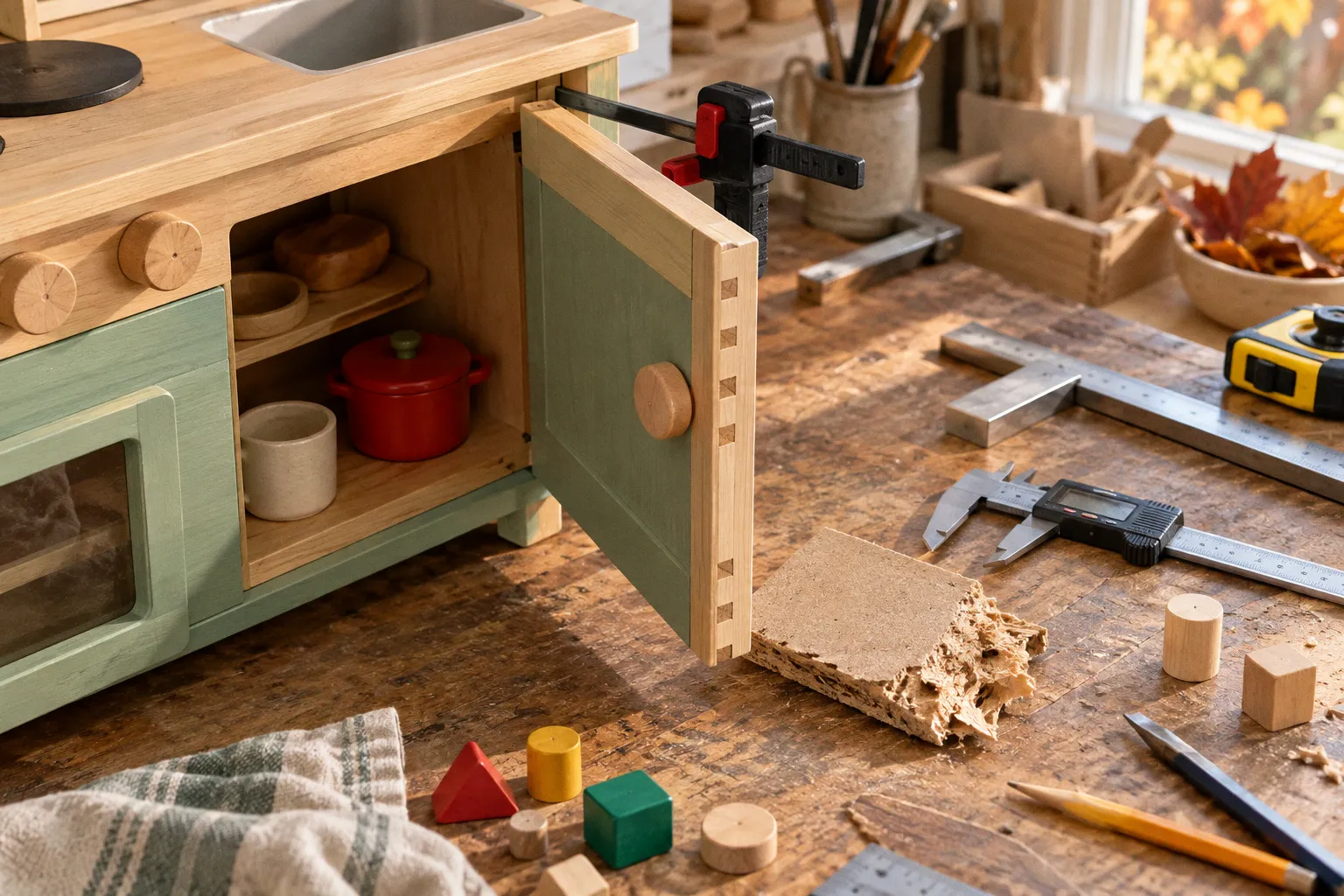
The hinges, finish, hardware, and stability all matter, especially for children under three, who are still learning how to judge risk.
The good news is that you don’t need specialist equipment to make a thoughtful assessment. Start with the manufacturer’s safety information, assemble the kitchen exactly as instructed, and then inspect it at your child’s height and pace. These wooden play kitchen safety features for toddlers are the ones I would look at first.
Start with the safety standard, not just the product name
A listing may describe a play kitchen as sturdy, child-friendly, or made for toddlers. Those phrases are reassuring, but they do not tell you which safety requirements the product was tested against. Look for a named standard in the product information or instructions.
Recognized toy safety benchmarks include ASTM F963 in the United States, EN71 in Europe, and AS/NZS ISO 8124 in Australia and New Zealand. The relevant standard depends on where the toy is sold. A reference to a standard is useful because it gives you something concrete to look for; it is not a reason to skip your own inspection of the assembled kitchen.
Before buying, find the manufacturer’s information about:
- The applicable toy safety standard and the intended age range.
- The materials and finish used on the surfaces children can touch or mouth.
- Assembly instructions, including any wall-anchoring guidance.
- Replacement parts and what to do if a hinge, handle, or accessory comes loose.
Treat a vague safety claim differently from a specific one. If the listing does not name the finish or standard, ask the manufacturer rather than assuming that “natural wood” means untreated or non-toxic. Wood products can include coatings, adhesives, and engineered panels, so the material description alone does not settle the question.
A safety label gives you a starting point; the assembled kitchen still needs to pass a hands-on check.
Look closely at finishes, wood, and hardware
Children touch the counter, rub their hands across the edges, and often bring play food or utensils close to their mouths. For that reason, a smooth surface is not enough: you also want clear information about what is on it.
When comparing non-toxic finishes for play kitchens, look for a water-based coating described as free from lead, phthalates, and BPA. If the manufacturer provides a product or safety specification, read the actual wording instead of relying on broad phrases such as “eco-friendly” or “safe for kids.” Those labels may sound comforting, but they do not tell you precisely what was used.
The same care applies to the kitchen’s construction. Solid wood, plywood, MDF, and particle board can all appear in toy furniture, sometimes within the same product. The name of the material is not a complete verdict on safety or durability. What matters in everyday play is whether the assembled unit holds together, whether surfaces and edges are properly finished, and whether hardware stays firmly attached.
A sustainably sourced wood label, such as FSC certification, addresses forestry sourcing. It does not replace information about the coating, construction, or toy safety testing. Think of these as separate questions rather than one all-purpose stamp of approval.
Pay particular attention to:
- Exposed edges and corners. A coating should be even, without flaking, rough patches, or splinters.
- Handles and knobs. They should be securely fixed and not wobble when gently handled.
- Fasteners. Screws and other hardware should sit properly in place, with no sharp ends or loose pieces.
- Panels and seams. Gaps, cracks, or peeling surfaces can worsen as a child handles the kitchen.
- Accessories. Small pieces should be accounted for separately from the main unit, especially in a home with children of different ages.
A very low price does not automatically mean a kitchen is unsafe. It does make it worth slowing down and checking the details: inexpensive sets can have thin panels, fragile accessories, or finishes that are not clearly identified. If the seller cannot answer basic questions about materials or testing, that uncertainty is part of the buying decision.
Check that the kitchen stays put
A toddler may pull on an oven door, lean heavily on the counter, or use a shelf as a handhold while standing. A stable wooden play kitchen design should tolerate ordinary play without rocking or shifting. Stability is not just about the weight of the unit: construction, assembly, floor contact, and how a child interacts with it all play a part.
Assemble the kitchen on a level surface and follow the instructions step by step. Tighten fasteners as directed, but do not force a screw or improvise a fix if a panel does not line up. Misaligned parts can leave gaps, weaken a joint, or cause doors and drawers to sit poorly. If the unit still rocks after assembly, stop and check the instructions and hardware before allowing play.
Then consider the room. A kitchen placed on a soft or uneven surface may feel less steady than one on a flat floor. Keep it away from routes where children run or from spots where a child might grab it while climbing onto another object. If the manufacturer supplies an anti-tip strap or recommends anchoring, follow that guidance. Do not assume that a low unit cannot tip simply because it is shorter than a child.
Here is a practical order for checking stability:
1. Press gently on the counter from the front and sides. Look for rocking, shifting, or a joint that opens under light pressure.
2. Open and close doors and drawers. Notice whether the movement pulls the whole unit forward or makes it slide.
3. Inspect the base. All intended contact points should rest evenly on the floor; a wobbling foot can make the rest of the structure less predictable.
4. Use the supplied anti-tip hardware as instructed. If the manual calls for anchoring, treat it as part of assembly rather than an optional finishing touch.
5. Recheck after moving the kitchen. A unit that was stable in one position may need its placement and fasteners checked again elsewhere.
Once the kitchen is in use, make stability part of ordinary upkeep. A loose screw, a cracked panel, or a door that suddenly drags can change how the structure behaves. A quick look during tidying is often enough to spot a problem before it becomes a play hazard.
Run a touch test for edges, hinges, and pinch points
Children explore at hand level. They slide fingers around the sides of doors, reach into cupboards, and press on moving parts to discover what happens. That makes a careful touch test one of the simplest ways to find trouble you might miss by looking at a product photograph.
With the kitchen fully assembled, run your hands slowly along every accessible edge and seam. Check the counter, shelves, door openings, handles, and the places where separate panels meet. Feel for burrs, splintering, rough corners, or sharp transitions. Check both the inside and outside of doors; a smooth outer face does not guarantee that the edges around the opening are finished well.
Move each door and drawer through its full range, watching where a child’s fingers could rest as it closes. Hinges should be securely mounted and should not create an obvious trapping gap. A door that swings freely is not automatically a safe door: what matters is whether the child can put fingers between moving parts or between the door and frame.
For child-safe hinges in toy kitchens, look for a design that keeps hardware secure and reduces access to moving gaps. If the product uses soft-close or concealed hinges, that feature may help with movement, but it does not replace checking the actual gaps and edges. Follow the manufacturer’s instructions, and do not remove or modify a hinge to make a door behave differently.
A few details deserve a second pass:
- The hinge side of every door, where a narrowing gap may catch fingers.
- Drawer tracks and stops, especially if a drawer can be pulled out completely.
- The underside of the counter and the edges around the sink or stovetop opening.
- Any small decorative trim that could loosen with repeated handling.
- Spots where two panels meet and a child might press or slide a hand.
If you find a sharp edge or a hinge that pinches, set the kitchen aside until the manufacturer can advise on a safe repair or replacement. Sanding, taping, or adding a homemade cover may hide the symptom without fixing the underlying problem. With a toy used so close to a child’s face and hands, a reliable repair matters more than a quick one.
Count the small pieces with your youngest child in mind
Pretend food, knobs, salt shakers, and utensils are often what make a play kitchen inviting. They are also the pieces most likely to be carried away from the set, dropped under furniture, or explored with a toddler’s mouth. Check the accessories as carefully as the kitchen itself.
Under EU toy safety regulations, detachable parts smaller than 31.7 mm in diameter and 57.1 mm in depth are classified as choking hazards for children under 36 months. These measurements are useful context, but they are not a substitute for the product’s age guidance or local safety requirements. Do not assume a wooden accessory is safe for an under-three simply because it feels solid or looks too large at first glance.
Before play, gather the accessories and look for loose or damaged pieces. Check that handles, caps, and decorative parts cannot be pulled free. If the set includes small items that are not appropriate for your youngest child, store them separately and bring them out only when an adult can supervise and keep them out of reach of younger siblings.
This is where the play setup can help. Keep the main kitchen and larger pieces available, but offer only the accessories that suit the children who are playing. A child can still pour, stir, serve, and share roles without a crowded countertop full of tiny extras. In practice, fewer pieces can make co-play easier too: children have more room to take turns and invent a shared routine.
Make safety part of the play routine
A well-chosen kitchen supports rich pretend play: children copy everyday routines, practise language, and negotiate who is cooking or serving. Those benefits come through best when the play space is dependable. Stability, smooth edges, secure hardware, and age-appropriate accessories create the conditions for children to explore without an avoidable hazard getting in the way.
Before the first play session, assemble the kitchen carefully, check the finish and hardware, run the touch test, and follow any anchoring instructions. Afterward, keep an eye out for changes: a loose handle, a rough patch, a new wobble, or an accessory that has cracked. If something fails inspection, pause play with that item until it is properly addressed.
You can also extend the play value without adding more small parts. Set out a few larger, age-appropriate utensils; invite your child to take an order or prepare a pretend snack; then join in as a co-player and let them lead. These simple invitations support language and emotional regulation while keeping the focus on the activity rather than a pile of accessories.
Safe play is not about making a toy risk-free in every possible sense. It is about choosing a kitchen with clear safety information, putting it together securely, and noticing how it changes as children use it. That steady attention leaves more room for the part everyone came for: imaginative play that feels comfortable for both children and the adults nearby.