Kids Logic Puzzle Mistakes: Why Children Stall and the Fix
When a child freezes on a logic puzzle, the first parental instinct is usually wrong. Adults assume the puzzle is too hard, or quietly conclude that the child isn't bright enough for it. Neither is typically true.
What looks like a stall is almost always a working memory bottleneck, a spatial visualization gap, or a missing strategy — problems that have precise, addressable causes. The research is consistent: children stall on logic puzzles not because they lack intelligence, but because multi-step problem solving strains specific developing cognitive systems. Identifying which system is overloaded changes the entire intervention.
The Cognitive Mechanics Behind the Stall
Logic puzzles are not single-skill exercises. They demand that several foundational abilities operate in parallel: working memory holds the clues, pattern recognition spots recurring structures, planning sequences the moves, and cognitive flexibility shifts strategy when the first approach fails. When one of these systems lags, the whole process grinds to a halt.
For younger children — roughly grades K through 2 — the cognitive load of holding even two or three spatial constraints simultaneously can exceed working memory capacity. The result is what looks like confusion but is actually overflow. The clues aren't being forgotten because the child isn't paying attention; they're being lost because the mental desk is too small.
This is measurable. Executive function skills undergo peak developmental maturation between ages 6 and 12, meaning the very capacity that logic puzzles demand is what's still under construction during the years most parents push these puzzles hardest. Add an estimated 25% to 40% of children with ADHD who experience significant executive function deficits affecting multi-step problem solving, and the population of stalled children becomes much less mysterious.
A stalled puzzle is rarely evidence of low ability. It's evidence of an overtaxed working memory.
Beyond Intelligence: How Working Memory and Executive Function Shape Puzzle Success
The most common misreading by parents is treating the stall as a measure of the child's general intellect. It isn't. A 7-year-old who breezes through arithmetic can still freeze on a logic grid because arithmetic is sequential and logic puzzles are simultaneous. The brain is doing two different things, and one of them is harder.
Working memory — the ability to hold and manipulate information in mind for short periods — is the first system to buckle. In a logic puzzle with four clues and three variables, the child must track each clue against each variable while ruling out options. That's an enormous working memory load for a developing brain. When the load exceeds capacity, the child reverts to a default strategy, which for young children is almost always random guessing.
The fix isn't more puzzles. It's reducing the cognitive load while the system matures. That means fewer variables per puzzle until working memory expands, visual scaffolds such as grids and marker chips that externalize what the working memory can't hold, and time limits removed entirely because the clock adds anxiety that further degrades executive function.
A child doesn't need to solve harder puzzles. They need to solve simpler puzzles with better tools.
The Trial-and-Error Trap: Moving Children from Random Guessing to Systematic Logic
Younger children default to trial-and-error because the prefrontal cortex — the brain region responsible for planning and systematic thinking — is still maturing. A first grader presented with a logic grid will almost always try pieces at random, move them, try again, move them back. This looks like effort but isn't strategy.
The transition from guessing to systematic elimination is one of the most predictable developmental shifts in puzzle solving, and it doesn't happen automatically. It happens when the child is taught what facts are definitely known — the difference between a hypothesis and a confirmed deduction.
A practical scaffold: before any piece is moved, ask the child to state what is already known from the clues. "Which piece definitely doesn't go here?" is a different cognitive task from "Which piece might go here?" The first forces deduction; the second invites guessing. Parents often skip this step because it feels like giving the answer. It isn't. It's teaching the child to inventory their own knowledge before acting, which is the underlying skill the puzzle is meant to build.
| Strategy | Cognitive Demand | Typical Age | What It Builds |
|---|---|---|---|
| Random trial-and-error | Low planning, low memory | K–1 | Engagement, persistence |
| Confirmation by elimination | Moderate working memory | 2–4 | Deduction, rule-following |
| Hypothetical-deductive testing | High working memory, high flexibility | 4–6+ | Strategic planning, abstraction |
The table matters because it shows parents what each stage actually trains. A 6-year-old stuck on hypothetical-deductive puzzles isn't failing — they're at the wrong rung of the developmental ladder.
Mastering Spatial Visualization: Helping Kids Mentally Rotate and Align Pieces
Spatial visualization is where logic puzzles most often break down, and it's where parental guidance has the strongest measurable effect. A major hurdle in visual logic puzzles is the mental manipulation and rotation of shapes — children must imagine how a piece will look when flipped, rotated, or slid into place. When this skill is weak, kids consistently misjudge fit, force wrong pieces, or reject correct ones.
The mistake parents make is treating this as a visual problem. It's not. The child can see the piece perfectly well. The bottleneck is internal — the brain can't yet transform the image it sees into the image it needs.
The fix is descriptive spatial vocabulary. When a parent says "rotate it a quarter turn" or "flip it over — see the flat edge?" the child is being given language for a mental operation they cannot yet perform unaided. The words don't solve the puzzle; they externalize the rotation so the child's working memory doesn't have to carry the entire transformation alone.
Useful vocabulary to introduce deliberately:
- Edge, corner, flat, curved — the language of piece geometry
- Above, below, next to, between — the language of position
- Rotate, flip, slide, mirror — the language of transformation
- Same, different, matches — the language of comparison
This isn't chatter. Constructive parental guidance and descriptive spatial vocabulary measurably boost children's spatial reasoning and problem-solving outcomes. The vocabulary is the scaffold; the skill grows underneath it.
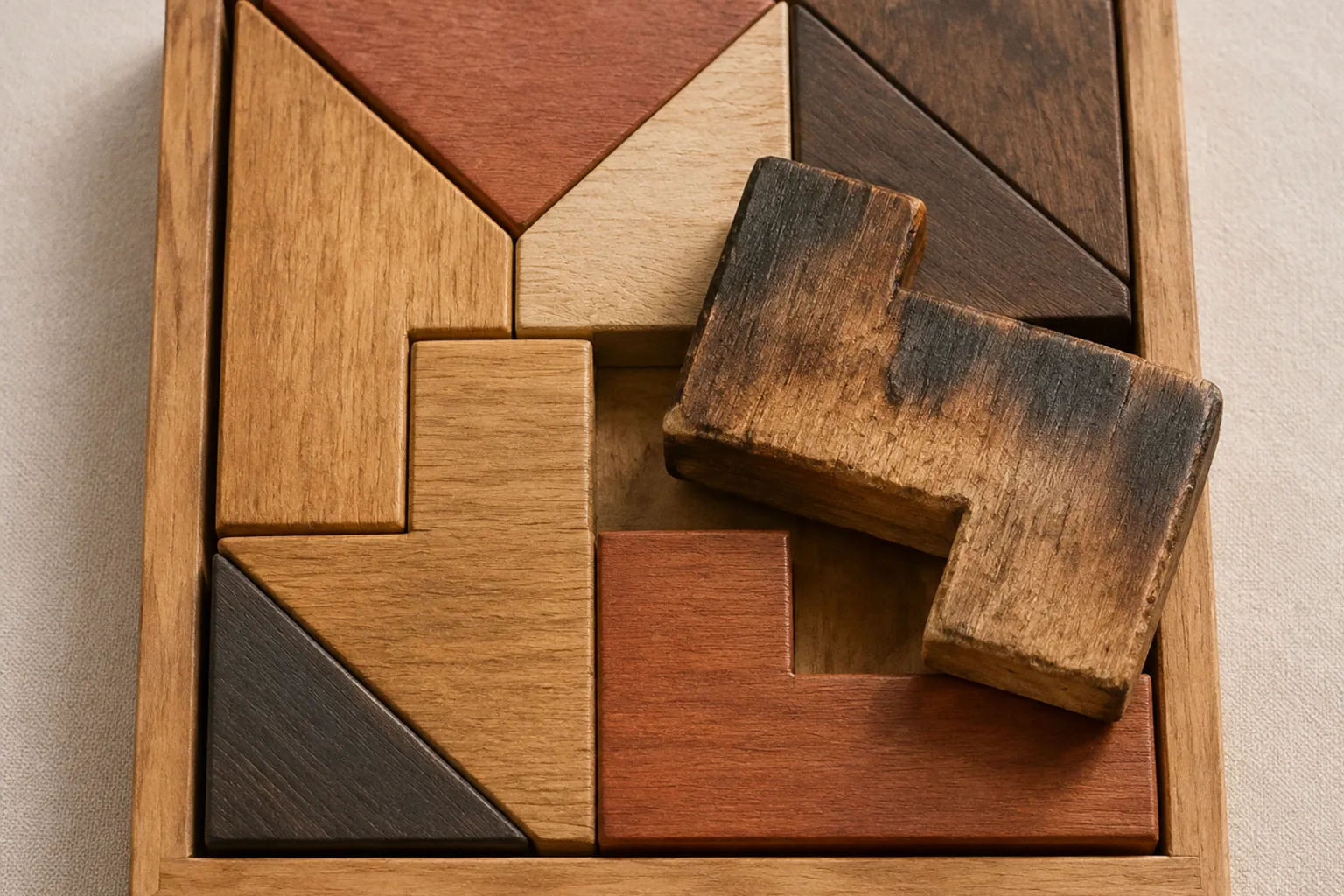
One tactile note: the puzzle itself matters. Pieces with crisp, unambiguous edges and high-contrast imagery support rotation tasks; blurry illustrations or pieces that all look similar force the visual system to work harder before spatial reasoning even begins. A well-made wooden puzzle with clear shapes isn't a luxury — it's an accessibility tool for a developing visual system.
Scaffolding Strategies: Using Descriptive Vocabulary to Bridge the Gap
Scaffolding means building a temporary structure that lets the child reach a skill they don't yet have on their own. With logic puzzles, the structure is mostly linguistic and procedural. Three scaffolds work better than any others:
1. Think-aloud modeling. When solving alongside the child, narrate your own reasoning: "I'm going to look at all the corners first because I know one piece has a flat edge there." The child hears the structure of systematic thought before being asked to produce it.
2. Clue inventory before action. Teach the child to read all clues first, then restate what is certain, then attempt the puzzle. This converts the puzzle from a guessing task into a planning task, which is exactly the cognitive upgrade the brain needs.
3. Single-variable isolation. Reduce a multi-variable puzzle to one variable at a time. Solve that variable completely, then add the next. This matches how working memory actually develops — by handling smaller loads with high success before expanding.
The mistake is treating scaffolding as cheating. A child who solves a logic puzzle with structured parental guidance is not getting less developmental benefit — they're getting more, because the scaffold allows them to operate in the zone where the skill is actually being built. Even fifteen to twenty minutes of focused brain teaser time per day, paired with this kind of guidance, has been linked to measurable gains in primary school academic performance.
The Long View: Lifecycle of a Puzzle Skill
Logic puzzle fluency isn't a single achievement. It's a developmental sequence that unfolds over years, and the goal at each age is different. A 5-year-old who guesses systematically is succeeding. A 9-year-old who still guesses hasn't been given the tools to move past it.
The lifecycle looks roughly like this:
- Ages 4–6: Tactile familiarity, piece recognition, willingness to try. Strategy is irrelevant; engagement is the win.
- Ages 6–8: Single-variable puzzles, simple elimination, introduction of spatial vocabulary. Working memory is the limiting factor — reduce load, not difficulty.
- Ages 8–10: Multi-variable grids, hypothetical reasoning, strategy comparison. Cognitive flexibility becomes the new bottleneck.
- Ages 10–12: Abstract puzzles, rule-generation, independent strategy selection. This is where peak executive function begins to consolidate.
The most common parental error is treating a child at one stage as though they should be at the next. The stall isn't a failure. It's a mismatch between the puzzle's demand and the brain's current capacity.
Puzzles don't train the brain by being hard. They train it by being solvable — with the right support at the right moment.
The fix is rarely a better child. It's a better-fit puzzle, a sharper vocabulary, and the patience to let the cognitive system finish building. A puzzle that lasts — physically, in its material integrity, and cognitively, in the skills it builds across years — is worth more than a dozen that frustrate a child into giving up on brainteasers altogether.