Montessori geometry solids: quality checklist before purchase
A complete Montessori geometric solids set contains 10 three-dimensional forms and is generally introduced at approximately 3.5 years of age.
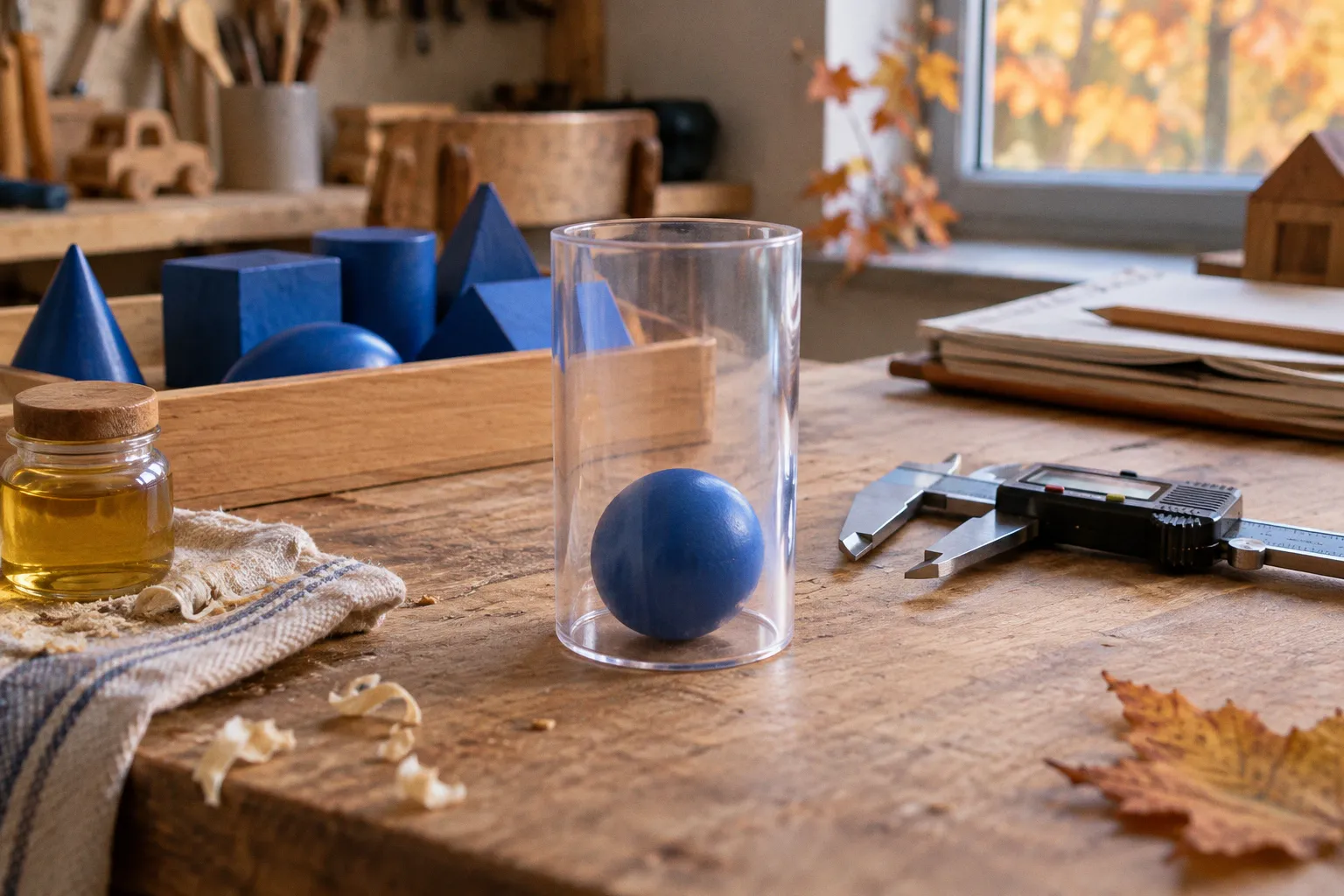
The material is designed to isolate geometric form through touch, visual discrimination, movement, and classification. A purchase that omits several shapes, uses unstable coatings, or provides no reliable safety documentation is not equivalent to the traditional sensorial material.
The correct evaluation is therefore not based on color or product photography alone. A Montessori wooden geometry solids quality checklist should examine five variables: the complete shape configuration, the wood and surface finish, laboratory safety compliance, sensory design, and the accessories required for controlled handling.
The central quality test is simple: the set must preserve the geometry, tactile feedback, and controlled presentation that make the material educationally useful.
The 10-piece standard: verify the complete set
A standard Montessori geometric solids set consists of 10 solid forms:
1. Sphere
2. Cube
3. Cylinder
4. Cone
5. Rectangular prism
6. Triangular prism
7. Square pyramid
8. Triangular pyramid
9. Ellipsoid
10. Ovoid
This configuration is not arbitrary. It provides contrast between curved and plane surfaces, between solids with rotational symmetry and solids with distinct edges, and between forms that may appear similar from one angle but behave differently when handled.
For example, a cube presents six flat square faces and stable edges. A rectangular prism introduces unequal dimensions. A cylinder combines two circular planes with one continuous curved surface. A sphere has no plane face and rolls in every direction. These distinctions give the child material for classification based on observable properties rather than on naming alone.
A reduced set may still be useful as a general wooden geometry toy, but it should not be described as a complete traditional Montessori geometric solids material if essential forms are missing. Product listings sometimes use the Montessori label for any collection of painted wooden blocks. The configuration should be checked before considering the finish or packaging.
Compare the product listing with the physical configuration
| Parameter | Acceptable indication | Warning sign |
|---|---|---|
| Number of solids | 10 distinct three-dimensional forms | Fewer shapes without a clear explanation |
| Shape variety | Combination of curved solids, prisms, pyramids, and basic polyhedra | Several blocks with nearly identical geometry |
| Approximate size | Individual shapes commonly fall within approximately 5–10 cm in height or major dimension | Very small pieces marketed for unsupervised toddler use |
| Form accuracy | Clean planes, consistent edges, and recognizable geometric proportions | Irregular faces, asymmetry, or visibly distorted curves |
| Surface treatment | Smooth, continuous finish that does not obscure the form | Thick coating, rough grain, peeling paint, or unsealed areas |
| Accessories | Stands or bases for rolling forms; projection-related materials where specified | Sphere, ellipsoid, and ovoid supplied without any means of stabilizing them |
The dimensions do not need to be identical across manufacturers. What matters is proportional consistency within the set and sufficient scale for controlled handling. If a shape is too small to grasp securely, fine motor precision becomes secondary to awkward manipulation. If it is excessively large or heavy, the child may use it primarily as a lifting object rather than as a classification material.
Material integrity: why hardwood affects tactile learning
Wood is not an interchangeable category. The species, grain structure, drying process, and surface treatment determine how the solids feel in the hand and how they tolerate repeated handling.
High-quality educational materials commonly use durable hardwoods such as beechwood, maple, or basswood. These woods can provide a stable base for repeated manipulation when properly processed. The objective is not luxury. It is dimensional stability, resistance to splintering, and a consistent tactile surface.
A geometric solid is a sensorial tool. The child may trace an edge, rotate a cylinder, compare a plane with a curve, or identify a form without looking directly at it. The surface should therefore provide clear tactile information without introducing distracting defects.
Examine the wood itself
A practical inspection should focus on the following characteristics:
- Grain stability. The surface should not show open splits, deep cracks, or areas where the grain is lifting.
- Edge integrity. Edges should be defined but not sharp enough to cause injury during normal handling.
- Dimensional consistency. Identical or related forms should not show severe warping or uneven bases.
- Surface density. The wood should feel solid rather than unusually hollow or fragile.
- Finish continuity. Paint or sealant should cover the intended surface evenly, without bubbles, flaking, or exposed patches.
- Odor. A strong persistent chemical smell is a reason to pause and request information about the coating and curing process.
A lightweight softwood imitation may look acceptable in a product photograph but provide weaker resistance to dents and compression. Damage to an edge changes the geometry. A chipped corner no longer presents the same tactile and visual cue as a clean edge, and a warped base can alter how the child interprets stability.
This does not mean that every non-hardwood product is automatically unsuitable. The material should be judged by its documented composition and physical finish rather than by the species name alone. However, a manufacturer that identifies the wood clearly provides more useful information than a listing that says only “natural wood.”
Distinguish solid wood from composite construction
Some products use laminated wood, medium-density fiberboard, or other engineered materials. These materials are not automatically unsafe, but they require closer inspection of the edges and coating. Exposed layers, swelling, or delamination are particularly relevant when the solids are cleaned with a damp cloth or used in environments with variable humidity.
The product description should make clear:
- whether the solids are made from solid wood or an engineered board;
- which coating or paint system is used;
- whether the finish is intended for children’s products;
- whether the manufacturer can provide batch-level safety documentation.
FSC certification may provide information about the origin of the wood, but it does not replace toy-safety testing. Responsible forestry and chemical safety are separate questions. A product can satisfy one and provide no evidence for the other.
Safety compliance: interpret EN71 and ASTM F963 correctly
Safety claims need to be separated into specific standards. A phrase such as “non-toxic” is not sufficient evidence by itself. It may describe the manufacturer’s intention, the type of paint, or a marketing position rather than a verified test result.
For products sold in European markets, the relevant EN71 framework includes several parts:
- EN71-1: mechanical and physical properties;
- EN71-2: flammability;
- EN71-3: migration of certain elements, including heavy metals, into saliva or gastric fluids.
EN71-3 is particularly relevant to painted or coated wooden solids because it evaluates chemical migration from accessible surfaces. It does not, by itself, describe every mechanical feature of the product.
In the United States, ASTM F963 is the principal toy safety standard. It addresses a broad range of requirements relating to physical properties, materials, labeling, and other safety factors. The exact testing obligations can depend on the product category, age grading, and market.
What to request from the manufacturer
A reliable product listing should identify the applicable market and provide meaningful compliance information. The strongest documentation usually includes:
1. The name of the testing standard, not only a general safety statement.
2. The product or model reference covered by the test.
3. The manufacturer or responsible economic operator.
4. The testing laboratory or certification body.
5. The date or batch information, where available.
6. Confirmation that the tested configuration matches the set being sold.
A generic certificate image is less useful if it does not identify the actual product. Documentation for one wooden toy cannot automatically be applied to another shape set from the same factory. Paint color, coating formula, dimensions, and accessory components may differ.
The research record identifies EN71-3 and ASTM F963 as important benchmarks, but neither should be treated as a visual quality guarantee. Standards testing does not eliminate the need to inspect the physical pieces for rough edges, cracks, unstable stands, or loose coating.
“Non-toxic” is a product description. EN71-3 and ASTM F963 are testing frameworks. They should not be treated as equivalent evidence.
Small-parts risk and age grading
Traditional Montessori geometric solids are generally recommended from approximately 3.5 years of age. This age guidance matters because the set contains multiple separate pieces, and the pieces are intended for deliberate handling rather than infant mouthing.
Products marketed as safe wooden geometry shapes for toddlers require special scrutiny. A label that includes the word “toddler” does not override the physical characteristics of the set. Safety guidance for small parts identifies a diameter threshold of greater than 1.25 inches, or 3.175 cm, for components intended for children under 3 years old. This measurement should not be interpreted as permission to give any geometry set to a young child without supervision. Shape, accessibility, and foreseeable use also matter.
The following conditions should result in a conservative age decision:
- the manufacturer provides no clear age grading;
- the pieces are small enough to fit fully into a child’s mouth;
- the set includes detachable rings, stands, or pegs that are smaller than the main solids;
- the product is marketed simultaneously for infants and preschoolers without explaining the difference;
- the packaging gives no warning about small parts.
A 3.5-year recommendation is not a minor marketing detail. It reflects the intended level of motor control, attention, and safe handling. Children develop at different rates, so adult supervision remains appropriate even when the stated age range has been reached.
Sensory design: why uniform blue matters
Traditional Montessori geometric solids are uniformly painted blue. The purpose is not decoration. A single color reduces visual interference and directs attention toward form, dimension, surface, and movement.
If every solid has a different color, the child may classify by color before examining geometry. That can be useful in a general preschool learning kit, but it changes the sensory task. The traditional material is designed to isolate one variable: geometric form.
Uniform coloring also supports consistent presentation. The adult can place several solids on a work mat and ask the child to compare them without adding a second classification system. The child may then explore questions such as:
- Which solids roll?
- Which solids have flat faces?
- Which forms have edges?
- Which shapes can stand without support?
- Which solids feel similar when handled without looking?
A blue finish does not prove that a set is authentic or pedagogically complete. It is one design feature within a larger system. A poorly formed block remains poorly formed even if it is painted the correct color.
Inspect the paint and sealant
The finish should be smooth and fully cured. Check for:
- peeling at corners;
- inconsistent thickness;
- visible brush marks that interrupt the surface;
- exposed raw wood;
- sticky areas;
- paint transfer onto a clean cloth;
- strong odor that persists after unpacking.
Water-based paints are commonly preferred for children’s wooden products because they can reduce the use of solvent-heavy coatings, but the phrase “water-based” alone is not a complete safety certification. The relevant question is whether the finished product has been tested under the appropriate toy-safety requirements.
A clear natural finish may preserve the appearance of wood but does not necessarily replicate the traditional Montessori isolation of form. Conversely, a glossy colored finish may increase visual distraction and make tactile inspection less precise. The finish should support the intended learning task rather than merely improve shelf appearance.
Essential accessories: stands, bases, and projection materials
Curved-sided solids require controlled placement. A sphere, ovoid, and ellipsoid can roll away from the work area. A complete or thoughtfully designed set may include wooden rings, display bases, or other stands to stabilize these pieces.
The stand is not an ornamental addition. It changes the conditions under which the child can compare and classify the forms. Without support, the child may spend part of the activity retrieving a rolling object. With support, the focus remains on the solid’s geometry and tactile properties.
Inspect each stand for:
- a stable base;
- a smooth contact surface;
- a diameter appropriate to the intended solid;
- sufficient weight to resist tipping;
- no exposed fasteners or sharp edges;
- a size that does not create an additional small-parts hazard.
A stand should not grip the solid so tightly that the child cannot remove it independently. Its function is stabilization, not mechanical locking.
Projection planes and 2D representation
Some Montessori geometry materials include plane figures or projection-related components. These accessories can connect three-dimensional forms with their two-dimensional representations. For example, the child may observe how a solid produces a circular, triangular, or rectangular outline when viewed from a particular direction.
Not every commercial set includes these components, and their absence does not necessarily make a basic 10-piece solids set defective. However, a listing that claims to provide a complete geometry curriculum should specify whether projection planes or flat geometric figures are included.
The distinction is useful:
- Geometric solids provide three-dimensional sensory exploration.
- Plane figures represent two-dimensional shapes.
- Projection materials help relate the visible outline of a solid to a flat form.
These are related materials, not interchangeable ones. A box containing only flat cards is not a geometric solids set, and a set of solids without plane figures does not provide the full range of representation-based work.
A practical inspection sequence
When the set arrives, inspect it in a fixed order. This reduces the chance that attractive packaging or a low price will substitute for evidence.
1. Confirm the configuration
Count the pieces and match each one to the expected 10-shape list. Do not rely only on the product title. Photograph the contents if the listing is ambiguous, especially when the product is sold as a multi-piece educational kit.
2. Check every surface
Run a clean finger over the faces, edges, and curves. Look for splinters, rough patches, cracks, dents, and areas where the coating has lifted. A single damaged piece may be replaceable, but widespread defects indicate weak manufacturing control.
3. Test the geometry
Place each solid on a flat surface. Observe whether:
- the cube and prisms rest evenly;
- the pyramids have stable bases;
- the cylinder rolls as expected on its curved side;
- the sphere, ovoid, and ellipsoid are appropriately supported;
- the pieces are visibly symmetrical.
The purpose is not to demand mathematical perfection from a children’s material. The purpose is to identify defects that alter the child’s interaction with the form.
4. Examine the finish
Check color uniformity, paint adhesion, exposed wood, surface tackiness, and odor. A blue finish should be consistent enough to avoid becoming a separate visual distraction.
5. Inspect documentation
Look for specific references to EN71 testing, including EN71-3, and ASTM F963 where relevant. Confirm that the information applies to the actual product model and not merely to the manufacturer’s general catalog.
6. Review age and small-parts information
Check the recommended age, warnings, accessory dimensions, and packaging. If the product is marketed for children under 3 but contains small detachable components, request clarification before use.
7. Evaluate storage and presentation
A wooden tray, fitted box, or organized storage system can preserve the pieces and support controlled presentation. Storage is secondary to safety and geometry, but missing or poorly fitted storage may lead to damaged edges and lost accessories.
Common purchasing errors
Several recurring mistakes reduce the educational value of otherwise attractive products.
Confusing a shape assortment with Montessori material
A collection of colorful blocks may introduce basic shape vocabulary, but the Montessori geometric solids material has a more specific configuration and sensory purpose. The label should be assessed against the actual contents.
Treating color as proof of authenticity
Uniform blue paint is consistent with traditional design, but it does not verify wood quality, safety testing, or dimensional accuracy. It is one criterion, not the entire evaluation.
Accepting an unsupported safety claim
Terms such as “child-safe,” “eco-friendly,” and “non-toxic” do not identify the testing standard or the product batch. Ask for documentation that corresponds to the actual set.
Ignoring accessories
A sphere that repeatedly rolls away is not necessarily defective, but a set intended for structured presentation should provide a practical method of stabilization. The absence of stands can limit how the curved solids are used.
Selecting by age label alone
An age label is useful only when it matches the physical design. A product marked for toddlers may still contain components that require adult supervision or may be unsuitable for children who mouth objects.
Overlooking the distinction between wood origin and product safety
FSC certification can address the source of the timber. It does not establish compliance with EN71-3, ASTM F963, or mechanical safety requirements. These claims belong to different parts of the evaluation.
Final assessment
A high-quality Montessori geometry solids set should contain the complete 10-piece configuration, use stable and well-finished wood, preserve clear geometric distinctions, and provide credible safety information. Uniform blue coloring supports the traditional sensory objective, while stands improve the controlled use of curved solids. Documentation under relevant standards, including EN71-3 and ASTM F963 where applicable, is stronger evidence than generic claims about being natural or non-toxic.
The recommended starting point is approximately 3.5 years, with continued supervision and careful attention to small detachable components. Products intended for younger children should not be selected solely because the packaging uses the phrase “early learning.”
The definitive purchase decision is therefore procedural: verify the forms, inspect the material, examine the finish, confirm the safety documentation, and assess the accessories. If the set passes these checks, it can function as a durable sensorial geometry material rather than merely as a collection of painted wooden blocks.