Wooden pattern blocks: a step-by-step guide for early geometry
Wooden pattern blocks are among the most controlled tools for introducing geometry to children. Their value does not come from visual variety alone. A standard set uses six shapes with fixed side lengths, proportional angles, and predictable ways to combine.
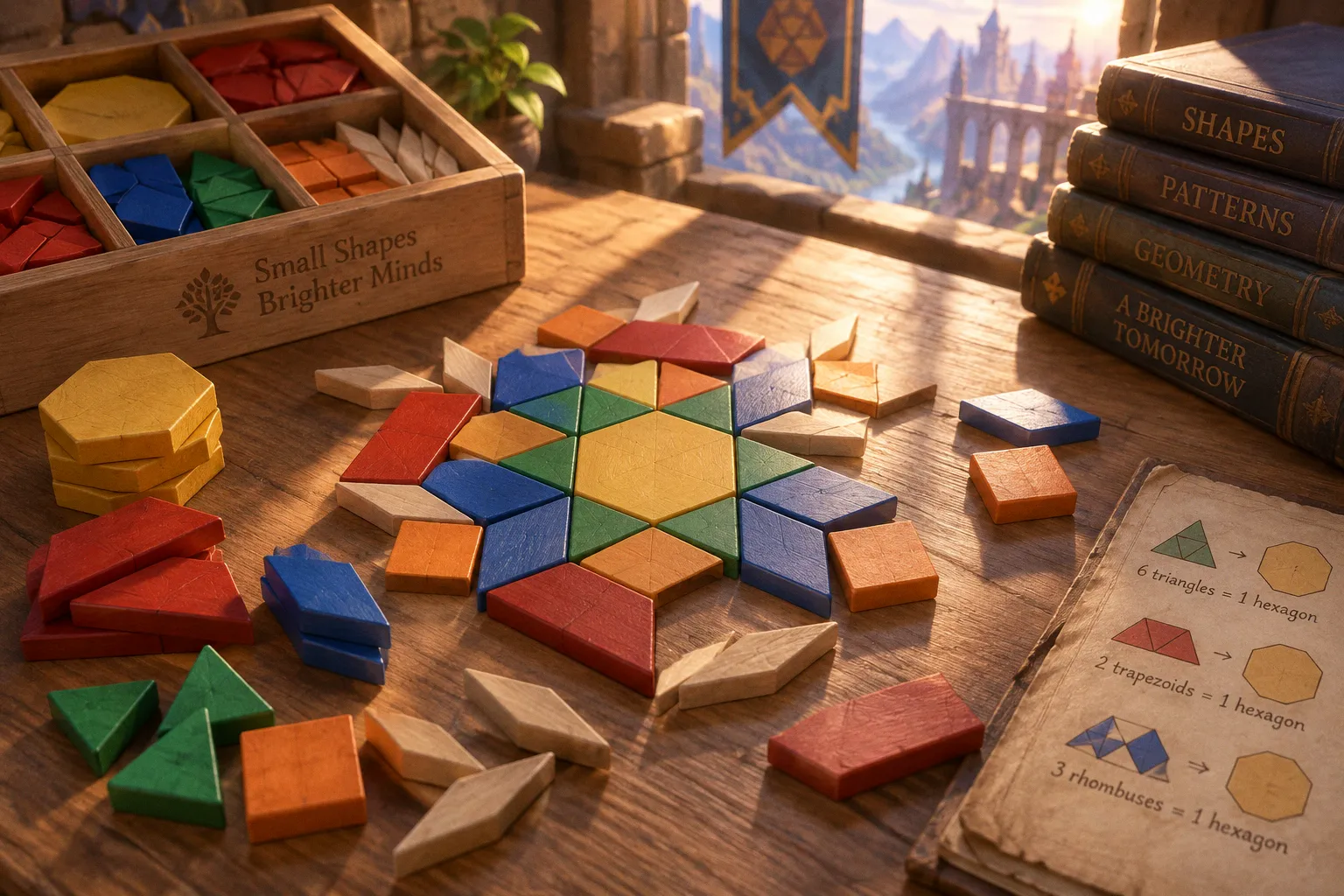
This structure allows children to investigate spatial relationships through direct manipulation rather than memorizing isolated terms.
The central design principle is the 30-degree angle. Every interior angle in a traditional pattern block set is a multiple of 30 degrees: 30°, 60°, 90°, 120°, or 150°. Because the pieces share compatible edges and angles, children can construct, deconstruct, rotate, reflect, and compare shapes within a consistent geometric system.
For parents and educators, this makes wooden pattern blocks for kids an effective early math manipulative. They support spatial reasoning, symmetry recognition, visual decomposition, and the first stages of algorithmic thinking. The activities should, however, follow a progression. Free arrangement is an appropriate starting point, but it is not the complete learning sequence.
The geometry of a standard pattern block set
Traditional pattern blocks were developed in the 1960s by the Education Development Center as mathematical manipulatives for teaching early geometry. The pieces were designed to fit together without gaps when their edges and angles are used correctly.
A standard set contains six color-coded shapes:
| Shape | Traditional color | Defining features | Common geometric use |
|---|---|---|---|
| Hexagon | Yellow | Six equal sides; interior angles of 120° | Whole-shape reference and composition tasks |
| Trapezoid | Red | One base is twice the length of the other three sides | Comparing equivalent constructions |
| Rhombus | Blue | Rhombus with 60° and 120° angles | Rotation, tessellation, and decomposition |
| Equilateral triangle | Green | Three equal sides; three 60° angles | Basic unit for building larger shapes |
| Square | Orange | Four equal sides; four 90° angles | Right-angle recognition and mixed constructions |
| Thin rhombus | Beige or tan | 30° and 150° angles | Angle comparison and more complex tiling |
Except for the trapezoid, the side lengths across the standard shapes are uniform. The trapezoid has one base that is twice the length of its other three sides. This distinction matters. A child may see the pieces as unrelated colored tiles, while the geometry shows that they belong to a proportional system.
The usual classroom sets contain between 155 and 250 pieces. A common full wooden set contains 250 pieces, and many classroom blocks are approximately 10 millimeters thick. Smaller sets are sufficient for individual work, but larger collections permit group construction, repeated pattern work, and multi-step composition tasks.
The pieces are generally suitable across a broad developmental range, commonly from ages 3 to 11. That does not mean the same activity is appropriate at every age. A three-year-old may work on matching and edge alignment. An older child can investigate fractions, transformations, area relationships, and formal symmetry.
What children should learn from the pieces
The six shapes provide a compact vocabulary for several early mathematical ideas:
- Shape classification: distinguishing triangles, quadrilaterals, rhombi, trapezoids, squares, and hexagons by attributes rather than color.
- Spatial orientation: recognizing that a shape remains the same after rotation.
- Composition: combining smaller shapes to create a larger target.
- Decomposition: identifying which smaller pieces can replace one larger piece.
- Angle structure: noticing that corners can fit together because their measures are compatible.
- Symmetry: comparing the left and right sides of a design or identifying reflectional balance.
- Tessellation: covering a surface with repeated shapes without gaps or overlaps.
Color is useful as an entry point, but it should gradually become less important. If a child can identify only the red piece or the blue piece, the task remains at the level of visual association. If the child can identify a piece by its side length, angle, or number of sides, the activity is becoming geometric.
Pattern blocks teach geometry most effectively when color stops being the answer and shape relationships become the answer.
The 30-degree logic and spatial reasoning
The angle system explains why pattern blocks are more than wooden shape puzzles for spatial reasoning. Each standard piece is built from angles that are multiples of 30 degrees. This makes it possible to create complete junctions and predictable compositions.
For example, six green equilateral triangles form one yellow hexagon. Two red trapezoids also form one yellow hexagon. Three blue rhombi can produce the same hexagonal outline. These constructions are not simply visual tricks. They provide concrete evidence that different arrangements can preserve the same overall shape.
The child must coordinate several mental operations:
1. Identify the target boundary.
2. Select a piece with compatible edges.
3. Rotate the piece into alignment.
4. Predict whether the remaining space can be filled.
5. Revise the arrangement if a gap or overlap appears.
6. Compare the completed construction with the original target.
This sequence places a manageable cognitive load on the child. The material gives immediate feedback: an edge either aligns or it does not; a corner either closes the space or leaves a gap. The child does not need to wait for an adult to confirm every step.
Why rotation matters
Young children often treat a rotated shape as a different object. A square turned on one corner may be described as a diamond, even though its defining attributes have not changed. Pattern blocks create repeated opportunities to correct this misconception without relying on verbal explanation alone.
Place the same piece in several orientations and ask the child to determine whether it remains the same shape. Avoid leading the child toward a particular answer. The aim is to establish invariance under rotation: position changes, but side relationships and angle structure remain constant.
A productive sequence is:
- Present one shape in a familiar orientation.
- Rotate it 90° or 180° without changing its size.
- Ask the child to match it with the original.
- Introduce a visually similar shape with different angles.
- Ask the child to explain the difference using attributes.
This is a spatial reasoning task, not a vocabulary drill. Terms such as side, corner, angle, equal, longer, and shorter become more useful when attached to a physical comparison.
Why gaps provide useful information
A gap is not merely an error. It is diagnostic information. It may show that:
- the selected shape has an incompatible angle;
- the piece is positioned correctly in size but not rotated correctly;
- the child has mistaken a visual outline for a complete geometric match;
- the target requires a combination of pieces rather than one piece;
- the construction has reached a limitation of the available angle system.
Standard pattern blocks cannot form every arbitrary two-dimensional outline. Their angles are restricted to multiples of 30 degrees. This limitation is part of the instructional value. The child learns that geometric construction depends on constraints, not only on visual similarity.
From free play to structured geometry
Open-ended exploration is appropriate at the beginning. It allows the child to develop hand control, observe fit, and form an initial mental model of the pieces. However, an activity becomes more mathematically informative when the adult introduces one variable at a time.
The following pattern block activity progression moves from recognition to composition, symmetry, and explanation.
1. Sort by attributes
Begin with all six shapes or with a smaller selection. Ask the child to group pieces by one attribute:
- same shape;
- same number of sides;
- same color;
- same angle type;
- same side length;
- pieces that can combine to make a specified outline.
The first groups may be based on color because color is perceptually accessible. The next round should remove color as the main clue. For example, place a blue rhombus and a beige thin rhombus together and ask how they are alike and different. Both are rhombi, but their angle structures differ.
Do not correct every imprecise description immediately. Instead, ask for a comparison. A child who says that one piece is more pointed can be prompted to identify which corners create that appearance.
2. Match pieces to outlines
Use a board, printed outline, or simple drawn boundary. Start with a single-piece outline. Progress to designs that require two or more pieces.
At this stage, the child is learning to distinguish between:
- matching the entire outline;
- filling the interior area;
- placing pieces with aligned edges;
- leaving no gaps or overlaps.
The adult can vary the task by showing only the boundary, showing the completed design, or presenting an incomplete construction. Each version creates a different cognitive demand.
A completed picture primarily tests visual matching. An empty outline requires planning. An incomplete design requires the child to infer the missing piece from the existing constraints.
3. Build a target with different combinations
Ask the child to make one yellow hexagon using different pieces. The standard relationships provide a clear progression:
- six green triangles;
- two red trapezoids;
- three blue rhombi;
- combinations of smaller shapes that preserve the same outer boundary.
The objective is not speed. The objective is equivalence. The child should observe that the interior arrangement changes while the external shape remains stable.
Once the child can reproduce the hexagon, remove the model and provide only the instruction. Later, ask the child to find as many constructions as possible and record them with drawings or photographs.
4. Introduce symmetry
Teaching symmetry with wooden blocks is most effective when the line of symmetry is visible. Place a vertical line on the work surface and build one half of a design beside it. Ask the child to construct the reflected half.
Use simple shapes first. A triangle, square, or hexagon provides a clear starting structure. Then introduce designs with multiple pieces and internal color changes.
The child must coordinate two forms of symmetry:
- Geometric symmetry: the shape arrangement mirrors across the line.
- Color symmetry: corresponding pieces have the same color or an intentional color relationship.
These are not identical. A design may be geometrically symmetrical but use different colors on each side. Ask the child to determine which type is being tested.
5. Create and explain a rule
Pattern blocks also support early algorithmic thinking. Give the child a repeating sequence, such as triangle–rhombus–triangle–rhombus, and ask what comes next. Then increase the complexity by changing orientation or using a repeating group of three pieces.
A stronger task is to ask the child to create a pattern that another person must continue. This requires the child to define a rule rather than simply recognize one.
Useful prompts include:
- Which part repeats?
- Does the piece repeat in the same orientation?
- Is the color pattern different from the shape pattern?
- How would you describe the rule without pointing?
The aim is precise description. A child who can build a pattern but cannot state its rule is demonstrating a different level of understanding from a child who can communicate the generating structure.
Proportional relationships and early fractions
Pattern blocks are well suited to concrete introductions to fractions because the pieces share a common geometric system. The yellow hexagon can function as a reference whole. Children can then compare how many equal or equivalent pieces are needed to cover it.
Six green triangles cover one hexagon. This can be represented as six equal parts, with each triangle occupying one-sixth of the reference shape. Two red trapezoids cover the same hexagon, so each trapezoid represents one-half of that whole in the specific construction. Three blue rhombi also cover the hexagon, creating three equal parts.
The activity should remain grounded in the physical relationship. Avoid presenting symbolic fractions before the child can demonstrate the equivalence with pieces.
A sequence may look like this:
1. Cover the yellow hexagon with six green triangles.
2. Remove the triangles and replace them with two red trapezoids.
3. Compare the number of pieces in each construction.
4. Discuss whether the pieces have the same size and shape.
5. Introduce the idea that different numbers of pieces can cover the same whole.
6. Record the relationship with drawings or simple notation when developmentally appropriate.
This is not a complete treatment of fractions. The shapes are not all equivalent in area, and not every piece can be assigned a simple fraction of every possible reference shape without defining the reference first. The instructional value lies in comparison and conservation: the outer boundary remains constant while the internal partition changes.
Area without formal calculation
Older children can use the pieces to investigate area before working with formulas. Ask them to cover a fixed outline and determine which arrangements use more or fewer pieces. If the pieces are treated as units within the same system, the child can compare coverage and count repeated components.
The adult should distinguish between:
- number of pieces;
- total covered area;
- perimeter of the outside boundary;
- internal boundaries created by the arrangement.
Two constructions may use different numbers of pieces but have the same total area. They may also have the same area but different internal divisions. This creates a concrete basis for later work with units, composition, and conservation.
Selecting and maintaining a wooden pattern block collection
The best set is not necessarily the largest one. Selection should follow the intended use, available workspace, and developmental stage.
A practical collection should include:
- all six standard shapes;
- enough repeated pieces for composition tasks;
- consistent side lengths across the set;
- clearly differentiated colors;
- flat, stable pieces that do not rock on the work surface;
- edges that meet without substantial gaps;
- a thickness that is easy for the child to grasp and rotate;
- storage that keeps the shapes separated and countable.
For an individual child, a smaller set can support sorting, matching, symmetry, and basic composition. A classroom or multi-child setting benefits from a larger quantity, often within the common range of 155 to 250 pieces. Repetition matters because many activities require several copies of the same shape. Six triangles are necessary for one hexagon construction; a single triangle cannot support comparison between multiple arrangements.
Surface and edge quality
Wooden pattern blocks should be inspected for splinters, rough edges, loose paint, and warping. The pieces are handled repeatedly and often pushed across a table. Surface quality affects both safety and precision. A warped piece may create a gap that the child interprets as a geometric failure.
Color consistency also has a functional role. If the same shape appears in multiple colors, the set may be useful for reducing color dependence, but the change should be intentional. In a traditional set, color coding helps children identify pieces quickly. In advanced tasks, the adult can ask the child to work from shape and angle rather than color.
Storage is part of the instructional system. A divided tray supports classification and quick inventory. An undivided container encourages sorting and may be useful for independent organization. Neither option is universally better. The choice depends on whether the target is rapid access or classification practice.
Common instructional errors
Several adult behaviors reduce the mathematical value of the activity.
1. Giving the answer too early.
If the adult immediately rotates the piece or supplies the missing shape, the child loses the opportunity to generate and test a spatial hypothesis.
2. Treating every design as equally educational.
Decorative arrangements may develop visual planning, but they do not automatically teach symmetry, fractions, or geometry. The learning objective must be explicit.
3. Using color as the only classification system.
Color matching is an entry point, not a sufficient understanding of shape.
4. Ignoring orientation.
Children need repeated exposure to rotated pieces so they can distinguish geometric identity from position.
5. Demanding terminology before observation.
A child may understand that two corners differ before knowing the terms acute, obtuse, or right angle. Start with comparison and attach vocabulary progressively.
6. Making the task harder by adding random pieces.
Increased quantity does not always increase cognitive complexity. A small set with a precise target can create more useful reasoning than a large pile without constraints.
A practical progression for ages 3 to 11
Age ranges should be treated as approximate developmental guides rather than fixed thresholds. The relevant question is whether the child can manage the motor and perceptual demands of the activity.
Ages 3 to 4
Use large, simple tasks:
- identify and name common shapes;
- sort pieces by color or shape;
- fit one piece into a matching outline;
- build simple designs without a model;
- practice placing edges together.
At this stage, the main demands are visual discrimination, bilateral hand coordination, and basic spatial orientation. Keep the number of pieces limited. Too many options create unnecessary cognitive load.
Ages 5 to 6
Introduce:
- two- and three-piece outline puzzles;
- rotated matching;
- simple repeating patterns;
- mirror designs with a visible line;
- building one target shape in more than one way.
Ask the child to describe what changed when a piece was rotated. The explanation may be informal, but the activity should move beyond silent placement.
Ages 7 to 8
Add:
- multi-piece silhouettes;
- symmetry without a fully drawn second half;
- equivalence between different constructions;
- shape composition with restricted piece types;
- verbal rules for repeating patterns.
This is an appropriate stage for connecting physical arrangements to diagrams. The child can draw a completed design, mark a line of symmetry, or record the number of pieces used.
Ages 9 to 11
Use more analytical problems:
- compare area and perimeter across constructions;
- investigate fractional relationships using a defined whole;
- construct designs under angle or piece restrictions;
- identify whether a shape can or cannot be built from the available pieces;
- explain a solution as a sequence of decisions;
- create a puzzle with more than one valid solution.
At this level, wooden pattern blocks can support the transition from concrete manipulation to symbolic reasoning. The material remains useful because it preserves a visible model of the relationships being analyzed.
Definitive assessment
Wooden pattern blocks are effective early geometry manipulatives because their design imposes meaningful constraints. Six standardized shapes, shared side lengths, and angles based on 30-degree increments create a coherent system for investigating composition, decomposition, rotation, symmetry, and proportional relationships.
They should not be presented as a complete mathematics curriculum, nor should every free-form design be described as a developmental exercise. Their instructional value depends on the progression of the task. Begin with recognition and matching. Move to construction and rotation. Add symmetry, equivalence, pattern rules, and fraction relationships only when the child can manage the underlying spatial operations.
For an educational wooden toy collection, a complete set of durable pattern blocks is a strong choice when the goal is structured spatial reasoning rather than passive manipulation. The decisive feature is not the material alone. It is the precision of the geometric system and the quality of the questions built around it.