Solid wood vs plywood toys: material durability for heirloom play
The phrase “wooden toy” hides a manufacturing decision that matters more than most product photography suggests.
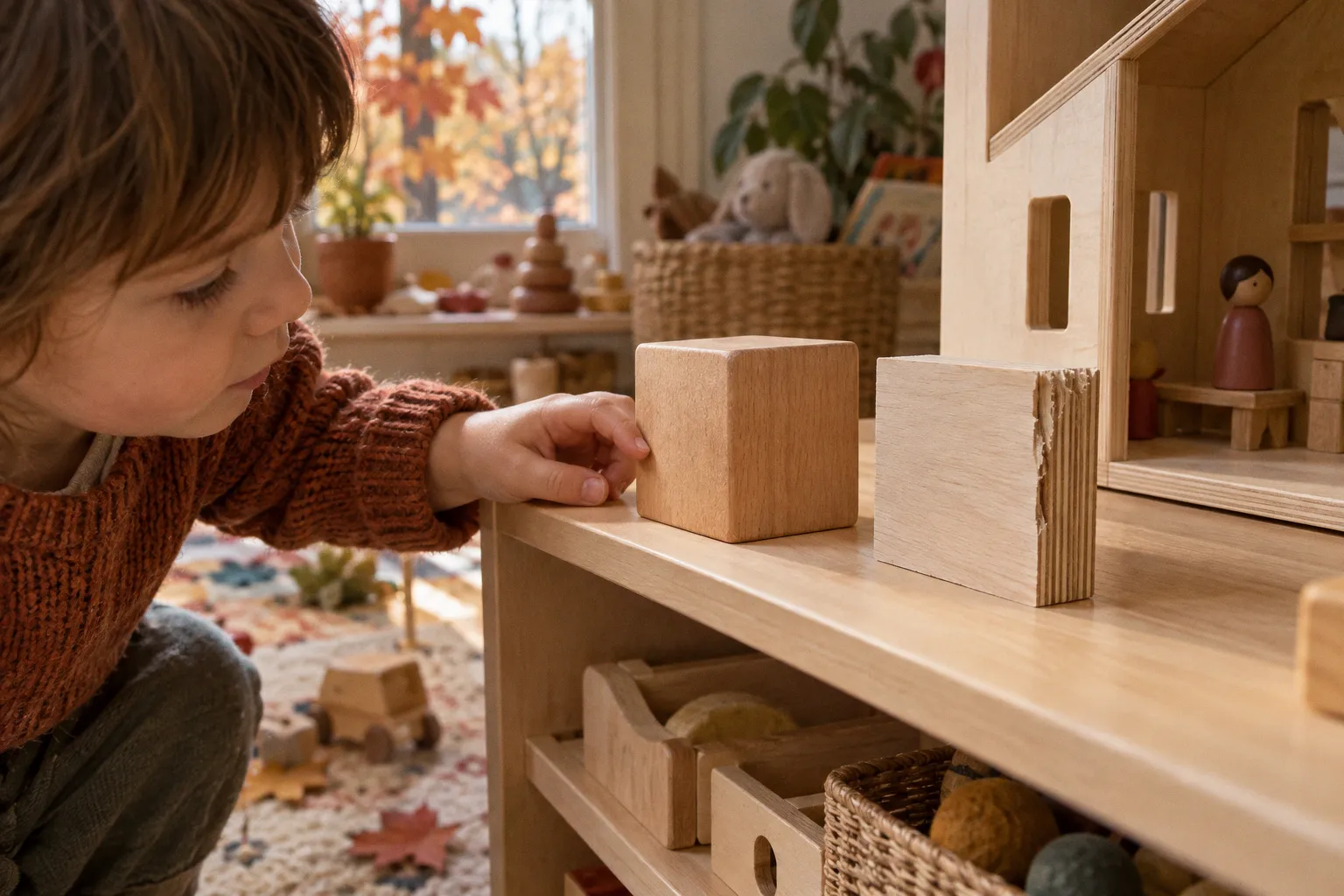
Solid Wood vs Plywood Toys: Choosing Materials for Heirloom Play
A toy made from solid beech is not equivalent to a toy cut from Baltic birch plywood, even when both are finished in the same muted palette and sold as “natural,” “sustainable,” or “heirloom quality.”
The difference appears under pressure: when a block is dropped repeatedly, when a teether is mouthed, when a play kitchen is exposed to changing humidity, or when a damaged surface needs to be repaired rather than discarded. Solid wood and plywood each have legitimate strengths. The useful question is not whether one material is universally better. It is whether the material suits the toy’s shape, the child’s handling, and the expected life of the object.
For solid wood vs plywood toys, durability is therefore a matter of construction, not branding. Hardwood generally leads in impact resistance and tactile longevity. Plywood often performs better in large, flat structures where dimensional stability matters more than deep surface repair.
Impact Resistance and Tactile Longevity: Why Hardwoods Lead
Small wooden toys are handled aggressively, even when the play itself looks gentle. Building blocks collide, rattles strike the floor, stacking pieces are knocked sideways, and teethers encounter repeated moisture and pressure. The material needs to tolerate this kind of concentrated use without producing sharp splinters, crushed corners, or a surface that quickly feels rough and degraded.
Solid beech is particularly well suited to this category. Its Janka hardness is approximately 1,300 to 1,450 lbf, placing it among the more impact-tolerant woods commonly used for children’s products. That hardness does not make a toy indestructible. A beech block can still dent, especially against stone or tile. But it gives the piece a substantial resistance to the ordinary punishment of play: drops, collisions, squeezing, and repeated handling.
The tactile effect is important. A well-finished solid hardwood toy retains a continuous grain structure beneath the hand. The surface can feel smooth without becoming plasticky, and the edges can be rounded into a generous radius rather than merely covered with a thin coating. This is what tactile integrity means in practice: the child encounters the material itself, not just a decorative skin over a composite core.
For small, frequently handled objects, the advantages of solid wood include:
- High resistance to local impact. A solid block distributes force through its body instead of relying on a thin face veneer.
- Reliable edge shaping. Rounded corners can be cut and sanded directly into the timber, which helps reduce sharp transitions.
- Consistent tactile weight. Solid pieces usually have a dense, substantial feel that supports grasping and manipulation.
- Better repair potential. Surface damage can often be sanded and resealed without changing the basic construction.
- Longer visual continuity. Scratches expose more wood rather than immediately revealing a contrasting core layer.
That last point is often underestimated. Children do not experience a toy as a product photograph. They feel its weight, listen to the sound it makes against another object, trace its edges, and test its resistance. A dense hardwood block that remains comfortable to hold after years of handling has a different developmental and sensory value from a lightweight object whose veneer begins to lift at the corners.
Hardness is not the same as safety
A harder wood is not automatically a safer toy. Poor machining, sharp edges, loose components, unstable finishes, and inadequate testing can compromise any material. Nor does “solid wood” guarantee a high-quality product. Softwoods such as pine may dent and splinter more readily than high-grade Baltic birch plywood. The construction details still matter.
The finish must be smooth, firmly bonded, and appropriate for children’s products. A natural material can be mishandled in production just as easily as a synthetic one. “Untreated” is not a complete safety description if the surface is rough, contaminated, or prone to shedding fibres.
The same applies to mouth contact. For rattles, teethers, and toys likely to be chewed, the relevant questions are whether the timber is properly finished, whether coatings meet applicable chemical requirements, and whether the shape has been designed without hazardous detachable parts. A beautiful grain pattern does not compensate for a finish that flakes or a joint that opens under pressure.
Solid wood earns its heirloom reputation through repairable structure and repeated tactile use—not through the word “natural” on the label.
Structural Stability in Large-Scale Play: Where Plywood Has the Advantage
Plywood is an engineered material made from layered veneers bonded with their grain directions arranged across the panel. That cross-laminated construction changes how the material responds to moisture, stress, and changes in humidity.
For large flat components, this can be a significant advantage. A play kitchen side panel, dollhouse wall, ramp, or broad tabletop needs to remain reasonably stable across its surface. A wide solid-wood panel may expand, contract, cup, or warp as its moisture content changes. Plywood is designed specifically to limit this kind of movement.
Toy-grade Baltic birch plywood has strong resistance to warping because of its layered structure. Its typical Janka hardness is around 1,260 lbf, which is substantial, although somewhat below the range associated with solid beech. For a large play assembly, that tradeoff can be sensible: the panel’s dimensional stability may matter more than its ability to absorb concentrated impacts on a small corner.
This is why plywood vs solid wood children’s toys should not be treated as a simple quality hierarchy. A well-designed plywood play kitchen may remain square and functional where a large solid-timber panel would move more noticeably. A dollhouse made from stable plywood can provide a reliable framework for imaginative play, especially when the manufacturer has engineered the joints and sealed the exposed edges properly.
The material comparison looks different depending on the toy format:
| Toy format | Solid wood | Plywood |
|---|---|---|
| Building blocks | Excellent for dense, tactile pieces that receive repeated impacts | Less suitable when exposed face veneers may chip at corners |
| Rattles and teethers | Strong choice when made from appropriate hardwood with a safe finish | Requires careful edge treatment and attention to adhesive and veneer integrity |
| Dollhouse panels | Can be attractive but may move across broad surfaces with humidity changes | Strong structural choice because cross-lamination limits warping |
| Play kitchens | Useful for solid knobs, handles, and small components | Often practical for large side panels, shelves, and doors |
| Trains and small vehicles | Good for wheels, bodies, and parts needing rounded shaping | Suitable for flat-profile designs, but exposed layers need clean finishing |
| Flat puzzles and trays | Durable when cut and finished well | Efficient for stable, thin panels, provided edges do not delaminate |
The failure modes also differ. Solid wood commonly shows dents, surface scratches, or movement along the grain. Plywood may remain flat while developing chipped face veneers, exposed plies, or delamination at poorly sealed edges. Neither material eliminates maintenance. They simply concentrate wear in different places.
The edge is where construction quality becomes visible
When assessing plywood toys, inspect the edge rather than focusing only on the face. A clean, tightly bonded edge suggests a more controlled manufacturing process. Gaps, lifting veneers, rough cut lines, and unfinished corners are not merely aesthetic defects. They can become points of snagging, moisture entry, or material separation.
The same principle applies to solid wood. Look for end grain that has been properly smoothed, joints that do not flex unexpectedly, and corners that are rounded rather than simply softened by a superficial coating. The surface should feel continuous when a finger moves across it. A painted toy may hide the grain, but it should not hide poor preparation.
This is where wooden toy construction quality comparison becomes more useful than a material label alone. A mediocre solid-wood toy can be less durable than a carefully engineered plywood one. The timber species, moisture conditioning, machining, joinery, adhesives, finish, and quality control all contribute to the outcome.
The Reality of Refinishing: Sanding, Sealing, and Surface Damage
Heirloom play requires more than initial durability. It requires a plausible route back from damage.
Solid wood has a clear advantage here because it is materially continuous. When a surface becomes scratched or rough, it can often be sanded and resealed. The repair removes a small amount of timber without immediately destroying the structure. On a simple block or wooden vehicle, this can extend useful life considerably.
Refinishing should still be approached carefully. Sanding changes dimensions and can soften crisp geometry. It can also remove part of an existing finish without removing all contamination or embedded residue. For children’s toys, a repair should result in a smooth, stable, fully cured surface using a finish appropriate to the intended contact and use.
The practical sequence is straightforward:
1. Inspect the damage rather than sanding automatically. A shallow scratch is different from a split, loose joint, or deep gouge.
2. Remove loose fibres and unstable finish. Anything lifting from the surface should not remain beneath a new coating.
3. Sand gradually. Aggressive sanding can flatten rounded edges or expose an uneven area around the repair.
4. Clean away dust completely. Residual dust can compromise the new finish and create a rough tactile surface.
5. Reseal with a suitable product. The coating must be intended for the relevant use and allowed to cure fully before the toy returns to play.
6. Retire the item if the structure is compromised. A repairable scratch is not the same as a cracked body, loose component, or failure near a small detachable part.
Plywood is more complicated. Its face veneer is usually thin, and sanding deeply enough to remove serious damage can cut through that layer. Once the veneer is breached, the underlying plies may become visible, uneven, or difficult to seal neatly. The panel may remain structurally serviceable, but it will no longer be equivalent to a solid hardwood surface that can be renewed across its depth.
This does not make plywood disposable. It means the repair strategy is different. Light surface wear may be refinished if the face layer remains intact. Chipped veneer or delamination may call for component replacement rather than repeated sanding. In a well-designed toy, replaceable panels or robust edge treatment can make that process more realistic. In a cheaply made object, the damaged surface often becomes the end of its practical life.
Moisture content and dimensional movement
Wood is hygroscopic: it exchanges moisture with the surrounding air. Manufacturing quality depends partly on bringing the material to an appropriate moisture condition before assembly and finishing.
For solid wood toys, a target moisture content of approximately 8–12% is a useful reference range. Toy-grade plywood is often associated with a somewhat narrower range of around 6–10%, reflecting the stability expected from panel products. These figures do not mean a toy will remain dimensionally unchanged in every home. They indicate that the material begins with a controlled moisture condition suitable for indoor use.
Humidity still matters. A wooden toy stored beside a radiator, left in a damp bathroom, or repeatedly exposed to wet play will age differently from one kept in a stable indoor environment. Sealing helps moderate moisture exchange, but it does not turn wood into a waterproof material.
For long-term care:
- Wipe spills rather than soaking the toy.
- Dry surfaces promptly after cleaning.
- Avoid prolonged storage in plastic bags when the toy is damp.
- Keep large plywood assemblies away from persistent humidity.
- Do not use abrasive cleaners that damage the finish.
- Reinspect edges and joints after seasonal changes.
These are not glamorous details, but heirloom quality is partly a maintenance relationship. The most durable material still needs an environment it can tolerate.
Chemical Safety and Off-Gassing: What the Material Actually Contains
Environmental language becomes unreliable when it is reduced to colour palettes and unqualified claims about being “natural.” Solid wood and plywood have different chemical profiles because plywood depends on adhesive systems to bond its layers.
Natural raw solid timber contains no added adhesive and has 0 ppm formaldehyde off-gassing from the raw wood itself. That statement concerns the untreated timber, not necessarily the completed toy. A finished solid-wood product may include paints, stains, sealers, glues, or other components, so the entire construction—not just the species—must be considered.
Plywood is not inherently unsafe or illegal for children’s products. Certified toy-grade plywood is manufactured to meet chemical emission requirements. Standards such as TSCA Title VI and CARB Phase 2 set formaldehyde emission limits for relevant composite wood products, with a referenced limit of under 0.05 ppm. Toy products may also be evaluated under broader safety frameworks, including EN71-3 in Europe, ASTM F963 in the United States, and AS/NZS 8124 in Australia and New Zealand.
A responsible product description should provide more than vague reassurance. Useful information may include:
- The wood species or panel type.
- Whether the plywood is toy-grade or intended for interior construction use.
- The finish category, including whether it is water-based or otherwise specified for children’s products.
- Relevant compliance or testing information.
- Whether exposed edges have been sealed.
- Whether the product contains small parts or components unsuitable for younger children.
FSC certification can address responsible forest management and supply-chain traceability, but it does not replace chemical safety testing. A product can use FSC-certified timber and still require scrutiny of its finish, adhesive system, and manufacturing quality. Conversely, a plywood product that is not marketed with a sustainability label is not automatically unsafe or environmentally irresponsible. Claims must be separated: forest sourcing, emissions, durability, repairability, and end-of-life disposal are different questions.
This separation matters because greenwashing often compresses several unrelated virtues into one soft phrase such as “eco-friendly wood.” A material with responsible sourcing may have poor durability. A durable toy may contain a finish that is not clearly documented. A recyclable panel may be difficult to repair after veneer damage. The honest assessment is more specific.
A credible sustainability claim names the wood, the adhesive, the finish, and the expected repair path. “Eco-friendly” by itself names almost nothing.
Selecting the Right Material for a Child’s Developmental Stage
The best material depends partly on how the child will interact with the toy. Developmental use changes the type of stress placed on an object.
For infants and young toddlers, toys are often grasped, mouthed, dropped, and explored through repeated sensory contact. Small solid hardwood objects are usually well suited to this pattern because they offer dense weight, rounded shaping, and a surface that does not rely on a thin decorative face. A beech rattle or teether still needs appropriate dimensions, secure construction, and a compliant finish. Solid wood does not override age grading or supervision requirements.
For toddlers building and sorting, solid blocks are especially demanding. They are knocked together, stacked under uneven pressure, and frequently thrown outside the intended play area. A durable hardwood can preserve its edges and proportions through this use, which helps the toy remain useful for open-ended construction rather than becoming a collection of misshapen pieces.
For preschool children using larger imaginative-play environments, plywood becomes more compelling. A play kitchen, dollhouse, shop counter, or broad building panel benefits from resistance to warping. These toys are not necessarily being chewed or dropped as compact objects. Their main structural challenge is maintaining alignment across a larger surface while supporting doors, shelves, handles, and repeated assembly.
A practical selection framework is:
1. Identify the dominant force. If the toy will be dropped, chewed, or struck on small edges, solid hardwood is often the stronger candidate. If it must remain flat across a broad panel, plywood may perform better.
2. Check the contact pattern. Frequent hand and mouth contact increases the importance of a smooth, continuous, well-documented finish.
3. Look at the geometry. Thin panels, wide doors, and large walls benefit from plywood’s cross-laminated stability. Rounded blocks and carved pieces benefit from solid timber.
4. Inspect the vulnerable surface. Ask whether the design can tolerate chipped veneer, exposed plies, or repeated edge impact.
5. Consider the repair route before buying. Solid wood usually offers a more forgiving path for sanding and resealing. Plywood may require replacing a panel once the face veneer is deeply damaged.
6. Separate sourcing from safety. FSC-certified wood is relevant to forestry and traceability; it does not by itself confirm the quality of the finish or adhesive.
7. Match longevity to actual use. A large plywood structure may remain useful for years if protected from moisture, while a small solid-wood piece may survive multiple children precisely because it can be refinished.
A Material Decision That Holds Up Over Time
Solid wood is generally the stronger choice for small tactile toys that need impact tolerance, dense handling, rounded shaping, and a realistic chance of refinishing. Beech is particularly convincing for blocks and other compact playthings because its hardness supports repeated drops and contact without sacrificing the sensory quality of natural timber.
Plywood is not the inferior substitute implied by some heirloom marketing. For large flat assemblies, its cross-laminated structure can provide the dimensional stability solid wood struggles to maintain across broad surfaces. A well-made Baltic birch plywood play kitchen or dollhouse may be more structurally reliable than one built from an unstable or poorly conditioned solid-wood panel.
The decisive issue is construction integrity. Look at the edge treatment, the finish, the joints, the adhesive documentation, and the likely repair process. Ask where the toy will receive force and which part is expected to fail first. A product deserves the heirloom label only when its material choices support years of play, maintenance, and continued safe handling—not merely when its packaging uses kraft paper and a leaf icon.
The most durable wooden toys are not defined by one material. They are defined by a material used honestly, shaped appropriately, finished responsibly, and designed to remain useful after the first scratch appears.