Wooden Balance Scales: What to Check Before Buying
A wooden balance scale placed in front of a toddler is not a toy in the passive sense. It is a simple mechanical system that introduces the child to comparison, cause and effect, proportional reasoning, and bilateral coordination.
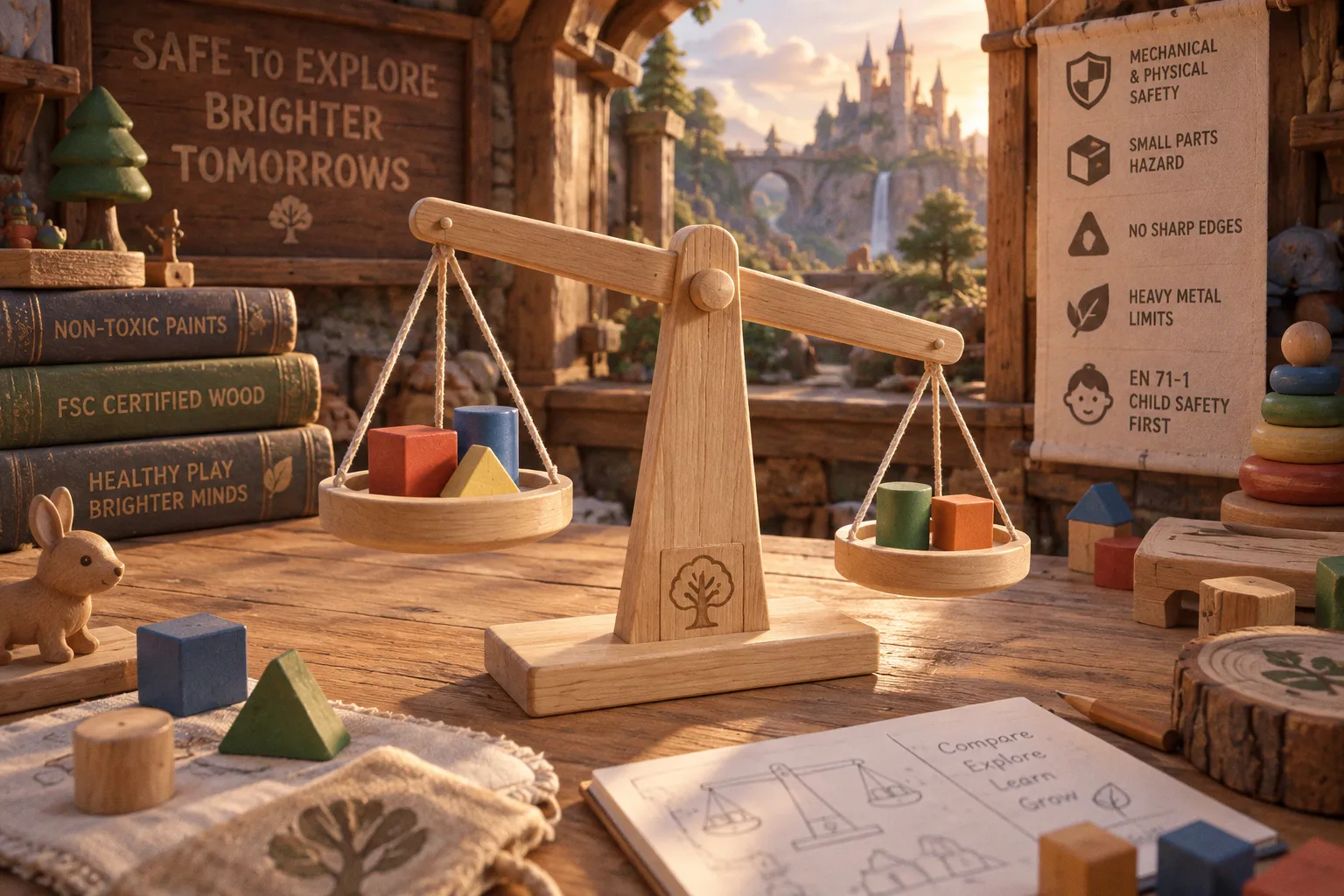
Those experiences can become a useful foundation for early mathematical thinking — but only when the product is designed for the child’s stage and intended to be used as an exploratory tool rather than a miniature laboratory instrument.
The difficulty is that products sold under the same name can serve very different purposes. One may be a sturdy qualitative toy for comparing heavier and lighter objects. Another may be a math balance scale for kids, with marked increments and removable weights intended for early equations. A third may be little more than a decorative wooden object with pans that look convincing in photographs but do not move evenly in use. The differences between a well-engineered educational instrument and a desk ornament are not always visible on a product page.
Before buying a wooden balance scale for toddlers, start with the safety framework, then consider what the scale is supposed to teach, how its moving parts are attached, and whether the material claims are specific enough to mean anything.
Navigating Safety Standards: EN 71 and ASTM F963 Compliance
Safety standards are the first checkpoint, but they should be described accurately. EN 71 is a European series of toy-safety standards, while ASTM F963 is a US toy-safety standard. Neither is a regulatory body. Their legal significance depends on the market in which the product is sold and on the applicable national or regional rules. A reference to one of these standards is therefore useful evidence about the product’s testing framework, but it is not, by itself, a universal guarantee of safety in every jurisdiction.
The standards address overlapping categories of risk, including mechanical and physical hazards, flammability, and the migration of certain elements from accessible materials. The relevant requirements for a balance scale depend on the complete design: the child’s age grade, the dimensions and accessibility of parts, the presence of cords or chains, the way components are attached, and the materials used on surfaces the child can touch.
EN 71 is divided into several parts. EN 71-1 covers mechanical and physical properties. For a wooden balance scale, that can bring attention to sharp points and edges, structural durability, accessible small parts, and the design of cords or suspension elements. EN 71-2 concerns flammability. EN 71-3 addresses the migration of certain elements from materials such as paints, coatings, and other accessible components.
A cord does not automatically make a toy non-compliant, and a removable weight does not automatically establish a violation. The question is how the specific feature performs under the relevant tests and whether it is appropriate for the stated age grade. A suspension cord may be acceptable in one design and require a different treatment in another. A weight may be considered a small part depending on its dimensions, accessibility, and the age category for which the product is intended. Product-specific testing, not the mere presence of a feature, determines compliance.
ASTM F963 covers comparable areas for products placed on the US market, using its own terminology and test methods. It addresses hazards such as sharp points and edges, impact and durability, small parts, accessible materials, and other physical or chemical risks. In both systems, the practical question for a buyer is not whether a product looks simple, but whether the complete toy has been assessed as a complete toy.
EN 71 and ASTM F963 are testing frameworks, not badges of universal quality. What matters is the applicable standard, the product’s age grading, and evidence that the actual design was assessed.
A product listing that says only meets safety standards gives the buyer very little to work with. More useful documentation identifies the relevant standard, the market for which the product was assessed, the manufacturer or responsible economic operator, and the recommended age range. Packaging or instructions may contain information that is absent from a retailer’s page, so the absence of a visible reference online is not conclusive proof that the product has not been tested. It is, however, a reason to ask for clarification before buying.
The standards most relevant to this type of toy can be understood broadly as follows:
| Standard or part | General relevance | What a buyer should keep in mind |
|---|---|---|
| EN 71-1 | Mechanical and physical properties | The result depends on the toy’s complete construction, accessible parts, cords, edges, and age grading |
| EN 71-2 | Flammability | Applies to the materials and design covered by the standard; it is not a general statement about every finish |
| EN 71-3 | Migration of certain elements | Relevant to accessible paints, coatings, and other materials, subject to the applicable test conditions |
| ASTM F963 | US toy-safety requirements | Covers several physical, mechanical, and material hazards through US-specific requirements and test methods |
Qualitative Play vs. Quantitative Math: Defining the Scale’s Purpose
A major source of buyer confusion is the difference between two products that share the same visual form: the qualitative balance and the quantitative math balance.
A qualitative wooden balance scale is designed to make differences visible. Put an object in one pan and the beam tips. Add another object and the relationship changes. The child begins to notice heavier and lighter, equal and unequal, more and less. The scale may be balanced accurately enough for this comparison without being calibrated for repeatable measurement.
Many educational sets, including products such as the TTS Discovery Wooden Scales, belong broadly to this category. They may include objects or weights that encourage sorting and comparison, but they are not necessarily precision instruments. They may have no graduated readout, no guaranteed standard mass for every counterweight, and no way to produce a measurement that should be treated as exact outside the activity for which the manufacturer designed it.
That is not a defect. For a young child, the physical relationship can be more valuable than a numerical result. The scale turns an abstract comparison into something visible: one side rises, the other falls, and the child can change the outcome by adding or removing an object.
A quantitative math balance is a different tool. It may include marked positions, standardized counterweights, numbered elements, or a beam that supports structured arithmetic tasks. The objective is no longer only to observe which side is heavier. The child may use the device to represent addition, subtraction, equivalence, or an unknown quantity. This type of math balance scale for kids is generally more appropriate when the child is ready to coordinate the physical model with symbolic numbers.
A qualitative scale makes comparison visible. A quantitative scale connects comparison to a number. The two experiences overlap, but they are not interchangeable.
The product description often reveals which category you are looking at. Words such as exploration, balance, compare, sort, and discover usually point toward qualitative play. Words such as measure, equation, numbered weights, increments, and arithmetic suggest a more structured quantitative activity. Neither vocabulary is automatically better; it simply indicates a different learning objective.
The purchasing mistake is to expect a qualitative scale to perform like a calibrated weighing instrument. If the pans respond to uneven loads but do not return to exactly the same position every time, that may be entirely acceptable for exploratory play. It becomes a problem only if the product is marketed as a precise measuring device or if the lack of repeatability prevents the activity from working as intended.
Montessori settings make this distinction especially visible. Early sensorial work may focus on discriminating differences in weight and organizing objects by a perceptible property. Later mathematical work can use concrete materials to represent numerical relationships. A Montessori wooden balance scale should therefore be selected for the prepared environment and the intended activity, not simply because it is made from wood or carries a Montessori label.
Before buying, ask three practical questions:
1. Is the child meant to observe a physical difference or calculate a numerical one?
2. Does the set include large comparison objects, detachable weights, numbered pieces, or a marked beam?
3. Can the child use the mechanism without the apparatus becoming more complicated than the concept?
A product can be developmentally useful without being sophisticated. For a toddler, the best balance may be the one that makes the consequence of every action immediately clear.
Structural Integrity: Evaluating Pan Attachments and Cord Safety
Once the scale’s purpose is clear, examine how it is built. The central beam, pivot, pan attachments, and any included weights determine whether the toy will remain useful after repeated handling.
The common design choices are rigid pan attachments and flexible suspension systems. A rigid design may use rods, dowels, hooks, or molded supports connected directly to the beam. A flexible design may suspend the pans on cords, chains, or several short connecting elements. Each arrangement has its own mechanical behavior.
Rigid attachments can reduce swinging and make the scale easier for a very young child to load. They also transfer sideways force directly into the joint. Toddlers rarely place an object gently in the center of a pan every time; they push, pull, lift, and test the limits of the object. A joint that looks stable under vertical loading may loosen when it is repeatedly exposed to lateral pressure. Press-fit parts are not automatically poor, but the connection should not wobble noticeably or separate during ordinary handling.
Flexible suspensions can give the scale a clearer visual movement and may make the balancing action more intuitive. At the same time, cords and chains introduce additional questions. Their length, attachment, accessibility, and ability to form loops are relevant to the applicable safety assessment and age grade. The presence of a cord is not an automatic failure, but a long or poorly secured cord can change the hazard profile of the product. This is precisely why the complete construction must be evaluated rather than judged by a single feature in isolation.
The same principle applies to detachable weights. A small weight is not automatically prohibited, and a large weight is not automatically safe. Its dimensions, shape, accessibility, material, and the manufacturer’s stated age grade all matter. If a product includes pieces that a young child can remove and place in the mouth, the age recommendation deserves particular attention.
When inspecting the product, look for the following:
1. Pan-to-beam stability — The pans should remain securely attached during normal loading and unloading. Excessive play, visible gaps, or a joint that shifts under light handling suggest weak construction.
2. Pivot behavior — The beam should move freely rather than scrape, jam, or require force to tip. A pivot that binds can make a simple comparison activity frustrating and can place unnecessary stress on the frame.
3. Cord or chain attachment — Suspension elements should be properly secured at both ends. Look for loose knots, exposed sharp hardware, crimped parts that can pull free, or decorative connectors that serve no structural purpose.
4. Accessible small components — Inspect screws, hooks, caps, beads, and removable weights, especially when the toy is intended for a child close to the lower end of the stated age range.
5. Pan and frame edges — The rim of a pan is frequently grasped. It should feel smooth, without splinters, sharp corners, lifted fibers, or rough patches in the finish.
6. Base stability — A scale that is easy to tip over may still function mechanically, but it is less suitable for independent play on a child’s shelf or table.
A product can pass a formal safety assessment and still be disappointing as an educational tool if the beam sticks or the pans hang unevenly. Safety compliance and good play value are related, but they are not the same evaluation.
Material Transparency: FSC-Certified Wood and Non-Toxic Finishes
Material claims are useful only when they are specific. FSC certification, for example, concerns the sourcing and chain of custody of forest-based materials. It does not automatically describe the paint, varnish, adhesive, dye, metal fittings, or plastic components used in the finished toy. A product can have responsibly sourced wood while still requiring separate scrutiny of its coatings and construction materials.
The same caution applies to the phrase non-toxic. It is a broad marketing expression unless the manufacturer explains what it refers to and supports it with relevant compliance information. For a toy that a toddler will handle repeatedly, the important questions include which surfaces are painted, how the finish was tested, whether the finish is likely to flake under ordinary use, and whether the manufacturer identifies the applicable toy-safety requirements.
Water-based paints and coatings are common in educational wooden toys and typically have lower VOC emissions during application than many solvent-based systems. That can be a meaningful advantage for manufacturing conditions and indoor use. It does not mean that every water-based finish is automatically safer in every respect, nor does it guarantee superior resistance to abrasion, moisture, or chipping. Durability depends on the complete formulation, the preparation of the wood, the number and thickness of coats, curing, and how the toy is used.
A solvent-based finish is not automatically unacceptable either. The relevant issue is whether the finished product complies with applicable requirements and whether the manufacturer provides clear information about the materials and testing. Avoid turning finish chemistry into a shortcut for judging the whole toy.
A material label is a starting point, not a test result. The useful question is what the manufacturer can document about the finished product.
For a balance scale, material transparency usually involves several separate points:
- Wood source — Look for a specific FSC reference or another identifiable sourcing claim rather than relying on general language about natural or sustainable wood.
- Surface finish — Identify whether the product uses paint, lacquer, oil, wax, or another coating. A water-based finish may reduce VOC emissions, but its wear resistance still depends on the formulation and application.
- Adhesives and composite parts — If the toy uses laminated wood, fiberboard, or joined components, the manufacturer should provide relevant material information instead of implying that solid-looking wood means every part is solid timber.
- Painted and coated surfaces — Confirm that the manufacturer addresses the applicable requirements for accessible coatings, including relevant migration testing where required.
- Condition after use — A finish should remain intact under ordinary handling. Peeling, powdering, or exposed splinters are reasons to remove the toy from play, regardless of the original marketing claims.
FSC certification and a non-toxic finish claim answer different questions. One concerns material sourcing; the other concerns the composition and safety of the coating. Neither replaces product-level safety information.
Age-Appropriate Design: Matching Complexity to Developmental Milestones
Age grading is not just a suggestion about when a child might find a toy interesting. It can reflect small-parts risk, the design of the mechanism, the amount of force required, the level of fine-motor control expected, and the cognitive complexity of the activity.
Balance scales commonly fall into several broad design patterns, although the exact age range must come from the manufacturer’s instructions and the applicable safety assessment.
- Early toddler designs often use large, simple components and may avoid separate counterweights. The activity is primarily cause and effect: the child places an object in a pan and observes the beam move.
- Preschool qualitative designs may include several removable pieces for sorting, comparing, and creating approximate equilibrium. The child must coordinate grasp, release, observation, and repeated adjustment.
- Older preschool and early school designs may introduce numbered weights, marked positions, or simple equations. Here the physical balance becomes a model for numerical relationships rather than an end in itself.
These categories are not rigid developmental laws. Children acquire motor and reasoning skills at different rates, and a product’s actual design matters more than an age label viewed in isolation. Still, the distinction helps explain why a scale that is engaging for one child can be confusing or frustrating for another.
For a child in the early toddler period, a large pan and a visible beam movement may be enough. The child does not need to understand the word weight or produce a stable comparison to benefit from watching an action produce a physical result. At this stage, the adult’s role is often to name the relationship without turning the activity into a lesson: heavier, lighter, up, down, same.
As fine-motor control develops, separate pieces can add a more deliberate challenge. The child may sort objects, place one item in each pan, remove pieces, and notice that the balance changes when the load changes. If the weights are too small or the pans too difficult to load, the motor demand can dominate the activity. The child ends up concentrating on not dropping the pieces rather than comparing quantities.
With greater numerical readiness, the scale can support structured reasoning. A child may explore how two smaller weights relate to one larger one, or use the beam to make an equation physically visible. At this point, numbered or standardized pieces can be helpful, but only if their values are clear and the balance behaves consistently enough for the activity to make sense.
The best age match is not the most advanced-looking product. It is the scale whose mechanism lets the child notice the intended relationship without fighting the toy.
When comparing a product with the child’s abilities, consider:
- Can the child grasp and release every included piece safely?
- Are the removable components large enough for the stated age grade?
- Does the child understand the visual result of adding or removing an object?
- Is the beam movement clear, or does it require precise loading that the child cannot yet manage?
- Will the product remain interesting after the first cause-and-effect discovery?
- Does the manufacturer’s age recommendation match the actual components, not just the educational ambition of the product description?
Adult supervision remains particularly important when a set includes separate weights, cords, chains, or other detachable elements. Supervision does not replace appropriate age grading, but it allows the adult to notice whether the child is using the toy as intended and whether any component has become damaged.
Making the Decision
The purchasing decision does not require a perfect product page or a laboratory vocabulary. It requires separating the questions that are often bundled together under words such as educational, Montessori, natural, and safe.
Start with the safety information. Determine which standard or regulatory framework applies to the market where the toy will be sold, and look for product-specific documentation rather than a vague promise. Treat EN 71 and ASTM F963 as relevant safety standards, not as regulatory bodies or universal quality seals. If the product includes cords, chains, or removable weights, assess the complete design and age grade rather than assuming that one feature automatically passes or fails.
Then establish the scale’s purpose. A qualitative wooden balance scale for toddlers can be excellent for heavier-and-lighter comparisons without offering precise measurement. A quantitative balance is more appropriate when the goal is to connect physical balancing with numbers and equations. The distinction prevents a good exploratory toy from being judged as a defective measuring instrument.
Next, inspect the construction. Pans should remain attached, the beam should pivot without binding, the base should resist tipping, and exposed edges should be smooth. Flexible suspension parts need secure attachment and an age-appropriate design. Small weights need to be considered in relation to the child’s age and the applicable small-parts requirements.
Finally, separate sourcing claims from finish claims. FSC certification can tell you something about the wood’s origin. It does not answer questions about paint, lacquer, adhesive, or durability. Water-based coatings often have lower VOC emissions than many solvent-based alternatives, but their resistance to wear depends on the particular product. A specific description of the finish and relevant testing is more useful than a blanket claim that the toy is non-toxic.
A well-chosen balance scale does not need to do everything. It does need to do one thing clearly: turn a physical relationship into an experience the child can see, repeat, and gradually understand. For toddlers, that may be the simple movement of a pan. For an older child, it may be the beginning of an equation. The responsible purchase is the one that matches the mechanism, materials, safety information, and level of complexity to that actual purpose.