Wooden board game storage: space-saving tips for playrooms
A compact playroom rarely has a pure storage problem. It has a geometry problem. Boxes compete with the table, the chairs need room to move, and the games that are easiest for children to reach are often the ones that end up scattered across the floor.
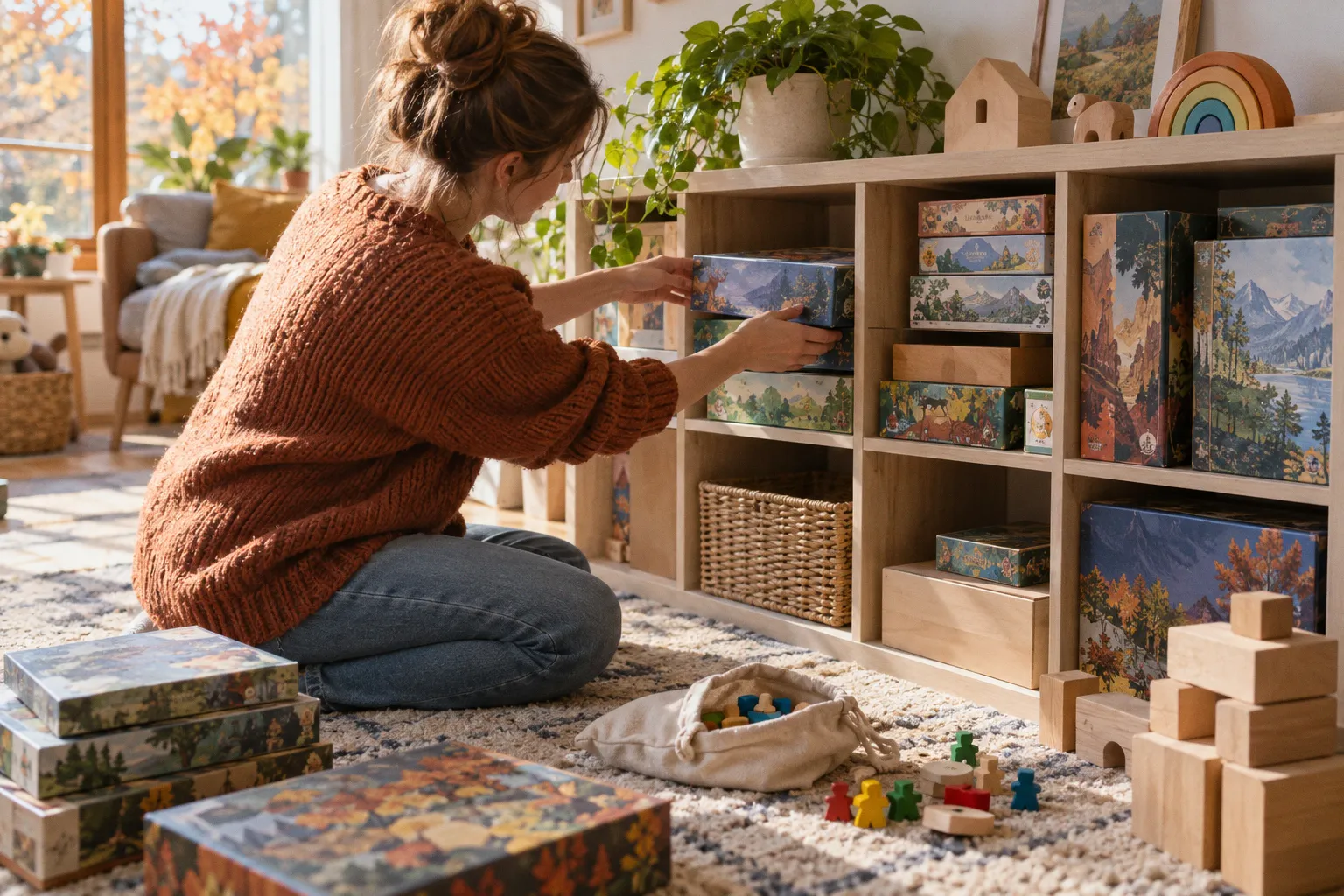
Wooden board games make the arrangement less forgiving: solid tiles, chunky pawns, peg boards, and thick puzzle pieces need more protection than a deck of cards in a slim box.
The most effective wooden board game storage solutions for small spaces do not depend on one perfect cabinet. They come from matching the collection to the room: using vertical space where the packaging allows it, separating oversized boxes from compact games, and keeping the route between shelf and play surface clear.
Mastering Vertical Storage for Board Game Longevity
Vertical storage is usually the most efficient starting point for organizing kids board games. A box stored upright can be removed without lifting several others first, and the shelf remains usable even when the collection grows unevenly. This is especially valuable in a family room where a game may be chosen, returned, and chosen again several times in one afternoon.
That said, upright storage is not automatically suitable for every box. The decision depends on how the lid closes and how the components are held inside. A box with a loose lid, a shallow tray, or small pieces that are only loosely contained may need a fabric band, an internal bag, or a horizontal position. The practical rule is simple: open the box, tilt it carefully, and check whether the contents stay in their assigned compartments before making vertical filing the default.
For most ordinary game boxes, vertical placement offers three everyday advantages:
- Easier retrieval. One box can come out without disturbing the rest of the shelf. This reduces the temptation to leave a stack half dismantled after a game has been chosen.
- Clearer inventory. The spines or long edges form a visible row, making it easier for children to recognize familiar games and return them to the right place.
- Less shelf congestion. A row of upright boxes generally makes better use of a cube or open shelf than a pile that leaves a large unused gap above it.
The important distinction is between a box standing securely and a box leaning under pressure. A row should be supported by a shelf divider, bookend, or neighboring box. If the final box in the row tilts sharply, the whole group becomes harder to remove and the lid can rub against adjacent packaging. Adjustable dividers are useful here because a small game should not be left sliding around in a space designed for a much larger one.
When horizontal storage is the better choice
Horizontal storage still has a legitimate place in a playroom. Use it for boxes with fragile inserts, loose-fitting lids, heavy wooden boards, or unusual proportions. Some educational games include a fitted tray that only works correctly when the box rests on one particular face. Others have a lid that is not deep enough to hold the contents securely when the box is turned on its side.
Large boards and boxed wooden puzzles also often behave better when stored flat, provided they are not buried under a heavy stack. The aim is not to impose one orientation on every item; it is to prevent the packaging from being used in a way that makes opening, closing, or carrying awkward.
Before filing a game upright, check four things:
1. The lid remains aligned with the base when the box is moved.
2. Bags or trays keep small parts from falling into the lid space.
3. The box does not bow when it is lightly supported by neighboring boxes.
4. Children can remove it without pulling at the lid or tipping the entire row.
The best orientation is the one that keeps the components contained and makes the next retrieval uncomplicated.
For children’s games, retrieval friction is not a minor detail. If a box is difficult to remove, it is more likely to be left out. If returning it requires rebuilding a precarious stack, cleanup becomes an adult-only task. Good storage makes the correct action the easiest one.
Optimizing Shelf Real Estate with Modular Cubic Systems
Modular cube shelving works well in playrooms because it can accept different storage methods without requiring a full furniture change. A cube can hold a vertical row of smaller boxes, a single large game, a basket of loose pieces, or a stack of puzzles. The same flexibility also creates a common problem: shelves become inefficient when every cube is filled without considering the dimensions of the collection.
The familiar 33 cm cube format is a useful planning reference, not a universal rule. Many cube units use a similar internal scale, but actual clearances vary by manufacturer, back panel, trim, and shelf thickness. Measure the opening inside the unit rather than relying only on the advertised external dimensions. A few centimeters can determine whether a box slides out comfortably or catches at the front edge.
A practical sequence is:
1. Measure the shelving first. Record the clear width, height, and depth of one usable compartment.
2. Measure the largest boxes. Oversized packaging should influence the layout before the small games are assigned to every available cube.
3. Group the collection by footprint. Separate compact card games, standard square boxes, tall educational sets, puzzles, and unusually long packages.
4. Reserve difficult spaces. A low cube may be ideal for a heavy wooden game; a higher one may be better for light puzzles or decorative storage.
5. Leave a little working clearance. A box that fits exactly may still be unpleasant to remove, especially when a child is reaching from the side.
A simple planning table can prevent a great deal of rearranging:
| Box type | Typical storage challenge | Useful arrangement | What to watch |
|---|---|---|---|
| Small card or travel games | Several boxes disappear in a deep shelf | Group in a shallow basket or file in a small row | Keep each game in its own labeled container |
| Standard square boxes | Easy to stack, but lower games become inaccessible | Store upright where the lid and insert allow it | Prevent leaning and excessive compression |
| Large educational sets | Heavy contents and irregular trays | Give each set a dedicated shelf or cube | Place low enough for safe lifting |
| Wooden puzzles | Flat pieces and varied box shapes | Stack lightly or use a wide drawer-style bin | Avoid crushing corners and mixing similar pieces |
| Oversized or long boxes | Do not fit efficiently in standard cubes | Use a larger shelf or a dedicated vertical section | Do not force them into a bent or unstable position |
The exact capacity of a unit will always depend on the collection. A cube filled with slim card games may hold many more items than a cube occupied by one thick wooden activity set. Treat capacity estimates as planning ranges rather than promises. The useful question is not how many boxes technically fit, but how many can be removed and returned without disturbing the rest.
Making cube shelving work for children
Adult-friendly storage often prioritizes maximum density. Children need a different balance. The most-used games should be visible and reachable, with no need to climb, pull at a heavy door, or move a row of unrelated boxes. Less frequently used items can occupy higher compartments, but avoid placing heavy wooden sets above shoulder height.
Open cubes can be divided into zones:
- Daily play: familiar games and simple puzzles at child height.
- Shared play: games that need an adult for setup or contain many small pieces.
- Reserve storage: seasonal activities, duplicate sets, and boxes used less often.
- Loose-piece station: a small, clearly contained area for sorting components after play.
A shelf insert or narrow basket can turn one tall compartment into two more manageable levels. It is better to add a stable insert than to create a tall pile that collapses when the bottom box is pulled out. For younger children, handles and soft-sided bins may be more practical than tightly packed shelves, even if they hold slightly fewer games.
Alternative Container Strategies for Bulky Packaging
Some games occupy far more shelf volume than their components require. A large box may contain a folded board, a rulebook, a deck of cards, and a handful of wooden tokens. That does not mean the original packaging is useless. It may protect the board, preserve the artwork, and keep setup information with the game. But in a small room, retaining every box at full size can make the collection difficult to access.
The safest approach is selective repacking rather than a complete conversion. Keep original boxes for games that are frequently gifted, collected, unusually fragile, or dependent on a fitted insert. Consider an alternative container for games whose packaging is damaged, excessively bulky, or already failing to keep the components together.
Three useful container types
Clear zipper pouches work well for card-heavy games and small travel sets. They make the contents visible and compress closer to the actual volume of the game. Use one pouch per game, and include the title, a short setup note, and any small reference cards that might otherwise be mistaken for spare pieces.
Mesh bags are useful when visibility and airflow matter more than rigid protection. They can hold chunky wooden pieces, fabric accessories, or large tokens that are awkward in a narrow plastic pouch. They are not ideal for games with many tiny parts unless the closure is secure and the bag is placed inside a larger bin.
Rigid craft cases provide better separation for sets with multiple types of components. Adjustable dividers can keep pawns, tiles, dice, and counters from becoming one mixed layer. The divisions should not be so tight that wooden pieces are forced against the lid when it closes.
There are also simple hybrid solutions. Keep the original board and rulebook in a shallow document sleeve, while placing the smaller pieces in a labeled case beside it. Store the case and the sleeve together in a single basket. This reduces the footprint without separating the information needed to play.
Before removing anything from its original packaging, preserve the parts that are easy to lose:
- the game title and age guidance;
- the setup diagram or illustrated instructions;
- special tokens that look similar to ordinary pieces;
- spare components and blank pieces;
- the original box dimensions, if resale or gifting may matter later.
A photograph of the open box can be enough to preserve an unfamiliar setup. For a frequently played educational game, a short handwritten note may be more useful than a perfect digital archive: number of bags, location of the rulebook, and the order in which the tray is packed.
Repacking should reduce bulk without turning the game into a sorting project at the start of every play session.
The one-container-per-game rule remains the most reliable. Combining several games because they use similar wooden pieces may appear efficient, but it transfers the work from storage to setup. A child looking for one matching board should not have to empty a mixed box of tiles, pawns, and cards from three different games.
Labels that support independent cleanup
A label does not need to be elaborate. A large title, a simple color mark, or a small picture can help a child identify the right container. If the original box is kept elsewhere, place the same label on both the container and the shelf location.
For pre-readers, color coding is particularly useful, but it should not be the only system. Colors fade, and similar shades are easy to confuse. Pair a color with a symbol or a photograph of the game contents. The aim is recognition, not cataloguing for its own sake.
Planning Your Playroom Layout for Better Traffic Flow
A storage unit can hold every game in the room and still fail if the play area is difficult to use. The route from shelf to table should be wide enough for a child carrying a box with both hands and an adult helping from behind. Chairs also need space to move without striking the shelving or catching on a basket.
A planning clearance of roughly 30 to 36 inches, or about 76 to 91 cm, around the active sides of a table is a useful starting point for many rooms. It is not a fixed safety standard for every layout. The required space changes with chair size, door swings, mobility needs, and whether children play on the floor rather than at a table. Marking the intended furniture footprints with tape before moving the shelves is often more informative than judging from an empty room.
Two arrangements are particularly practical.
Linear storage against one wall
Placing the main shelving along one wall leaves the center of the room available for a table, floor mat, or temporary building area. It also creates a clear visual boundary between storage and play. This arrangement works best when the shelf does not block a radiator, window opening, or frequently used door.
The route to the games is short, but the front of the shelving needs to remain open. A cube unit that is technically shallow can still make the room feel tight if a chair or toy basket is always parked in front of it. Marking a permanent “no parking” zone helps preserve access.
Corner storage with an opposing play zone
Corner placement can reclaim the center of a narrow or irregular room. It is useful when one wall is interrupted by a door, built-in cabinet, or window. The compromise is that the distance between storage and table may increase, and diagonal routes can become awkward when several children are carrying boxes at once.
This layout benefits from a smaller secondary basket near the table. The basket can hold the game currently in use, pencils, timers, or sorting trays, while the main collection remains in the corner. It should be a temporary landing place rather than a second permanent storage system. Otherwise, the room develops two inventories and nobody knows where a game belongs.
Put weight and frequency at child height
The lowest accessible shelves are usually the best place for heavier wooden games. Children can lift them with less risk, and a dropped box has less distance to travel. The same area can hold games that are used often, provided the boxes are not so heavy that they become difficult to control.
Higher shelves are better for light puzzles, spare materials, and activities that require adult supervision. Do not use high storage as a solution for a box that is too large or too heavy for the lower shelf. A child may still try to retrieve it, especially if the game is visible.
Flooring affects the layout as well. Hard surfaces make lost pieces easier to spot and sweep, but a dropped wooden component can be noisy and may chip at a sharp edge. Carpet softens falls but can hide small parts. A shallow tray or washable mat beneath the play table creates a defined search area without turning the entire room into a storage surface.
Maintaining Wooden Game Components in Compact Spaces
Wooden pieces are durable, but durability is not the same as immunity. Their condition is influenced by moisture, heat, friction, dirt, and the way they are packed. Compact rooms can intensify all of these problems because storage is often placed against an exterior wall, close to a radiator, or inside a closed cabinet with little air movement.
Control the storage environment
Avoid placing wooden games where they are exposed to repeated swings in temperature or humidity. Areas directly beside heating vents, damp walls, poorly ventilated closets, and unheated storage rooms deserve particular caution. The goal is a stable, ordinary indoor environment rather than a perfectly controlled one.
A small hygrometer can help identify a problem area, especially in a playroom that changes significantly between seasons. If a box feels damp, smells musty, or shows signs of condensation, move it away from the wall and inspect the contents before returning it to the collection. Do not seal moisture inside a plastic container.
Keep storage slightly raised from the floor in rooms where spills, mopping water, or dampness are possible. A shelf base, legs, or a low cabinet plinth provides a useful buffer. This is as much about protecting cardboard boxes and printed boards as it is about protecting the wood itself.
Pack components so they do not rub unnecessarily
Wooden tiles and pawns generally do not need elaborate preservation treatment. They do need enough room to avoid being forced against one another or trapped under a heavy stack. Store them in fabric or paper bags when the original packaging provides them, and replace split bags before pieces begin escaping into the box.
For painted or printed pieces, avoid prolonged contact with damp materials, adhesive tape, rubber bands, or labels placed directly on the finish. A soft divider or separate compartment is preferable to a tight elastic bundle. If pieces are dusty, wipe them with a dry or barely damp cloth and allow them to dry fully before closing the box. Do not soak unfinished wood or apply household polish unless the manufacturer specifically recommends it.
Large wooden boards should lie flat when they are too heavy, flexible, or awkward to stand safely. Smaller boards can be filed with their game if they remain supported and do not bend against the lid. In either case, do not use the board as a shelf for several heavy boxes.
Give puzzles their own storage logic
Wooden puzzles vary widely. A thick tray puzzle, a jigsaw with a separate frame, and a set of loose geometric pieces should not be treated as one packaging category. Original boxes or trays are often useful because they identify the puzzle and keep its shape-specific pieces together. Removing the puzzle simply to make it fit a different shelf can create more handling and more opportunities for pieces to be misplaced.
If the original box is oversized or damaged, transfer the pieces to a flat, rigid container with enough room for them to lie without being forced. Keep the image, frame, or reference card with the pieces. For a puzzle with a fitted tray, protect the tray from bending and avoid stacking heavy items directly on top of it.
Do not assume that storing every puzzle in a single flat layer is necessary for long-term preservation. Light stacking can be acceptable when the containers are rigid, dry, and not overloaded. What matters is that pieces are not compressed, mixed with incompatible parts, or stored where the box can warp. If a puzzle has a delicate finish, add a clean sheet of paper or a thin divider rather than sealing the pieces tightly against another surface.
Inspect before putting a game away
A quick inspection after play prevents small problems from becoming storage problems:
- Check that the board and pieces are dry and free of food residue.
- Return small components to a closed bag or divided tray.
- Make sure the lid closes without forcing it.
- Look for bent boards, split bags, loose labels, or a tray that has shifted.
- Store the rulebook flat or in a position where its corners will not curl.
This is not a ceremonial end-of-game routine. It is a way to stop one missing token from becoming a mixed box, or one damp board from affecting the rest of a shelf.
Building a storage system that survives real play
The first arrangement is rarely the final one. A family’s collection changes: a toddler outgrows peg puzzles, a new wooden matching game arrives, and a favorite board game suddenly needs to be stored at the front rather than the back. Leave some flexibility in the system instead of filling every compartment to its absolute limit.
A useful working arrangement has three layers:
1. Visible access for current favorites. These games should be identifiable without opening several boxes.
2. Protected storage for complete but less frequent sets. Use higher shelves, closed bins, or less central cubes for these items.
3. A controlled overflow space. Keep one basket or shelf section available for new games, games awaiting repair, and pieces that need sorting.
That final category matters. Without an overflow space, damaged or incomplete games are pushed back into the main collection and become harder to identify. A small labeled repair container can hold a loose lid, a replacement bag, or a game waiting for a full component check. It should be reviewed regularly rather than allowed to become a permanent graveyard.
The most successful space saving game storage is not the arrangement with the highest theoretical capacity. It is the one that makes the collection easy to see, easy to carry, and easy to put away. Vertical storage can reduce unnecessary lifting; modular cubes can adapt to different box sizes; alternative containers can tame bulky packaging; and a sensible layout can keep games out of the traffic path.
Wooden game components need room to remain clean, dry, and supported, but they do not require a museum cabinet. Match the container to the pieces, keep heavy items low, preserve the information needed for setup, and resist the urge to compress every last gap. A little unused space is often what allows a child to return a game without damaging the box or scattering its contents.