Wooden Rainbow Stackers: Quality Markers to Inspect
A wooden rainbow stacker is a deceptively simple object. Seven to twelve concentric arches, nested by size, stacked by a child’s hand.
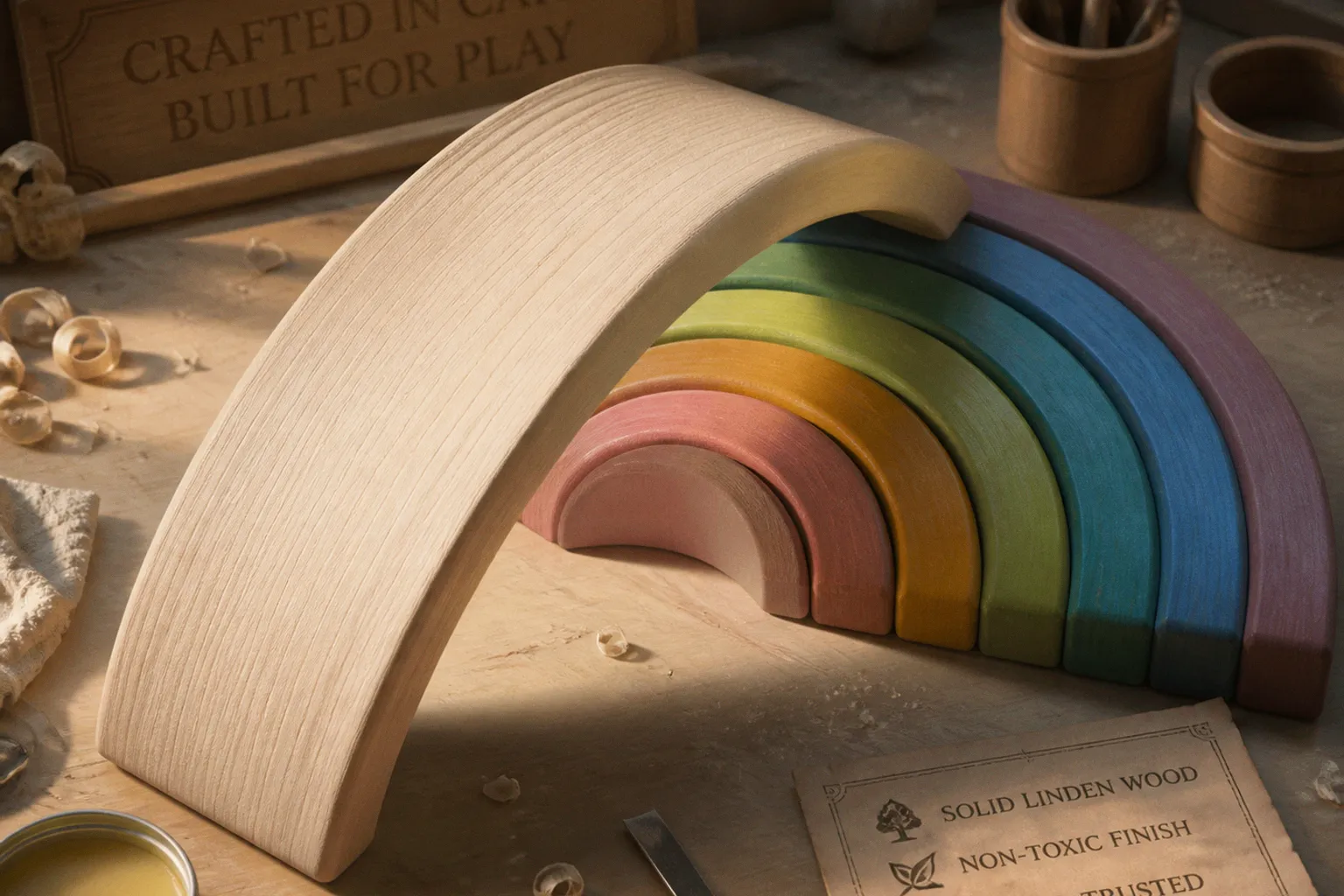
Yet beneath that apparent simplicity lies a cascade of material and manufacturing decisions that affects how the toy feels, how reliably it can be used, and how much freedom it gives to open-ended play.
A poorly made stacker is not merely disappointing. Uneven cuts, rough inner curves, unstable bases, or a finish that turns every arch into a slippery block can interfere with the very exploration the toy is meant to invite. The child is no longer testing balance or building a tunnel; they are compensating for defects in the object.
The difference between a quality rainbow stacker and a mediocre one begins with the timber and extends through the finish, cut precision, structural stability, and safety documentation. For parents, educators, and early childhood professionals sourcing these arch sets, the ability to distinguish genuine craftsmanship from surface-level aesthetics is not optional. It is the baseline competence required to make an informed purchase.
The Anatomy of a Quality Arch: Solid Wood vs. Plywood Construction
The most consequential material decision in a rainbow stacker’s construction is whether each arch is carved from a single piece of solid timber or cut from laminated plywood. The choice affects weight, edge behavior, resistance to impact, and the way the piece responds to repeated handling.
High-quality rainbow stackers are often made from solid linden wood, also called lime or basswood in different lumber traditions. Linden has a fine, relatively uniform grain and a workable surface that can be shaped without producing especially brittle edges. It also accepts colour evenly, which is one reason it is common in painted and stained wooden toys.
When an arch is carved from one block, the grain can run continuously through the curve. That continuity does not make the piece indestructible, but it avoids the exposed layer structure and glue lines found in laminated construction. A well-oriented piece of solid wood tends to feel coherent in the hand: its weight is distributed through the body of the arch rather than concentrated in a thin, light sheet.
Plywood has genuine advantages in many forms of furniture and construction. Its cross-grain layers can improve dimensional stability, and a carefully manufactured plywood toy can be safe and durable. The issue is not that plywood is automatically poor. The issue is how the curved arch has been cut and finished. On a small radius, the cut can expose multiple layers along the inner curve. If the edge is inadequately sealed or sanded, the layers may become visible, raised, or vulnerable to wear. A separated veneer or splintered edge is a different failure mode from ordinary surface wear.
Weight also matters, although it should not be confused with a guarantee of quality. A solid linden arch usually has more heft than a thin plywood arch of the same external dimensions. That weight gives the child clear tactile and proprioceptive feedback while lifting, rotating, balancing, and placing the piece. It also gives a partially built structure more stability. An unusually light arch may still be well made, but it deserves a closer look at its construction rather than an automatic quality pass.
What to inspect in the construction
1. Hold the arch and assess its weight. It should feel substantial for its size, not hollow or unexpectedly flimsy. Compare several pieces in the set: a sudden difference in weight can indicate inconsistent material or a repaired component.
2. Examine the cut ends and underside. Solid wood shows a continuous grain pattern. Plywood reveals alternating layers at the cross-section. Neither appearance is automatically disqualifying, but exposed layers should be cleanly finished and firmly bonded.
3. Look for glue seams. An arch assembled from two or more pieces may show a line along the inner or outer curve. A seam is not proof of an unsafe toy, but it is a point worth checking for lifting, gaps, or a change in level.
4. Run a fingertip—not a sharp tool—along the inner curve. The edge should be consistently smooth. Raised fibres, sharp transitions, and rough patches are more important than whether the surface looks perfectly uniform from a distance.
5. Inspect the ends for compression and dents. The feet of the largest arch receive repeated contact with the floor. Small cosmetic marks are normal; crushed fibres or a deep split indicate a structural concern.
A single-block arch with continuous grain is not automatically superior in every respect, but it removes one common source of weakness: exposed layers and glue joints running through a highly handled curved edge.
The phrase “linden versus pine” also needs some restraint. Linden is often chosen for its fine grain and workable surface, while pine can be perfectly serviceable when it is well selected, properly dried, and carefully finished. Pine tends to have more visible grain variation and resin channels, so knots and rough areas deserve particular attention. Species alone cannot certify a toy. The execution of the cut and finish is what determines whether the material works well in the finished object.
Why Texture Matters: The Role of Matte Stains in Open-Ended Play
The surface finish on a wooden rainbow stacker is not a decorative afterthought. It is the interface between the child’s hands and the wood. It affects grip, visual clarity, cleaning, and the way the arches behave when they are placed at an angle.
A rainbow stacker is not limited to the prescribed action of nesting the pieces from largest to smallest. Children turn arches upside down, offset them, use them as tunnels, build bridges, create enclosures, or balance one piece against another. These arrangements depend on friction. If the surface is too slick, even a carefully placed arch will slide as soon as the structure is slightly off-centre.
A matte or low-sheen surface usually gives the child more tactile information than a thick glossy coating. The point is not that matte automatically means safe, or that every glossy finish is unsuitable. The useful question is whether the coating is stable, evenly applied, and appropriate for a children’s product. A very smooth film can reduce friction and make open-ended constructions harder to control. A poorly cured or brittle film can chip and create a different problem.
Water-based stains and paints are common in children’s products, but “water-based” is not a complete safety assessment. It describes the carrier or formulation category, not the entire chemical profile of the finished toy. The relevant documentation should identify the applicable toy-safety requirements and the product’s intended age range.
EN71-3, specifically, concerns the migration of specified elements from toy materials under defined test conditions. It can support a claim about limits for those elements in the tested material. It does not, by itself, establish that a finish contains negligible volatile organic compounds, nor does it serve as a general certification for every aspect of a coating’s formulation. Those are separate claims requiring separate evidence.
A finish applied to a wooden toy should also remain firmly attached during ordinary use. Peeling, flaking, and powdering are not signs of an appealingly natural surface. They suggest poor adhesion, inadequate curing, or wear that has gone beyond the normal patina of a handled object.
Surface markers worth checking
- Visual: A matte or satin sheen is often more practical for balancing than a mirror-like gloss. The colour should be even, with no cloudy patches, pooled coating, or bare areas on the inner curve.
- Tactile: The arch should feel smooth without feeling plasticky or greasy. A fine, dry texture is generally more useful in open-ended play than a slick film.
- Edge condition: Pay special attention to the inner radius and the feet of each arch. These are areas where sanding and coating can be inconsistent.
- Finish adhesion: Rub the surface lightly with a clean fingertip. It should not leave pigment, dust, or a tacky residue. Do not scrape the toy to perform an improvised durability test.
- Odour: A strong persistent solvent-like smell is a reason to pause, especially if the seller provides no information about the finish or curing process. Odour alone cannot identify a chemical hazard, but it is a useful signal that the product deserves more documentation.
The best finish is not necessarily the one with the brightest colour. It is the one that stays attached, preserves enough grip for construction, allows the grain or form to remain legible, and is supported by credible product information.
Navigating Safety Standards: Understanding EN71 and ASTM F963 Compliance
Safety certification is a threshold, not a luxury feature. It does not tell you whether a toy is beautifully proportioned or pleasant to handle, but the absence of meaningful compliance information makes every other quality claim harder to trust.
The European toy-safety standard EN71 is divided into several parts. For a wooden rainbow stacker, the most relevant are usually:
- EN71-1, covering mechanical and physical properties, including hazards related to sharp edges, sharp points, small parts, and certain forms of structural failure.
- EN71-2, covering flammability.
- EN71-3, covering the migration of specified elements from toy materials under the conditions defined by the standard.
EN71-3 should be described precisely. It addresses the migration of specified elements, including elements such as lead, cadmium, chromium, and mercury where applicable under the standard’s test categories and limits. It does not substantiate a broad statement that a stain is low in volatile organic compounds. Nor does passing EN71-3 alone prove that the complete toy has passed every mechanical, flammability, labelling, or age-grade requirement.
The US framework includes ASTM F963, the Consumer Product Safety Improvement Act, and related requirements administered through the Consumer Product Safety Commission. ASTM F963 addresses a range of toy-safety hazards, including mechanical and physical properties and certain chemical requirements. The applicable requirements depend on the product, materials, construction, and intended age range.
The testing and certification process is also worth stating accurately. Accredited third-party laboratories conduct the required testing for covered children’s products. The manufacturer or importer is responsible for issuing the Children’s Product Certificate, commonly called the CPC, based on the applicable testing and compliance records. The laboratory does not issue the CPC on the manufacturer’s behalf. This distinction matters because a seller’s vague reference to a “lab certificate” is not the same thing as transparent evidence of the product’s compliance documentation.
For a buyer, the practical question is whether the product listing or packaging identifies specific standards and the responsible company. Claims such as “safe,” “non-toxic,” or “tested” are too broad to evaluate on their own. More useful information includes:
- the intended age grade;
- the market for which the product was tested;
- the applicable standard or regulation;
- the manufacturer or importer responsible for the product;
- clear information about the finish and materials;
- documentation that matches the actual product, rather than a generic certificate for an unrelated item.
A certificate is not a substitute for inspecting the physical toy. A product can be damaged in transit, altered after testing, or sold with incomplete instructions. Conversely, a beautifully made arch set without credible compliance information should not receive a free pass simply because its timber and finish look attractive.
FSC certification belongs to a different category. It concerns the sourcing and chain of custody of timber, not the mechanical safety or chemical compliance of the finished toy. It may be relevant to buyers who prioritise forest management and material traceability, but it should not be presented as evidence that the product meets EN71 or ASTM F963.
| Standard or label | Main scope | What it can tell you | What it does not establish on its own |
|---|---|---|---|
| EN71-1 | Mechanical and physical properties | Whether relevant mechanical hazards were assessed under the standard | That the finish has a particular VOC profile or that every aspect of the product is covered by one test |
| EN71-2 | Flammability | Whether the product was assessed against the standard’s flammability requirements | Structural quality, sourcing, or long-term durability |
| EN71-3 | Migration of specified elements | Whether specified elements migrated within applicable limits under defined test conditions | General chemical safety, VOC content, or full toy-safety compliance |
| ASTM F963 | US toy-safety specification | Assessment of covered toy-safety requirements for the relevant product and age grade | Compliance with every separate US legal requirement |
| CPSIA | US federal product requirements | Requirements concerning areas such as lead, phthalates, testing, and certification | A laboratory-issued CPC; the manufacturer or importer issues the CPC |
| FSC | Timber sourcing and chain of custody | Information about certified forest-product sourcing | Mechanical safety or chemical compliance of the toy |
Assessing Precision: Grain Continuity and Structural Stability
Beyond the material itself lies a more practical question: how accurately were the arches cut, sanded, and matched?
A rainbow stacker works because the pieces have a predictable relationship to one another. Each arch should nest inside the next with a consistent gap—close enough to make the size progression obvious, but open enough for a young child to separate the pieces without excessive force. If the gap changes dramatically from one side to the other, the child is not simply solving a size or balance problem. They are compensating for inconsistent geometry.
This does not mean every arch must be manufactured to engineering-equipment tolerances. Wooden toys have natural variation, and a small difference in grain or sanding is not a defect by itself. The concern is a repeated or visible lack of symmetry that changes how the set functions.
Grain continuity can help reveal the quality of the carving. Hold the largest arch under even natural light and look at the inner and outer curves. In a well-selected piece of solid wood, the grain generally flows without a sudden interruption, large knot, or exposed patch of end grain in a high-stress area. Grain direction does not need to follow the curve perfectly; timber is a natural material. But a severe change in direction, a deep knot, or a split along the curve deserves attention.
The base is equally important. Place each arch on a flat surface. It should rest without rocking, and both feet should make stable contact. A small irregularity may be harmless on a soft play mat, but an arch that rocks noticeably can destabilise a whole construction. It also gives the child misleading feedback: the structure may lean because of the cut rather than because of the child’s placement.
Four useful precision checks
1. Nest the complete set. Look at the gaps between adjacent arches. They should be broadly consistent rather than pinched on one side and wide on the other.
2. Check the inner curve. It should be smooth to the touch, with no sharp transition where the cutting tool changed direction or where sanding stopped.
3. Test the base on a flat surface. Press gently on each side. The arch should not rock between high points.
4. Compare the two ends. When the arch rests on its feet, the ends should appear close to the same height. Strong asymmetry can indicate an off-centre cut or uneven sanding.
Structural stability also includes the relationship between the size of the arch and its thickness. A very thin arch with a narrow inner radius may be more vulnerable to breakage than a broader, better-supported piece. This is particularly relevant in smaller novelty sets, where the manufacturer may reduce material to keep the overall product compact. The smallest pieces deserve the same inspection as the largest ones; their size does not make them exempt from rough edges or weak areas.
Age-Appropriate Sizing: Testing for Small Parts and Developmental Readiness
The final quality marker is dimensional: whether the smallest arch is suitable for the intended age range and whether the overall set gives the child a manageable progression of challenges.
For children under three, the critical issue is small-parts safety. A component that fits within the applicable small-parts test cylinder can present an ingestion or aspiration hazard. The same concern applies to a piece that is initially large enough but can break, detach, or shed a smaller fragment during foreseeable use.
With a rainbow stacker, the smallest arch is the obvious component to examine, but it is not the only one. Check for detachable paint chips, loose veneer, splintered edges, and fragments that could come away from a damaged curve. Product age grading should be based on the toy as supplied and on foreseeable play, not simply on the largest piece in the box.
A larger stacker is not automatically more developmentally advanced. A set with ten or twelve arches offers more size distinctions and more possible combinations, but it can also be visually and physically demanding for a very young child. A smaller set with fewer, clearly differentiated pieces may be easier to grasp, separate, and arrange. The right choice depends on the child’s current coordination, attention, and experience with construction toys.
The developmental progression is better understood as a range than as a rigid schedule:
- Around 12–18 months: Fewer, clearly different arches can support grasping, carrying, turning, and early size comparison. At this stage, the child may not follow a complete nesting sequence and does not need to.
- Around 18–30 months: The child may begin arranging pieces by size, placing one arch inside another, and experimenting with simple balance. Pieces should be easy to lift and separate without forcing a precise grip.
- Around 30 months and above: More arches can support longer sequences and more complicated constructions, including bridges, tunnels, enclosures, and asymmetrical arrangements. The toy still needs to remain physically manageable; complexity should come from the possibilities, not from excessive weight or awkward proportions.
Age labels should be read together with the physical design. If a seller markets a tiny set to toddlers but provides no small-parts information, no manufacturer details, and no credible safety documentation, the low price or attractive colour palette does not resolve the concern. Likewise, a set labelled for older children may be perfectly suitable for open-ended building but inappropriate for a younger child who still mouths objects.
The intended environment matters too. A wooden arch used in a nursery, playroom, or classroom may be handled by several children, dropped onto hard flooring, and mixed with other pieces. In that setting, edge durability and finish adhesion become more significant than they would be in occasional supervised play. A set that is acceptable for a careful older child may not be the right choice for a busy group environment.
Reading the Product as a Whole
No single marker proves that a wooden rainbow stacker is well made. Solid linden is useful, but species cannot compensate for a rough cut. A matte finish may improve grip, but a matte surface is not evidence of chemical compliance. A standards reference is valuable, but it must correspond to the actual product and the correct responsibility chain.
A more reliable assessment comes from looking for agreement between the claims and the physical object:
- The material description should match what is visible at the edges and cut ends.
- The finish should be even, stable, and appropriate for handling.
- The arches should nest without unexplained variations in gap or alignment.
- Each piece should sit securely without rocking.
- The smallest arch and any potentially detachable fragment should fit the stated age grade.
- Safety claims should name relevant standards accurately rather than using “non-toxic” as a catch-all phrase.
- EN71-3 claims should be limited to migration of specified elements, not extended to unsupported statements about VOCs.
- For US products, laboratory testing and the manufacturer’s or importer’s CPC should not be conflated.
The best rainbow stackers are not the ones with the loudest colours or the longest list of promises. They are the ones whose material, geometry, finish, and documentation tell the same story.
Closing Assessment
A wooden rainbow stacker that performs its developmental function is defined by a convergent set of decisions. Solid construction can provide useful weight and a coherent grain structure. Accurate curves and stable bases let the child explore balance without constantly fighting manufacturing errors. A well-adhered matte or low-sheen finish preserves tactile information and makes open-ended building more workable. Appropriate sizing protects younger users and keeps the challenge within reach.
The most important distinction is between appearance and evidence. A rainbow stacker can look charming in a product photograph while hiding rough inner edges, unstable feet, thin laminated layers, or vague safety claims. Conversely, a modestly finished set may be a stronger toy if its arches are carefully shaped, easy to handle, and supported by precise compliance information.
Inspect the timber, then the edges. Test the nesting, then the balance. Read the standards language closely, especially where a seller uses broad phrases such as “non-toxic” or “tested.” Quality is not one decorative feature; it is the point at which the child’s hands, the wood’s structure, the finish, and the manufacturer’s responsibility all hold together.