Wooden rocking horse stability: a safety checklist for parents
A wooden rocking horse can look reassuringly solid while hiding the failures that matter most: a loosened mortise-and-tenon joint, a runner that rocks unevenly, a finish that has begun to flake, or a…
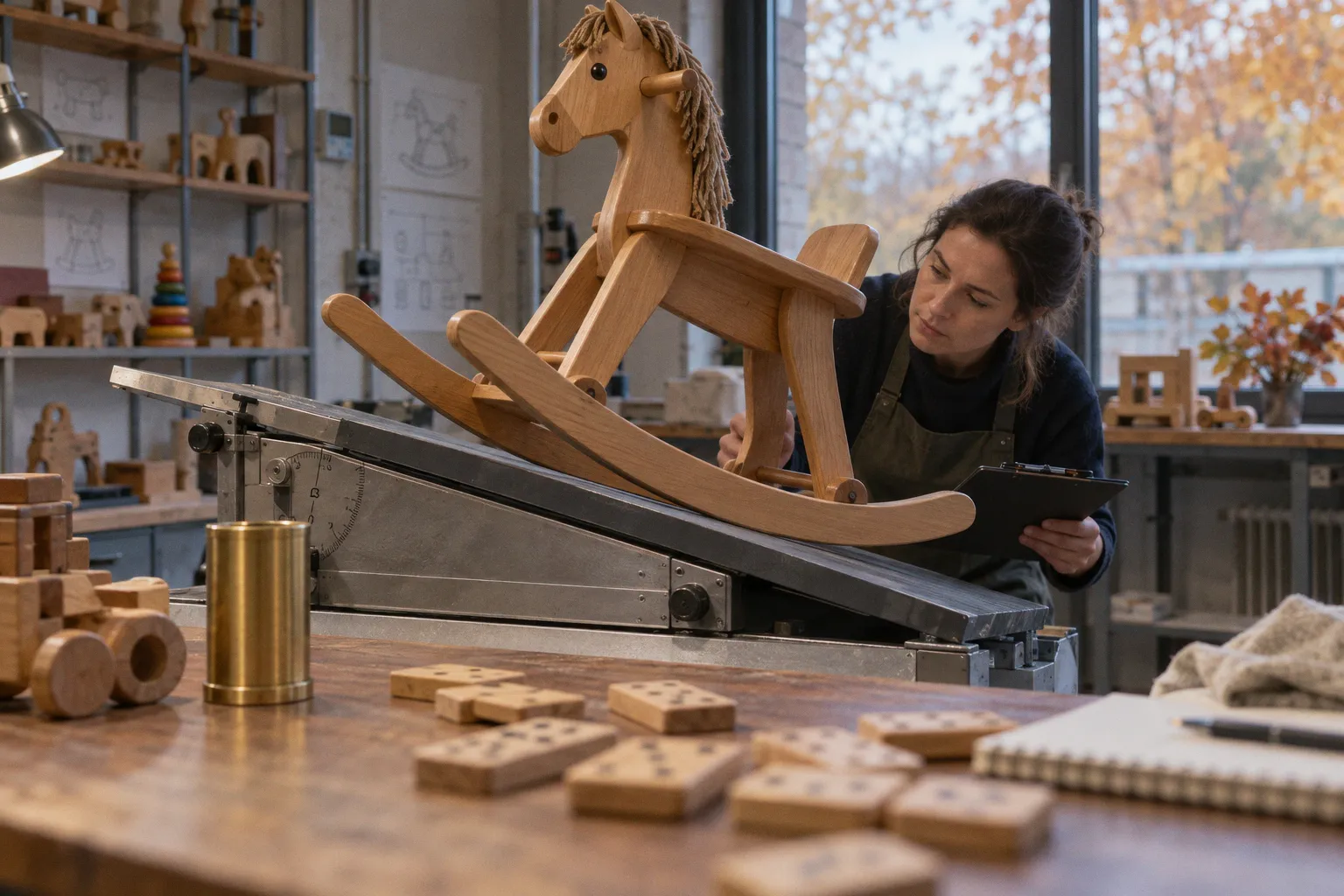
A wooden rocking horse can look reassuringly solid while hiding the failures that matter most: a loosened mortise-and-tenon joint, a runner that rocks unevenly, a finish that has begun to flake, or a decorative cord positioned exactly where a small child can pull it toward the neck. Wood is durable, but it is not automatically safe. Stability depends on geometry, joinery, surface treatment, and how the finished toy fits the child using it.
A proper handcrafted wooden rocking horse structural integrity check is therefore more than a quick glance at the paintwork. It is a practical inspection of the toy’s load-bearing structure, rocking motion, chemical exposure, and age-related wear. This is especially important for heirloom toys and antique wooden toys, which may have been stored in fluctuating humidity, repaired with unsuitable adhesives, or finished before current safety expectations were established.
Begin with the rocker base, not the decoration
The curved runners are the foundation of the toy. They control how far the rocking horse moves, how quickly it returns toward its center, and whether the horse remains supported when a child leans sideways. A beautifully carved body cannot compensate for a poorly balanced base.
Place the horse on a hard, level floor. Avoid beginning the inspection on a thick rug, where the fibers can conceal movement and make a weak runner appear stable. The horse should sit evenly, without one end lifting noticeably or one side carrying more of the weight.
Check the following:
- Both runners should make consistent contact with the floor along their intended curves.
- The horse should not twist when gentle pressure is applied to the head, saddle, or side.
- The rocking motion should be smooth rather than jerky, scraping, or abruptly stopping.
- The horse should return toward a stable resting position instead of drifting sideways.
- The runners should be aligned with each other and firmly attached to the body.
- There should be no cracks running across the grain at the points where the runners meet the upright supports.
A rocking horse runner balance test does not require force. Apply slow, controlled pressure from several directions and watch the base rather than the decorative body. If the horse shifts laterally, lifts a runner, or makes a sharp contact with the floor, stop using it until the cause is understood.
The curvature of the runners matters because excessive movement increases the chance of a fall, while an abrupt or restricted arc can throw the child forward. A typical maximum rocking angle is around 20 degrees, but an artisan-made toy may not have been tested to a standardized limit. Do not treat that figure as proof that an individual horse is safe. The practical question is whether the movement remains controlled under the child’s weight and normal changes in posture.
A rocking horse is stable only when its geometry, joinery, and child fit work together. “Made of solid wood” is not a stability assessment.
Inspect the structure where the load travels
The most important parts of a wooden rocking horse are often the least visible. Look closely at the connections between the runners, upright supports, body, neck, head, handles, and footrests. These areas absorb repeated movement and can loosen long before the wood itself appears damaged.
Traditional handcrafted rocking horses may use mortise-and-tenon joints, in which one shaped wooden component fits into a corresponding cavity. This type of joinery can be highly durable when accurately made and properly maintained. It should not, however, be treated as inherently superior simply because it is traditional. A poorly fitted joint can loosen; an adhesive repair can conceal movement; a metal fastener can corrode or pull through the wood.
Run through this sequence:
1. Hold the main body steady and test each connected part separately.
Gently move the head, neck, handles, saddle, footrests, and runners. Movement that belongs to the rocking action is different from a joint that flexes independently.
2. Look for gaps around the joints.
A fine, consistent seam may be part of the construction. A widening gap, lifted shoulder, or visible separation suggests that the joint is no longer transferring load evenly.
3. Check for cracks around drilled holes and fasteners.
Small cracks can spread when the toy is rocked repeatedly. Pay particular attention to areas where screws, bolts, or dowels enter end grain.
4. Examine repaired sections for incompatible materials.
Hardened filler, exposed glue, improvised brackets, and protruding screws are not neutral details. They may indicate a previous structural failure or create new impact and snagging hazards.
5. Repeat the inspection with the horse under light load.
A joint that appears firm when empty can open slightly when the child’s weight is applied. Use only a load within the maker’s stated limit; do not place a child on a toy with uncertain structural condition.
For parents carrying out a wooden rocking horse safety inspection, the distinction between cosmetic wear and mechanical wear is essential. Scratched paint is usually a surface issue. A runner that shifts in relation to the body is a structural issue. A faded finish may be unattractive. A split around a handle or footrest can affect the child’s grip and balance.
Common signs of joint failure
Take the horse out of service if you find:
- a clicking sound from a joint during rocking;
- a saddle, handle, or footrest that rotates independently;
- visible wood fibers separating around a connection;
- a runner that moves sideways under gentle pressure;
- a crack that continues from a joint into the surrounding timber;
- missing hardware or a fastener that no longer sits flush;
- glue lines that have opened enough to admit a fingernail.
Do not solve these problems with a general-purpose household adhesive and return the toy to play immediately. Structural repairs require an understanding of wood movement, joint design, clamping, and curing. A repair that looks tidy can still fail under repeated rocking.
Treat the finish as a safety surface
A wooden toy’s finish is not merely an aesthetic layer. It is the surface a child touches, mouths, scrapes with fingernails, and sometimes bites. A natural timber appearance tells you almost nothing about the chemistry used during manufacture or repair.
Paints and finishes may contain substances that require controlled testing, particularly when they can migrate from the surface. EN 71-3 addresses chemical migration, including restrictions involving toxic heavy metals such as lead and cadmium. ASTM F963 in the United States also forms part of the broader safety framework for toys, including mechanical and chemical requirements.
Look for evidence of:
- flaking or powdering paint;
- soft, sticky, or partially cured areas;
- exposed layers beneath a damaged finish;
- splinters along edges, handles, or the mouth;
- varnish cracking where the wood flexes;
- an unknown coating applied during a later home repair;
- strong persistent chemical odour.
A finish described as “natural,” “eco,” or “non-toxic” is not the same as a documented safety result. Likewise, “handcrafted” describes a production method, not chemical compliance. If the maker claims FSC-certified timber, that can provide information about responsible forest sourcing, but FSC certification alone does not confirm the safety of the paint, oil, varnish, adhesive, or surface treatment.
For an older or second-hand rocking horse, ask whether the finish is original and whether the toy has been repainted. A new coat can seal an old surface, but it can also introduce an unsuitable product or hide damage underneath. If the coating is unknown and deteriorating, keep the toy away from children until it has been assessed and, where necessary, professionally refinished with a documented child-safe system.
“Natural wood” describes the material’s appearance. It does not certify the finish, the adhesive, or the manufacturing process.
Remove cords and decorative strangulation hazards
Reins, ribbons, cords, loose straps, and long decorative elements deserve a separate inspection because they create a different category of risk from tipping or breakage. A child can pull, wrap, or become caught in a loose component even when the wooden body is structurally sound.
Loose reins and cords have been associated with product recalls when designs fail to meet safety expectations. Examine every flexible element for length, attachment, and tension. A rein that is firmly integrated into the design is not the same as a cord loosely tied around the neck or handle.
Remove the horse from use if:
- a rein can be pulled free by hand;
- a cord forms a loop large enough to pass around a child’s neck;
- decorative tassels or straps are fraying;
- a fastening point has split the surrounding wood;
- the material can become caught around the handle during rocking;
- a loose element is long enough to wrap around the child or the horse’s neck.
Do not add reins, bells, bags, reins made from ribbon, or other decorative accessories without considering how they behave during movement. A visually convincing restoration can make an heirloom toy less safe.
Match the toy to the child’s body
A stable rocking horse can still be unsuitable if the child cannot control it. Ergonomic fit is part of structural safety because a child who cannot reach the ground, footrests, or handles is more likely to slide, overbalance, or grip the wrong part of the toy.
The child’s legs should fit comfortably around the horse’s sides, with the feet able to reach the ground or designated footrests. The seat should not force the child too far forward or leave the torso unsupported. Handles should be reachable without the child stretching across the neck.
Consider the following before use:
- Can the child mount and dismount without climbing onto an unstable side?
- Are both feet supported in a natural position?
- Can the child hold the handles without leaning heavily over the head?
- Does the child’s weight remain within the manufacturer’s stated limit?
- Is the horse appropriate for the child’s age and coordination?
- Does the child understand that the toy is for controlled rocking rather than standing?
Commercial and handcrafted wooden rocking horses commonly carry weight limits ranging from approximately 25 kg to 60 kg, depending on their size, construction, and hardwood components. That range is not a universal allowance. Use the specific limit supplied by the maker whenever it is available. If there is no reliable specification, the uncertainty itself is a reason to avoid load testing with a child.
A height of around 21 inches is sometimes used as a reference point for models intended for children at least 18 months old, but height alone does not determine readiness. A child’s balance, leg length, coordination, and ability to follow instructions matter just as much.
Seat height and warning labels
EN 71-1 includes requirements for adult-supervision warnings on rocking toys with a seat height exceeding 600 mm when they are intended for children under 36 months. This is not a substitute for reading the manufacturer’s age guidance. It is a reminder that seat height changes the consequences of a fall and the level of supervision required.
A missing label does not prove that a toy fails the standard, particularly if it is an older or individually made piece. It does mean that parents should not assume the toy has been assessed to current requirements. For a new product, look for clear age guidance, weight limits, manufacturer identification, and safety documentation rather than relying only on the word “heirloom.”
Check compliance claims without accepting marketing shorthand
Safety standards are useful only when the claim refers to the actual product. A seller may mention ASTM F963 or EN 71 while providing no test report, no model identification, and no indication of which requirements were evaluated.
For a new handcrafted wooden rocking horse, look for:
- the exact product or model covered by the documentation;
- the intended age range and weight limit;
- information about paint, oils, varnishes, and adhesives;
- warnings concerning supervision and use;
- manufacturer contact details;
- evidence of testing relevant to the market where the toy is sold.
ASTM F963 and EN 71-1 address important mechanical concerns, including structural strength, small parts, and tip-over risks. EN 71-3 concerns chemical migration. None of these standards turns a poorly maintained or modified toy into a safe one. A product can have been compliant when manufactured and become unsafe after years of cracking, repair, moisture exposure, or missing components.
For antique wooden toys, assume that modern compliance has not been established unless documentation says otherwise. Antique value and child suitability are separate questions. An object may deserve preservation but not active play.
A practical inspection schedule
A rocking horse should be inspected:
- before first use;
- after any fall, impact, or unusual rocking event;
- whenever a new child begins using it;
- after storage in a damp, very dry, or unheated space;
- whenever paint, joints, or hardware appear changed;
- at regular intervals during frequent use.
A quick pre-play check can be brief: look at the runners, test the handles and footrests, scan for loose cords, and check the floor contact. A deeper heirloom toy stability assessment should include the joints, finish, load-bearing areas, and any previous repairs.
Wood responds to its environment. Changes in humidity can contribute to swelling, shrinkage, open joints, and finish failure. Store the horse in a dry indoor space away from radiators, persistent condensation, and direct heat. Do not place it where a child can use it near stairs, sharp furniture corners, or a hard drop.
When the correct decision is to stop using it
A parent does not need to prove that a rocking horse will fail before removing it from play. Uncertainty is enough when the uncertainty concerns a load-bearing joint, a damaged runner, an unknown coating, or a loose cord.
Set the toy aside if:
- the manufacturer’s weight limit is unknown and the construction appears fragile;
- the horse tips, twists, or slides during gentle testing;
- a structural crack is visible;
- a repair has failed or cannot be identified;
- paint or varnish is flaking where a child can reach it;
- a cord or rein can form a dangerous loop;
- the child cannot place their feet securely;
- the toy has been exposed to conditions that may have weakened the timber.
Professional repair may be worthwhile for a well-made heirloom, particularly when the body and runners are sound and the problem is localized. But restoration should preserve structural honesty. Filling a crack, repainting over a split, or adding decorative hardware without correcting the underlying failure is not conservation; it is concealment.
The long-term test: does the toy deserve continued use?
A wooden rocking horse earns its heirloom status through durable construction, repairability, and safe continued use—not through age, weight, or nostalgic styling. Solid timber can outlast plastic, but only when the joints remain sound and the surface is maintained. A toy that must be repeatedly patched, has no traceable materials, and cannot be matched to a child’s body may have reached the end of its practical life.
The strongest sustainable choice is often to keep a well-built toy in service for many years, passing it between children while inspecting it at each transition. That requires more than a rustic appearance. It requires traceable materials where possible, non-toxic finishes with credible documentation, stable joinery, replaceable components, and a design that can be repaired without introducing new hazards.
A handcrafted wooden rocking horse should leave the playroom in the same condition it entered it: structurally sound, chemically appropriate, and free from loose elements that turn decoration into risk. If the wood, finish, runners, and joints cannot support that standard, the responsible choice is not to romanticize the object. It is to remove it from play, repair it properly, or preserve it as a display piece rather than a child’s ride-on toy.